Government

New sweeper will only sweep valley streets

The City and Borough of Juneau is getting a new eight cubic yard, vacuum street sweeper.

But as City Manager Rod Swope explains, it can only be used in the Mendenhall Valley.

“Funding for this was acquired through a federal government congestion mitigation/air quality program transferred through the Department of Transportation and Public Facilities to us,” said Swope at Monday’s CBJ Assembly meeting. “And the funds are to be used to improve air quality in federally designated non-attainment areas, of which the Mendenhall Valley is one.”

Assembly members appropriated a 250-thousand dollar grant for purchase of the street sweeper.

Woodstoves are the main contributor to the valley’s air quality problem. That’s why the city periodically prohibits their use when the level of fine particulate matter in the air is high. But CBJ Lands Manager Heather Marlow says dust is also a factor, which the vacuum street sweeper should help mitigate.

“These street sweepers have a particular design to them where they don’t kick up as much dust if you will as they go through and clean the street. It’s more of a contained cleaning, rather than the exterior broom type that you typically see,” says Marlow.

Other factors that contribute to particulates in the air include vehicles and power plants.

The city and state Department of Environmental Conservation monitor air quality in the Mendenhall Valley from atop Floyd Dryden Middle School.

Plastic bag tax, sales tax extension placed on ballot

A citizens’ initiative to impose a “plastic bag tax” on certain stores in Juneau will go to voters this fall.

The CBJ Assembly last night had the option of adopting an ordinance in place of the initiative. But instead of passing the ordinance or delaying action on it past August 22nd, which would have put the initiative on the ballot in October 2012, the assembly simply declined to act on it. That puts the initiative on the municipal election ballot this year.

Mayor Bruce Botelho, participating by telephone, said some in the community had urged the assembly to table the ordinance and delay the vote.

“We’ve all received emails and I suspect calls arguing in opposition to it. I think that explains why it would be inadvisable for us to forgo the initiative process by attempting to adopt the initiative by ordinance itself,” Botelho said.

The initiative would require a 15-cent per bag fee, levied at the point of sale, for all retail outlets in Juneau with annual gross sales of 15-million dollars or more. Stores would remit the tax to the city, just like the CBJ sales tax, and the revenue would go into the city’s general fund.

Dixie Belcher is with Turning the Tides, a local nonprofit concerned about the effect plastic bags have on the environment – especially the ocean. She says the goal of the citizens’ initiative is to encourage people to give up plastic bags in favor of reusable ones.

“It’s something that is just a habit, and we can just as soon get into a habit of taking our own reusable bags,” says Belcher. “They do that in many other parts of the world. They’re actually banned, because of their impact on the ocean they’re banned in 25 percent of the world, and they’re taxed in many other parts of the world. And generally the taxation lowers the use of plastic bags by about 90 percent in the first three months.”

As the mayor pointed out the initiative sponsors will have a tough time convincing many in Juneau to support the tax. Mendenhall Valley resident Geri Swanson thinks the proposal is unfair and won’t have the intended effect.

“Personally, I own several reusable bags and I always forget to bring them with me when I go shopping,” Swanson says. “I recycle those small shopping bags in my garbage in my bathrooms and some I even take to the recycle center. So, I think 15-cents is just a silly idea for the city.”

Joining the “plastic bag tax” on the October municipal election ballot will be a proposition to extend the CBJ’s temporary 3 percent sales tax another five years. Assembly members voted unanimously to put the issue to a vote in October.

The 3 percent tax is due to expire July 1, 2012. The current 5 percent CBJ sales tax has three components – the temporary 3 percent tax, a temporary 1 percent tax, and a permanent 1 percent tax. Among the city functions covered by the 3 percent tax are police, fire, street maintenance, parks and recreation, libraries, and some capital project expenses.

Assembly passes rezone, Freer asks for reconsideration

The Juneau Assembly on Monday narrowly voted to approve a controversial request to rezone a property in the Mendenhall Valley from D-10 Residential to Light Commercial. But Assemblyman Peter Freer asked for reconsideration, so the issue will be back before the assembly at its next regular meeting.

The vote to rezone was 5 to 4, with Freer in the minority. He says he’s concerned that the zone change goes against the city’s Comprehensive Plan, which calls for the property to be zoned medium density residential, and thinks the assembly could benefit from a more thorough discussion of the differences between the MDR and Light Commercial zones.

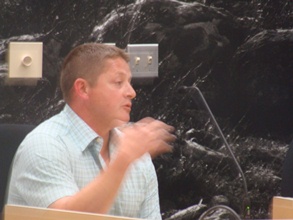
CBJ Community Development Director Dale Pernula (left) explains zoning concepts to the Juneau Assembly on Monday. (Photo by Casey Kelly/KTOO)

“As the zoning progresses upward if you will from D-10 through D-15, D-18 and Light Commercial the intensity of uses that can occur on the property also increases. And some uses may not require a review before the Planning Commission, but may be simply approved as building permits – for example, offices of up to 10-thousand square feet,” Freer says.

Assembly member Mary Becker made an attempt to amend the ordinance so the property would be rezoned D-18 – still medium density residential, but with more allowable uses than D-10. But her amendment was voted down.

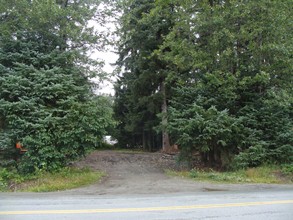
The 2.68 acre property in question is on Atlin Drive where it intersects with Mendenhall Loop Road. Developer Richard Harris bought it in 2010 from the US Forest Service. The northeast corner is bordered by Duck Creek Pond, making 40 percent of the property unusable due to required setbacks. Harris hasn’t said what he intends to build on the parcel, but says he’ll have more opportunity to do something nice for the neighborhood with a Light Commercial zone.

“There is no plan at all. At this point we know that we can build 20 apartments. But we don’t want to spend money to design 20 apartments if there’s something bigger and better that can be done here,” said Harris. “And not necessarily bigger, but mostly better. It’s going to be the face of the community. I personally would not be proud to build 20 apartments right there. I think it’s a waste.”

Developer Richard Harris wants to rezone his 2.68 acre lot in the Mendenhall Valley from Medium Density Residential to Light Commercial. (Photo by Casey Kelly/KTOO)

Homeowners on Atlin and nearby Teslin Street are against the rezone. They say Harris ought to submit a plan before receiving a Light Commercial designation. The city’s Planning Commission also recommended against the change at the urging of the CBJ Community Development Department.

Reconsideration of the assembly’s vote will occur at its next regular meeting, scheduled for August 22nd.

Plastic bag tax initiative goes to CBJ Assembly

Organizers of a citizens’ initiative in Juneau to tax plastic shopping bags at certain retailers have collected the required number of signatures to put the measure on the ballot. But it might have to wait a year before going to voters.

The 15-cent “plastic bag tax” would be levied at the point of sale, and apply to all retail outlets with annual gross sales of 15-million dollars or more. It’s aimed at reducing the use of plastic bags by encouraging people to go with re-usable shopping bags. Organizers collected more than the required 2,271 signatures to put the initiative on the ballot.

The CBJ Charter gives the assembly the option of adopting an ordinance bypassing a citizens’ initiative, as long as the ordinance doesn’t change the substance of the proposal. If the assembly fails to act in 45 days the measure goes to voters as is.

The plastic bag tax initiative is on the agenda for tonight’s regular assembly meeting. Because of the deadline for preparing this fall’s municipal election, if the assembly delays action beyond August 22nd, the measure would appear on the October 2012 ballot.

Also on the agenda for tonight’s assembly meeting is a public hearing on an ordinance asking voters to extend the CBJ’s temporary 3 percent sales tax another five years. The tax is due to expire July 1, 2012. The current 5 percent CBJ sales tax has three components – the temporary 3 percent tax, a temporary 1 percent tax, and a permanent 1 percent tax. Among the city functions covered by the 3 percent tax are police, fire, street maintenance, parks and recreation, libraries, and some capital improvement projects.

Tonight’s meeting starts at 7 p.m. in City Hall Assembly Chambers. It can be heard live on KTOO.

Assembly to take up controversial valley rezone

The developer of this property at Atlin Dr and Mendenhall Loop Road wants a rezone to Light Commercial. Area residents oppose the move. (Photo by Casey Kelly/KTOO)

The Juneau Assembly tonight (Monday) will settle a simmering controversy over a zone change request in the Mendenhall Valley.

At issue is a property on the corner of Atlin Drive and Loop Road, and whether it should go from medium density residential to light commercial. Homeowners in the neighborhood, along with the city’s Community Development Department and Planning Commission oppose the change. The property owner says it’s warranted, but has yet to say what he wants to do with the land.

Casey Kelly has more.

9th Circuit denies state’s Juneau Access appeal

The full US 9th Circuit Court of Appeals will not take up the State of Alaska’s latest petition in the Juneau Access case.

In May, a three-judge panel of the 9th Circuit upheld a lower court’s order for a new Environmental Impact Statement for the road project. The state petitioned to have all 11 members of the appeals court hear the case, but not one judge asked for a hearing.

In light of this latest defeat, Alaska Department of Transportation Spokeswoman Brenda Hewitt says the state is looking at its options.

“We’ll be meeting with the Federal Highway Administration, because they’re actually key in this,” said Hewitt. “So, we’ll be meeting with them and discussing alternatives. So, we’re not giving up.”

In 2006, the highway administration issued a record of decision approving the project. But in 2009, the federal agency declined to participate in the state’s appeal over the EIS decision.

Juneau Access would extend the road north of the Capital City to a ferry terminal at the Katzehin River, where a boat would shuttle passengers the rest of the way to Skagway.

A citizens group is already urging the state to appeal to the US Supreme Court. Citizens Pro Road Chairman Dick Knapp says the project has been studied enough, and a new environmental impact statement would be a waste of time and money.

“Let’s be realistic. You’re going to go back and do a supplemental EIS, okay? That takes time, probably more time – running through the hoops again – than it would take to go to the Supreme Court,” Knapp said. “Not only that, we’ve been at this now, for what? Twenty years. What do you think has been happening to the cost of construction with all the delays?”

The Southeast Alaska Conservation Council challenged the original EIS, saying it didn’t adequately consider improvements to existing Lynn Canal ferry service. SEACC Communications Director Dan Lesh says if the state wants to move the project forward it should do another EIS.

“What we want is investment in the ferry system. But if the state thinks the road needs further study and wants to a full Environmental Impact Statement that looks at all the options, that’s fine with us. I think it’ll show that ferries are a cheaper and better way of moving things around in Lynn Canal and throughout Southeast Alaska,” Lesh said.

The latest estimates put the project cost at 500-million dollars. It’s been a regional transportation priority of the past three state administrations.

Site notifications
Update notification options
Subscribe to notifications