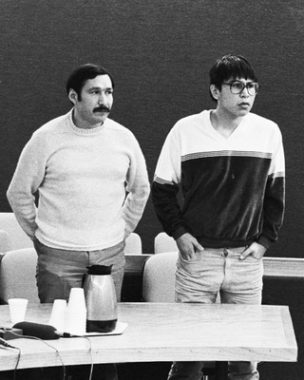
Jurors in the federal case of three Alaska militia members have reached a verdict on 15 of the 16 counts.
Alaska Peacemakers Militia leader Schaeffer Cox, Lonnie Vernon and Coleman Barney were charged with conspiring to kill government officials and amass a cache of dangerous weapons.
Jurors took two days to deliberate after the month long trial.
Militia leader Schaeffer Cox was found guilty for most of the charges against him including conspiracy to commit murder.
Defendent Lonnie Vernon was also found guilty of conspiracy to commit murder.
Jurors told the judge Monday they were deadlocked on count of murder-conspiracy against Coleman Barney.
The Anchorage Daily News reported on Twitter that defendant Schaeffer Cox yelled at the jurors following the reading.
Schaeffer Cox erupted after verdicts were read. “The prosecutors withheld evidence from you guys!” he said to the jurors.
A Juneau man has been arrested for allegedly stabbing three people late last night at the Super 8 Motel on Trout Street.
The victims were treated at Bartlett Regional Hospital, according to a police news release. Their names and conditions were not released.
Officers say about ten people were partying in a room at the motel early this morning (Friday), when a fight broke out just after 1:30 a.m. A 25-year-old man was stabbed twice in the torso. A 32-year-old man received a 3-inch cut to his right forearm, and a 22-year-old woman had a superficial cut to her left hand.
Witnesses said 32-year-old Charles Alan Abbott was responsible for the stabbing. He and a 23-year-old woman were detained near the motel. The woman turned over a bloody knife to officers, who placed Abbott under arrest.
He’s charged with one count of Assault in the 2nd Degree, and two counts of Assault in the 3rd Degree. He was booked at Lemon Creek Correctional Center on no bail.
Police say alcohol was involved in the incident, which remains under investigation.
Alaska Supreme Court Chief Justice Walter "Bud" Carpeneti in his Juneau office. (Photo by Rosemarie Alexander)
It could take a long time to fill Justice Walter Carpeneti’s seat on the Alaska Supreme Court.
That’s why he’s given the state court system six months to find a replacement.
As KTOO reported on Friday, the chief justice is retiring in January. Rosemarie Alexander spoke with him after the announcement.
Justice Carpeneti is giving early notice of retirement because of the lengthy procedure for filling Supreme Court vacancies. Carpeneti knows the process well — before he was appointed to the bench, he was a member of the Alaska Judicial Council, which screens applicants for judgeships.
Alaska judges are selected on merit through an arduous evaluation process. Just the kind, Carpeneti says, that lawyers should go through before giving them the power and authority of a judge.
“All of the lawyers in the state are polled when a person applies for the job, so you’ve got the person’s peers commenting. The application itself is a long document so an applicant needs to set out the last several trials. The Judicial Council goes to the judges in those trials, goes to the opposing council and gets information on how the person performed,” he says.
The Judicial Council analyzes applicants’ writing ability; there are credit checks, ethics checks, and criminal records checks. Carpeneti says public hearings are held and the council interviews at length every one of the candidates.
“The council really looks hard for the kinds of things that you would want in a judge,” Carpeneti says, including temperament, integrity, fairness, legal competence, and prior experience on the bench. When the extensive investigation is complete, the council grades each applicant then selects at least two names to forward to the governor, who makes the appointment.
Carpeneti was first appointed to the state Superior Court in Juneau in 1981 by Gov. Jay Hammond. He served for 17 years, retained three times by voters. Gov. Tony Knowles appointed him to the state Supreme Court in 1998 and he was retained by voters in 2002.
Alaska Supreme Court justices selected Carpeneti as chief justice in June 2009. The chief justice serves a three-year term, and Carpeneti’s ends this month.
Alexander Sadighi is sworn into the Illinois Bar by Chief Justice Carpeneti. Sadighi is a 2003 JDHS graduate & earned his JD from Duke University in 2010. He is a private funds associate in the New York office of Kirkland & Ellis LLP. (Photo by Rosemarie Alexander/KTOO)
The chief justice says he likes aspects of both the Superior and Supreme courts.
“I’m going to defer making a choice as to which I love the best,” he says. “I loved the trial court because it’s closer to the process and because you see and hear the witnesses and you work with the jurors and it’s much more immediate.”
The best thing about the appellate process is being able to work with people in the same job.
“You really learn so much about cases when you hear the different perspectives of other people. It’s sometimes very difficult, the appellate process, because you’re searching for agreement and you’re trying to synthesize different views and find commonality,” he says. “Our court tries not to have a lot of separate opinions and you know you work to find common ground and sometimes that a difficult process but it’s also pretty exhilarating,” he says.
Alaska’s mandatory retirement age for judges is 70. Carpeneti is 66-years-old and says it seems like the right time to retire.
“I kind of look at it from the other perspective. I was appointed in 1998 so I’ve been on the bench for over 30 years. And it just seems like it’s probably the right time now to get some younger folks in with a little more vitality,” he says, laughing.
His last day on the bench will be January 31, 2013.
A suspended prison sentence was handed down for an Anchorage man who deposited Alaska Permanent Fund Dividend checks meant for his grandchildren.
Daniel Batalona, 65, was sentenced in Juneau Superior Court on Thursday. He participated in the hearing by telephone.
As part of a plea and sentence agreement, he was sentenced to 24 months in prison – all suspended with no time to serve – for theft and forgery charges. He must also perform 160 hours of community service.
Juneau Superior Court Judge Philip Pallenberg explained that those who are convicted of PFD theft and fraud usually serve time in prison. But Pallenberg said it’s clear that Batalona’s case is different since he did not apply for the PFDs.
Comments made by Judge Pallenberg, the prosecutor, and defense attorney in the courtroom seemed to indicate that Batalona’s crime centered only on the acceptance of the checks. Batalona’s son, now believed to be in Hawaii, filled out the PFD application and put Daniel Batalona’s address on the form as the legal residence address for the children. The elder Batalona then forged his son’s name and signed his own name to endorse the checks and deposit them into his own bank account. Batalona admitted the crime fairly quickly and the three $1021 checks were paid back to the state.
Batalona did not say much during Thursday’s sentencing hearing except at the very end. He seemed eager to start his community work service right away and asked if he could simply walk into a place like Beans Café or The Salvation Army to begin work.
A former Juneau resident who turned himself in to Unalaska police after being indicted on drug charges will spend the next year-and-a-half behind bars.
Robert Biddinger, 44, was sentenced Thursday in Juneau Superior Court.
He was originally charged with twenty-two felony counts related to scamming Juneau pharmacies out of vicodin prescriptions. Twenty counts of misconduct involving a controlled substance were dropped as part of a plea and sentence agreement with prosecutors.
His girlfriend, 29-year old Donya Owens, worked at a local dental practice and would phone in bogus prescriptions to feed his addiction. Last week, Owens was sentenced to serve a year in prison.
Biddinger turned himself in to Unalaska Police in January. Owens was arrested by troopers at the Ketchikan ferry terminal in February.
Biddinger, who identified himself as a former coach with the Juneau Youth Football League, said he was sorry and embarrassed. But he also said he was glad that he got picked up, and said he’s stayed clean for the last several months.
Biddinger, his defense attorney, and prosecutors described how he became addicted after a pair of shoulder surgeries and then more injuries suffered after falling out of a truck. He reportedly tried to contact his doctor to stop the prescriptions, but he became addicted after eighteen months. He described how phantom pains took over and then he said he lost control.
The remaining two charges against Biddinger were Class C felonies that include a maximum of two years in prison even with Biddinger’s previous conviction for driving while intoxicated. As part of the plea and sentence agreement with prosecutors, Biddinger was sentenced to two years in prison with one year suspended for each charge. Six months of each charge would be served concurrently for a total of a year-and-a-half to serve in prison. He’ll also be on probation for three years once he gets out.
John Marvin, Jr. is escorted into Juneau Superior Court on Monday morning by Judicial Services officers. Photo by Matt Miller/KTOO News.
John Marvin, Jr. – the man accused of shooting and killing two Hoonah police officers nearly two years ago – has been declared competent to stand trial.
Superior Court Judge David George made the determination Monday after listening to two psychologists provide their own slightly different assessment of Marvin. Judge George partly directed his comments to Public Defender Eric Hedland who has had issues communicating with his client.
“But I don’t think – based upon the evidence before me – that it’s been demonstrated by a prepondence of the evidence that it’s a result of a mental disease or defect,” said Judge George.
Marvin himself was in the courtroom seated next to his attorney, dressed in red prison garb, and cuffed with waist and leg chains. Marvin occasionally interrupted Hedland throughout the hearing with objections about the apparent line of questioning.
Superior Court Judge David George explains his reasoning during Monday’s competency hearing. Photo by Matt Miller/KTOO News.
Haley Tokuoka, wife of fallen officer Matt Tokuoka, is relieved that there may be justice after all.
“I was just very happy! I just said ‘Yay!,” said Tokuoka. “Because I feel like we’re moving forward and once this is over (then) the family can move on.”
Marvin faces murder and weapons misconduct charges for the August 28, 2010 killing of Tokuoka and fellow Hoonah officer Tony Wallace. Marvin also allegedly engaged in a stand-off with other law enforcement officers for nearly 24 hours after the shooting.
Judge George is the same judge who in January declared Marvin incompetent after getting opinions from three psychologists. He believed that Marvin understood the nature of the charges against him, but he could not adequately help his attorney with his defense.
At the time, Judge George committed Marvin to the Alaska Psychiatric Institute in Anchorage. The judge explained that Monday’s hearing was a statutorily required review.
Dr. Lois Michaud, forensic psychologist at the Alaska Psychiatric Institute, says Marvin understands the court process. She believes that Marvin is not delusional and is competent to stand trial.
“When Mr. Marvin begins to talk about his version of things, I believe that he is not being forthright,” said Dr. Michaud. “I believe that there is a strong possibility that he could be malingering.”
Dr. David Sperbeck had earlier determined that Marvin would be incompetent because he could not provide relevant testimony or help his attorney with crucial facts. But, on Monday, Dr. Sperbeck said he had a different view after another evaluation.
“He remains guarded, oppositional, very controlling,” said Dr. Sperbeck. “He comes across as very gamey.”
Sperbeck said Marvin suffers from delusional paranoid disorder with overtones of grandiose and persecuted feelings.
“He is obviously not a normal person,” said Sperbeck.
Defense Attorney Eric Hedland and John Marvin, Jr. listen during Monday’s competency hearing. Photo by Matt Miller/KTOO News.
A few members of the Marvin family appeared in Juneau Superior Court on Monday to observe the proceedings. But they did not remain available to answer questions afterward.
Haley Tokuoka and her niece – accompanying her for moral support – also watched from the courtroom gallery. Tokuoka said it’s been especially hard for her two children, now ages 3 and 8. She said both watched Wallace, a best friend to the family, go down. Tokuoka said they’ve moved to Juneau for her children’s health care. She said both children suffer from attachment, anxiety, and post-traumatic stress disorders stemming from the shooting.
“We’re making progress,” said Tokuoka. “And we’ll be very happy once this is all over.”
The next hearing in the case is scheduled for October 15th with a jury trial planned to start October 22nd. It’s expected to last two weeks.
Rule 45 clock tolled
Every defendant is supposed to be tried within 120 days of being charged. In Alaska, it’s commonly referred to as Rule 45, or the Speedy Trial Rule, and it derives from the Sixth Amendment right to a speedy and public trial. But that clock can be stopped for special circumstances like Marvin’s competency evaluations and hearings. Monday’s ruling means that the clock would start running again with only 22 days left.
Both District Attorney Dave Brower and defense attorney Eric Hedland mutually agreed that it would be impossible to prepare for a trial within the next three weeks or even hold a trial sometime in the next few months. Both attorneys are already occupied with other high-profile cases going to trial throughout the summer. Judge George determined that there was sufficient cause or reason to toll or suspend the clock.
(Edit: Corrected Dr. Sperbeck’s first name.)
Close
Update notification options
Subscribe to notifications
Subscribe
Get notifications about news related to the topics you care about. You can unsubscribe anytime.