Public Safety

Alaska Appeals Court takes up American Samoa-born woman’s voter misconduct case

The seal of the state of alaska as seen from below
The seal of the state of Alaska hangs behind the dais at the Boney Courthouse, where a three-judge panel of the Alaska Court of Appeals heard oral arguments Thursday, Jan. 15 in the voter misconduct case of Tupe Smith. (file photo/Alaska Public Media)

The Alaska Court of Appeals took up the case of a Whittier woman Thursday who was indicted in 2023 on felony charges of voter misconduct.

Like others born in American Samoa, Tupe Smith is a U.S. national but not a U.S. citizen. Smith says she thought that meant she could vote in local elections but not presidential elections.

When filling out voter registration forms in the past, Smith and her lawyers say a Whittier city official told her to check a box that said she was a U.S. citizen, even though Smith knew she wasn’t, because the forms did not have a box for U.S. national.

That led to an investigation by Alaska State Troopers, who arrested Smith in late November 2023.

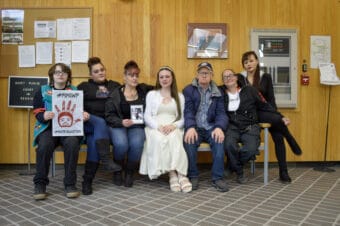
Voting rights advocates have linked Smith’s case – and a similar, separate case that includes some of her family members in Whittier – to national efforts by conservatives to end birthright citizenship in the United States. The advocates say the plight of people born in American Samoa highlights a group that is already being denied the right to vote.

After a grand jury indicted Smith in early 2024, her lawyers asked a Superior Court judge to toss the indictment, saying a trooper who testified to the grand jury had misled them on the issue of whether Smith intentionally checked the box saying she was a U.S. citizen.

The judge denied the request. But in a rare move, the Alaska Court of Appeals accepted Smith’s appeal before the Superior Court judge’s final decision and on Thursday heard oral arguments from one of her lawyers, as well as an attorney for the state.

Now, one of the main sticking points is whether the words “knowingly” and “intentionally” mean the same thing in regards to a person making a false statement on a voter registration form.

While some people might use the terms interchangeably, doing something “intentionally” requires a higher mental state – in legal terms, mens rea, or “guilty mind” in Latin – than doing something “knowingly.”

Smith’s attorney, Whitney Brown, told the three-judge Appeals Court panel Thursday that the words do not mean the same thing. In writing the law on voter misconduct, Brown said, the Legislature used both terms differently and therefore they should be understood differently.

“The record also reflects that if she had known she was not supposed to vote, she would not have done so,” Brown said. “So the state has just shown no evidence of an intent to mislead or deceive. So we believe that the court, in this instance, can take the extra step of just dismissing the indictment.”

The state wants the Appeals Court to send the case back to the Superior Court for a final decision. The state’s attorneys argue that the words “intentionally” and “knowingly” can mean the same thing.

“It’s not that she didn’t know what she was writing was false. It’s that she thought she was supposed to write something that she knew was false for these specific purposes, and that’s a little bit different,” Assistant Attorney General Kayla Doyle told the Appeals Court judges.

Doyle agreed with Brown that it was a difficult, but important, case. And there were multiple puns made in Thursday’s oral arguments – intended or not – about how intentional the Legislature had been in including the word “intentional” in the law on voter misconduct.

The Appeals Court will make a decision in the case at a later date, though it’s unclear when that will be.

Residents in avalanche zones return home after Juneau clears last evacuation advisory

The Behrends slide path on Mount Juneau on Wednesday, Jan. 14, 2026. (Photo by Clarise Larson/KTOO)

Residents living in avalanche-prone downtown neighborhoods got the all-clear to return home Wednesday after the city lifted its last remaining evacuation advisory this morning. 

Mary Amor was finally preparing to leave Juneau’s emergency shelter at Centennial Hall. She’s been staying there with her brother since last Friday, when the city issued an evacuation advisory for residents in all known slide paths downtown and along Thane Road.

“I know that a snow avalanche is nothing to play with,” she said. 

Amor lives on Gastineau Avenue, which borders the city’s avalanche hazard zone and has seen multiple landslides in recent years. She evacuated with her brother because they were scared for their safety. Amor is in her 60s and is disabled. 

She said living away from her home has been stressful, but she was grateful to have a safe place to hunker down.  

Blankets sit in a stack for avalanche evacuees at Centennial Hall on Friday, Jan. 9, 2025. (Photo by Clarise Larson/KTOO)

“It’s much a blessing, because there ain’t nowhere else to go out except outside,” Amor said. “This is a real blessing, them helping out the people that need it, in a time of need.”

Amor was one of 13 people to stay at the shelter Tuesday night, according to Britt Tonnessen, the community disaster program manager for the American Red Cross of Alaska in Southeast. She says more than 50 people used the shelter over the six days that the risk of large avalanches loomed over downtown neighborhoods and Thane. 

“The partners that came together, I think, did a really incredible job and utilized the limited resources we have in Juneau, brought in what was needed and cared for people to the extent that we could,” she said. 

The Red Cross plans to close the shelter on Thursday morning. 

Some evacuees stayed with family or friends instead, like Carlos Cadiente and his wife. Cadiente said he returned to his home in the Behrends slide path Sunday night after looking at the remaining snow on Mount Juneau and deciding he felt safe enough.

And he said he’s glad to be back.

Carlos Cadiente stands in the backyard of his home kitty-corner from Juneau-Douglas High School: Yadaa.at Kalé in the Behrends slide path on Wednesday, Jan. 14, 2026. (Photo by Clarise Larson/KTOO)

“Oh it’s a relief,” Cadiente said. “I’m happy that the big one didn’t come down. I mean, nobody got hurt.”

But now, he said his basement is flooding, and he thinks it’s because some of the shingles on his roof are too short to shed water away from the house.

The Behrends neighborhood evacuation advisory ended Wednesday morning, after the advisory for all other neighborhoods, including Amor’s, ended Sunday evening. 

John Bressette is an avalanche advisor at the City and Borough of Juneau. He said that the city didn’t decide to lift the evacuation advisory lightly. 

“I think people can feel good about going back to their homes,” he said. 

Concern grew again on Tuesday due to winds forecasted to reach as high as 60 miles per hour overnight. 

But Bressette said the city’s new radar system did not detect any new avalanches on Mount Juneau overnight. On Wednesday morning, drone flights showed him that previously undetected avalanches at high elevations had happened earlier on the Behrends slide path, then the rain and warm air melted a lot of the snow that would have made a large avalanche possible. 

“Overall snow levels being reduced quite a bit by all the rain, especially in the lower elevations, where avalanches have a tendency to entrain more snow. There’s just not a whole lot of snow left for that to happen,” he said. 

But Bressette said people in avalanche zones should keep ‘go’ bags packed in case conditions change. 

Mount Juneau gets new radar avalanche detection system as Behrends path remains under evacuation advisory

Avalanche forecasters view drone footage avalanche paths at City Hall on Jan. 12, 2025. (Photo courtesy of Catherine Melville).

An avalanche evacuation advisory remains in effect for one neighborhood that sits beneath Mount Juneau in Alaska’s capital city. And now, for the first time, the city is using a radar detection system to track avalanches that rumble down the mountain, thanks to state money freed up by the city and tribe’s disaster declaration last week. 

Severin Staehly works for an avalanche technology start-up called Gravimon in Zurich, Switzerland. On Sunday, he installed the Doppler radar system at the Alaska Electric Light & Power substation on Douglas Island. It’s called an Avymonster, and it points at Mount Juneau continuously to scan for avalanches. 

“We can really see where it happens and where it starts, where it ends, measure the speed and give all this information to the forecasters,” he said in an interview at City Hall. 

Staehly said the Avymonster is popular in other places with high avalanche risk like Norway, Canada and the European Alps. He said he installed one in Alaska last week near Portage Lake, south of Anchorage.

A slide coming off Mount Juneau down Chop Gully above the flume in the Basin Road area on Friday, Jan. 9, 2026. (Mikko Wilson/KTOO)

John Bressette, the city’s avalanche advisor, said it works just like boat radar, so it can scan through the night and in poor weather. Now, the team won’t have to wait for clear weather to see whether avalanches occurred. The radar system notifies staff instantaneously.

“It allows us to detect avalanches when we can’t visually see them, which in Juneau is often with the darkness and with the weather,” he said. 

Using drone flights and binoculars when the clouds rose a bit on Sunday, Bressette said he was able to see where avalanches released some snow down the Behrends path to the end of Judy Lane. But he said the avalanche didn’t start from high up the mountain. 

“There’s a lot of undisturbed snow at the top of the Behrends pass still that hasn’t been affected yet,” he said. “We feel that there’s still potential for — if that were to go — to potentially reach homes.”

An annotated photo of the Behrends avalanche path from the 1967 report. (Keith Hart, Report of the Preliminary Evaluation of the Behrends Avenue Avalanche Path)

That’s where the city is still advising residents to keep clear. An evacuation advisory was issued Friday for residents living in avalanche hazard zones for all slide paths in downtown Juneau, and for part of Thane Road south of downtown. The advisory was lifted Sunday for everywhere but Behrends. 

North of downtown, Bressette said he confirmed a loud avalanche reported on Thunder Mountain this morning around 9:00 a.m., but that it didn’t threaten homes. 

Bressette said his next step is to work with the Alaska Department of Transportation and Public Facilities to fly a helicopter-mounted LIDAR sensor over the mountain to measure the snow. He also wants to dig snow pits to look at layers in the snowpack. He said that will help forecasters better estimate the risk to those who live in the Behrends path. 


View this post on Instagram


A post shared by KTOO (@ktoopubmedia)


Ryan O’Shaughnessy, the city’s emergency programs manager, estimates the radar system and installation costs about $200,000 or less. Since Gov. Mike Dunleavy approved the city and tribe’s disaster declaration, he said the state is likely to pay for it. 

“We’re very confident that this will be part of our public assistance reimbursement,” he said. 

At the top of the White avalanche path on Mount Juneau, weather sensors track air temperature and snow depth. But avalanche experts say adding other sensors that measure wind, solar radiation and snowpack temperatures could also help refine avalanche risk assessments for downtown Juneau neighborhoods. 

Multiple small avalanches release in Juneau after city issues evacuation advisory

Ezra Strong in front of the Behrends slide path on Friday, Jan. 9, 2025. (Photo by Alix Soliman/KTOO)

Two small avalanches released on a slide path of Mount Juneau, above the Behrends neighborhood, as Ezra Strong was on a walk this morning in the pouring rain. 

The city issued an evacuation advisory about an hour earlier for Juneau residents in all known slide paths downtown and along Thane Road. Strong and his wife live on Gruening Avenue with their dog. He said he’s not heeding the advisory.

“I think in part because we’re a little bit protected by a rock wall and some other things behind us, in part because we have seen slides come down before on the main slide path that didn’t even get close to us,” he said.

During an online press conference Friday morning, the City & Borough of Juneau’s new Avalanche Advisor John Bressette said that many small slides reduce the hazard by decreasing the amount of snow that could be released in a larger slide. 

“So it’s actually a good thing that we’re seeing smaller slides reducing the total snow load that is capable of producing an avalanche,” Bressette said. 

Some avalanches released above the Flume Trail today. The Alaska Department of Transportation and Public Facilities confirmed numerous small avalanches along Thane Road Friday morning. The agency expects more avalanches this evening since the forecast shows continued heavy rainfall, strong winds and warming temperatures. The closure of Thane Road could be extended multiple days. 

A slide coming off Mt. Juneau down Chop Gully above the flume in the Basin Road area on Friday, Jan. 9, 2026. (Photo by Mikko Wilson/KTOO)

Some residents of the Behrends neighborhood have evacuated to friends’ houses or Centennial Hall, the official shelter set up by the city and the American Red Cross.

Carlos Cadiente lives kitty-corner from Juneau-Douglas High School: Yadaa.at Kalé in the Behrends slide path. He evacuated at around 11:30 a.m. in one vehicle while his wife drove behind in another. At a stop sign, he told KTOO they were headed to a friend’s house just down the street. 

“We already had a go-bag going and we already had the cars loaded up and ready to roll, and so we’re rolling,” Cadiente said. 

He said this is the first time they’ve heeded an avalanche evacuation advisory in the decades they’ve lived here. 

“It’s kind of an extreme measure, you know, extreme weather that we’ve had,” he said. “So we’re just kind of trying to be proactive and not be a problem,” he said. 

Britt Tonnessen is the community disaster program manager for the Red Cross of Alaska in Southeast. In coordination with the city, the Red Cross set up an emergency shelter at Centennial Hall downtown for residents on Friday. 

Blankets sit in a stack for avalanche evacuees at Centennial Hall on Friday, Jan. 9, 2025. (Photo by Clarise Larson/KTOO)

At the shelter on Friday morning, she said the Red Cross has been preparing for the last week in case of an evacuation. 

“We’ve seen multiple fatal landslides and avalanches in the past decade,” she said. “Evacuating to a congregate shelter is not people’s dream idea. It’s a safe place to go. We do the best to meet the needs and we have incredible, loving, warm volunteers to meet people.”

Tonnessen said that anyone from avalanche zones, as well as those who feel the load on their roof is becoming too heavy, are welcome at the shelter. 

She said they are prepared to take 150 people, and around 30 people signed in by the early afternoon

Avalanche, weather and road conditions are expected to worsen Friday evening.

KTOO reporter Clarise Larson contributed to this report. 

Snow removal, roof monitoring at Juneau schools continues through weekend

A green dinosaur play structure and a green swing set are covered in several feet of snow.
A swing set and dinosaur play structure are buried under several feet of snow at Harborview Elementary School in Juneau on Jan. 7, 2025. (Photo by Jamie Diep/KTOO)

The City and Borough of Juneau has largely wrapped up shoveling on Sít’ Eetí Shaanáx — Glacier Valley Elementary School and began work on Mendenhall River Community School on Friday. 

This comes after record snowfall caused the district to close schools multiple times this week, including all schools Friday.

Assistant City Manager Robert Barr said at a press conference Friday the rain from the current atmospheric river could increase the weight on roofs.

“We expect snow weights to increase because of the rain, until it is able to warm up sufficiently for that snow-ice melt to drain both through the roof drains, which we’re giving careful attention to, as well as off the roofs through through, you know, gutter and gutter style systems,” he said.

Juneau School District Superintendent Frank Hauser said shoveling on the roof of Mendenhall River Community School is expected to continue this weekend. He said CBJ engineering teams plan on inspecting schools through this weekend to make sure it’s safe to occupy them on Monday.

Hauser said schools will move to remote learning if there’s any need to be closed for snow removal next week. He said a wider number of factors will determine if another districtwide closure is needed.

“Though none of our schools are in the avalanche zones, it is something that, you know, could inhibit transportation,” Hauser said. “And so as we’re looking at that and looking at the road conditions, those are factors we take when we look at a more broad potential school closure.”

Juneau-Douglas High School: Yadaa.at Kalé and Harborview Elementary School sit just outside the Behrends Avenue slide path avalanche zone, which is included in the evacuation alert issued Friday.  

Hauser encouraged families to make sure their contact information with schools are up to date, and to download the district’s app to receive the latest alerts.

Part of residential roof collapses under snow in Mendenhall Valley

Part of the front eave on Tracey Muir’s house collapsed under the weight of heavy snow on Jan. 8, 2026. (Photo by Jamie Diep/KTOO)

A portion of a residential roof collapsed Thursday in Juneau under the weight of several feet of snow that fell over the past few weeks. 

Tracey Muir was born and raised in Juneau and bought the house in Mendenhall Valley a little over a year ago. He was inside when the roof gave way.

“This morning, I heard crackling, came and took a peek, and it was down and, well, all the snow we’ve been getting is what took it,” he said. 

An overhanging section of the roof collapsed on the front of the house, which was built in the 1970s. 

The National Weather Service estimated the weight of snow on a flat roof could be around 41.6 pounds per square foot as of Wednesday, based on ground measurements made at their forecast office in Mendenhall Valley. 

Emergency officials and engineers say most homes built in Juneau before 1991 were designed with a snow load capacity of 40 pounds per square foot. 

Muir said that, thankfully, there’s been no damage to the inside of the house, and that he was already planning to have the roof replaced this spring. He plans to patch it until then. 

“I’m definitely done with winter,” he said. 

Muir hadn’t cleared snow from the roof, and said he was hoping warmer weather would melt it for him. Now, he suggests others don’t follow in his footsteps. 

“Get your roofs cleaned,” he said. 

Nate Geary is a civil engineer who specializes in structural design. During the record-breaking storm that dumped four feet of snow on Juneau just after Christmas, he measured the weight that accumulated on his roof using roughly the same method as NWS. 

“Once I got close to 40 pounds a square foot, which is the snow load rating for my roof, I decided it was close enough to switch over from a science experiment to going ahead and cleaning it off,” Geary said. 

That was on Dec. 30. His home in Mendenhall Valley was built in 1973. 

He said a roof will show some warning signs before it gives out. 

“It’ll start to deform, which can create some cracks in the sheetrock or make some popping sounds,” he said. 

Geary said there are some steps homeowners can take to reduce the risk of roof collapse, even if they can’t clear the whole thing. 

“I think the first layer of risk management would be like using a snow rake and clearing eaves and overhangs, since they’re the weakest part of the structure,” he said. 

Then, he suggests clearing around vents to prevent moisture accumulation in the attic, and shoveling drainage paths on flat roofs. 

Geary is from Juneau and said that when heavy snow has fallen on his roof in the past, it melted relatively quickly. That’s not the case this time.

“This snowstorm is just not like anything that I’ve seen since I’ve lived here,” he said.

More heavy snow and rain are on the way. Meteorologists said that could make the snowpack heavier, wetter and harder to move. 

KTOO’s Jamie Diep contributed to this story. 

Site notifications
Update notification options
Subscribe to notifications