Search & Rescue

Search called off for missing boater, one body found, another man found alive

The search has been suspended for a missing boater from a vessel that sank Thursday night in central Southeast.

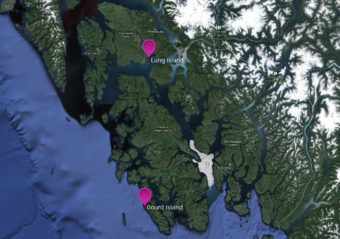
The fishing vessel Tanya Faith, described as an aluminum drop bow landing craft that was used as recreational vessel, sank near Cape Ommaney at the southern tip of Baranof Island. Three people on board the vessel attempted to swim to shore using float coats or life jackets.

One survivor, identified as 46-year old Dennis Monroe of Montesano, Washington, was picked up from the beach by the F/V Otter on Friday morning. Monroe was taken to Sitka for possible medical treatment.

Coast Guard watchstanders said they only received a report of the sinking after they were notified of Monroe’s rescue on Friday.

The body of another missing boater was found by a Good Samitaritan vessel in open water about seven miles offshore due west from the southern tip of Baranof Island on Saturday afternoon. Identified as 44-year old John Reid, he was described as unresponsive and transported to Sitka by a Coast Guard H-60 helicopter. Troopers say his relatives have been notified.

Debris from the vessel was found, but not the third boater who was identified as Fred Swenson of Montesano, Washington.

The U.S. Coast Guard says searchers included H-60s from Sitka, a C-130 aircraft from Kodiak, and a Canadian Coast Guard DeHavilland Dash 8. A Civil Air Patrol aircraft and the USCG cutter Chandeleur also participated in multiple searches of the coast of Baranof Island that covered over 1200 square miles.

The trio was reportedly left Sitka on Thursday to fish for sockeye salmon in the Redfish Bay area.

According to Alaska State Troopers, the boat overshot the bay and they had to turn around. Rough waters swamped the drop bow style boat and caused it to sink.

Tragedy and Courage on the Bering Sea

FPV Galaxy on fire in the Bering Sea, Oct. 20, 2002. Courtesy U.S. Coast Guard.

One of the most riveting stories of disaster and bravery at sea is now a television documentary, being broadcast this week on KTOO’s 360 North.

Tragedy and Courage on the Bering Sea, by filmmaker John Sabella, recounts the fire that destroyed the Fishing / Processing Vessel Galaxy in 2002.  The story is told entirely by the ship’s captain, Dave Shoemaker.

As Rosemarie Alexander reports, Shoemaker is now devoting his life to training people who spend their time on the water.

On October 20th, 2002, Captain Dave Shoemaker and his crew aboard the 180-foot Galaxy were fishing in the Bering Sea some 30 miles southwest of St. Paul Island in the Pribiloffs. About 4:20 p.m., the ship was hit by a very large wave on the starboard side.

From all accounts, smoke was immediately detected on multiple decks.  Captain Shoemaker was in the wheelhouse when a factory foreman alerted him.

Thick, black smoke began to fill the bridge.

As he set the fire alarm, explosions began to wrack the ship.

“The next thing I feel is this boat rock violently and this explosion took place, and now I’ve got people screaming ‘man overboard,’ ” Shoemaker told filmmaker John Sabella.

Up to that point, it had been just another day on the freezer longliner.

“Within 4 minutes there had been a huge backdraft explosion that basically destroyed the vessel and most of its survival equipment and all of their safety plans and procedures,” Sabella says.

He originally produced training films for fishing groups with Shoemaker. The television documentary grew out of those projects.

“This catastrophe occurred so fast it just overwhelmed the crew,” Sabella says.

The 137-page U.S. Coast Guard accident report is gripping, but the story of the Galaxy in the Captain’s words is powerfully evocative.

The documentary condenses the more than three hours between the discovery of smoke to Shoemaker’s rescue.  He was the last man on the burning ship.

“I’m asking people to jump off the back of a boat that’s 34 feet out of the water at the dock, and add 20-foot seas to that. You’ve got 40, 45, 50 feet and these kids are standing back there petrified,” Shoemaker recounts in the documentary. “Not only am I going to have them jump off the back of the boat,  I’m going to have them jump out of a four-story building.”

Several of the crew members were in their early 20s; for some it was their first experience on a floating processor.

Three men died, but the rest were rescued, including a National Marine Fisheries Observer who was in the frigid water for nearly  an hour and a half without a survival suit.

Since that day, Shoemaker has told the story hundreds of times.

“And when I bring up the fact that I prayed on the bow of the boat on the Galaxy I was actually saying ‘goodbye world, hello heaven.'”

Shoemaker had been with the Bering Sea fleet for nearly 30 years, but this was a near-death experience no one ever expects.

A Good Samaritan vessel comes to the aid of the Galaxy. Courtesy U.S. Coast Guard.

Good Samaritan boats broke off their fishing to help rescue the Galaxy crew. Later, skippers called him in the hospital where he recovered from his burns.

“They said, ‘you know Dave, if it can happen to you it can happen to any of us. We need to pay closer attention.'”

He is now a Coast Guard certified trainer with the North Pacific Fishing Vessel Owners’ Association.

“This is something I’m going to do for as long as I can do it and get in front as many fishermen that I can,” he says.

He has realized a goal of speaking to the cadets at the U.S. Merchant Marine Academy.  He’s become a trainer for the National Oceanic and Atmospheric Administration, or NOAA fisheries.

It wasn’t that Shoemaker or his crew had not trained for emergencies before. Training was part of their work.

“I think one of the things that happens in the fleet is everybody becomes calloused at one particular point or another, because we don’t have the experience to relate to. We’ve not had  the emergency we had to deal with.  We become a little hardened to the fact that it could in fact happen,” he says.

Shoemaker knows mistakes were made that day. Throughout the film he talks about trying to regain control of his crew and the ship.

The Coast Guard report of the Galaxy fires and sinking calls his actions extraordinarily brave and heroic. He and two other crew members were given Coast Guard commendations.

“Twenty-three people managed to survive and I attribute that to the effort, energy and heroism of every individual on the vessel that day,” he says.

He believes most of the Galaxy crew members have left fishing.  His therapy for dealing with the trauma is to help other fisherman achieve through training what he calls a level of unconscious competence in emergency response.

Tragedy and Courage on the Bering Sea can be seen on 360North, Sunday, at 7 p.m.  360North can be found on GCI cable channel 18 in Juneau, and channel 15 elsewhere in Alaska, as well as DirecTV and Dish Network.


Valdez boat explosion burns two people

Valdez boat hire
The Falcon burns in the Valdez Small Boat Harbor on Monday. Photo courtesy of Tony Gorman/KCHU

The Valdez Fire Department is investigating the cause of a Monday morning explosion that left a Fairbanks father and daughter with severe burns.

Owen Guthrie and his family were preparing to go out on the Prince William Sound when they stopped at the Crowley Fuel Dock at the Valdez Small Boat Harbor to fill up their bayliner, the Falcon. When Guthrie turned the ignition, the 28-foot vessel exploded.

His wife and two of his three daughters were able to escape through a window that blew out during the explosion.

Guthrie went back to retrieve the third daughter after she fell into the boat’s engine compartment. He and the teenage girl sustained severe burns. The mother and the other girls suffered cuts while escaping.

A medic from the Silver Bay Seafoods Cannery assisted the family until Valdez Fire crews and paramedics arrived on scene. Several workers from cannery weren’t far behind.

I was like right in the corner right where the boat was. I just saw people running into the factory and then telling us to get out. That’s pretty much all that was said. Then everyone started running out.”

I don’t know how it happened. A lady caught on fire and a man pulled her out of the boat. That’s all I heard, though.”

Crews arrived on scene to find the vessel engulfed in flames. Valdez Fire Chief George Keeney says the fire burned through the boat’s rope causing the vessel to go adrift. He said the blaze had also spread to the dock by the time crews had arrived on scene.

The harbor crew was quick. They pushed the skiff back into the docks so that we could tie on to it. We went ahead and had crews at both locations working putting the fires out. We had fire crews coming over here to the dock trying to get out quickly. At the same time, we’re knocking down the one in the boat.”

The Coast Guard reopened the harbor to traffic 45 minutes later. Keeney says the crews boomed off the area and still had to fight off hotspots on the boat.

The fuel dock will to remain close for the next three to four days while officials investigate the cause of the fire.

As for Guthrie and his daughter, they were medavaced to the Providence Alaska Medical Center in Anchorage and later to the Harborview Burn Center in Seattle for further treatment.

The family’s dog, Sweetie, was also onboard the boat. The Valdez Fire Department says Sweetie is safe.

Update: 9 Rescued After Boat Runs Aground Near Auke Bay

Shelter Island near Auke Bay
Shelter Island near Auke Bay. (Image courtesy Google Maps)

Nine passengers were rescued from a boat that ran aground near Juneau on Monday evening.

The 36-foot motor vessel Islander ran aground at Shelter Island just outside Auke Bay while on a commercial whale watching tour.

Coast Guard Petty Officer Sara Mooers said there were no injuries and all passengers were transported off the boat by Good Samaritan vessels in the area.  No fuel or oil was spotted in the area.

Coast Guard sector Juneau responded with a small boat crew to make sure there was no danger or further need for help, Mooers said.

The Islander, a boat with Alaska Galore Tours, ran aground on Shelter Island Monday evening.

“We did send Coast Guard Station Juneau, one of our small boats, out to put eyes on the scene and confirm there was no distress and that there’s no pollution,” Mooers said. “They will investigate the grounding as well, our marine safety personnel from Juneau.”

“They’ll touch base with the vessel when it’s back in port and make sure there’s no significant damage and if there is, that it gets dealt with accordingly.”

The petty officer said the boat captain stayed with the vessel. It was refloated Tuesday morning and towed to Auke Bay.

The Islander is listed as part of the fleet with Alaska Galore Tours, a whale, bear and glacier tour operator in Juneau.

Note: This story has been updated to reflect that the boat was part of a commercial whale watching tour and has been refloated and towed to Auke Bay.

Coast Guard winds down search for missing crewman

The Coast Guard suspended their portion of the search for the deckhand who went overboard from F/V Swift in Excursion Inlet.

Alan Young, 25, of Chehalis, Washington fell or jumped from the vessel on Monday night near an area commonly known as ‘Home Shore’. Alaska State Troopers say Young was last seen entering the water and attempting to swim to the beach without a flotation device.

The vessel’s skipper, Tim Lane, 47, of Sitka, launched a dinghy and attempted a rescue. He also ended up in the water and floated for several hours with a personal flotation device. After he was rescued, he was eventually transported to Juneau for treatment of mild hypothermia.

The U.S.C.G Cutter Liberty, a 45-foot response boat, two H-60 helicopters, the Civil Air Patrol, and the National Park Service searched on Tuesday. Nothing was found, but a SEADOG team alerted on an area over the water.

Lt. Sarah Morin of the Coast Guard Command Center in Juneau says they searched for 43 asset hours in an area encompassing over 420 square miles.

Alaska State Troopers will continue with the effort on Wednesday with an underwater camera. They may also call in divers to the scene.

Protect your dog from summer heat, noises

Diego took off during Monday’s thunderstorm & was gone about 20 hours. Loud noises & heat can stress out dogs. Photo courtesy Kevin Ritchie.

Heat, thunderstorms, fireworks – what’s a dog to do?

“Diego, who’s a 70 pound Golden Retriever, just ripped the leash out of her hand and ran.”

Southeast Alaska seldom gets electrical storms, and the loud claps of thunder on Monday sent Kevin and Barbara Ritchie’s dog on a 20-hour outing.

They were returning to Perseverance Trail parking lot when the storm hit.

“He turned onto the flume and never stopped,” Ritchie says.

They searched, asked friends to look; had Juneau radio stations, including KTOO, put the word out; called Animal Control, and sent Facebook messages.

About 1 p.m. on Tuesday, Diego showed up.

“He came out of the woods limping and got on somebody’s back porch and wanted some help,” Ritchie says.  He showed up at Jon Tillinghast’s house in what’s known as the Highlands.

Ritchie says Diego has not been a dog that normally reacts to loud noises, but the thunderbolts were something many Juneau dogs haven’t heard before.

Diego wasn’t the only dog to take off, according to Animal Control Director Matt Musslewhite.

“And it’s probably a good reminder that fireworks season is coming up. Maybe it’d be a good time to start making plans for alternate places to have your pooch stay during the fireworks on the fourth,” he says.

Musslewhite says Animal Control gets busy the night of July 3rd with reports of pets that have escaped their owners.

“During the night of the third, it’s probably loud enough to rattle windows in some parts of town,” he says. Not only are the fireworks over Gastineau Channel loud, but lots of residents shoot off their own.  It’s a very stressful time for dogs that are hypersensitive to certain noises.

Then there’s the unusually high temperatures Juneau has had.

Musslewhite says officers often get calls on hot days for welfare checks on dogs in vehicles.

“The hottest one I’ve seen here was an outside temperature of somewhere around 80 degrees and an internal temperature in the car of 136 (degrees Fahrenheit),” he says.  “And that was with windows rolled up and that was actually late in the morning, so it didn’t have the full day to heat up.”

Just like humans, animals can succumb to heat stroke.

It’s better to leave your pet at home on hot days. If you must take Fido, park in the shade, provide plenty of fresh water, and, of course, make sure windows are open enough that fresh air will flow through the vehicle but the animal cannot escape.

Musslewhite also reminds pet owners that city law requires dogs and cats be licensed.  He says that process helps reunite lost pets with their owners.

Site notifications
Update notification options
Subscribe to notifications