It will be an all-Juneau final in the Region V 4A basketball tournament Friday night.
The Thunder Mountain Lady Falcons defeated Ketchikan 64-55 in third-round action Thursday morning at Sitka’s Mt. Edgecumbe High School.
Sophomore Ashley Young and senior Jonelle Staveland both put up double-digits for the Lady Falcons, with 19 and 18 points respectively. But Ketchikan junior Jayley Taylor — despite her team’s losing effort — now holds the single-game tournament record of 34 points, with 12 coming in the fourth period, including a pair of three-pointers.
The second loss takes Kayhi out of the tournament. Thunder Mountain advances to the final against the Juneau-Douglas Lady Crimson Bears. If Thunder Mountain defeats the as-yet undefeated Lady Crimson Bears, it will force a playoff game between the same two teams on Saturday afternoon. The winner of that game will represent Region V in the state 4A tournament in Anchorage.
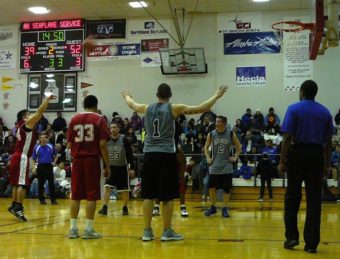
Photo courtesy of Robert Woolsey, KCAW
It’s the same matchup on the boys side, except it is Juneau-Douglas which is coming into Friday’s final through the losers’ bracket.
The Crimson Bears defeated Kayhi Thursday morning, 60-58, in the closest contest yet in the boys’ tournament.
Juneau senior Keith Ainsworth led all scorers with 18 points, including a pair of three pointers. Fellow senior Phillip Fenumiai put up 13 points.
Ketchikan once again had a balanced scoring attack, with three players in double-digits. Seniors Kable Lervick and Brien Auger scored 12 and 10 respectively. Junior Isaiah Navales also had 10.
The second loss knocks Kayhi out of the tournament. Juneau will meet Thunder Mountain in the 4A final Friday afternoon. As with the girls, a win by Juneau will force a Saturday playoff for the regional title.
The top-seeded Juneau-Douglas Lady Crimson Bears were rested and rock-solid, as they took down the Ketchikan Lady Kings, 49-33, in the second round of the regional tournament in Sitka this week.
The first-round bye for Juneau might have made the difference in Wednesday’s game. The Lady Kings traded baskets in the first quarter, which ended with Juneau ahead 13-12. But Ketchikan had trouble finding the basket in the next two periods.
Juneau senior Gabi Fenumiai led all scorers with 18 points before fouling out in the fourth quarter. Juneau had consistent scoring from its bench as well. Nine of the twelve players on the squad put up points for the Lady Crimson Bears.
Kayhi also had balanced scoring from seven players, but no one reached double-digits. After struggling through the second and third periods, the Lady Kings woke up in the fourth quarter, outscoring Juneau behind seven points by Junior Brooke Simmons, and three clutch free-throws from sophomore Alexis Biggerstaff. But the effort was not enough to break Juneau’s momentum.
The Lady Crimson Bears will play in the 4A final Friday at 3 p.m.. The Kayhi girls drop to the losers bracket, and wil meet Thunder Mountain Thursday morning at 8 a.m.
Region V Tournament photos courtesy of Robert Woolsey, KCAW
The top-seeded Thunder Mountain boys also used their first-round bye to advantage, beating the Ketchikan Kings 55 – 33 in the second round.
Like the Lady Kings, the Ketchikan boys also waited until the fourth period to make things interesting. Junior Isaiah Navales sprang to life and scored two field goals and a free throw. Sophomore Alex Pihl also scored four of his six total points in the fourth period.
In all, nine of the twelve players on the Ketchikan team scored, but no one was red-hot.
That was not the case with Thunder Mountain, which had two players in double digits. Junior Matt Seymour led all scorers with 19 points. Senior Sam Jahn put 10, dropping 6 of 10 free throws.
Thunder Mountain now advances to the final at 4:45 p.m. Friday. Ketchikan drops to the losers bracket and will play Juneau-Douglas at 9:45 a.m. on Thursday.
The Ketchikan Lady Kings advanced in the first round of the Region V Tournament Tuesday with a win over Juneau’s Thunder Mountain, 53-42.
The Lady Kings will meet top-seeded Juneau-Douglas High School Wednesday afternoon at 3 p.m.
Junior Jayley Taylor led all scorers with 24 points for the Lady Kings. Freshman Eliah Anderson scored 6 points in the first quarter, and brought in 11 for the game.
The Lady Falcons had balanced scoring in their loss. Senior Jonelle Staveland put up 14 points, sophomores Sarah Morris and Ashley Young scored 9 and 6 respectively.
Thunder Mountain moves to the bottom bracket in the double-elimination tournament, but can still vie for the coveted berth to state. The Lady Falcons will play the loser of Wednesday’s contest between Juneau-Douglas and Ketchikan, and could move into the title game.
Region V high school basketball tournament in Sitka March 5, 2013 courtesy of Raven Radio.
In the 4A boys tournament, the Juneau-Douglas Crimson Bears fell to the Ketchikan Kings 51-47 in Tuesday’s opening round.
The game was every bit as close as the 4-point final difference suggests: The Crimson Bears were within a basket of tying the game with less than a minute to play, but clutch free-throw shooting by the Kings put things out of reach.
Kayhi had three players in double-digits: Juniors Omar Mendoza and Malik Almenzor each had 12. Sophomore Alex Pihl put up 10.
Juneau’s Phillip Fenumiai led all scorers with 14. Senior Keith Ainsworth scored 10.
The Kings will advance in the winner’s bracket and play top-seeded Thunder Mountain Wednesday afternoon at 4:45 p.m. The Crimson Bears will meet the loser of that game on Thursday.
This year’s 2A, 3A, 4A tournament is being held at Sitka’s Mt. Edgecumbe High School. Twenty teams are competing for berths to the state tournament in Anchorage.
Michel Phillips gives her team a solid rest in Rainy Pass. (Credit Emily Schwing / KUAC)
Mushers have known since the start that this year’s race is likely to be fast, but many seemed surprised that the blistering pace would pick up so early. Mushers typically plan to maintain strong teams and take their time along the first third of the trail.
Martin Buser surprised nearly everyone when he arrived in Rainy Pass in the early hours of Monday morning. At the restart in Willow Sunday, the four time champion said he was happy to leave the chute first.
“For the rest of the filed I would suspect that’s a lot of pressure, but I rather enjoy it. I think that’s a perfect schedule for me,” Buser says.
Buser has three decades of Iditarod racing under his belt. It may have been his plan all along to set a fast pace. In Willow, he said he was more prepared than he’s ever been.
“I should get into the race with a sled that’s set up, a team that’s trained up and equipment that’s kind of fine-tuned, and I enjoy that,” Buser says.
Despite 29 previous, Buser’s race has other experienced mushers scratching their heads.
“Are you kidding me? 20 hours off the starting line? You gotta be an idiot, but that’s just my opinion,” Lance Mackey says.
When Mackey pulled into Rainy Pass, he was happy to comment on this year’s early fast pace as he sliced open drop bags, searching for an extra pair of socks and some snacks. As he rearranged his cooker, he admitted to at least one major mistake in his own race so far.
“I thought I was gonna get in here and have a sixth of my team missing. Apparently, it was first time switching out leaders and I just had a little mishap,” Mackey says.
Jake Berkowitz arrived just behind Mackey. Berkowitz helped the four-time champion catch his loose dog. But it didn’t faze Mackey, who took off down the trail after a short chat with a veterinarian. He doesn’t plan to spend much time in any checkpoint this year.
“I’m blowing through everywhere,” Berkowitz says.
Mackey struggled to get his dogs lined out as they trotted across a frozen lake. Spectators and a number of parked bush planes had dogs veering left and right past the lodge. Soft, deep snow had Mackey stumbling around as he reoriented his leaders.
Mike Williams, Jr. finished in eighth place last year. The Akiak musher says a soft trailed changed his plan as he made his way for Rainy Pass.
“The trail was pretty choppy going into Finger Lake and I knew with not as many dogs teams going through, the trail would be better so I decided to come here,” Williams says.
As a bush plane took off behind him, Williams, Jr. was debating about how to set up his run through the infamous Dalzell Gorge, to Rohn and on into Nickolai. He says the punchy trail hasn’t affected his dogs.
“They’re handling it really good. They’re doing better than I thought they would,” Williams, Jr. says.
Many mushers spent the afternoon waiting out the heat of the day. Pete Kaiser, a three time finisher from Bethel says he won’t be looking to change anything up until after the first third of the trail is behind him.
“Maybe later in the race, there will be something different that I do but up until the next few runs, it’s pretty similar to last year,” Kaiser says.
Dog care is crucial in the early part of the race. Ken Anderson had just doled out snacks to his team as Defending champion Dallas Seavey pulled into the yard for some rest nearby. But the veteran from Fox barely looked up. Right now, his eyes are on his own dogs.
“To me, I could be racing against no one. To me it’s just getting those dogs to Nome as fast as I can and that’s kind of boring. But it does me no good to key off what other people are doing until the end where maybe you might push a little harder than you otherwise would want to,” Anderson says.
Just across the dog yard, a small woman, clad in pink, was organizing dog booties. DeeDee Jonrowe started the Iditarod for the 31st time this year. She knows better than to think of racing for real before she completes her mandatory 24 hour layover.
“This early in the race, I really just need to run what I’ve trained my dogs to do. If I do that, then I will have a dog team I can do something with later. If I start chasing other people’s races, Ill be just patching other things back together later,” Jonrowe says.
Mushers starting trickling out of the Rainy Pass dog yard late in the afternoon. Many of them say they’d like to get healthy, happy dogs to Nickolai, roughly 250 miles into the race. That’s where they’ll start to look around. With as so teams vying for a top ten finish, it’s too early to tell how things might shake out.
Mushers can bring up to 20 dogs to the Iditarod but can start the race with only 16. In the days before the competition, the animals are taken to the Iditarod headquarters in Wasilla, Alaska, for pre-race exams. Russell Lewis/NPR
In Anchorage, Alaska, on Saturday, the “Last Great Race on Earth” begins.
Sixty-seven sled dog teams will start the 998-mile Iditarod race across the barren, frigid and unforgiving land. In this year’s competition, there are a handful of first-time racers — but those aren’t the only rookies.
One is veterinarian Greg Reppas, whose job is to ensure the dogs are healthy throughout the race.
Days before the race, Reppas squats in a snowdrift in Wasilla and checks out Leo, one of the 16 dogs on this team that will start the Iditarod. He’s a mix of husky and several other breeds and looks like a mutt. Born to run, he is raring to go. He’s small like most sled dogs, just about 50 pounds.
Reppas uses a stethoscope to listen to Leo’s heart. He then runs his hands across the dog’s back, feeling his joints and muscles.
A few days before these exams, Leo and the 1,000 other dogs running in the Iditarod had blood work done and EKGs to check for cardiac issues. Any animal with problems is pulled and replaced before the start of the race.
These tests are just the beginning. Reppas and 50 other volunteer vets will fan out across the Iditarod’s 24 checkpoints. At each one, the vets will scan the animals, sometimes taking just 30 seconds.
“When I see the dog come across the line, the first question I ask is, ‘What are the problems?’ So that I can emphasize my efforts on those problem dogs,” Reppas says.
On the trail, it’s a different kind of medicine — no fancy diagnostics or elaborate tests, just a vet’s expertise.
Teams of veterinarians inspect the dogs before the race begins. Greg Reppas uses a stethoscope to listen to a dog’s heart and lungs. Russell Lewis /NPR
The biggest problems they see are exhaustion, dehydration and ulcers. If a dog is deemed unfit to continue, it’s flown back to Anchorage for additional care. The team will keep racing but will be down a dog.
This is Reppas’ first time out on the trail. He says he’s ready for the challenge, partly because of his day job: He’s a major in the Army. Reppas says the Iditarod is more than just a race.
“Some say these dogs are a good model for humans as far as human sports medicine,” he says. “We’re learning things on an annual basis on these dogs … [and] this is the ideal laboratory to learn in.”
Musher Angie Taggart of Ketchikan, Alaska, is racing in her second Iditarod.
“I always make a joke that, you know, they don’t really care about the mushers because they just have the vets out there,” she says. “They don’t have any regular doctors. See who’s important in this race? It’s not the musher. It’s the dog!”
For veterinarians like Reppas, the dogs are their main mission for the next two weeks. But he is also looking forward to seeing wild Alaska.
“You get that sense of perspective and how some of the locals have lived here for thousands of years,” Reppas says. “You get a brief but clear look into how some folks live in this type of environment.”
Bush pilots will shuttle him to remote checkpoints where he’ll sleep in a tent in sometimes minus-20 degree temperatures. Like the dogs, he won’t get much rest either.
Former Juneau ski racers Nathan Ord and Brian Vandor took the top two spots for men in Sunday’s Town Downhill, while former ski team head coach Jeffery Johns came in third.
Heidi Denton and Lucy Squibb, both former Juneau ski racers, were first and second for women, and current race team member Quincy Bates came in third.
Nearly 60 skiers and snowboarders competed in the second annual community Giant Slalom race at Eaglecrest Ski Area. The race was open to those age ten and up, and participants raced in categories ages 10 to 12; 13 to 16; 17 to 39; and over age 40.
Before the race, Juneau Ski Team Head Coach Dan Ord said he had “ordered the sun” for the Sunday event. It turned out to be probably the most beautiful Sunday since the season started in December.
Original story:
The second annual Town Downhill is Sunday at Eaglecrest Ski Area.
The community race is open to skiers and boarders age ten and up.
“I ordered the sun; sun’s going to come out for the event,” says Juneau Ski Team Head Coach Dan Ord.
We can only hope!
Even if the sun doesn’t shine, the race will start at noon on what’s known as the Super G trail, above tower 12 of Ptarmigan lift.
Ord makes the course sound almost easy:
“Let’s say a 15 to 20-foot steep start down onto the flats right above the tower, then it shoots you straight down the last bits of Super G. Nice right footer and a left footer, and you’re out, coming across Upper Hilary’s over towards what I know to be Thiokol Lake. And then it’s just four cat tracks wide, nice element of glide and you’re swooping out over onto Lower Face. Then it’s just a big right footer and you’re down a pitch then you’re back onto Lower Hilary’s.”
Young Juneau Ski Club racer on Lower Hilary’s run.
Last year about 50 racers turned out for the first community race held in years at the city-owned ski area. Ord hopes it will spark an adult race series like the Rainier Challenge in the 1980s. The winner then got a pair of K2 skis topped with the Rainier beer logo. Those skis can still be seen making turns at Eaglecrest.
No free skis this year, but the event will end with a free barbeque and awards ceremony.
Juneau Ski Club parents are putting on the Town Downhill. Sign up before 10:30 Sunday morning at the Eaglecrest Lodge. Training runs begin at 11 a.m. and the race at noon. Each racer gets two runs.
Close
Update notification options
Subscribe to notifications
Subscribe
Get notifications about news related to the topics you care about. You can unsubscribe anytime.