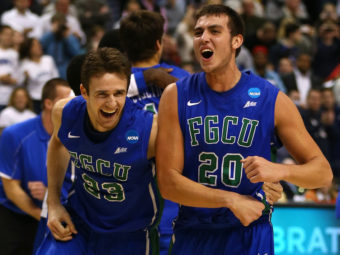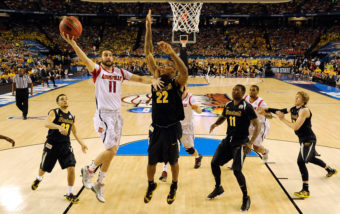
The Gold Medal Basketball Tournament is happening in Juneau this week. More than 20 teams from Metlakatla to Yakutat are competing in three brackets.
But it’s more than a sports event.
See Gold Medal photo slideshows.


The Gold Medal Basketball Tournament is happening in Juneau this week. More than 20 teams from Metlakatla to Yakutat are competing in three brackets.
But it’s more than a sports event.
See Gold Medal photo slideshows.


Juneau’s Twin Lakes are slowly receding and will remain dry through April to control the invasive weed milfoil.
CBJ Parks and Landscape Superintendent George Schaaf says the gates under Egan Drive were opened about 4:30 Tuesday morning.
“We do it at negative tide so there is plenty of pressure for the water to get out of the lakes,” Schaaf says, “and then when they get refilled we do it when we’re having really big tides so that we can get the lakes as full as possible.”
Draining the lakes and filling them with salt water reduces milfoil growth without using herbicides.
State Fish and Game Biologist Brian Glynn says Northern Water Milfoil is common in Alaska. He says Twin Lakes conditions are ripe for a health supply of organic matter.
“You know you get warm water conditions there (and) aquatic plant growth. These species in particular do very well in those conditions. Then you get a bit of a positive feedback loop in that as they decompose in the fall, they provide fertilizer for subsequent year’s growth,” Glynn says.

Fish and Game has been stocking Twin Lakes with king salmon for more than 20 years, Glynn says, “and as the weed problem developed, that started cutting into that sport fishing opportunity, especially along the shoreline where anglers want to fish. It got to the point where you were guaranteed reeling in weeds as opposed to maybe catching one of the hatchery king salmon.”
Glynn says once refilled the popular Twin Lakes will be restocked with about 10,000 little salmon, just in time for Family Fishing Day.

Last night Mitch Seavey emerged as the winner of the Iditarod Trail Sled Dog Race. It was his second win and the second time Aliy Zirkle came in second behind a Seavey.
The top five Iditarod teams crossed under Nome’s burled arch overnight. This year’s was one of the most competitive and closest races in Iditarod history.
A crowd in Nome cheered as 53 year old Mitch Seavey drove his ten dog team into Nome under the burled arch to become the Iditarod’s oldest champion. Seavey made a tough final push to Nome from White Mountain with Aliy Zirkle chasing close behind.
“I hate to do that to Aliy, but you know there’s only room for one winner this year, so it had to be me.”
This is Seavey’s 18th finish and second win. He says he was pleased with how he ran his dogs in the first half of the race.
“The main key about the whole Iditarod is the run rest ratio, run enough to be in position and rest enough to keep your speed. I think I did a pretty good job of that in the early part of the race.”
But Seavey fretted over the amount of rest is team had as they got closer and closer to Nome.
“I tried to make a couple of big jumps and it took away my speed and so then you get into the wrong kind of a cycle, where you can’t rest enough to get your speed back without losing out on a top position so you get stuck back in the crawling mode and having turtle races out there.”
The top ten teams spent most of the 936 mile race leap frogging each other.
Second place finisher Aliy Zirkle pulled into Nome less than an hour behind Seavey, as the crowd chanted her name.
Zirkle worked her way up to second in the last few runs, but was unable to finally catch the team in front. This is the second time in as many years that Zirkle has finished in second place.
It’s also her second loss to a Seavey. Last year she trailed Mitch Seavey’s son Dallas coming into Nome. The Two Rivers musher took a deep breath as she checked her gear and gave her final signature to race officials.
“Yeah, I was glad to be done for sure.”
Zirkle had a frustrating run into Nome. At times both she and Mitch Seavey could see each other. But Zirkle’s leader, Quito, who ran the entire race up front ,just wasn’t feeling up to the chase.
“She had a belly ache. She did and I did and she wouldn’t lope at all today.”
An hour and a half after Zirkle’s team had left the finish chute, a delighted Jeff King pulled his team across the finish line. The four-time champion and 23 time finisher, from Healy, went up the line greeting each of his dogs on the way.
When he got to his leader, Skeeter, he laid down, lifted the dog on his chest and took a deep breath. King says he’s very proud of his team.
“This team is here in spite of me. I made a couple of really big mistakes. You never really know until you have things play out a bit. In retrospect, I did a couple things I really wish I hadn’t but I can’t complain. An awesome finish with an awesome team and great competitors.”
King made a big move out of Koyuk to take the lead late in the race, but a soft trail and the hot sun worked against him.
“It takes a lot of confidence. The dogs need to know you’re on their side and you’re in this together. It was getting so difficult to travel after such a long run after Unalakleet, basically, such a long run that we just stopped until they had the energy to do it again.”
King will take home a portion of this year’s 600-thousand dollar purse, which is split among the top 30 finishers. More than $50,000 of it goes to winner Mitch Seavey. Seavey also wins a brand new Dodge Ram pickup truck.
With Dee Dee Jonrowe’s arrival at the burled arch at 4:24 this morning, there were ten teams in Nome. Between Dallas Seavey and her were Ray Redington Junior, Nicholas Petit, Joar Leifseth Ulsom, Jake Berkowitz and Sunny Lindner. Next in will be Aaron Burmeister.

We will have a winner today. White Mountain is next, with Mitch Seavey carrying a narrowing lead in the Iditarod. Aliy Zirkle and Jeff King are cutting rest to try to keep up with Seavey along the coast to Nome.
The top ten teams on the way in to White Mountain and an eight-hour layover are Mitch Seavey, Aliy Zirkle, Jeff King, Ray Redington Junior, Dallas Seavey, Aaron Burmeister, Joar Leifseth Ulsom, Jake Berkowitz, Sunny Lindner, and Dee Dee Jonrowe. Just a short way outside of White Mountain, Seavey’s team appears to be tiring, and Aliy Zirkle’s confidence is growing.
For a brief time in this year’s Iditarod, all eyes were on Aaron Burmeister’s team. But the dogs caught a bug near Eagle Island and the Nome musher had to rethink his race plan.
It’s very frustrating because we came the race to win the Iditarod and with a team capable of winning the Iditarod. Just to be hammered with one little bug after another, it’s part of racing, it’s something we deal with, but it’s hard to swallow you know when your hopes are so high and the team is so strong.
Burmeister admits time is running out with only a few checkpoints left before the finish line in Nome, but, he says it’s not impossible.
There’s a few teams ahead of us that potentially we can pick off if I can get the dogs healthy on these next couple runs.
Jake Berkowitz’s dogs also caught the stomach bug that’s going around. He was extremely concerned about his team when he rolled into Unalakleet. He also completely reworked his race plan.
I’m not letting another pack catch us. We’re solidly in the top ten, but I really want to keep this group of 15 together. If I drop one or two here or there, but a nice big group to the finish line.
Berkowitz is the only musher at the front of the pack to have a team as big. That has both mushers and spectators scratching their heads. But the Big Lake musher’s goal is to build long-term careers for his dogs, not to win a single Iditarod.
Everyone has different goals. My goal right now is to finish with a big string of dogs in the top ten. It’s not all about finishing one spot higher. There’s other factors at plan and our factor right now is we still have some young dogs and instead of racing really hard and finishing with eight dogs, that doesn’t benefit me in the future.
Dogs have changed things up for rookie Joar Lleifseth Ulsom.
Yeah, I’m very, very surprised. They’re doing much better than I thought and I’m very happy with each individual dog in the team.
Lleifseth Ulsom was hoping to finish in the top twenty this year. Unless something goes awry, he’s likely to claim Rookie of the Year and a top ten finish. The Norwegian says the biggest surprise is due to his inexperience. His team is surrounded by well-seasoned Iditarod veterans.
Especially now, when we’re getting further in the race and a little bit tired and stuff, it’s hard for me to figure out what’s going on. I’m not awake enough to figure out what they’re doing.
Fairbanks-area musher Ken Anderson hadn’t given the next series of runs much thought, but pulling into Koyuk in eleventh place did motivate him to think about trying to move up.
He fell behind on the Yukon River after coming down with a head cold.
Anderson is the only member of his team to get sick. He says his dogs have been healthy for the entire run from Willow. But, he says, he knows enough to be careful if he does decide to make a move.
When teams reach Koyuk, there are less than 100 miles left before they take their mandatory eight hour rest in White Mountain, 77 miles outside the finish line. Mushers can break this stretch of trail into two or three shorter runs. It’s too long and likely too late in the game for most mushers to try and do it all in one shot. But this year, it seems, almost anything can happen to shake up the race.

Dog teams face the last 250 miles of the Iditarod Trail Sled Dog Race. The trail runs along the windy coastline of the Bering Sea from Unalakleet to Nome. It’s getting close to the time when mushers will make some of their last moves. It’s only a matter of time before decisions on the trail turn into race results.
Mushers look at the 250 miles between Unalakleet and Nome a few different ways: it’s either a long way to go, or not long enough. For long time veteran Dee Dee Jonrowe, it’s likely somewhere in between. She came into the small coastal city with a sled full of water-logged gear.
“You know, it’s stupid to go up the coast, when you’re just semi-dry and your survival gear you can’t get into.”
Instead of chasing the leaders, Jonrowe opted to stay at the checkpoint long enough to dry out. She also wrapped hot pink wind and water proof raincoats around her dogs as they finished up second and third helpings of kibble and meat. From here to Nome, Jonrowe says calories are critical to keep dogs running.
“I would be really scared to take a dog out of here that wasn’t eating.”
A dog rode for most nearly all of the 85 mile run from Kaltag to Unalakleet in Sonny Lindner’s sled bag. Lindner dropped her when he arrived. He says the coast is no place to carry extra weight.
“I gotta keep ‘em together now, you know?”
Lindner has run the race more than twenty times. To cut down on weight and pick up some speed, he also switched out his sled. He traded his heavy tail dragger for a lighter coastal sled that rides higher.
We used to use the coastal sled even in the very first ones. You need smaller teams, smaller pile of gear, short runs, end of the race. Get me outta here!”
Aliy Zirkle is also a seasoned veteran, having finished the Iditarod twelve times. But her plan coming out of Kaltag backfired.
“I was hoping to draw out the guys who were already there earlier than they wanted to leave, so they didn’t rest their dogs as much and their dogs would be tired. Then I’d go camp at a cabin and be really cozy until they went by, but I didn’t make it to the cabin, so I was really cozy in a snow berm as usual.”
She says her plan B also didn’t work out. As she scarfed pancakes and a cheeseburger in Unalakleet, Zirkle puzzled over the latest standings.
After a few hours rest, Zirkle still wasn’t sure how she’d approach the next few runs… unlike another long-time vet, who is very sure he won’t be leading the way into Nome.
“Iditarod, you used to have three or four shots at winning.”
Martin Buser lead for more the half the race, but lost his lead coming off the Yukon River.
“You know you could make a move… now the competition is such that you have one shot at trying something and if it doesn’t work, that’s it.”
Buser opted to give his tired dogs some well-deserved rest before tackling the coast. He plans to bring his team of young dogs back for another try next year. He’d prefer his team has a fun run into Nome, without pushing too hard.
Like Buser, former champion Mitch Seavey knows that decisions made on the trail can sometimes come down to a gamble:
“At this point, I’m so tired, you just kind make something up.”
The 19 time finisher had little to say beyond emphasizing the importance of rest as he dug through his sled looking for more weight to drop before he left to drive his team along the coast to Shaktoolik and across the sea ice to Koyuk.

Juneau’s two schools each took home a few pieces of net following championship games Friday night in the Region V Tournament in Sitka.
The Juneau-Douglas Lady Crimson Bears won the 4A title in the girls’ side of the tournament; the Thunder Mountain Falcons won in the boys side.
4AGirls
The top-seeded Lady Crimson Bears received a first-round bye, and then went undefeated for the rest of the tournament, beating the Thunder Mountain Lady Falcons 61-54 in the final Friday afternoon.
The Lady Crimson bears played steady basketball through all four periods, and stayed out of foul trouble.
Three Juneau players were in double-digit scoring. Senior Marissa Brakes led with 15 points — all the hard way. Brakes sank two three-pointers, and did the rest of the damage from the free-throw line.
Juniors Ari Gross and Kaitlin Fagerstorm had 12 and 11 points respectively.
The Lady Falcons pushed hard to close the gap in the game — outscoring Juneau 22-20 in the fourth period. Senior Jonelle Staveland had another stellar performance with 22 points, including 4 from the three-point line. Freshman Ava Tompkins scored 10.
Because reclassification left only three teams in 4A, there will be no second place berth at the state tournament in Anchorage this year. Juneau-Douglas will be the sole 4A team in the girls tournament.
4A Boys
On the boys’ side, Thunder Mountain will represent the region in Anchorage, defeating rivals Juneau-Douglas 56-52.
With an eight-point lead at halftime, it looked like Juneau had finally decoded the Falcon defense, which has been troublesome all season long.
But Thunder Mountain regrouped in the locker room and set up an offense around the three-point line. The Falcons sank four three-pointers in the third period, along with three field goals.
Thunder Mountain had three players score ten or higher: Seniors Vili Tupou and Sam Jahn had 10 and 12 respectively, and junior Matt Seymour led Falcon scoring with 17.
Senior Ty Grussendorf had 9 points — all on three-point shots.
Juneau-Douglas senior Jeffrey Pusich led scoring for the Crimson Bears, with 15 points. He went 4 for 5 from the free-throw line. Senior Gary Speck scored 11. Fellow senior Phillip Fenumiai scored 8 points before heading to the bench with a sprained ankle early in the fourth period.
This year’s 4A Region V Basketball Tournament was played at Mt. Edgecumbe High School in Sitka. The 2A and 3A tournaments were played at the same time.