Archives for:

"capital creep"

Despite concerns of capital creep, Juneau advances plan to move City Hall to Michael J. Burns building

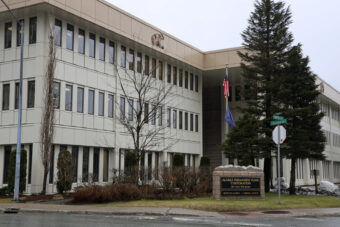
The Michael J. Burns Building, which houses the Permanent Fund offices on 10th Street, on Tuesday, Jan. 20, 2024. (Clarise Larson/KTOO)

The Juneau Assembly has reluctantly agreed to move forward with plans to purchase two floors of the Michael J. Burns building, which houses the Alaska Permanent Fund Corporation. If finalized, it would become Juneau’s “new” City Hall.

The plan comes after voters shot down the city’s request to fund a new City Hall via bonds — twice. Since then, the city has been trying to find a new space for all its staff.

“We are in a real bind with our city office space, and there are no other good solutions,” said Assembly member Ella Adkison during Monday’s Committee of the Whole meeting. “That being said, I have a lot of difficulty with this proposal. I just really see this as a detriment to both short-term and long-term Juneau’s future.

Adkison worries the purchase could contribute to capital creep – the slow trickle of state jobs moving away from Juneau to Anchorage. She works as a legislative aide to Juneau Sen. Jesse Kiehl.

Right now, City Hall fits less than half of city employees and needs roughly $14 million in maintenance work. Plus, the other buildings that city staff work out of have been riddled with issues and cost the city hundreds of thousands of dollars to rent each year.

According to City Manager Katie Koester, the two floors and parking spaces at the PFD building would cost roughly $12 million.

The city’s proposal is to form a condo association at the Michael J. Burns Building on 10th Street by the federal building. It would allow it to jointly own the building, instead of renting it. Assembly member Wade Bryson says that’s a big plus. But, he’s still disappointed that it’s not the new building the city wanted to construct.

“It would have been the best solution for the community,” Bryson said. “However, the community wished for us to take a different direction. So we are still left in a position where we can own a building and condo ownership is better than renting.”

The Assembly’s vote means Koester and the city attorney will start figuring out the logistics of forming a condo association with the Alaska Permanent Fund Corporation. That will likely take a few months before the proposal returns to the Assembly again.

Juneau’s leaders discuss priorities heading into new legislative session

Juneau Democratic state Rep. Andi Story, center, speaks at a meeting between Juneau’s legislative delegation and members of the Juneau Assembly on Jan. 15, 2020. (Photo by Adelyn Baxter/KTOO)

Juneau’s state lawmakers met with city staff and Juneau Assembly members this week to talk ahead of the start of the legislative session.

At the end of last year’s session, the city found itself on the hook for more than $5 million in cost shifts from the state. Meanwhile, its legislators were trying to stem the tide of state jobs leaving town while also monitoring what some see as yet another effort to move the capital.

Juneau’s trio of legislators said they’re committed to working together to address impacts to the city from last year’s state budget vetoes.

“We’re still looking at education. We’re looking at funding the ferry system. We’re looking at anything with mental health issues,” said Juneau Mayor Beth Weldon.

Beth Weldon, pictured on Sept. 11, 2018. (Photo by Adelyn Baxter/KTOO)

Of the many state budget vetoes last year, the biggest impact for Juneau was $3.7 million in school bond debt reimbursement — money the city used to get from the state.

“The state is not living up to their obligations as far as school bond debt, but I don’t see any changes this session,” Weldon said.

Despite that, she said she came away from the meeting with lawmakers feeling encouraged.

Education funding is an annual a priority for Juneau. Last-minute cuts and delays at the state level in recent years have made it difficult for school districts to budget.

Rep. Andi Story is a former Juneau School Board member. She plans to introduce a bill this session that would put $30 million that was outside the state’s education funding formula last year back in so that districts can better plan ahead.

Rep. Andi Story, D-Juneau, speaks at a rally on the Capitol steps, Feb. 13, 2019. (Photo by Skip Gray/360 North)

“It’s dollars school districts can count on, and it’s inflation-proofing that amount. So it brings some certainty,” Story said.

Story, a Democrat, is a member of the Alaska House of Representatives majority coalition. After getting off to a slow start last year in the House, Story said the coalition hopes to expedite this year’s budget process.

“In fact, we are already going to have budget subcommittee meetings starting first week of session,” Story said.

She also serves on the House Transportation Committee, which will take up business on the state ferry system on Jan. 23.

Another ongoing concern is so-called “capital creep” — the slow-but-steady migration of state jobs out of Juneau to other parts of the state.

Rep. Sara Hannan, D-Juneau, speaks during a House floor session, March 11, 2019. (Photo by Skip Gray/360 North)

Last year, the delegation sent letters to state commissioners asking for a heads-up whenever they planned to eliminate positions in Juneau or move them elsewhere.

“The administration has great latitude in where they place a job or how they move a job around,” said Juneau Democratic Rep. Sara Hannan.

According to the Juneau Economic Development Council, government jobs have been on the decline for eight years straight. Between 2017 and 2018, average monthly employment in state government fell by 46 workers.

According to numbers provided to Juneau’s legislative delegation by the state’s Department of Administration, Juneau saw a further loss of 16 state jobs between January and October last year.

Sen. Jesse Kiehl, D-Juneau, listens during a Senate Judiciary Committee meeting in Juneau on March 22, 2019. Assistant Attorney General William Milks was laying out some details of Senate Bills 23 and 24, which would compensate Alaskans for past cuts to the Alaska Permanent Fund dividend.
Sen. Jesse Kiehl, D-Juneau, at a committee meeting in Juneau on March 22, 2019. (Photo by Skip Gray/360 North)

Hannan said many of those jobs seem to be going to Anchorage and the Mat-Su.

“There’s some focus that concentrating them all in Anchorage better serves Alaska, but we don’t see any cost-benefit analysis being done that used to be required,” she said.

As for the proposed ballot initiative to move legislative meetings to Anchorage, Hannan said she hasn’t heard much about it since the organizers got approval to start collecting signatures last year.

The initiative has until the start of the legislative session on Tuesday to turn in the 28,501 signatures necessary to get it on this year’s ballot.

Juneau’s legislative delegation looks to get ahead of potential cuts to state jobs

Rep. Sara Hannan, Sen. Jesse Kiehl and Rep. Andi Story (left to right), all Democrats and newly sworn in to represent Juneau, pose for photographers outside the Capitol, Jan. 16, 2019. (Photo by Skip Gray/360 North)

With Gov. Michael Dunleavy’s budget set for release Wednesday, some in Juneau are concerned by what $1.6 billion in cuts to state government could mean for the capital city.

That includes Juneau’s new legislative delegation. According to the Juneau Economic Development Council, state government jobs make up more than 20 percent of local employment.

Sen. Jesse Kiehl said Juneau’s legislators decided to take a proactive approach this year.

“With the new administration and the new members of the legislative delegation, we found ourselves — with a lot of people — concerned about job moves,” Kiehl said.

Along with Kiehl, Reps. Andi Story and Sara Hannan sent letters to each state commissioner last month asking for detailed information about any Juneau-based jobs they plan to eliminate or move elsewhere.

According to Story, the delegation has met with several commissioners so far, including Kelly Tshibaka from the Department of Administration.

Tshibaka told them Juneau has lost about 12 exempt positions since Dunleavy took office, due to the kind of restructuring that happens whenever a new administration takes over.

But Story said they want to know what’s in store for classified positions, which make up the majority of Juneau’s state workforce.

“We really don’t have a true picture yet because we have not gotten that,” Story said.

According to a report by Rain Coast Data, Southeast Alaska lost 850 state jobs between 2012 and 2018. Two-thirds of those jobs were in Juneau.

Kiehl said job loss is always a concern from an economic standpoint. But he argued that keeping essential state jobs in one place helps keep government efficient too.

That’s why they want to make sure the Dunleavy administration has thought through every budget decision.

“How he proposes to do that with the kind of budget cuts he has hinted at, I’m not sure,” Kiehl said. “We should save a buck wherever we can save a buck, but harming Alaska’s future is not a road I’m ready to go down.”

The delegation said it will continue to work with commissioners after the budget is released and will do all it can to prevent the loss of more jobs.

Gov. Walker responds to Juneau lawmakers’ concerns over commissioners

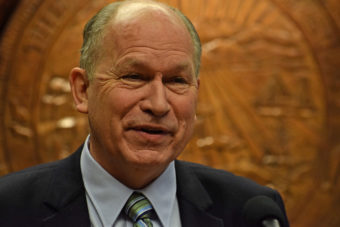
Bill Walker, Juneau
Gov. Bill Walker addresses reporters at a Feb. 5 press conference in Juneau. (Photo by Skip Gray/360 North)

Gov. Bill Walker says he’d like all of his commissioners to live in Juneau, but he’s proud of the team he put together and thinks it’s OK if some of them choose to live in other parts of the state.
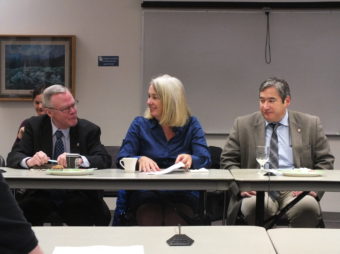
The governor last week responded to recent criticism from Juneau lawmakers, who questioned why just two of his administration’s commissioners had committed to living in the capital city. Walker says three have now made that commitment, and three more are seriously considering a permanent move.

In a Feb. 11 letter to Juneau Sen. Dennis Egan and Reps. Cathy Muñoz and Sam Kito III, Walker writes that his cabinet members “must heavily weigh how the decisions will affect their families and find sufficient housing.”

He also notes that he and first lady, Donna, along with numerous senior staffers will make Juneau their permanent home while he’s in office. And the governor reaffirmed his commitment to keeping the capital in Juneau.

Muñoz says she’s satisfied with the governor’s response, but the delegation plans to keep pressing the issue.

“In terms of being most effective and being able to communicate most effectively with your team, it’s better to have them in one location,” she says.

Muñoz says the delegation is also leaning on the administration to keep Alaska Public Offices Commission staff in Juneau. In light of the state’s multibillion dollar deficit, Walker’s proposed budget would shutter the Juneau APOC office and move two of its three employees to Anchorage.

“I believe strongly that that’s not a good idea,” Muñoz says. “I think we need to keep the APOC office close to the legislature and the lobbying community, which by and large is located here in Juneau during the legislative session.”

Juneau lawmakers have long been concerned about capital creep – the slow migration of state jobs away from the capital city.

Juneau lawmakers: Commissioners should live in capital city

Dennis Egan, Cathy Munoz, Sam Kito
Juneau’s Legislative delegation, Sen. Dennis Egan and Reps. Cathy Muñoz and Sam Kito III. (Photo by Casey Kelly/KTOO)

Juneau legislators want more of Gov. Bill Walker’s cabinet members to live in the capital city.

In a letter sent to Walker on Monday, Sen. Dennis Egan and Reps. Cathy Muñoz and Sam Kito III say they’re concerned that only two state commissioners have committed to living in Juneau. Education Commissioner Mike Hanley is a year-round resident. Fish and Game Commissioner Sam Cotten has said he will relocate for legislative sessions, but owns two houses elsewhere in Alaska where he plans to spend at least part of his time.

Egan says state government works better when high-level officials are in the same place.

“With all state agencies, most of them headquartered here in Juneau, it makes sense to the delegation,” says Egan. “You know, teleconferencing is fine, but a one-on-one, face-to-face with their commissioners works a heck of a lot better.”

The delegation says commissioners who aren’t close to the action in Juneau “risk weakening the management of, and political support for” their agencies, which is especially concerning given the state’s recent budget shortfalls.

The letter also brings up a long-running concern of Juneau lawmakers: Capital creep, or the slow migration of state jobs away from the city.

Gov. Walker does live in Juneau full time. Lt. Gov. Byron Mallott is a longtime resident and, like Egan, a former mayor of the city and borough.

Walker’s spokeswoman Grace Jang says the governor’s office will respond to the delegation’s letter today (Wednesday).

Site notifications
Update notification options
Subscribe to notifications