Listen to this story:
An unusual partnership is sailing Alaska’s waters this summer. A cruise line is teaming up with an international whale advocacy organization to host a marine mammal observer on board for part of the season.
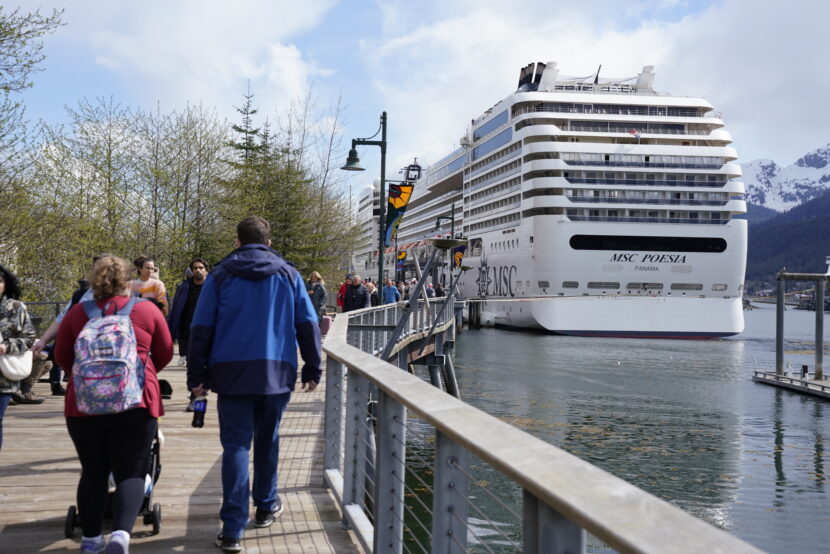
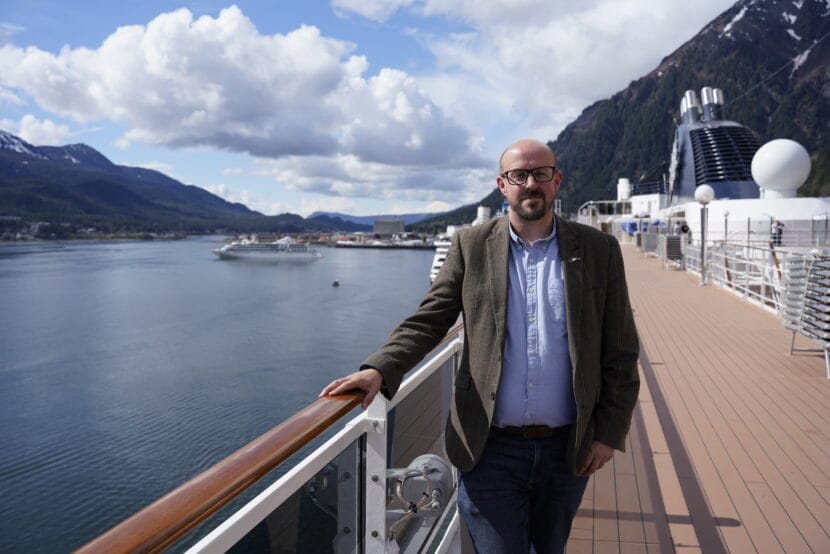
Steve Jones is the chief operating officer at ORCA, a citizen-science nonprofit based in the United Kingdom that advocates for whales and dolphins around the globe. He joined the MSC Poesia’s maiden voyage through Southeast Alaska in May to kick off a collaboration meant to study how ships can avoid hitting whales.
“We still don’t understand some really fundamental questions,” Jones said. “What action should the ship take? What species-specific guidance might there be?”
Later this summer, the MSC Poesia will host a marine mammal observer for five weeks — as it sails from Seattle through the Inside Passage — in an effort to help answer those questions. The observer, named Maria Snell, will see humpback whales as they spend the summer fattening up on herring and krill while raising their young.
Snell will track whales using a video camera and binoculars stationed on the ship’s bridge. She’ll alert the crew when she sees whales and collect data on whale behavior and proximity to the ship. In addition, she plans to train the crew on whale avoidance and talk to passengers about conservation.
Jon Olav Stedje is the manager of sustainability and community engagement for MSC Cruises, an international cruise line headquartered in Geneva, Switzerland. He said the company is collaborating with ORCA to honor Alaska’s waters.
“Now we enter (the) Alaska market for the first time, and we want to make sure that we do that in a proper and respectful way,” Stedje said.
In Alaska, it’s illegal for vessels to get within 100 yards of humpback whales, speed near them, block their path or disrupt their behavior. But it’s still common for ships to hit whales, causing severe and sometimes fatal injuries. Between 2020 and 2024, there were nine reported vessel strike incidents in the Juneau area — six involved calves.
According to the International Whaling Commission, collisions with large vessels often go unnoticed or unreported.
Jones said it’s important to keep watch and collect more information to protect whales from ships.
“The classic baseline is always: if you see a blow, go slow,” Jones said. “So the second you become aware, you try and slow down as much as possible.”
But he said crews can do more than that.
“You can, if you’re aware far enough in advance and going at a slow enough speed with the right sort of propulsion, maneuver around a whale,” Jones said.
Some local research backs this up. During the summers of 2016 and 2017, a marine mammal observer watched whales aboard 67 large cruise ships as they passed through the waters of Glacier Bay National Park. Scientists combined the observer’s data on humpback whales rising to the surface with simulated ship responses and found that it is possible for big ships to actively avoid hitting whales. The scientists estimated that crew have, on average, three chances to see a whale surfacing as the ship approaches. But they have to be looking.
Heidi Pearson is a professor of marine biology at the University of Alaska Southeast who studies humpback whale health in Juneau. She said she isn’t familiar with ORCA’s work, but supports ships taking on marine mammal observers.
“I think if more vessels had dedicated marine mammal observers aboard, potentially they could help to avoid more whale strikes,” Pearson said. “I don’t see any downside to that.”
But she said it will probably be difficult to collect rigorous scientific data on how whales respond to the vessel.
“That’s hard to get without, like, a baseline or control or, you know, really dedicated behavioral studies,” she said.
ORCA hasn’t published any peer-reviewed scientific papers, but Jones said the organization makes its citizen science data freely available. He said ORCA has submitted data to Happywhale, an organization that identifies individual whales from crowd-sourced photos, and the National Oceanic and Atmospheric Administration.