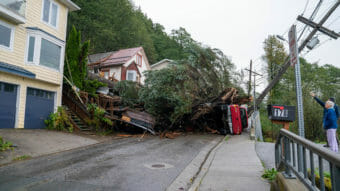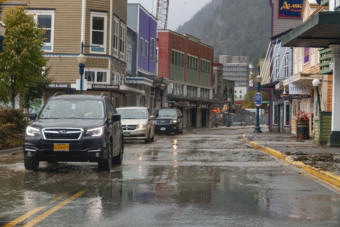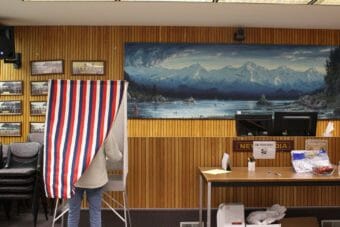
Cars drive through mud and high water in downtown, on Sunday, October 6, 2019, in Juneau, Alaska. The city was inundated with rain over the weekend causing minor flooding, property damage and road closures. (Photo by Rashah McChesney/KTOO)
Updated — 9/24 at 6:32 PM
Southeast Alaska is in for another drenching from an atmospheric river, starting Sunday and continuing into next week.
A warm, wet weather front is headed northeast from Hawaii, bringing heavy rain to the southern panhandle first.
“Then that’s going to kind of lift north a little bit, but then we’ve got another wave along this front that’s going to impact the area continuing into Monday into Tuesday,” said Aaron Jacobs, senior service hydrologist for the National Weather Service in Juneau.
The heaviest and most consistent precipitation is expected to occur in the northern panhandle, with Juneau seeing anywhere from six to eight inches of rain. The biggest flooding concerns will be Monday night into Tuesday as rain continues.
“Things will change between now and Tuesday, but just stay tuned to the National Weather Service for any updates on the system,” Jacobs said.
On Saturday afternoon, the Weather Service issued a flood watch from Sunday evening through Tuesday for parts of the northern panhandle including Juneau, Sitka, Tenakee Springs, Hoonah, Gustavus, Haines and Skagway.
A Flood Watch has been issued for portions of the northern Alaska Panhandle. Rainfall amounts Sunday night through Wednesday could approach 6-8 inches in some locations including @cbjuneau. Potential impacts included the possibility of flooding, and isolated landslides #akwxpic.twitter.com/aMHdcCCoo7
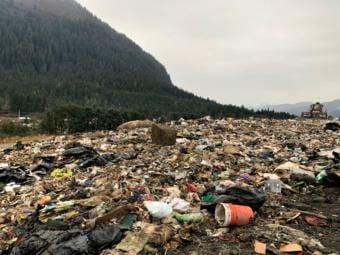
The view from the top of Juneau’s landfill in November 2019. (Photo by Adelyn Baxter/KTOO)
It is a truth universally acknowledged that landfills are smelly, and Juneau’s is no exception.
But lately, neighbors say it’s been extra stinky.
A landfill might seem like just a big pile of, well, trash. And it is. But there’s actually some cool stuff going on in there.
As more and more garbage gets layered on top, it compacts everything below. Bacteria start to chow down on organic material like food waste and lawn clippings, causing them to break down. And, they love moisture.
“It biodegrades much more quickly when it’s wet,” said Doug Buteyn, environmental program manager for the Alaska Department of Environmental Conservation’s solid waste program. “There are landfills in the Lower 48 that have allowances to actually pump water into the landfill for that very same purpose.”
Obviously, Juneau’s landfill doesn’t need extra water pumped in. Especially not this year. In fact, our rainy environment speeds up the whole process.
As the wet, hot trash cooks down inside, it produces methane and sulfur — that’s the really stinky stuff — and it needs somewhere to go.
Usually, at Juneau’s landfill, it’s burned off. If you’re visiting, you’ll notice metal pipes sticking out of the ground — those are hooked up to a burner and that neutralizes the smell.
But that’s not happening as consistently right now, and neighbors are noticing.
“Luckily, it doesn’t blow towards our neighborhood very often, but when it does, it’s overwhelming,” said Shawn Wille. “It’s so stinky, you don’t want to be outside.”
Wille lives in the nearby Eagles Edge Subdivision, across Lemon Creek from the landfill.
“I’ve seen kids at the playground just go home … and just wait for it to pass,” Wille said.
It usually doesn’t hang around for too long, but it’s been showing up more than usual for the last few months.
“I don’t think it’s probably a health issue or anything, but it’s definitely unpleasant,” he said.
There are a few reasons why the landfill smells worse. For one, ‘tis the season.
“The inversions especially are strong in the winter,” said Buteyn. “They help to hold the gas, and anything else, close to the ground. So that’s really a big factor at this time of year.”
Another factor is that Waste Management — the Texas-based company that operates the landfill — is upgrading its gas collection system, so parts of it have been shut down recently.
Landfill Manager Eric Vance wrote in an email that they shut off portions of the network while upgrading it over the last two months.
They’re almost done with the project, which should improve the system overall. But he wrote that it might take a few weeks to get everything back to normal.
Until then, neighbors in the surrounding area will just have to deal. Buteyn says they’ve heard from a few people this year.
“We can act as an intermediary, and we do get some complaints,” Buteyn said. “We don’t get a lot.”
The city operates a recycling center on the site but otherwise doesn’t have any say in how it’s run.
Neither do neighbors like Wille. He said he’s talked to Waste Management in the past about the smell.
“That’s about it, not much we can do, besides up and move,” he said.
The Juneau Assembly made changes to two local relief programs available to businesses and people impacted by the COVID-19 pandemic.
Now, people who applied for individual CARES Act funded grants can’t get them if they’ve already gotten housing assistance grants from the city. The Assembly held a special meeting Thursday to add the new condition.
City staff say it appears about half of the people who applied for individual assistance also applied for housing relief. They say the change allows the city to spread out the $2 million in CARES Act funding set aside for the program.
The Assembly also approved several changes to the city’s extreme hardship business grant program. It relaxes some eligibility requirements and adds a few others. Business owners must demonstrate lost revenue over a period of the past year to receive a grant.
Several Assembly members said they want to add more money into the individual assistance program by next week. The Assembly has more than $1 million remaining of the $53 million the city received as its share of the CARES Act.
As of now, that federal funding expires at the end of the year.
Capital Transit’s first electric bus from Proterra arrived in Juneau by barge on Wednesday, Dec. 16, 2020. The City and Borough of Juneau expects it’ll be ready for the public to ride in February 2021. (Photo from the City and Borough of Juneau)
Juneau’s first electric city bus arrived by barge on Wednesday.
The 40-foot bus should hit the streets by February. Capital Transit drivers and mechanics will receive training from California-based manufacturer Proterra in the meantime.
The city has been awarded a total of $9.5 million in state and federal grants so far.
“It’s pretty great that that Juneau would get four years in a row grants for that, and a lot of that is the community writing letters of support,” said Capital Transit’s Denise Guizio.
The Juneau Commission on Sustainability and Renewable Juneau both helped drum up support for the city’s grant applications. The plan is to replace seven diesel buses in the city’s fleet with electric buses when they retire in 2022.
Guizio says they don’t know yet how Juneau’s cold, wet environment will impact the lifespan of the electric buses. But they shouldn’t need to be replaced any sooner than diesel buses.
Juneau’s isn’t the first electric city bus in the state, but it’s the first one to hit the streets that’s owned by a transit agency. Anchorage previously leased an electric bus from Proterra for a trial period in 2018.
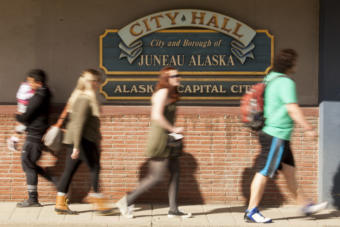
A woman crosses Marine Way in front of Juneau City Hall on Sept. 25, 2017. (Photo by Jeremy Hsieh/KTOO)
Updated post — Dec. 15, 1:00 p.m.
A city-owned Mendenhall Valley property sold to a local developer in 2018 will return to City and Borough of Juneau ownership.
The Juneau Assembly approved the transfer of the Hurlock Avenue lot at its meeting Monday night, along with leasing the property to Tlingit and Haida Regional Housing Authority for use as an emergency youth shelter.
Alaska Legacy Partners bought the property from the city in 2018. The agreement included a condition that the existing building become an assisted living facility.
Under the new terms, the property will return to city possession at no cost. The city will keep Alaska Legacy Partners’ $35,000 down payment and forgive the remaining debt of $315,000.
Alaska Legacy Partners’ Garrett Schoenberger says his company’s plans for the property fell through when the city approved a competing assisted living development nearby.
“We’re not looking to make a dime off of this,” he said. “We’re just hoping to get reimbursed for some of our out-of-pocket costs.”
Schoenberger says they looked at local groups who could provide a needed service to the community. They worked with the housing authority after learning that Juneau currently has no emergency shelter for youth.
The shelter would be managed by the city’s Zach Gordon Youth Center, with the housing authority acting as landlord and property manager.
The property transfer will take some time to complete. Local housing advocates say an emergency shelter for youth is badly needed, especially as the pandemic continues.
Original post — Dec. 14, 5:45 p.m.
The Juneau Assembly will hold a regular meeting Monday night at 7 p.m.
Items set for public hearing on Monday’s agenda include ordinances related to a piece of property in the Mendenhall Valley that may become an emergency shelter for at-risk youth, an emergency CARES Act appropriation and an extension of the city’s public mask ordinance.
The meeting will be streamed on Facebook Live and via Zoom Webinar. It will also air live on KTOO 104.3 FM and stream on the web.
Details about how to participate in the meeting can be found in the agenda packet.
Close
Update notification options
Subscribe to notifications
Subscribe
Get notifications about news related to the topics you care about. You can unsubscribe anytime.