Adelyn Baxter

Digital Content Director, KTOO

"I help inform KTOO listeners, viewers and readers by finding creative ways to bring our content to our audience wherever they are."
Juneau Assembly approves more CARES funding for businesses and individuals impacted by COVID-19

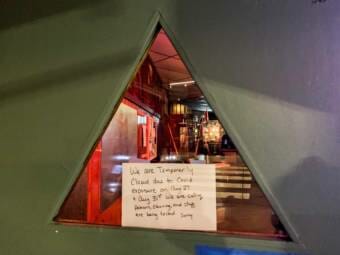
The Triangle Club Bar and a handful of other bars and restaurants in Juneau are temporarily closed due to an outbreak of COVID-19 among bar workers. (Photo by Rashah McChesney/KTOO)
The Triangle Club Bar in Juneau. (Photo by Rashah McChesney/KTOO)

Updated story

The Juneau Assembly has approved two new sources of relief meant to help Juneau residents and businesses struggling to stay afloat as the COVID-19 pandemic drags on.

On Monday night, the Assembly passed $2.3 million in CARES Act funding to create another grant program for businesses and another $2 million for grants to individuals impacted by the pandemic.

Leeann Thomas owns the Triangle Club bar downtown. She said at the meeting that the pandemic has made it extremely hard to run the business her family has owned for 80 years.

“My business was closed for ten weeks due to state and city closures. For two weeks, I was only allowed 25% capacity in my business. For the past three months, I was only allowed 50% capacity in my business,” Thomas said. “And on top of that, in the last month, we have been mandated to close at 11 p.m.”

Eligible businesses must demonstrate the loss of 50% of their revenue due to the pandemic. The grant amount is determined by the difference between businesses’ gross sales this year compared to the same time last year.

The Juneau Economic Development Council will distribute the grants.

Martin Stepetin testified in favor of the individual assistance program. He works in food service for Smokehouse Catering. He said that because of the pandemic, he made half as much this year as he did last year.

“Thank god I’m still working,” Stepetin said. “I’m just happy to have a job, honestly.”

Grants of up to $2,000 will be determined by income level. Dependents under 18 are eligible for an additional $300. Grants will be overseen by Catholic Community Service, which also oversees the city’s housing and utility relief grants.

With federal CARES funding set to expire at the end of the year, Juneau and other municipalities around the country are rushing to spend the remaining money.

It’s still not clear whether Congress will extend the program or pass any additional economic relief.

The Assembly also approved $73,000 in CARES funding for Eaglecrest Ski Area to help with operations this winter and a $300,000 grant to Family Promise of Juneau for additional space for supportive housing services.

Original story

The Juneau Assembly will hold a regular meeting Monday at 7 p.m.

Items set for public hearing on tonight’s agenda include $2.3 million in CARES Act funding for local businesses that lost more than 50% of their revenue as a result of COVID-19 and $2 million for individual residents financially harmed by the pandemic.

The Assembly will also decide whether to give $1.5 million to Sealaska Heritage Institute for its Northwest Coast Arts campus construction and more funding to Eaglecrest Ski Area to help with COVID-19 mitigation this winter.

The meeting will be streamed on Facebook Live and via Zoom Webinar. Note: The meeting will not air live on KTOO 104.3 FM.

Details about how to participate in the meeting can be found in the agenda packet.

This post has been updated.

Veteran lawmaker Jay Kerttula remembered as mentor, statesman and father

In this undated photo, former Alaska Senate President Rick Halford leans back to hear from former Senate President Jay Kerttula. The inscription reads “Beth — This is how I learned everything I know.” (Photo courtesy of Kerttula family collection)

Alaska state flags were lowered to half-mast Friday in honor of Jalmar “Jay” Kerttula, the only state legislator to serve as both senate president and speaker of the house.
Those who knew Kerttula best remember him for his warmth and humor as much as his many political accomplishments.

Remembrances and tributes for Jay Kerttula,92, poured out following the news of his death on Nov. 13.

The lifelong Democrat represented Palmer in the Alaska Legislature from shortly after statehood well into the 1990s.

He played a major role in the formation of state government and the Permanent Fund and was, until recently, the longest-serving legislator in state history.

Former state Senate President Rick Halford, a Republican, remembers Jay as a friend and teacher who never hesitated to reach across the aisle.

“Our working relationship started out on opposite sides. But as is often the case, we learn the most from the people we think we disagree with,” Halford said. “I got a lot of great lessons from him, some of which I didn’t want to learn at the time.”

Gov. Bill Egan signs a bill by Rep. Jay Kerttula, holding his daughter Anna, into law. Also pictured, wife Joyce Kerttula and daughter Beth Kerttula. (Uncredited photo via Alaska House Democrats)

Along with other state leaders, Halford credits Jay with working to ensure Alaska got its share of oil revenue, despite political opposition.

“Without their efforts, we wouldn’t have had the financial resources on which the Permanent Fund is based,” he said.

And of course, Halford added, no picture of Jay is complete without his wife, Joyce, who died in 2015.

She worked by Jay’s side throughout his legislative career, running his office behind the scenes.

Their daughter, Beth Kerttula, represented Juneau in the Alaska House for 15 years. She didn’t realize how important her parents’ working relationship was until she got elected.

“When I got in office, myself, what I understood deeply is how much freedom that gave my father to just do politics and be a legislator, because my mother had it all under control,” Beth Kerttula said.

On his last day in the Legislature, Halford gave his friend’s daughter a photo of himself and Jay conferring during a past session. Jay is ever the mentor, leaning in to whisper some piece of advice in Halford’s ear.

Halford left a message on the photo: “Beth – This is how I learned everything I know.” It sits on her desk to this day.

Beth and her sister, Anna Kerttula de Echave, grew up splitting their time between Palmer and Juneau, going to school in both places.

Anna ended up getting diplomas from both high schools.

Both of them also followed in their parents’ political footsteps.

After leaving the Legislature, Beth became the Director of the National Ocean Council under President Barack Obama. Anna worked for years on Capitol Hill in Washington, D.C. and is now program director of the Arctic Social Science Program at the National Science Foundation.

Jay Kerttula and his daughter Beth Kerttula during lunch in Juneau in February 2020. (Photo by Adelyn Baxter/KTOO)

Beth said, despite dementia, her father kept his sense of humor to the end.

She thinks that humor may have developed out of necessity. As a child, Jay and his family migrated from Minnesota to join the Matanuska Valley Colony. The New Deal-era program brought farmers from the Midwest to Alaska — but self-sufficiency in the state was hard, and most failed.

Jay’s family managed to establish a successful farm against the odds. He remained a lifelong farmer.

“That enabled him past a lot of hardship, a lot of trouble and, and also to join other people and he could defuse anger or defuse bad things pretty quickly, through that amazing sidestep that having a great sense of humor will do for you.”

Because of the pandemic, Beth said her family will hold off on funeral services for now.

“Then we’ll have a memorial and I’ll let everyone know so they can all come tell the funny, wonderful, sad sometimes, but great stories about my dad, and my mother,” she said.

She knows her dad would have liked that.

Norwegian Cruise Lines unveils initial design concepts for downtown Juneau property

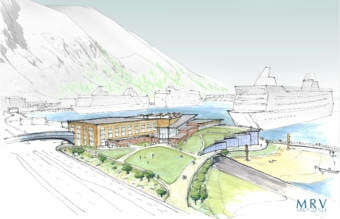
Initial designs for the subport lot in downtown Juneau. (Courtesy of MRV Architects)

Last year, Norwegian Cruise Lines outbid competitors when it agreed to pay the Alaska Mental Health Trust Authority $20 million for a 3-acre parcel of waterfront land in downtown Juneau. Now, Norwegian is moving forward with its development plans for the lot. 

Howard Sherman from Norwegian spent much of last fall and winter talking to people in Juneau about plans to build a new cruise ship dock on the property. 

During a public meeting on Wednesday, he addressed local concerns that a new cruise ship berth would lead to more cruise ship traffic. 
“We’re not looking to increase our NCL cruise traffic there, and so any pier that we’d build, we’d only be looking for cruise ships to be accommodated on one side of the pier and then possibly NOAA and/or Coast Guard on the other side of the pier,” Sherman said. 

Sherman and Paul Voelkers from local firm MRV Architects both said the new dock would cut down on the need for large ships to turn around in Gastineau Channel and idle while waiting for another ship to depart.

The current design concepts feature a multi-story building with bus parking underneath and a new dock perpendicular to the shore. There’s green space extending down to the water. The Alaska Ocean Center could be incorporated too, and Sherman said they plan to include electric hookups for ships to use while in port.

The concept also incorporates city-owned tidelands to the west, with hopes to extend the seawalk from Gold Creek closer to its intended connection to the existing cruise ship docks.  

Sherman said Norwegian wants to make it an area that locals can use year-round. 

He also said that after speaking to Sealaska Heritage Institute and learning about the history of the Aak’w Kwaan people at the site, he wants to incorporate cultural elements into the design. 

“It is actually my intention to rename this from the subport to Auke Landing,” Sherman said. “We would also feature a mural on the site to show what it would have looked like a few hundred years ago.”

Initial designs for the subport lot in downtown Juneau. (Courtesy of MRV Architects)

Sherman did not go as far as to offer up a budget for the project. He said it’s too early. 

“You get real careful with throwing out budget numbers before you have them really buttoned up, because people tend to hold you to that first number and that first number is for some reason always lower than what it turns out to be,” Sherman said. 

Like all major cruise ship lines, Norwegian faced uncertainty earlier this year as the pandemic bulldozed plans for the 2020 cruise ship season in Alaska and around the world. But the company successfully raised more than $2 billion in May through stock options and bonds to help weather the storm. 

“Cash isn’t an issue for us, going forward,” he said. “(But) budgets on all of our projects are always an issue. My budget nowhere has ever been unlimited and never will be.”

Two more virtual meetings will be held Dec. 2 and Dec. 28 to gather more input on the project. They’re also circulating a public survey for locals to share their thoughts. 

The hope is to present the final designs to Juneau’s planning commission by June.  

Norwegian also has development projects at Ward Cove in Ketchikan and Icy Strait Point in Hoonah. Sherman said those projects are moving forward as planned. 

Hoonah reports 1st confirmed cases of COVID-19

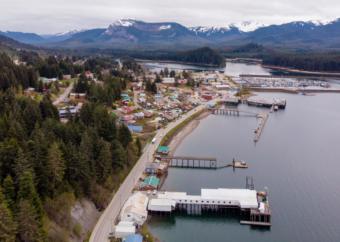
The city of Hoonah on May 2, 2019 (Photo by David Purdy/KTOO)

Hoonah has its first confirmed cases of COVID-19. 

The City of Hoonah learned Tuesday that three people tested positive for the virus. 

The Southeast community has a population of fewer than 800 people. City Administrator Dennis Gray said bars and restaurants are now required to limit their capacity. 

Anyone arriving in Hoonah by plane or ferry must get tested beforehand or when they arrive. 

Hoonah City Schools had been open for in-person learning since the start of the school year but moved classes online this week after administrators learned that a student who traveled outside the community may have been exposed to the virus.

Here’s how the state’s new travel testing requirements will impact Juneau

Updated 6 p.m.:

New travel requirements from the State of Alaska take effect this Saturday. 

Health order 8 allows communities to enact their own travel restrictions. It also provides guidance on in-state travel. 

For Juneau residents, COVID-19 testing is now required before traveling to other Alaska communities off the ferry or road systems. Residents should receive a negative test result 72 hours before their flight, or follow strict social distancing upon arrival until they receive their result. 

Testing prior to in-state travel can be done at the Juneau International Airport. Appointments should be made in advance

The same rule applies to people traveling to Juneau from communities off the ferry or road system for longer than three days. 

If their visit to Juneau is shorter than that, they do not need to be tested beforehand. But they should either get tested within five days of returning or quarantine for 14 days.

Original story:

The City and Borough of Juneau’s weekly community update is at 4 p.m. today.

Members of the city’s emergency operations center will provide information about the COVID-19 response in Juneau and answer questions.

Juneau has seen high rates of COVID-19 transmission in the community for a number of weeks, with almost half of positive cases in the last two weeks resulting from secondary spread from a known case.

The city now considers the outbreaks among the homeless population and at the Mendenhall Auto Center to be resolved. But seven students at the University of Alaska Southeast recently tested positive.

Community members can submit questions to COVIDquestions@juneau.org.

Watch on Zoom, Facebook Live or here once the meeting is live. You can also call the city to listen by phone by calling 1-346-248-7799 or 1-669-900-6833 or 1-253-215-8782, webinar ID 985 6308 5159.

Southeast Alaska Regional Health Consortium ends free COVID-19 testing in Juneau for people without symptoms

Juneau’s SEARHC campus. (Photo by Lisa Phu/KTOO)

Southeast Alaska Regional Health Consortium, or SEARHC, is no longer offering free COVID-19 testing for people who don’t have symptoms of the virus in Juneau. 

SEARHC began offering weekend testing clinics in July thanks to a grant from Indian Health Services. Now, that funding has run out. 

While free asymptomatic testing ended in Juneau and Sitka, SEARHC will continue providing limited free testing in other Southeast communities until Dec. 19.

Asymptomatic people can still request a test through SEARHC but will have to pay $145 out of pocket at the appointment.

People with symptoms or who are close contacts of positive cases can call to schedule tests and will not be charged. 

“Due to the demand for testing, grant funds have been depleted,” SEARHC Chief Medical Officer Dr. Elliot Bruhl said in a press release. “By prioritizing symptomatic patients, we will be able to ensure those who must have a test have access to them. We encourage all patients to continue utilizing free, asymptomatic testing clinics in participating communities until the program sunsets.”

The City and Borough of Juneau’s testing site only performs asymptomatic tests for people undergoing medical procedures. Testing at the Juneau International Airport is reserved for those returning from travel outside the community. 

Otherwise, people experiencing symptoms such as a fever, cough or difficulty breathing can call the city’s COVID-19 screening hotline to schedule a free test. 

According to city data, most results are taking an average of two to six days to return.  

Several other clinics in Juneau offer asymptomatic testing paid for through insurance or out of pocket.

Site notifications
Update notification options
Subscribe to notifications