Adelyn Baxter

Digital Content Director, KTOO

"I help inform KTOO listeners, viewers and readers by finding creative ways to bring our content to our audience wherever they are."
Juneau cruise activist goes global to create network focused on rethinking tourism

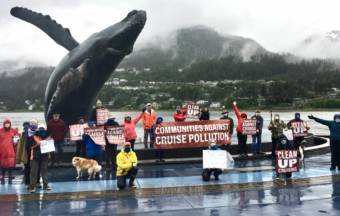
Local activists hold a protest at Overstreet Park for World Oceans Day 2020. (Photo courtesy of Global Cruise Activist Network)

After a summer without cruise ships, many people in Southeast Alaska are desperate to see tourists return. But not everyone.

Some who were already frustrated with the industry’s rapid growth have added pandemic safety to their list of concerns, and they’re talking to people in other parts of the world who feel the same.

Karla Hart is a familiar face at public meetings in Juneau where tourism is on the agenda.

She’s testified repeatedly about negative impacts like noise, pollution and “leakage” — a term for money that doesn’t stay in the community.

It can be lonely. Even though there are people that agree with her, it’s hard to speak out against an industry that generates millions of dollars in local revenue each year.

“I mean, some people who live in Juneau have never experienced it in the summer without any cruise ships,” Hart said.

Recently, she shifted her focus out of state.

The inspiration hit her last year. She was working outside her house when yet another group of helicopters headed to the Mendenhall Glacier flew overhead.

“It popped into my head that we just need to get people from all over the world together, who are experiencing impacts of cruise tourism and start talking,” she said.

Hart went inside and sat down at the computer. She started by reaching out to someone she knew in Florida. That led to someone in another cruise port, and another, until they had a network of activists in dozens of countries around the world.

It’s called the Global Cruise Activist Network. The logo is two maritime signal flags. They represent “I want to communicate with you” and “stop your vessel immediately.”

Scrolling through a map on the network’s website takes you to places like Vancouver, Venice, Key West, Bar Harbor and Australia’s Gold Coast.

Her original idea was to bring people together for an in-person conference in Juneau this past fall. When the pandemic made it clear that wouldn’t happen, they shifted focus to putting pressure on the industry.

The network recently launched a “Rethink Cruise Tourism” campaign aimed at highlighting the risks of restarting cruising too quickly amid the pandemic.

In a video montage, network members around the world make an appeal directly to cruise passengers.

”Cruise ships have demonstrated that they simply aren’t safe during a pandemic,” a member standing in front of the Mendenhall Glacier says, followed by others who chime in with the reframe “rethink before you reinfect.”

Hart said members have diverse goals. A few want to see an end to cruising all together, but many of them just want to see the industry become more sustainable.

And that goes for Hart’s fellow activists in other Southeast communities too.

Over in Hoonah, Icy Strait Point drew about 260,000 passengers to the small community in 2019.

Even though the industry creates a lot of local jobs, Kashudoha Wanda Culp said the lack of local input outweighs the benefits.

“All we are is for display,” Culp said.

Like many people in Hoonah, Culp traces her heritage to nearby Glacier Bay. She’s concerned about the environmental effects cruise ships are having on her clan’s ancestral homeland.

Culp contends that the National Park Service wants to allow more ships into Glacier Bay. The current limit is two cruise ships per day.

Working with groups like Stand.earth and the Global Cruise Activist Network makes Culp feel hopeful that her concerns are reaching people outside of Hoonah.

Meanwhile, Hart and other concerned Juneauites are also holding community meetings to discuss what can be done at a local level to limit the growth. The next meeting will be held Thursday on Zoom.

“We could build a tourism industry in Juneau that consists of overnighting tourists, who come on an appropriate scale to our community, and who put more money into the economy per person in spending,” Hart said. “The money that they spend is money that will stay in the economy longer.”

Now is the time to make it happen, she said, before the ships return in full force.

Correction: A previous version of this story misstated the number of cruise ships allowed in Glacier Bay National Park on a daily basis. The limit is two ships per day. 

Valley property once slated for assisted living may house Juneau youth shelter again

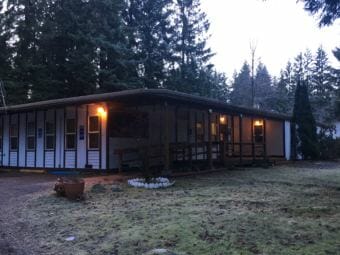
The facility at 9290 Hurlock Ave. formerly housed an emergency shelter for at-risk youth before Juneau Youth Services vacated at the start of the year. (Photo by Adelyn Baxter/KTOO)
The facility at 9290 Hurlock Ave., pictured here in 2018, formerly housed an emergency shelter for at-risk youth before Juneau Youth Services vacated at the start of the year. (Photo by Adelyn Baxter/KTOO)

For more than a year, Juneau teens in need of temporary shelter have had nowhere to go.

Now, a property that served that purpose for decades may fill the need again, but getting it back up and running isn’t a simple process.

Local housing providers say, right now, finding a safe place for homeless, at-risk and runaway youth to stay should be a priority.
“There is no shelter for kids at the moment,” said Gus Marx, grants coordinator for Juneau Youth Services. “There’s a dozen kids at least that we could probably count who right now need somewhere to go.”

Juneau Youth Services used to operate an emergency shelter at a city-owned property in the Mendenhall Valley.

Marx testified at a Juneau Assembly committee meeting on Monday. He said the Hurlock Avenue facility isn’t in perfect condition, but it has everything it needs to open up quickly.

“There’s nowhere else I can think of in town that, at least immediately, could be used to house kids,” Marx said. “And again, this is temporary. This is just to get kids back on their feet, hopefully back home, back to someplace safe.”

The Hurlock facility was Juneau’s emergency shelter for homeless and at-risk youth for decades. But Juneau Youth Services relocated the shelter in 2017 and had to close it down last year after losing federal funding.

Jorden Nigro manages the city-owned Zach Gordon Youth Center. She works with teens facing housing issues all the time, but this year is different.

“This issue has been pretty significantly exacerbated by the pandemic,” Nigro said on Monday. “So, average year, there’s around 125 homeless youth annually and about 50% of those youth in the Juneau School District are teens.”

Nigro was presenting a project proposal to Assembly members. She said teen homelessness is usually less visible, because they tend to couch surf with friends or find other ways to stay under the radar. But the pandemic is making that harder, along with so many other things.

“Their need is so high that they’re seeking us out and finding us, and so we’re just, we’re just seeing a lot more kids in need lately,” she said.

So now, with a pressing need for a youth shelter and an empty building practically ready to go, Tlingit Haida Regional Housing Authority and Zach Gordon Youth Center have stepped forward with a plan.

Under the proposal, the housing authority would basically act as landlord. Zach Gordon would oversee programming and staffing.

They’re proposing emergency housing for about a dozen youth ages 10 to 20 and an annual operating budget of $600,000.

They’ve got state and federal grants and local contributions to help cover most of that but would need about $120,000 in annual funding from the city. The building will also need a new roof in the next few years.

Here’s where the process gets a little complicated.

The city already sold the property in 2018, and they did it under pretty favorable terms, on the condition that the local company that bought it — Alaska Legacy Partners — turn it into senior assisted living. That’s another major need in Juneau.

But, that venture didn’t work out for a few reasons, with the pandemic and a competing assisted living project nearby among them.

Now, the Assembly would need to allow the city manager to take the property back from Alaska Legacy Partners. Then it has to allow the city to lease it for a youth shelter once again.

Alaska Legacy Partners Co-Founder Garrett Schoenberger said they’d be glad to see the Hurlock property serve a need in Juneau, even though their plans didn’t work out.

“You know, we’re not looking to make a profit on this,” Schoenberger said. “We’re just looking to recoup some of our costs, and we have found with Tlingit and Haida [Regional Housing Authority] and Zach Gordon and the youth homeless facility, it was a great use that felt like it was a win-win for us to be able to hand over the keys to a new use that’s going to be a community benefit.”

Several community members also testified at the meeting this week.

Some encouraged the Assembly to approve the proposal, and others raised concerns about the lack of neighborhood engagement so far.

The Assembly will hold public hearings on the two ordinances related to the proposal at next Monday’s meeting.

Correction: A previous version of this story misspelled Jorden Nigro’s first name. 

Updated: Bartlett Regional Hospital cancels lockdown after police locate suspect who threatened staff

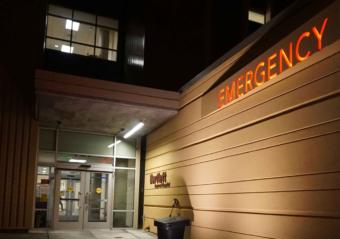
Emergency room entrance at Bartlett Regional Hospital.
Emergency room entrance at Bartlett Regional Hospital. (Photo by Jennifer Canfield/KTOO)

Update, 10:45 p.m.

The lockdown has been lifted.

According to an email from the hospital spokesperson, the Juneau Police Department found the individual who made the threat. They determined the threat was not credible.  District and city attorneys confirmed that no crime was committed.

Original story:

Bartlett Regional Hospital is on lockdown after someone threatened emergency department staff. 

According to Bartlett spokesperson Katie Bausler, a person with a known history of violence threatened to shoot staff members in the emergency department. 
The Juneau Police Department is looking for the person who made the threat to determine if it’s credible. Officers are also assisting Bartlett with security. 

The hospital will continue to closely check all patients arriving at the entrance until the lockdown is lifted.

This post has been updated. 

Juneau salmon hatchery forced to destroy fish because of landslide damage

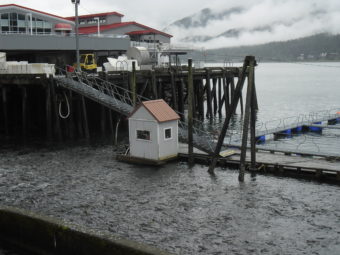
Thousands of chum salmon return to DIPAC’s Macaulay facility where they were released 4 to 5 years ago. (Photo by Lisa Phu/KTOO)

One of the largest salmon hatcheries in the state was forced to destroy thousands of fish after a landslide Wednesday damaged a pipeline that supplies its water. 

The Macaulay Salmon Hatchery in Juneau is run by Douglas Island Pink and Chum Inc., known locally as DIPAC. Its water comes from Salmon Creek Reservoir and shares a pipeline with Alaska Electric Light & Power’s power plant.

Debris from the slide and others along Salmon Creek road caused by heavy rain makes it difficult to access the area. That means it will take some time to repair the pipeline

Without a freshwater source, the hatchery’s staff had to make a tough decision over which fish to save with the remaining water.

An aerial photograph shows damage along the pipeline below Salmon Creek Reservoir. (Photo courtesy of Alaska Electric Light & Power)

They destroyed all the young chinook salmon and rainbow trout that would have been released next spring, and most of the young coho salmon, too. 

The rest of the facility’s fish stock is stable for now. The hatchery is working with AEL&P to secure a backup water supply until the pipeline can come back on line. 

The Salmon Creek trail remains closed while AEL&P makes repairs. 

The hatchery has been operating in its current location since 1990, according to its website. It’s permitted for 135 million chum, 1.5 million coho, 1 million chinook and 50,000 rainbow trout. It can hold up to 300 million eggs and is one of the eight largest salmon hatcheries in the State of Alaska.

Correction: A previous version of this story had the wrong name for Douglas Island Pink and Chum, Inc.

Juneau officials caution residents to be prepared for landslides as rains continue

A historical photo of a 1936 landslide along South Franklin Street that killed 15 people. (Photo courtesy of the Alaska State Library historical collection)

The City and Borough of Juneau is warning residents to be prepared in case heavy rains and snowmelt cause landslides or avalanches. 

With high winds and heavy rain expected on already saturated ground, people living in hillside areas should be especially vigilant. 

Capital City Fire/Rescue recommends residents in those areas should have evacuation plans ready

The department suggests checking with friends or family to stay with in the event of an emergency. The Red Cross can also help people find places to stay if necessary. 

https://www.facebook.com/CapitalCityFireRescue/posts/1579652428903982

CCFR Chief Rich Etheridge said as of Tuesday afternoon crews had not responded to any landslides. The city public works department has been out pumping culverts where flooding might be an issue, such as along Tongass Boulevard in the Valley. 

A flood advisory remains in effect until Wednesday morning. An avalanche along Thane Road Tuesday afternoon did not cross the roadway.

https://www.facebook.com/CapitalCityFireRescue/posts/1579686682233890

In the event any kind of large scale evacuation would be necessary, Etheridge said Centennial Hall could be used as an emergency shelter. 

The city has used the downtown convention center as a COVID-19 isolation and quarantine facility for the past few months. No one with COVID-19 is currently staying there. 

No vacancy: Lawmakers won’t be staying at Juneau’s iconic Baranof Hotel this winter

The art deco entrance to the Baranof Hotel in downtown Juneau. (Photo by Flickr user Jasperdo)

In Juneau, this time of year is normally the slump between the busy summer and the Legislative session, when lawmakers and their staff arrive.

But after a nonexistent tourism season, downtown hotels are especially looking forward to the arrival of lawmakers and the opportunity to make up some revenue.

Since statehood, the Baranof Hotel in downtown Juneau has been a focal point for visitors.

The nine-story, art deco-inspired building has almost 200 guest rooms and a cocktail lounge called the Bubble Room, where legislators and lobbyists have wined and dined for decades.

It’s also where the FBI famously staked out in the mid-2000s as part of an investigation into political corruption in Alaska’s Capitol.

But right now, when you call the hotel’s main number, this is what you hear on the answering machine: “The Baranof Hotel is closed for the winter … Thank you and we’ll see you next year.”

Juneau’s largest hotel will remain closed through the upcoming Legislative session.

It’s not clear when it will reopen. Attempts to contact the out-of-state owners were unsuccessful.

“In my experience here in Juneau, that is an absolute first and it is troubling to us,” said Liz Perry, president and CEO of Travel Juneau. She’s been tracking the situation for hoteliers all summer.

“They were just facing a vacancy rate that was high enough that it did not make sense to keep the whole property open,” Perry said.

The Baranof’s out-of-state owners also own the Four Points by Sheraton, a few blocks away. Perry said they moved all of the reservations to that hotel to consolidate.

She said hotels in other parts of town have fared better. Many of the rooms at the Best Western and a few others near the airport have been booked almost continuously for hundreds of mine workers quarantining before heading to their job sites.

The owners of Juneau’s two local mines have spent hundreds of thousands of dollars on rooms and meal delivery for their employees.

“Aside from them, the downtown hotels have really been hard, hard hit this summer,” Perry said. “And will be well into the winter, so far as we can tell.”

As it stands now, the Legislative session is the best bet for local hotels to make up some revenue.

Jessica Meacham is general manager of the Ramada by Wyndham, formerly known as the Prospector Hotel. They had to lay off some staff early on in the pandemic.

“We saved on labor, we didn’t do any of the renovations we were planning on, like, we just hunkered down,” Meacham said. “You know, we’re just waiting ’til, you know, people come back.”

Even though this summer was a bust, she said things picked up a bit this fall. And she’s hoping the Baranof’s closure could mean more business for her.

“My rooms are huge and good for long term,” Meacham said. “So I’m hoping some of the people that usually stay there will come here, but no one’s contacting me.”

At a recent meeting, the Juneau Assembly approved $300,000 in city funding for the Alaska Committee. That’s the local group dedicated to keeping the capital in Juneau.

Assembly member Maria Gladziszewski said at the meeting the funding would be used to “intervene” in the local private housing market.

She said the Legislative Affairs Agency (LAA) that helps to coordinate housing ahead of the session is struggling, especially without all those rooms at the Baranof.  

“Normally this time of year, they have a good number of options for legislators and staff,” Gladziszewski said. “They currently do not have that many listings. So, not clear what is happening there, but if you’re looking for a way to make some money on some of your housing, please contact LAA.”

She said if more Juneau residents with rental properties reach out, they may not have to spend as much of the city’s money.

Legislators and staff will begin arriving shortly after the new year. The session is set to begin Jan. 19.

Correction: A previous version of this article incorrectly stated that the Legislative session begins Jan. 21. The spelling of Maria Gladziszewski’s name has also been corrected. 

Site notifications
Update notification options
Subscribe to notifications