Adelyn Baxter

Digital Content Director, KTOO

"I help inform KTOO listeners, viewers and readers by finding creative ways to bring our content to our audience wherever they are."
School closes in Hoonah after potential COVID-19 exposure

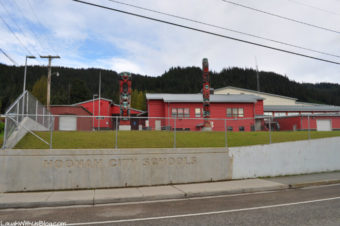
Hoonah City Schools (Photo courtesy laughwithusblog.com)

Children were sent home early from school in Hoonah Thursday after administrators learned that a student was exposed to COVID-19.

Hoonah City Schools superintendent and principal Ralph Watkins said by phone that the student recently returned from travel outside of Hoonah and tested negative for the virus.

Due to some confusion about the city travel mandate, Watkins said they returned to school even though they should have continued isolating at home.

“We do not have any confirmed cases of COVID in the school or community,” Watkins wrote on Facebook. “We are making this change out of caution, and in line with our Smart Start Plan.”

School is canceled Friday and will go virtual on Monday.

Watkins said they’re waiting for follow-up test results for the student, but will continue to teach virtually until after Thanksgiving just in case.

Hoonah has not had anyone test positive for COVID-19 in the community.

Students there have been attending class in-person since the beginning of the school year. Watkins said 137 students from pre-K through twelfth grade go to school in the same building. Masks are required.

Watkins said they’re well prepared to transition to online learning.

All Hoonah students have internet connection and the technology they need to learn at home thanks to a partnership between the City of Hoonah, Huna Totem Corporation, Royal Caribbean Group and Norwegian Cruise Line Holdings.

Karen Carey named new chancellor of University of Alaska Southeast

UAS Chancellor Karen Carey. (Photo courtesy of the University of Alaska Southeast)

Karen Carey is the new permanent chancellor of the University of Alaska Southeast. Carey has been interim chancellor since July when former Chancellor Rick Caulfield retired.
University of Alaska President Pat Pitney announced Wednesday that Carey will now lead UAS, which has campuses in Juneau, Ketchikan and Sitka.

Carey said Thursday she’s still a little bit in shock.

“I was working away here at home and President Pitney sent me an email and said she wanted to speak with me, and would I be willing to serve as chancellor in the permanent position? And I was very surprised,” she said.

Carey and President Pitney had discussed looking for a permanent chancellor next fall.

Typically, the university conducts a search to fill chancellor positions. But Carey said she believes Pitney wants to make sure the university continues to move forward.

“We’ve gone through a lot with the budget cuts and COVID and everything that’s been happening to the university over the past five or six years, and I think that she just wants to have things be stable,” Carey said.

UAS and the entire UA system experienced a tumultuous start to the year. Classes moved online abruptly due to COVID-19 last spring. Then UA President Jim Johnsen stepped down in June and the UA Board of Regents considered merging UAS with the University of Alaska Fairbanks.

The board voted not to move forward with that plan, but it raised concerns for many people about the future of UAS.

UAS Faculty Senate President David Noon said he’s happy with Carey’s appointment. He agreed that it would bring stability to the campus.

“Having a full time rather than an interim chancellor, I think is an important sign from the university leadership that UAS is going to remain independent, separately accredited to serve all the needs of Southeast Alaska,” Noon said.

Before becoming interim chancellor, Carey served as UAS provost since 2016. She has a Ph.D. in school psychology and arrived in Juneau from California State University Channel Islands.

Carey said enrollment at UAS dropped this fall, but not as much as she expected.

“Certainly COVID has thrown, you know, us all for a loop, and there’s not much we can do about that until we get a vaccine,” she said. “But overall, I think the morale on campus is really good. Even though no one’s on campus, except for a few people.”

She said 120 students are living on campus this semester, and about 30% of classes are happening in-person across the three campuses.

Those classes are observing strict social distancing, and use plexiglass shields between students and instructors when possible. Masks are also required on campus.

Carey said they may expand in-person classes in the spring, but she expects most will continue online.

Correction: A previous version of this story misspelled former UA President Jim Johnsen’s name. 

Juneau’s hospital sees surge in kids experiencing mental health crises

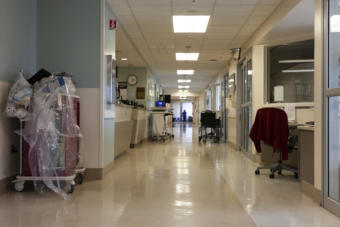
A nearly empty critical care unit at Bartlett Hospital on April 7, 2020, in Juneau, Alaska. (Photo by Rashah McChesney/KTOO)

Juneau’s Bartlett Regional Hospital is seeing a surge in children experiencing mental health crises.

Hospital officials say the effects of the COVID-19 pandemic are to blame.

Bartlett’s emergency department has treated an unprecedented number of kids experiencing high levels of stress, thoughts of self-harm and suicide attempts over the past seven months.
Chief Behavioral Health Officer Bradley Grigg told the Juneau Assembly on Monday that the kids and their families bring up the impacts of the pandemic when interviewed by staff.

“We’re not really attributing everything here specifically to COVID, but what we are saying is that this is what our families and our parents are sharing when they come in in crisis,” Grigg said. “There seems to be precipitating factors connected with that stress level.”

According to hospital data, during the nine month period from July 2019 to last March, kids made up about 4% of the patients seen in the emergency department for behavioral health crises.

After the pandemic began and schools moved to online learning, that number shot up.

Between April and June of this year, kids made up almost 20% of the cases.

“While we say age 17 and under, the youngest one we’ve seen is five,” Grigg said. “Our most common age group at this point in the last six months has been 13 – 14.”

From April through September, the number of children 13 and under who attempted suicide also grew dramatically.

A graph showing children’s psychiatric visits to Bartlett Regional Hospital’s emergency department.
(Graph courtesy of Bradley Grigg)

Families involved in treatment after an incident talk about financial struggles and housing issues.

Those concerns are clearly trickling down to kids, Grigg said, who also bring up virtual school and the lack of sports and extracurricular activities.

And the problem isn’t exclusive to any one demographic.

“They’re families that you know. They’re families that I know. They’re families that we pass not only in the grocery store, but at any other activities we do,” Grigg said. “We may not recognize them at first with the mask on, but eventually these are folks that we know. They come from all walks. They come from all areas of town.”

Assembly member Wade Bryson weighed in as a parent who has dealt with some of the same concerns.

“I can assure you that not only does the kid stress about it, but the parents not having clear direction, not having a clear answer on how to solve it, also adds an element of stress,” Bryson said. “Depression and these types of illnesses affect the whole family, not just the individual kid.”

Grigg said Bartlett reached out to the state several months ago to ask for help responding to the high number of cases.

The state provided some funding to help expand their outpatient services at the hospital. That’s allowed staff to do more follow-up with families and patients in the weeks and months following a crisis.

Bartlett is not alone. SEARHC, JAMHI, Juneau Youth Services and other providers are also offering mental health support for youth and adults.

Bartlett also plans to build a crisis stabilization center on its campus to be able to treat up to eight patients at a time.

But Grigg said as the pandemic drags on and social isolation continues to impact mental health, they need to do more.

He and Juneau School District Superintendent Bridget Weiss have discussed what they’re seeing.

During a community update Tuesday, Weiss talked about using grant money to hire more positions as virtual learning continues.

“We are looking at how we can support students and families in this real really, really unique situation where students are missing out on not only the structure part of those activities, but the social part of that,” Weiss said.

Grigg and Weiss plan to meet with local organizations to talk about solutions, like training educators and coaches how to recognize the signs of stress in children and ways to address it.

If you or someone you know is struggling with thoughts of suicide, contact the National Suicide Prevention Lifeline at 1-800-273-8255.

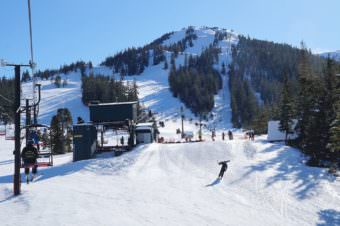
Eaglecrest prepares for ski season with high hopes for snow and no COVID-19 disruptions

Attendance numbers have spiked at Eaglecrest Ski Area thanks to fresh snowfall as seen here on March 5, 2017. (Photo courtesy of John Erben)

Juneau’s Eaglecrest Ski Area closed early last spring when coronavirus arrived in the United States.

The city-owned ski area has an ambitious reopening plan for this season. Staff hope it will be enough to provide uninterrupted outdoor distraction this winter and keep people healthy.

Snow has been steadily piling up on the mountain top.

And while Eaglecrest’s opening day isn’t for another month, General Manager Dave Scanlan is feeling optimistic.

“Some really good, strong early season season pass sales and sales of lesson programs,” Scanlan said. “It definitely seems like people are excited to be outside and getting exercise and sharing some well-spaced outdoor social time with their friend groups.”

Last year was a record-setting snow season. But like everything else, things ground to a halt for the ski mountain in mid-March.

Scanlan said Eaglecrest and other northern hemisphere ski areas spent the offseason watching what worked and didn’t work in places like New Zealand, Australia and South America.

“A lot of the ski areas down there were anticipating much lower demand for services, and it was actually the opposite,” said Scanlan. “There was a higher demand because, again, … people wanted to get outside and do something fun for their families.”

Eaglecrest’s plan for this winter is tied to the City and Borough of Juneau’s COVID-19 strategy.

For several weeks, Juneau has remained at its highest risk level, with significant community spread of COVID-19. If that keeps up until the start of the ski season, Eaglecrest will open in the most restrictive phase of its plan.

That means masks for anyone not actively skiing or snowboarding. Lodge access would be restricted, so all rentals, lesson reservations and food and drink orders would happen outside through service windows.

“Obviously, we were all hoping that we would be seeing our infection rate going the other direction, but it seems like we’re kind of holding at this current level with, you know, definitely some community spread and significant numbers of COVID,” Scanlan said.

Skiers and snowboarders are encouraged to treat their cars like the lodge: get dressed there, eat there and — within family groupings or social bubbles — socialize there.

Staff will enforce social distancing between groups and mask wearing. People who don’t mask up properly risk penalties, starting with a suspension of two weeks and working up to the full season.

To help with all the extra enforcement and mitigation this winter, Eaglecrest has a pair of budget requests headed for public hearing before the Juneau Assembly later this month.

One asks for $73,000 in federal CARES Act funding for tents, outdoor heaters and propane.

The other requests $160,500 in city funding to hire more staff for ski patrol and to operate the Black Bear chairlift with expanded hours, allowing people to spread out on the mountain and create less congestion in lift lines.

At an Assembly finance committee meeting in September, City Manager Rorie Watt pointed out that unlike pools or skating rinks, Eaglecrest can’t exactly limit how many people walk through the door.

Even if the lifts move to a reservation system — a possibility under Phase 3 of Eaglecrest’s plan — people will still hike up the mountain.

“Eaglecrest is a different, you know, arena,” Watt said. “It’s outdoors and on a big snow day it’s going to be very difficult for Mr. Scanlan and his staff to limit the number of people at the ski area.”

Skiing is bound to be popular this year, especially if the snow cooperates.

The new rules will be an adjustment for many people, especially when it comes to no indoor access.

“There are days in skiing, where the weather is just brutal,” said Nona Dimond, vice president of finance for the Juneau Ski Club. She also coaches ski racing for younger children and has a son in the youth program.

“We’ve had days where it’s so wet that you have to go into the lodge and wring out gloves and put them on the heater and dry them,” Dimond said. “There’s been days where it’s so cold that you worry about kids getting frostbite, and really the only way to do anything to mitigate that is to keep going in and get warm.”

Dimond said Eaglecrest has been working with the club and will provide heated tents for warming up and getting out of the slush.

She’s hopeful that if everyone follows the rules, this season can be a success.

“Skiing lends itself really nicely to socially distanced activity, yet still having a little bit of interaction with another human being, which we’re all sort of missing,” she said.

Eaglecrest’s opening day is Dec. 5.

If the snow is good, it could open earlier.

City says new machine should improve turnaround times for COVID-19 testing in Juneau

Juneau Airport COVID-19 test
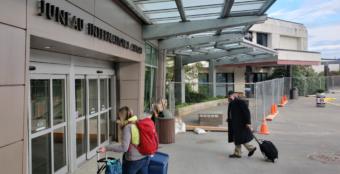
A public health worker in a tent outside Juneau International Airport bags a freshly collected nasal swab for COVID-19 testing on Sept. 1, 2020. (Photo by Jeremy Hsieh/KTOO)

Juneau will have its own machine to process COVID-19 tests starting next month. That should lead to a faster turnaround time for results.

The Juneau Assembly approved $700,000 in CARES Act money for testing equipment in June. But with the machines in high demand all over the world, the city expected to have to wait until 2021.

Instead, Juneau’s order will arrive in December.

“Ideally, we will have the staff and supplies in order to process all of our tests that occur in Juneau on the system,” said Emergency Operations Center Planning Chief Robert Barr.

The city is getting a cobas 6800 system from Roche. It will be able to process nearly 400 tests every eight hours. That means people should receive same or next day results.

Juneau currently performs about 150 to 200 tests a day on average, according to Barr. Each test has to be flown to a laboratory for processing.

Turnaround time for results from the airport testing site improved recently when the city started sending tests to a private lab in California, instead of the state lab in Fairbanks. But most results still take two to three days.

“A test is a point in time, right? So the closer to that point in time that you can tell someone that they tested negative or they tested positive, the higher value that test has,” Barr said.

The city plans to start sending tests from the Capital City Fire/Rescue testing site to the out of state lab next week. Barr said the state pays for shipping and processing.

Right now, Bartlett Regional Hospital has rapid tests available for some people.

Barr said they’re building a space at Bartlett for the new machine. The hospital is also hiring staff to run it. But it may take some time to reach full capacity for all testing done in Juneau.

“There may at first be some supply constraints. It kind of depends on the worldwide demand on the testing supplies,” Barr said. “But we would hope to transition all of it over. The most important test that we would do early on on this machine would be tests for people experiencing symptoms.”

The machine is a polymerase chain reaction test, also known as PCR. It takes about four hours to process a sample.

Barr said that’s the same type of equipment used at both the state and California labs.

Crews restore power after areawide outage in Juneau

Alaska Electric Light & Power crews work to restore power during an areawide outage in Juneau Thursday, Nov. 5, 2020. (Photo by Rashah McChesney / KTOO)

Power went out across Juneau shortly after 2:30 p.m. Thursday. It was restored for the majority of town by 4 p.m. 

Alaska Electric Light and Power responded to the areawide outage, which began with a tree falling on a power line on Gastineau Avenue in downtown Juneau. 

Several people on social media reported seeing sparks and a flash coming from power lines near the downtown waterfront. 

Katie McCaffery said she saw the explosion from across Gastineau Channel in Douglas. 

“It had started as, like, initially this small black plume that became this kind of billowing orange color and then went to a big blue light and eventually became this big searing white color that was almost the same size of this condominium that we’re above,” she said.

Capital City Fire/Rescue wrote on Facebook that staff responded to Gastineau Avenue where the tree had fallen on a powerline.

AEL&P wrote on social media that it had begun the restoration process for customers as of about 3 p.m. Power came back on in most parts of town before 4 p.m. But, according to AEL&P, another tree on a line near Tee Harbor would delay things for that area of town.

A similar outage on Monday morning knocked out power for several hours. That was caused by heavy ice and snow on power lines. 

AEL&P also responded to an outage late Wednesday night out the road. According to the National Weather Service, wind gusts of up to 40 miles per hour were expected Thursday, but were supposed to diminish throughout the day. 

Rashah McChesney contributed to this report.

Correction: A previous version of this story incorrectly said winds were light throughout the Juneau area at the time of Thursday’s outage.

Site notifications
Update notification options
Subscribe to notifications