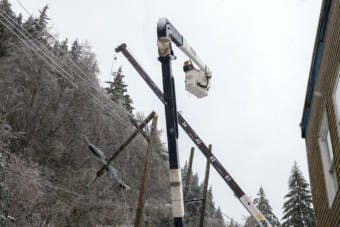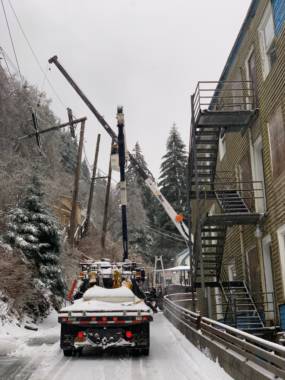
A crew from Alaska Electric Light & Power work on a downed power line on Monday, Nov. 2, 2020 in Juneau, Alaska. Power was out for much of Juneau as morning broke and a storm that had been forecasted to bring rain, instead brought a blizzard. (Photo by Rashah McChesney/KTOO)
Juneau residents from Thane to the end of the road woke up with no electricity Monday morning. Some outages persisted into the afternoon.
Alaska Electric Light & Power spokesperson Deb Driscoll said the outages began Sunday afternoon when trees weighed down by snow and ice started falling on power lines.
That happened repeatedly in multiple locations overnight and this morning.
“We had multiple trees coming down in multiple locations,” Driscoll said. “So the crew has been working nonstop.”
A fallen tree blocks the road at the intersection of Dixon Street and Calhoun Avenue in downtown on Monday, Nov. 2, 2020, in Juneau, Alaska. (Photo by Rashah McChesney/KTOO)
Driscoll says she can’t recall a similar event causing this many outages in more than a decade. Slick conditions on the roads didn’t help.
An areawide outage occurred at 5 a.m. when trees fell on a main transmission line along Thane Road. Power was restored for most areas of town at about 9:30 a.m.
As of Monday afternoon, crews were still working to restore power to Tee Harbor and areas further north due to a separate issue that was resolved by about 3 p.m.
Driscoll said the weather forecast remains unpredictable. More outages may occur.
“We want customers to be prepared for the possibility of additional outages, for sure,” Driscoll said. “I think what happens is, certainly if it warms up, then you get even heavier snow on trees and then that can cause additional problems if it ices up that can cause problems with the line.”
People should prepare by keeping their phones fully charged. If they have alternate heat sources like wood stoves, they should be prepared to use them.
She says people can also gather snow and place it in buckets in their fridge or freezer to help keep food cold if necessary.
Anyone with information about downed power lines and other damage should call AEL&P. Otherwise, customers can check Facebook, Twitter and the AEL&P website for updates.
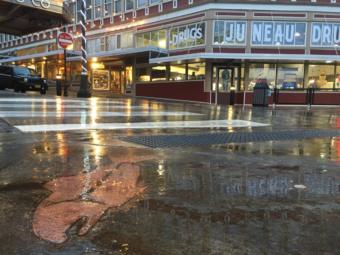
Rain trickles onto the pavement in an intersection in downtown Juneau, Nov. 19, 2019. (Photo by Ryan Cunningham/KTOO)
It will be a rainy Halloweekend for Southeast Alaska.
The National Weather Service forecasts two separate storm systems. Lead Forecaster Edward Liske said the rain is coming all the way from Hawaii.
“It’s basically drawing moisture up from that area and into our area, which is why we’re getting all the heavy rainfall,” he said.
The first system arrives Friday night through Saturday, and may bring wind gusts of up to 40 miles per hour in some places.
Liske said they expect between one and three inches of rain through Saturday evening. But it won’t stop there.
“Then it comes back with a vengeance on Sunday afternoon into Sunday night,” he said. “Probably two to four inches of rainfall, maybe even a little bit more, out of that between Sunday afternoon into Sunday night, maybe even into early Monday.”
The city is reminding boat owners to check their vessels ahead of time to make sure mooring lines are secure and pumps are operating.
Late Friday, the National Weather Service issued a flood watch for a large swathe of Southeast Alaska including Juneau, Gustavus, Hoonah, Pelican, Sitka, Petersburg, Craig, Klawock, Ketchikan and Metlakatla. The watch will be in place from Sunday morning through Monday morning, which is also when the largest rain amounts are expected to occur. The weather service expects to update that flood watch announcement by Saturday evening.
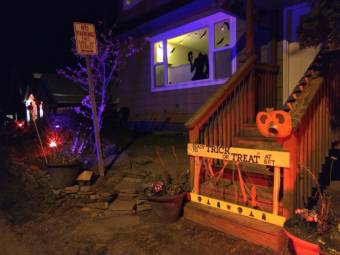
A home in downtown Juneau is decorated and ready for socially distant trick-or-treaters. (Photo by Mikko Wilson/KTOO)
While the pandemic put a damper on many holidays this year, determined Juneauites are finding creative ways to celebrate Halloween.
The City and Borough of Juneau recommends that families avoid parties, haunted houses and door-to-door trick-or-treating this year. Most of those are already canceled.
The CDC has a guide for how to celebrate Halloween safely. It encourages outdoor activities, masks, frequent hand washing and social distancing. Even with those measures, trick-or-treating is considered a moderate risk activity.
Still, all over town people have rigged up contraptions to deliver candy to costumed kids while staying socially distant, whether by clothesline or makeshift chute.
But not everyone is up for the usual Halloween activities this year. Even the Flats neighborhood — which usually attracts hundreds of trick-or-treaters from all over town — will be relatively quiet. A few households may still hand out candy, but many plan to sit this year out.
In the Mendenhall Valley, parents have organized a trunk-or-treat event at the Mendenhall Mall parking lot Saturday afternoon. Deborah Clements said they have about 30 volunteers who will stage their cars with trunks full of goody bags.
Trick-or-treaters will stay distanced in their bubbles and masks are required for anyone over two.
“We’re going to do nauseating amounts of mitigation, as far as people roaming with extra hand sanitizer,” Clements said. “We’re going to have a tent set up where people have to come and at least sign up with a representative name and phone number, just in case we need any quick contact tracing.”
A Halloween decoration in the Flats neighborhood of Juneau strikes a positive note during a quieter than normal holiday season. (Photo courtesy of Meilani Schijvens)
There’s also a Halloween car parade Saturday afternoon that will weave through different parts of town and deliver candy.
In Douglas, trick-or-treating has already been rare for decades. Most families opt for a drier option — the annual Ghost Walk at Mount Jumbo Gym.
But with this year’s event canceled, Melissa Griffiths saw an opportunity to revive trick-or-treating in a safe way. She posted a form for people to fill out if they plan to trick-or-treat with kids or if they would like to hand out candy, with the expectation that people observe health and safety rules.
She’ll turn the responses into a map.
“It’s definitely my goal that it becomes a thing again in Douglas,” Griffiths said. “I think there’s a chance for that this year, if it goes well, and it’s looking promising. It just took a global pandemic.”
This is her third year putting together the trick-or-treat map for Douglas, and Griffiths said the response has been at least double what she’s seen in the past. She’ll publish the map on Facebook on Friday.
For those hoping to remain in their bubbles, the Gold Town Nickelodeon and city Parks and Recreation department have organized drive-in movies at Sandy Beach on Halloween.
Everyone is required to stay in their cars. Family-friendly movie “The Addams Family” will show at 6 p.m. and “Poltergeist” will play at 9:30 p.m.
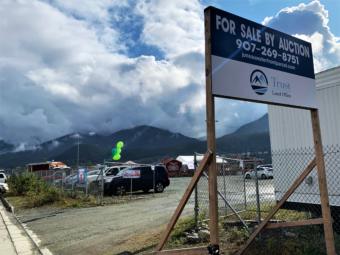
A “for sale” sign sits on a downtown Juneau waterfront lot that was auctioned off in 2019. A new city policy would require the disclosure of final sales prices for real estate transactions to the city assessor’s office. (Photo by Adelyn Baxter/KTOO)
But the Assembly may decide to reevaluate that decision at a future meeting.
From the city’s point of view, giving the assessor’s office access to final sales prices helps them make better property assessments each year. That leads to fairer rates for taxpayers.
“It’s one more tool for the assessor to fulfill the mandate of state law, which says that you will assess property at true fair market value,” said Assembly member Loren Jones on Tuesday. Jones made the motion to approve the change at Monday’s meeting.
Alaska is one of a handful of so-called non-disclosure states. That means the final sales price of property transactions doesn’t have to be shared publicly. Still, local communities are free to change that.
But local real estate agents and at least one Assembly member say there are still unanswered questions.
Assembly member Greg Smith tried to delay the vote and to send it back to committee.
“I wanted to follow the recommendation of the city manager, which was put it back to committee for further discussion, and potentially even a public hearing,” Smith said on Tuesday. “I didn’t feel like I fully understood the breadth of what we were doing.”
Smith’s motion failed, with other members saying they felt they had already discussed the topic enough and were ready to vote.
The new mandatory disclosure policy passed 6 to 3, with Smith, Wade Bryson and Mayor Beth Weldon voting against it.
But later in the meeting, Jones notified the mayor that he planned to motion for reconsideration.
“That’s a parliamentary move, so that if I want to bring it up at the next Assembly meeting, whenever that is, I can do that,” Jones said.
A motion to reconsider needs a majority vote for a “do-over” to happen. Otherwise, the original vote stands.
Jones said he may not even change his vote, but he realized some of the information he shared at the meeting may have been inaccurate.
“I want to go back and review the emails, go back and review the information that I was provided,” Jones said. “And if I was wrong, I need to state that. If that then changes my opinion, which I’m not sure it will, then I would have an opportunity to bring it back up before the Assembly.”
Curtis Francis is president of the Southeast Alaska Board of Realtors. He said there were a few inaccurate statements made at the meeting about what’s publicly disclosed during real estate transactions.
He and others who testified on Monday brought up privacy and the concern that this could lead to increased taxes for property owners. He also said the final sales price isn’t the best indicator of a home’s worth.
“Maybe a seller paid $10,000 towards closing costs, which would not go into this sales price,” Francis said. “Sometimes there’s repairs that are made in lieu of sales prices that are also not disclosed. So it’s not always an accurate price.”
The ordinance also mentions estimating the value of personal property, like appliances, included in a sale. He said it’s not clear who determines the value of those items.
Francis was disappointed the Assembly didn’t do more to talk to realtors who wrote to them before the meeting.
“They could have simply called someone, any realtor, title company and got some of these answers. But that didn’t appear to happen, which is unfortunate,” he said.
The earliest a motion for reconsideration could happen is the Nov. 16 special Assembly meeting.
A member of Bartlett Regional Hospital’s medical staff walks through a newly converted spillover shelter for COVID-19 patients on Monday, April 7, 2020 in Juneau, Alaska. The shelter is designed to house patients who need medical care, but not critical medical care from the city hospital. (Photo by Rashah McChesney/KTOO)
After seven months, Juneau’s residential substance abuse treatment facility reopens this week.
Although Rainforest Recovery Center will limit the number of patients for now, providers say the need in and outside the community is growing.
Bartlett Regional Hospital’s Rainforest Recovery Center can typically hold 12 patients at a time.
Now that they’re reopening, they’ve cut that capacity in half. Chief Behavioral Health Officer Bradley Grigg said they’re taking it slow to reduce the risk of spreading COVID-19.
“We would be fools to think that six beds is going to meet the need. But we’re doing it based off pure safety and caution,” Grigg said.
Since the pandemic began, Rainforest has shifted some rehab services online, offering outpatient treatment for the first time in recent memory.
Grigg said they now have more than 40 patients getting counseling virtually.
“So if they meet criteria to get in, and we don’t have a bed quite yet, we’ve got outpatient services that can support them until we can get them in there,” Grigg said.
They’ll only accept people from Juneau and other parts of Southeast Alaska. Patients need a negative COVID-19 test within 72 hours of admission, and they’ll be tested weekly. Masks are required for patients and staff in common areas.
They hope to be able to expand their admissions eventually, but for now, it’s easier and lower risk to focus on helping people locally.
“What we don’t want to do is have to bring people in and have to quarantine them automatically,” Grigg said. “Once they’re here, we’d like for them to get started in treatment as soon as they’re here and we think that local is just going to be the best at that point.”
Hospital staff move equipment into the Rainforest Recovery Center. City officials converted the drug and alcohol rehabilitation center into an emergency spillover shelter for COVID-19 patients at Bartlett Regional Hospital. The shelter is designed to house patients who don’t need critical medical care. (Photo by Rashah McChesney/KTOO)
According to the statewide dashboard that tracks how many beds are available, there are about two dozen other residential treatment facilities around the state.
Many of them have open beds, but waitlists range from a few days to several months long.
Now that it’s completed, patients going through withdrawal will be treated there, instead of across the street at the hospital. But since detox is a medical service, that means nursing staff needs to be on hand 24 hours a day.
“We went from seven 12-hour shifts, now to 21 12-hour shifts,” Grigg said. “So it’s a significant increase.”
He said they’re recruiting and have already hired new staff. They’ll also rely on travel nurses. They hope to have a new withdrawal management unit open in a few weeks. But things can change quickly in a pandemic. So they have to be flexible.
Rainforest patients were sent home in March, and the facility was converted into a backup site in case the hospital became overwhelmed with COVID-19 patients.
Although it never came to that, the equipment is still on-site just in case.
“So far, we’ve been fortunate to not have to use it. But if we have to stand it back up again, we know that we can do that pretty quickly,” he said.
For now, Grigg is more worried about what this winter will bring in terms of mental health crises.
“We have new folks who are struggling that have never struggled like this before, to where it’s obvious there that substance use is on the rise, whether it be alcohol or other drugs,” he said.
The pandemic is producing a lot of stress and social isolation, major factors that contribute to substance abuse.
“It’s increasing among children, it’s increasing among families, adults,” he said. “So that’s the bigger concern for me, of what is this going to look like five months from now?”
According to the latest data from the Department of Health and Social Services, there are roughly 145 people across Alaska waiting to get into facilities to treat drug and alcohol issues.
The Juneau Assembly and city staff bid farewell to Rob Edwardson at Monday’s meeting. (Zoom screenshot)
Update, 11 p.m.
The Juneau Assembly swore in its newest member and bid farewell to an outgoing member at its first meeting since the Oct. 6 election.
Returning members Maria Gladziszewski and Alicia Hughes-Skandijs took their oath together with new member Christine Woll Monday night over Zoom.
Each of them will serve a three-year term. Assembly member Loren Jones was appointed deputy mayor.
Woll replaces Rob Edwardson. In recognition for his service, the Assembly gifted Edwardson a copper artwork by artist Arnie Weimer and flowers to his wife Sandy.
Edwardson was elected in 2017 and worked on a number of issues during his one term on the Assembly. He recently spearheaded the creation of a systemic racism review committee. He was also the Assembly’s only Alaska Native member.
Edwardson thanked his colleagues for their support and wished them luck with the tough decisions that lie ahead.
“Even when we disagree with one another — sometimes very animatedly — that’s us working together in order to get things done. That’s what it looks like,” Edwardson said. “When somebody opposes on a body, they’re doing what they’re supposed to do and they’re making things better.”
Woll said she’s honored to be serving her community and inspired by the way the Assembly has responded to the COVID-19 pandemic so far.
“The reason I decided to run was watching you all over the last year,” Woll said. “This is a group that I wanted to be a part of. So thank you all for your hard work and (I’m) excited to jump in.”
And she did jump in — Monday’s meeting agenda went on for nearly four hours and was packed with topics related to CARES Act funding and COVID-19 mitigation.
They also discussed the safest way to take a group photo of the new Assembly.
Original story:
The Juneau Assembly will swear in its newest member Monday night during its meeting beginning at 7 p.m.
Christine Woll will represent District 2 on the Assembly, replacing outgoing Assembly member Rob Edwardson. She will serve a three-year term.
Current Assembly members Maria Gladziszewski and Alicia Hughes-Skandijs were reelected and will begin new, three-year terms.
After reorganizing, the Assembly will take up business on a number of issues like CARES Act funding and sales tax exemption onboard cruise ships.
Tonight’s meeting will be a hybrid between in-person and virtual. Assembly members and limited staff will be allowed in Assembly Chambers.
The meeting will be broadcast on Zoom and Facebook Live. You can also listen live on KTOO 104.3 FM and online, or here once the meeting begins.
The public can participate during the meeting by calling or emailing the City Clerk’s office ahead of time, or by hitting the “raise hand” button on the Zoom webinar to speak during public hearing. Details can be found in the meeting packet.
This post has been updated.
Close
Update notification options
Subscribe to notifications
Subscribe
Get notifications about news related to the topics you care about. You can unsubscribe anytime.