Adelyn Baxter

Digital Content Director, KTOO

"I help inform KTOO listeners, viewers and readers by finding creative ways to bring our content to our audience wherever they are."
Election officials hope for higher voter turnout in Juneau’s first by-mail election

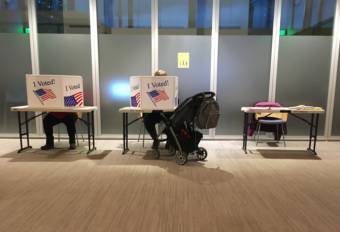
Voters wearing masks visit the Mendenhall Valley Public Library vote center for in-person voting and to drop off their ballots in Juneau’s first by-mail city election on Oct. 6, 2020. (Photo by Rashah McChesney/KTOO)

Voters cast their last minute ballots Tuesday in Juneau’s first-ever by mail election. 

Even though voters could return ballots by mail or at dropboxes, the city had two vote centers open for in-person voting. 

City Clerk Beth McEwen said voting was steady at City Hall and the Mendenhall Valley Library throughout the day. As of last week, about a quarter of registered voters had returned their ballots.

“Hopefully this has been an increase in voter turnout. I won’t know until we see the final numbers, but we’re keeping our fingers crossed,” McEwen said. 

Last year’s local election voter turnout was 31%.

Vote-by-mail has been touted by election officials around the U.S. to improve voter turnout by making it easier to vote. 

But it didn’t work out that way for some people. 

Greg and Christy Gendron stood in line with about 30 other people at the Mendenhall Valley Library. They were part of a rush of people who showed up to vote after 5 p.m.  They brought their toddler and 7-year-old daughter along with them. 

Christy said she got her ballot in the mail, but Greg didn’t. So they decided it would be easier to vote in person. But, they also didn’t realize this year’s election was primarily by-mail. 

“We initially went to our normal polling place,” Christy said. 

And, they prefer to vote in person. Christy said it makes more of an impression on the kids to get them interested in voting. 

“If we lived somewhere where there was an explosion of COVID[-19] cases, we would vote by mail,” she said. “I would rather do it in Juneau, in person. I mean, when in Juneau have you ever had to wait in line for more than 20 minutes.”

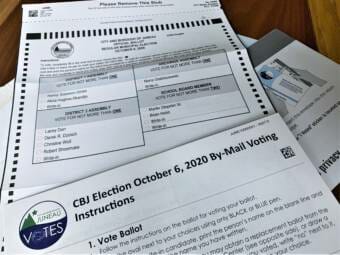
Seven candidates are running for three open Juneau Assembly seats this year. There were also two uncontested school board seats and two ballot propositions on the ballot.

Nancy Sutch stopped by City Hall to cast her vote. 

“I think they had it worked out pretty slick to accommodate both me voting in person and dropping off my other household members’ ballots,” Sutch said. “It was quick and it was easy.”

The vote centers and ballot drop boxes were open until 8 p.m. Ballots returned by mail had to be postmarked by Tuesday. 

The Juneau Assembly approved holding this year’s election by mail earlier this year to limit the chance of exposure to COVID-19 for poll workers and voters. 

The city partnered with Anchorage election officials. Anchorage has been holding local elections by mail since 2018. 

Juneau ballots returned by mail go straight to the Anchorage Vote Center. Another five crates of ballots have already been delivered there as well, according to McEwen. 

After gathering the remaining ballots, she and another city elections staffer will accompany them to Anchorage via Alaska Airlines on Thursday. 

Ballot processing will take place Friday, with initial results expected in the afternoon. Those will remain unofficial until the election is certified Oct. 20. 

For more information about this year’s local election and the candidates running, visit ktoo.org/elections

Reporters Jeremy Hsieh and Rashah McChesney contributed to this report.

This post has been updated.

One day left to vote in Juneau’s local election, results expected Friday

A voter enters an election both at Northern Light United Church during municipal elections on Oct. 1, 2019, in Juneau. (Photo by Rashah McChesney/KTOO)

Voting in Juneau’s local election ends Tuesday. 

Although Oct. 6 is Election Day, people have been voting since registered voters received their ballot packets in the mail in mid-September. As of Thursday, about a quarter of those ballots had been returned. 

Ballot envelopes returned by mail must be postmarked by Tuesday for the vote to count. Voters also have until 8 p.m. to vote in person at City Hall or the Mendenhall Valley Public Library. 

They can also drop off completed ballots there or in one of the drop boxes at Statter Harbor or the Douglas Library. 

If your ballot never arrived or you need a new one, you can visit one of the vote centers to get a replacement. 

This is Juneau’s first by-mail election. City staff will be using the Municipality of Anchorage’s resources to count and process ballots. Anchorage began holding all of its municipal elections by mail in 2018. 

There won’t be any results on Election Night this year. Instead, ballots will be processed later in the week. 

All of the ballots returned by mail go straight to Anchorage. Over 2,000 have already arrived and five cases of completed ballots received in Juneau have been sent there as well, according to Juneau City Clerk Beth McEwen. 

Once the remaining ballots have been collected in Juneau on Wednesday, McEwen and another election staffer will fly with them to Anchorage, where they’ll bring them to the Anchorage Vote Center. 

The first round of counting and processing ballots will take place Friday at the Anchorage Vote Center, with initial election results published online later in the day. 

Election staff will continue reviewing ballot signatures and ballots still arriving by mail after that. The final election results should be certified on Oct. 20. 

For more information about this year’s local election and the candidates running, visit ktoo.org/elections. Have questions about how to vote or what’s happening in the local election? Check out this list of questions and answers

6,000 ballots cast in Juneau’s local election so far

Canvass Review Board members Betty Cook, Carol Schriver and Tami Burgett count absentee ballots from the Oct. 2 municipal election at City Hall on Oct. 5, 2018. (Photo by Adelyn Baxter/KTOO)

About a quarter of Juneau’s registered voters have cast their votes in the by-mail city election so far. 

By Thursday more than 6,000 ballots had been returned from 27,000 sent out in mid-September, according to the city.  

Voters have until Tuesday, Oct. 6, to return their ballots, but they need to be postmarked by that day. Ballots deposited at one of the secure drop box locations at Statter Harbor or the Douglas Library must be in by 8 p.m. 

This year’s ballot features three Juneau Assembly seats, two school board seats and two ballot propositions. 

Most of those ballots returned so far arrived by mail at the Anchorage Election Center. All of the ballots will be counted and processed there next Friday. 

This is Juneau’s first year conducting an election by mailing ballots to voters and having them return them either by mailing them back or dropping them off at a secure drop box, City Hall or one of two vote centers.

Last month, the Assembly removed a requirement that voters get a witness to sign their ballot envelope. Even though ballots say a witness over 18 must sign the envelope in order for it to be counted, voters now only need to sign the envelope themselves. That change was made after ballots were already sent out. 

Last year, voter turnout in the local election was 31%, down from nearly 36% in 2018. 

Anchorage saw record voter turnout in 2018, the year it held its first by mail local election.

Here is the city’s breakdown of where ballots had been returned: 

Glory Hall reopens after closing for potential COVID-19 exposure

The Glory Hall homeless shelter in downtown Juneau. (Photo by Adelyn Baxter/KTOO)

The Glory Hall homeless shelter reopens Wednesday at 7 a.m. after closing for more than a week after two recent visitors tested positive for COVID-19.

In response to the possible exposure, the City and Borough of Juneau tested 102 people at the Glory Hall, AWARE shelter and the Housing First facility on Friday. All of the results came back negative.

The city’s emergency warming shelter at the Juneau Arts and Culture Center remained open.

About seven people who had close contact with the two people who tested positive for the virus are still in quarantine.

A number of people who had been staying overnight at the Glory Hall were moved to hotels during the closure.

The shelter will continue operating during the day 7 a.m. to 8:30 p.m. and overnight. It’s accepting fewer people than usual to reduce the spread of the virus.

As COVID-19 case surge slows, Juneau lifts restrictions on bars and restaurants

The Triangle Club Bar and a handful of other bars and restaurants in Juneau are temporarily closed due to an outbreak of COVID-19 among bar workers. (Photo by Rashah McChesney/KTOO)
The Triangle Club Bar and a handful of other bars and restaurants in Juneau are temporarily closed due to an outbreak of COVID-19 among bar workers.
(Photo by Rashah McChesney/KTOO)

Update | 5:50 p.m.

City officials lifted restrictions on indoor service in Juneau bars Tuesday, but said they are still concerned about community spread of COVID-19.

The city abruptly reduced restaurants to half capacity and closed bars to indoor service on Sept. 12 after seeing a sharp increase in positive cases of COVID-19.

Since then, the number of new cases has come down again, so the city lowered its risk level back to moderate.

During a weekly community update Tuesday, Deputy City Manager Mila Cosgrove said Juneau residents that visit bars and restaurants should be cautious.

“Risk does remain elevated in all situations where you as an individual are operating outside of your normal bubble of people,” Cosgrove said.

A significant portion of Juneau’s recent cases were connected to a large gathering at the end of August attended by a number of people who work in bars and restaurants around town.

According to the city, that outbreak has grown to about 45 people.

Last week, the Juneau Assembly extended a requirement that people must wear face masks in indoor, public spaces for three more months.


Original post:

The City and Borough of Juneau’s weekly community update is at 4 p.m. today.

Members of the city’s emergency operations center will provide information about the local COVID-19 response and answer questions.

City officials lowered Juneau’s COVID-19 risk assessment level to moderate Tuesday. The number of new positive cases has decreased from earlier in the month when the rate of community spread led to increased restrictions on bars and restaurants. Those restrictions are now lifted, but the city is still encouraging residents to continue wearing masks and maintaining social distance in indoor settings.

Community members can submit questions to COVIDquestions@juneau.org.

Watch on Zoom, Facebook Live or here once the meeting is live. You can also call the city to listen by phone by calling 1-346-248-7799 or 1-669-900-6833 or 1-253-215-8782, webinar ID 985 6308 5159.

Juneau inmates frustrated as state ban on classes, family visits, religious services continues

This is the eighth year Success Inside and Out has been held at Lemon Creek Correctional Center. The day's events took place inside the prison gym. (Photo by Lisa Phu/KTOO)
Inmates at Lemon Creek Correctional Center and outside volunteers participate in the Success Inside and Out program in 2015. The annual program offers resources to soon-to-be-released inmates, but many similar events and rehabilitative programs have been suspended indefinitely during the COVID-19 pandemic. (Photo by Lisa Phu/KTOO)

Six months ago as the COVID-19 pandemic began, the Department of Corrections suspended outside visits to state facilities to reduce the risk of exposure to staff and inmates.

That means friends, family, outside volunteers and educators have not been allowed to visit since March.

The department says it’s found ways to offer limited education and treatment programming and workarounds, but inmates and advocates say it’s not enough.

Right now at Lemon Creek Correctional Center in Juneau, inmates are basically locked down in their housing units — or mods — 23 hours a day.

They get out for an hour of recreation, but otherwise, they eat, sleep and live with the same group of men or women.

Inmates said that’s created a tense situation with no classes or family visits to break up the time.

“It’s crazy that all that got, basically all of it’s got taken away during a time like this where there’s so much uncertainty and stress,” inmate Ty Walker Davis said by phone recently. He’s been at Lemon Creek for a year waiting for trial, but it keeps getting pushed back. “It’s just a really bad environment.”

Germs spread quickly inside prisons and jails, so when coronavirus arrived in Alaska the Department of Corrections suspended all visitation indefinitely.

But department spokesperson Sarah Gallagher said they’ve found ways to offer limited education and treatment programming.

“Several of our institutions are able to offer self-study curriculum and increased access to programming delivered through a closed circuit television. That is something new that is not available in all of the institutions.”

Some religious services are also being offered on TV.

Gallagher said for drug and alcohol addiction treatment, some one-on-one meetings and small group sessions are happening when possible, and mental health staff are checking in with inmates more often.

“It’s not perfect. But like everyone, they’re kind of receiving modified education at the moment,” Gallagher said.

The inmates interviewed for this story said those things aren’t happening at Lemon Creek. They said it doesn’t feel like a real effort is being made to provide anything close to the programming they had before.

Jeremy Simile said anything offered on the one TV in his mod would be competing against sports or whatever else his 14 cellmates want to watch.

Before the pandemic began, Simile was taking anger management and parenting classes.

“If I don’t take the parenting class, then it affects my classification in whether I can go out on furlough or parole,” Simile said. “The class is a booklet, you can take the booklet and do it yourself as like a correspondence study. However, of course, there’s no booklets.”

At Lemon Creek, inmates said they’re not able to visit the library, but books are being delivered to mods occasionally.

Besides affecting his release date, Simile said he’s worried about what the lack of programming will mean for him and others when they do eventually get out.

“If I take the classes that I’m supposed to take and I behave myself, I could be out in the community and reintegrating within a year,” he said. “So we have a right to this stuff. It’s not something that we’re like, ‘hey, it would be better if you gave it to us.’ It’s like, ‘hey, you’re supposed to provide it and you’re not.’”

Simile is right about programming — inmates in Alaska have a right to rehabilitation that’s been upheld by the Alaska Supreme Court several times.

Megan Edge is a former spokesperson for the Department of Corrections. Now, she’s the communications coordinator for the American Civil Liberties Union of Alaska.

She said the ACLU has been pressuring DOC since the pandemic began for more information about what programs are being offered and when families can visit again.

“When I think of programming, I think of everything from GED certificates to vocational training, to mental health services to, you know, any behavioral health service. Sex offender treatment, anger management — all of that falls under the umbrella of programming,” Edge said.

National data shows that recidivism rates go down significantly for inmates who have access to postsecondary education and treatment programs. They’re more likely to reintegrate back into society and find a job when they’re released.

Edge said many people are in prison or jail for low-level drug and alcohol charges, but they’re not getting the counseling they need right now to learn how to deal with their addiction.

“Meanwhile, they’re still releasing,” she said. “And without that programming, they’re not going to release any better than they were.”

Back inside of Lemon Creek Correctional Center, Simile said he feels like damage is already being done.

Inmates and their families have to pay for phone calls, although DOC says every inmate gets three free, 15-minute phone calls per week.

Still, the charges add up just to stay in touch with loved ones. Simile said his relationship with his fiance has grown strained.

He’s also worried about the impact on his five-year-old son.

“My son the other day said, ‘Dad, do you have brown hair? Do you have black hair? Do you have blonde hair?’ I said, ‘You don’t remember what I look like?’ He said, ‘No, I can’t remember.’ That’s sad.”

DOC does not have a timeline for when regular education and treatment programming, in-person religious services or family visitation will be available again.

Disclosure: Reporter Adelyn Baxter previously taught writing as a volunteer at Lemon Creek Correctional Center. 

Site notifications
Update notification options
Subscribe to notifications