Adelyn Baxter

Digital Content Director, KTOO

"I help inform KTOO listeners, viewers and readers by finding creative ways to bring our content to our audience wherever they are."

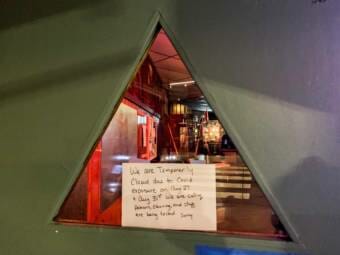
Glory Hall homeless shelter closes after recent visitors test positive for COVID-19

The Glory Hall homeless shelter in downtown Juneau. (Photo by Adelyn Baxter/KTOO)

The Glory Hall homeless shelter in downtown Juneau closed this week after two people experiencing homelessness tested positive for COVID-19. 

According to a release from the City and Borough of Juneau, seven others are in quarantine. 

Glory Hall Director Mariya Lovishchuk said they learned about the positive test results on Monday.

“We immediately moved everybody out of our night shelter into hotels and we closed the day facility,” Lovishchuk said. 

The city tested 75 patrons and staff at the Glory Hall last Friday. All of the results came back negative. Still, the city plans to do another round of testing this Friday.

Depending on the results of those tests, Lovishchuk hopes the Glory Hall can reopen next week. 

She said this incident underscores the need for a larger homeless shelter with more space. 

The Glory Hall has plans to build a new shelter in the Mendenhall Valley and is hoping the city will help fund it.

“If we had a bigger building than our existing facility, people could meaningfully isolate from one another and we could actually ensure safety and compliance with social distancing standards and we just simply cannot do it in our current facility. It’s just simply too small,” she said. 

The city’s emergency warming shelter at the Juneau Arts and Culture Center remains open for overnight sleeping. 

At Monday’s Juneau Assembly meeting, city staff discussed the need to provide day services to the city’s homeless population as the weather grows colder. 

Many of the public facilities where people would normally go during the day are closed or have capacity limits because of the pandemic.

Newscast – Tuesday, September 22, 2020

In this newscast:

  • Sen. Lisa Murkowksi backtracks comments saying she would not support President Trump’s nominee to the Supreme Court,
  • Sen. Dan Sullivan says he looks forward to voting on Trump’s SCOTUS nominee,
  • only one person called in to a comment at a public hearing about ballot Measure 2,
  • secret videos show Pebble Mine executives discussing working with Donlin Gold,
  • Southeast Alaska won’t have a commercial red king crab fishery again this year,
  • and conservation groups seek to stall a liquefied natural gas project in Alaska.
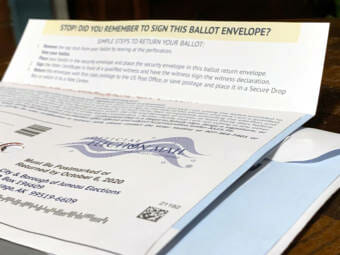
Witness signature no longer required to vote in Juneau’s local election

A mail-in ballot for Juneau’s 2020 municipal election. (Photo by Rashah McChesney/KTOO)

Despite what it says on the ballots, voters in Juneau’s municipal election do not need a witness signature for their vote to be counted. 

The Juneau Assembly passed an emergency ordinance Monday waiving the requirement for the Oct. 6 by-mail election. 

On every ballot envelope that arrived in registered voters’ mailboxes last week, there is a line for a witness to print and sign their name after witnessing the voter sign their own ballot. 

The only requirement for witnessing a ballot is being over 18. 

The Assembly voted 6 to 3 in favor of removing the requirement. Several Assembly members said they wanted to remove any possible hurdles that might prevent someone from voting. 

The emergency ordinance takes effect immediately and applies only to this year’s local election. Voters must still sign their ballots in order for it to be counted. 

City Clerk Beth McEwen said during the meeting that city election officials verify each voter’s signature before counting a ballot, but they have no way of verifying witness signatures.

Civil rights groups are currently suing the state for requiring witness signatures on absentee ballots in statewide elections. The groups claim the requirement places an undue burden on voters, especially since the U.S. Postal Service recently stopped letting workers act as ballot witnesses.  

Early voting started Monday and runs through Oct. 6. Voters can return their ballots by mail, drop them in a dropbox at Douglas Library or Statter Harbor, or vote in person at City Hall or the Mendenhall Public Library.


Here’s what Juneau voters need to know before voting in the local election

A ballot packet for Juneau’s Oct. 6 by-mail election features a return envelope, secrecy sleeve and instructions. (Photo by Adelyn Baxter/KTOO)

Monday is the start of early voting in Juneau’s municipal election. Instead of heading to the polls, registered voters should have received a ballot in their mailbox. 

Juneau’s election officials started thinking about the safest way to conduct this year’s Oct. 6 election soon after the COVID-19 pandemic came to Alaska. Many poll workers and election staff are older and more at risk for complications from the disease. 

City Clerk Beth McEwen was looking around the country at what other municipalities were doing. Anchorage was holding its regular by-mail election at the time. So, she reached out. 

“They very graciously offered to let us use their 10,000 square foot facility with their by-mail election processing equipment,” McEwen said this week. 

The Juneau Assembly approved holding the local election by mail in May

That set off months of work for the clerk’s office and a flurry of emergency ordinances allowing the city to meet deadlines for voter propositions and candidate filings before the ballots had to be sent to the printer in Washington state. 

Every registered voter in Juneau should receive a ballot at their permanent address. The ballots went out Sept. 15 and started arriving in Juneau mailboxes two days later. 

“If you haven’t received a ballot within a three-to-five day period after the fifteenth of September, please do contact our election hotline, which is 364-7401,” McEwen said. 

Each ballot packet contains a ballot, secrecy sleeve, return envelope and instructions. Voters will decide between three Assembly seats, two Juneau School Board seats and two ballot propositions. 

Once you get your ballot, here’s how it works: Pick your assembly and school board candidates, and vote on the two ballot propositions. Then, stick the ballot in the security sleeve, and seal it in the return envelope. 

There are three options for returning your voted ballot:

  1. You can return your completed ballot by mail with a stamp. Note that it has to be postmarked by Oct. 6. 
  2. You can leave it in the big, white dropboxes outside the Douglas Library and in the Statter Harbor parking lot by 8 p.m. on Election Day. 
  3. You can bring your completed ballot to a vote center at City Hall or the Mendenhall Valley Library. They’ll be open starting Monday until Oct. 6. 

“If you need to vote in person, if for some reason you didn’t receive a ballot or you just want to just bring your voted ballot in and have one of our vote center staff members be your witness on your ballot envelope — that would be another opportunity to come into the vote center,” McEwen said. 

Each return envelope has a line requiring a signature from a witness 18-years or older. But an emergency ordinance passed by the Assembly at its meeting Monday waived that requirement for this year’s election. Voter signatures will still have to be verified before the ballot is counted.

People watch Juneau municipal election returns come in at city hall on election night, Oct. 2, 2018. (Photo by Mikko Wilson/KTOO)

Election night will also look different this year. Usually, candidates gather at City Hall to watch results come in. Instead, McEwen will gather up the ballots and get on a plane.

“I’m going to physically take those on an airplane with me and another worker and we’re going to go up to Anchorage and process those with the Anchorage vote center,” she said. 

That means the earliest we’ll know election results is Oct. 9. Those results will still be unofficial until Oct. 20, when election certification should take place. 

It will be interesting to see how this year’s by-mail election affects voter turnout. Anchorage saw record turnout when it held its first by-mail election in 2018. 

In 2019, fewer than 32% of registered voters in Juneau voted in the local election. 

Some people may miss the communal parts of voting this year, like treats at the Douglas precinct or parents bringing their kids into the booths with them. But those who love to proudly wear their “I voted” stickers on Election Day don’t have to worry — the mailed ballots come with one. 

And you can wear it as long as you like. 

This story has been updated to reflect changes to the signature requirement on local ballots. 

Juneau police identify man whose body washed up by Gastineau Channel

Juneau Police Department badge logo
An arm badge for the Juneau Police Department on Lt. Kris Sell’s uniform, April 1, 2016. (Photo by Jeremy Hsieh/KTOO)

Juneau police have identified the body found washed up near the Douglas Bridge earlier this month as that of 60-year-old Juneau resident Stephen Wayne Todd. 

Todd’s body was found on the beach across the Gastineau Channel from Harris Boat Harbor on Sept. 3. Police were able to identify him from ID they found in his clothes, but they waited to publicly identify him while trying to locate his next of kin. 

According to an update Monday from the Juneau Police Department, attempts to contact Todd’s family have been unsuccessful. 

His cause of death is also still not clear.

Police said at the time that Todd’s body appeared to have been in the water for several hours. He had a cut on his right cheek, but it was unclear whether that happened before or after he went into the water. 

Todd’s body was sent to the State Medical Examiner’s office in Anchorage to determine how he died. Police are still awaiting autopsy results.

Site notifications
Update notification options
Subscribe to notifications