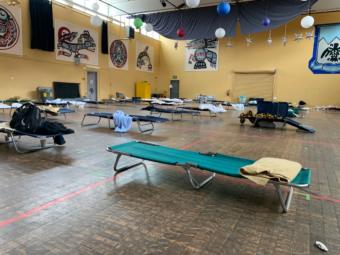
People who stay overnight at the emergency shelter inside the Juneau Arts and Culture Center use the same cot and blankets on consecutive nights. (Photo by Adelyn Baxter/KTOO)
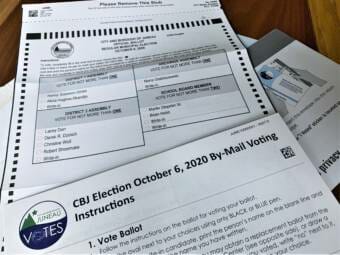
The debate over a permanent home for Juneau’s emergency shelter was put to rest Monday night when the Assembly rejected all of the proposals for new locations.
At a committee meeting, assembly members reviewed a list of properties the city could buy with federal CARES Act funding to serve as an emergency cold weather shelter. The city has been temporarily running a shelter out of the Juneau Arts and Culture Center, or JACC, since March.
Assembly member Loren Jones made the motion to keep the shelter at the JACC.
“More information about a couple of buildings is not going to give us any more information about what we ought to do,” he said.
The Assembly decided, unanimously, to keep the shelter where it is until next April.
Jones argued that moving the shelter would be a waste of money and staff time and that it wouldn’t address underlying issues of homelessness in Juneau.
When the city last counted the population in January, there were 46 unsheltered people and 69 people staying at the emergency shelter.
“So to me, operating the shelter as it is — at the place that it is — gives staff time to look at those numbers,” he said. “But it can’t be a solution done in two months.”
Jones pointed out that a number of other projects are in the works to address housing needs for the homeless.
But, Jones said that even with roughly 40 people staying in the emergency shelter on most nights, there are still others choosing to sleep on the street downtown, so buying a building might not be the right solution.
“You’re asking the wrong question about the wrong information, and you’re going to get the wrong answer,” he said.
The city’s two top contenders for the new emergency shelter were the Bill Ray Center on F Street and a warehouse on Willoughby Avenue. Some neighbors in the nearby Flats neighborhood took issue with the Bill Ray Center, saying it would bring the homeless population into an area with schools and families.
A virtual meeting last week saw mixed testimony from about 20 residents from all over Juneau weighing in on the list of potential sites for the shelter.
In past years, the shelter only operated between November and April on nights when the temperature was below freezing. It stayed open through the summer this year, due to an increased need for housing during the pandemic.
St. Vincent de Paul Society has a contract with the city to operate the emergency shelter at the JACC until April.
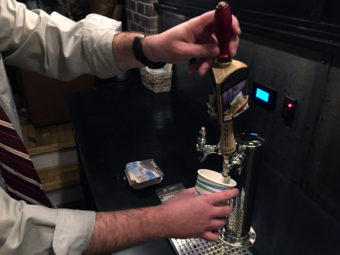
The Triangle Club Bar and a handful of other bars and restaurants in Juneau are temporarily closed due to an outbreak of COVID-19 among bar workers. (Photo by Rashah McChesney/KTOO)
The emergency order issued by the City and Borough of Juneau gave bars that don’t serve food just 16 hours’ notice to shift to outdoor service only. It also requires restaurants to reduce their capacity to 50%.
Juneau’s deputy city manager Mila Cosgrove says the decision was made swiftly on Friday evening after getting word of more positive cases from Juneau’s public health nursing department.
“Right as we were getting ready to leave for the day — literally like right at five o’clock — we got notified by Public Health that there were another seven positive test results that had come in,” she said. “So that brought the total positive test up to 18 for the day.”
Cosgrove noted that those later results were reported publicly by the city on Saturday.
So far, more than a dozen cases have been linked to a large social gathering at the end of August that was attended by workers from Juneau’s bar and restaurant industry.
Cosgrove said Public Health believes the cases from Friday were a mix of individuals linked to that event and community spread.
“That was enough to concern us to think that we should slow things down until we got an opportunity to finish the testing and see what the test results look like,” she said.
The emergency order is in effect for 14 days, but Cosgrove says the city may extend or lift it as needed.
Cosgrove said she spent much of the weekend fielding calls from business owners who wanted to know what exactly is allowed under the order. She explained that bars that have outdoor areas can continue to operate, but patrons must wear a mask when ordering drinks inside. The same thing applies to breweries.
“Socially distanced, right? So, tables can’t be close together. Social bubbles need to be spread out even if they’re outside,” she said.
Cosgrove said city staff will be monitoring businesses periodically to make sure they’re complying.
Overall, she said the response has been good from bar and restaurant owners.
“I’ve had a lot of really great conversations with business owners over the weekend where, you know, I feel pretty confident that they’re, they’re genuinely trying to protect the community,” she said.
The city recommends anyone who visited a bar in Juneau between late August and early September get tested, even if they don’t have symptoms.
A pop-up testing site at Centennial Hall saw 678 people from Thursday through Sunday.
Cosgrove says those test results should begin coming in late on Monday.
At 3:30 p.m. on Monday the city’s COVID-19 dashboard showed 47 active cases.
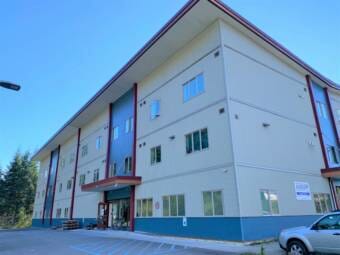
Phase two of Juneau’s Housing First project in Lemon Creek doubled the size of the existing Forget-Me-Not Manor. (Photo by Adelyn Baxter/KTOO)
The first tenants began moving into the new wing of Juneau’s Housing First facility this week.
Housing First is a concept that provides permanent housing and access to services for vulnerable people.
Juneau’s Housing First facility in Lemon Creek is called Forget-Me-Not Manor. The new wing doubles its size.
Once everyone’s moved in, the building will house more than 60 chronically-homeless residents.
Mariya Lovishchuk is the project coordinator for the Juneau Housing First Coalition. She also runs the Glory Hall, Juneau’s downtown homeless shelter.
“This time, it’s a little bit more complicated by COVID,” Lovishchuk said.
Moving into the Housing First facility requires federal vouchers, which the pandemic has made more difficult for some people to get. But Lovishchuk said everyone should be settled in before winter arrives.
Forget-Me-Not Manor first opened three years ago. There’s a medical clinic on-site and counseling is also available. Tenants pay rent on a sliding scale, depending on their monthly income.
In the first six months after it opened, a study by University of Alaska researchers found that tenants saw a significant drop in emergency room visits and interactions with police.
Lovishchuk hopes the new wing will reduce pressure on the Glory Hall and the city’s emergency shelter.
The Glory Hall had to reduce the number of people allowed inside the building during the pandemic. They plan to build a new facility in the Mendenhall Valley next year.
“I don’t think it’s going to help at all with our issue of having only 23 people inside or for our building being completely inadequate for COVID,” Lovishchuk said.
She added that people moving into the Housing First facility — many of them medically vulnerable — will be safer not sleeping in group settings.
Volunteers from a local quilting group made quilts for every new resident. Northern Light United Church donated gift baskets with basics like shower curtains, dish soap and towels.
People who stay overnight at the emergency shelter inside the Juneau Arts and Culture Center use the same cot and blankets on consecutive nights. (Photo by Adelyn Baxter/KTOO)
The City and Borough of Juneau is trying to decide where to put the local cold weather shelter. It’s hosting a public meeting Wednesday to share more information and get feedback on possible locations.
But one group that has been mostly absent from the conversation so far are the people who stay in the shelter.
The cold weather shelter doesn’t open till 8 p.m., but on yet another rainy evening, Jackie Bryant opens the doors early. The shelter has changed locations and operators a few times since it opened in 2017, but Bryant has been a constant.
She’s there most nights, setting up and welcoming people one at a time so they can be screened and sign in. Then she’s back in the morning to wake them up and hand out coffee and oatmeal.
“The other night, we had almost 60 people here again,” Bryant said. “We can take 71 and be social-distanced.”
Usually, the shelter is open seasonally and only on nights when the temperature is below freezing. But this year, it’s been open continuously since March, operating out of the Juneau Arts and Culture Center downtown.
“We didn’t think we’d be open this long, for one thing. This was unexpected,” she said.
The constant practice hasn’t made the routine any easier for her or the people who stay overnight. Neither has the weather.
“We have rain — rainy, windy days, and we still have to send them out the door knowing that they’re outside all days. And I don’t believe people treat their pets that way,” Bryant said.
Guests to the city’s cold weather shelter have their temperature checked by staff upon arrival. (Photo by Adelyn Baxter/KTOO)
The public libraries where many people go to stay dry were closed most of the spring and reopened with capacity limits.
Meanwhile, Bryant says the cots they use are taking a toll on peoples’ backs. Some are choosing to sleep on the floor instead. Their last working thermometer broke and they haven’t been able to get a new one yet. The building also doesn’t have shower or laundry facilities.
St. Vincent’s contract with the city has been extended to next year, but it’s not clear where the shelter is going to be.
Options for where to put it range from empty buildings and hotels downtown to sites in West Juneau and the Mendenhall Valley.
The city has a list of sites it’s considering, including keeping it at the JACC or discontinuing the shelter:
201 Cordova Street in West Juneau
1720 Crest Street, also known as the JMA building
1108 F Street, also known as the Bill Ray Center
247 Franklin Street, the location of the Glory Hall
the Breakwater Inn at 1711 Glacier Ave
224 Seward Street, also known as the Sommers Building
The city will hold a virtual meeting Wednesday night to talk about proposals for the shelter and hear from the public. People can participate through Zoom or by phone.
But talking to residents at the current cold weather shelter, it’s clear that it would be hard to listen or weigh-in at the meeting.
Some of the people who use the shelter have cell phones, but most don’t have access to a computer. And most of them didn’t know it was happening.
The former Walmart building in Lemon Creek is often brought up as a place to move shelter operations. It’s for sale, but providers say the building’s design is not ideal. And the cost at $6 million is more than twice the other properties the city is considering.
To Bryant, it doesn’t matter where the shelter is. It just needs to be more permanent than what they have right now.
“I don’t want them dying out there because there’s no place for them to be,” she said.
Travis Johnson is one of the paid staff who spends the night at the shelter and doles out blankets, hot coffee, and snacks.
He also knows what it’s like not to have a place to sleep. Johnson has been clean for almost a year now. When he wasn’t, he used to sleep under a bridge.
Travis Johnson hands out blankets to emergency shelter patrons at the Juneau Arts and Culture Center as they arrive on Thursday, Sept. 3, 2020. (Photo by Adelyn Baxter/KTOO)
Now he and his wife and newborn son have an apartment at the transitional housing complex at St. Vincent’s.
He says moving the shelter out of downtown won’t move unhoused people away from the shops and tourism businesses as some people think. As an addict, he says the temptations downtown are too strong.
“Even if all the other resources move out to the valley, there’s still going to be the core group of people that are downtown,” Johnson said. “They’re here because the liquor stores are here. They’re here because, you know, their resources for getting drugs is here. And, and they’re not going to change that.”
He thinks of it kind of like the bears that have been causing trouble downtown this summer.
“You can’t ask all the black bears and move out to the valley just because it bothers the business people that are down here, you know?” Johnson said. “You gotta show compassion and love them and find something that works.”
Joe Kool uses the shelter. He says he doesn’t care where it is, as long as there’s a way to get there.
Before the shelter moved to the culture center this spring, it was at the St. Vincent’s campus near the airport. They ran a shuttle to pick people up and bring them in for the night.
“I don’t mean to cause any trouble you know, because a lot of the neighbors think that,” Kool said. “I just need a place to sleep. I’m homeless and I appreciate this.”
The meeting begins at 5 p.m. Wednesday. Here’s how the city says the public can participate:
Join the Zoom webinar https://juneau.zoom.us/j/94264788341 and enter Webinar ID 942 6478 8341. To participate telephonically, call 1-346-248-7799 or 1-669-900-6833 or 1-253-215-8782 or 1-312-626-6799 and enter Webinar ID 942 6478 8341. During the public comment portion of the meeting, community members can provide testimony by clicking the “Raise Hand” function on the Zoom webinar or pressing *9 on the telephone.
Correction: A previous version of this story incorrectly stated that the Glory Hall is closed during the day. It remains open 7 a.m. to 8:30 p.m., but only allows 23 people inside at a time. It also misidentified one of the people interviewed as James Kool. His name is Joe.
The gate across Montana Creek Road restricts access beyond the Hank Harmon Rifle Range from November through May. (Photo courtesy of Frankie Pillifant)
Winter is coming and competition over a popular trail in Juneau has pit winter sports enthusiasts against each other.
One group says they should have exclusive winter access to the snow. The other feels that public lands should be shared among all users.
For half the year, a locked gate blocks vehicle access on Montana Creek Road past a certain point.
That wasn’t always the case, but dumping and other illegal activities became a concern several years ago.
Now, snowmachines and four-wheelers access the road through a side entrance in the winter.
That’s caused problems for the Juneau Nordic Ski Club, which has its own grooming equipment and spends hundreds of hours maintaining a cross country trail along the road.
“We’re expending member dollars to buy the equipment and the fuel and the repairs, and then if somebody goes up there on a motorized (vehicle), it takes us hours to fix it,” said Frankie Pillifant, president of the club. “You can’t simply just run up there and groom it, smooth it down. It takes more work.”
She said in other places she’s lived in Alaska, like Anchorage and Fairbanks, there’s plenty of space and snow for cross country skiing.
But in Juneau, that’s not the case.
“Montana Creek is what we call our snow hole. It has snow when there’s no snow anywhere else to ski on, whether it’s the campground or the lake or Eaglecrest,” Pillifant said.
With winters getting warmer, it’s getting harder to access reliable snow for skiing. The club has permission from the city to maintain the groomed trail throughout the winter.
Pillifant said safety is also an issue when motorized vehicles are on the narrow road.
So the club sent a request to the city asking them to restrict winter access so that only cross country skiers, hikers and other non-motorized users could access the road.
But, Montana Creek is also the way to get to state lands popular with All-Terrain Vehicle and snowmachine riders. That request didn’t sit well with them.
“We’re all for, you know, having all kinds of activities in that area,” said Darin Crapo from the Juneau Off-Road Association. “It’s public land. It should be shared publicly.”
The group circulated a petition that has more than a thousand signatures and encouraged off-road enthusiasts to let the city know how they feel about losing access to Montana Creek.
The response has been vocal online. ATV and snow machine users have limited options to ride legally in Juneau.
“It sets, to me, a dangerous precedent where what else are we going to lose? Who else is going to lose? What’s the next group that gets denied something?” Crapo said.
He said he tried to reach out to the ski club to find a compromise between off road vehicles and cross country skiers.
But, that conversation didn’t go anywhere. Pillifant said she feels they already have a compromise.
“If it went the way we’d like it, we get it from November to May and they get it from May to November,” she said.
In the end, the city will decide who gets winter access. Parks and Recreation is collecting public comment between now and Sept. 30.
Members of the Parks and Rec Advisory Committee and the Juneau Assembly have already received a number of messages about the topic.
The committee is scheduled to discuss it on Oct. 12. They’ll likely make a recommendation to the city manager.
Hopefully, that happens before the snow starts to fall.
The city is also working on a Juneau trails plan — a document that lays out priorities for the local trail system for the next two decades.
A survey asking locals to weigh-in had more than 1,300 responses by the end of August. A draft of that plan is expected by next spring.
Close
Update notification options
Subscribe to notifications
Subscribe
Get notifications about news related to the topics you care about. You can unsubscribe anytime.