Adelyn Baxter

Digital Content Director, KTOO

"I help inform KTOO listeners, viewers and readers by finding creative ways to bring our content to our audience wherever they are."
Juneau teachers and students prepare to start a new school year — virtually

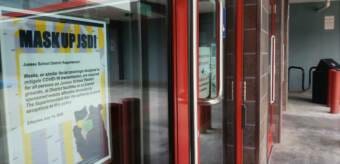
Various signs at the main entrance to Juneau-Douglas High School: Yadaa.at Kalé in Juneau announce mandatory mask and symptom-free policies for entrance on Aug. 6, 2020.
Various signs at the main entrance to Juneau-Douglas High School: Yadaa.at Kalé in Juneau announce mandatory mask and symptom-free policies for entrance on Aug. 6, 2020. (Photo by Jeremy Hsieh/KTOO)

Classes will be virtual when school starts again Monday in Juneau.

Students and teachers hope the lessons learned from the quick transition to virtual learning last spring will carry over. 

Linnea Lentfer says this is not how she imagined her senior year of high school going. 

“It was a disappointment, but not a total surprise,” she said on Friday. 

Lentfer grew up in Gustavus, but came to Juneau to attend Juneau-Douglas High School: Yadaa.at Kalé.

She said when students were first sent home as the pandemic spread in March, none of them could have guessed they would still be attending virtual classes five months later. 

“There’s people from that day who I’m quite literally never going to see again, like the people who I’d just say ‘hi’ to in the hallways every day,” Lentfer said. “Then it’s just like, ‘oh, we’re out for a week. We’re out for a month. We’re not going back to school.’”

With classes starting up again, Lentfer may be luckier than some of her peers. She has a lighter course load as a senior. 

Still, it’s hard to imagine how her Oceanography class will work virtually. 

“I’m pretty sure that we will have some opportunity to come in to school in small groups for labs, but I’m not sure what that looks like,” she said. 

The Juneau School District announced earlier this month that it will begin the school year virtually

Depending on the number of cases of COVID-19, the district may decide to allow small groups of students to attend in-person classes after Labor Day. But large numbers of students won’t be allowed back until at least mid-October. 

Kelly Stewart is the president of the Juneau Education Association. She’s also a special education teacher at Glacier Valley Elementary School. 

“When we shut down, we were in full survival emergency mode. And I think our staff did a fantastic job at doing the best they could at something that was so unknown,” Stewart said on Thursday. 

This time around, Stewart and many of her colleagues have spent the entire summer planning for the new school year. 

Staff spent the last two weeks training with the programs they’ll use to keep track of students. Kindergarten and first grade will use Seesaw. All other grades will use Canvas.

“It’s still going to look different, and we’re going to probably have to work a little harder to engage and get kids involved,” Stewart said. “But I think we’re much better prepared now than we were in March.”

Elementary teachers will also be collaborating in groups to help support one another and to help students become familiar with more than one person. 

“So that when they do come back face-to-face at school, or we do move to the hybrid model, that they are going to already know six to nine adults because they’ve been working with them,” Stewart said. 

Students and their families have been picking up textbooks and supplies all week, and can continue to do that next week too. The district is providing Chromebooks to students that need them. 

Even with all the preparation, Stewart says there are bound to be some hiccups with technology. The roll out of one of the apps teachers will be using is already a little delayed. 

Lentfer said she worries that getting to know her new classmates won’t be easy. Last school year when her classes moved online, she already knew everyone. 

“So being on Zoom, there was already kind of a classroom culture. And just what that will look like when we start on Zoom for the beginning will be really interesting to see,” Lentfer said. 

She’s grateful that she still has the cross country season to look forward to, even if they won’t get to travel. They have their first meet on Saturday, competing remotely against other Southeast teams. 

She just hopes that her senior year won’t have to end the way it did last year. 

“I really hope we get a little bit more of a graduation and kind of all of those end of high school pieces,” she said. “That’s definitely the hard unknown.”

Classes for grades 1 through 12 begin Monday. Kindergarten starts Thursday and preschool begins the following week. 

Breakfast and lunch will continue to be served for pick-up at each school this fall. Masks are mandatory for anyone on school grounds.

City responds to rising COVID-19 cases with new restrictions

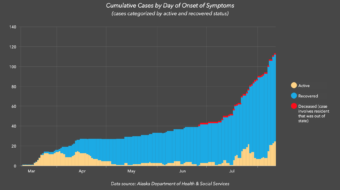
Chart showing cumulative COVID-19 cases in Juneau
Graph from CBJ COVID-19 dashboard showing cumulative COVID-19 cases in Juneau by day of onset of symptoms. (Data from Alaska Department of Health & Social Services)

Updated post

As Juneau’s number of positive COVID-19 cases trends upward, new policies are taking effect to control the spread

The local risk assessment is currently moderate. That means starting Friday at noon, bars and gyms will be limited to half capacity and indoor group gatherings must be kept to fewer than 50 people. 
During a briefing Wednesday, City Manager Rorie Watt said younger people, specifically people in their 20s and 30s, continue to see higher levels of positive cases statewide. That’s one reason bars are a concern. 

“We have not had a big bar-related spreading event, but we’re concerned that that’s an area of risk for us and rather than wait to see if it happens, we think the prudent course for the community is to be more careful in those types of settings,” Watt said. 

Watt said city staff will perform courtesy visits to bars and other businesses to distribute masks and information about the new measures. 

They’re hoping people comply voluntarily to avoid a situation like the one in Anchorage, where bars closed down completely this month due to the high number of cases attributed to  community spread. 

But in Juneau, only a small portion of recent cases has been attributed to community spread. Large-scale outbreaks like the ones at Kensington Mine and Alaska Glacier Seafoods, which are considered secondary transmission, have accounted for a large portion of the recent cases. 

Deputy City Manager Mila Cosgrove said during a briefing Thursday there have also been recent outbreaks at family gatherings like funerals and weddings. 

She urged community members to continue observing social distancing. 

“Especially large family gatherings, where people feel maybe a little more inclined to let their guard down, maybe make their social bubble a little bit bigger,” Cosgrove said. “We really urge members of the community to understand the risk that is associated with that and really keep their social bubbles as small as possible.”

The city will now hold COVID-19 updates over Zoom and Facebook Live every Thursday at noon. The public can submit questions at least a day in advance by email. 

Juneau is reporting 54 active cases of COVID-19. Six new cases were reported Wednesday.

Original post

The City and Borough of Juneau will hold weekly community updates Thursdays at noon, beginning today.

City Manager Rorie Watt and other members of the city’s emergency operations center will provide information about the COVID-19 response in Juneau and answer questions.

Community members can submit questions, but the deadline for this week has passed. For future weeks, the city is asking community members to submit questions by noon each Wednesday at COVIDquestions@juneau.org.

Juneau has seen an increase in the number of new cases reported over the past month, and the city recently introduced new COVID-19 risk metrics and mitigation strategies to help respond quickly to changing pandemic conditions.

Watch on Zoom, Facebook Live or here once the meeting is live. You can also call the city to listen by phone.

Note: This story has been updated.

https://www.facebook.com/cbjuneau/videos/328125445205901/

Rainforest Recovery Center delays reopening

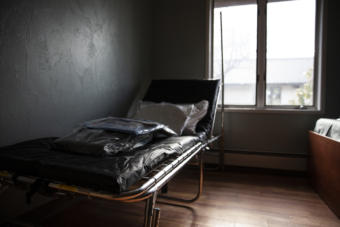
A cot inside of the Rainforest Recovery Center after city officials converted the drug and alcohol rehabilitation center into an emergency spillover shelter for COVID-19. (Photo by Rashah McChesney/KTOO)

Rainforest Recovery Center has delayed plans to reopen for at least another month.

The substance abuse treatment center had planned to reopen by the end of July. But Bradley Grigg, chief behavioral health officer for Bartlett Regional Hospital, said they had to postpone.

“At this point we are targeting, hopefully, the week of Labor Day,” Grigg said Friday. “There’s a chance it could be the week before that, but our hope is the week of Labor Day.”

The delay is partly due to construction inside the clinic, but Juneau’s steady uptick of COVID-19 cases has also raised concern that the center may need to be used as an overflow care site for the hospital.

When the pandemic began, Rainforest sent patients home and turned the clinic into an overflow site in case the hospital ran out of room.
Since then, the center has started offering telehealth outpatient services for patients in recovery.

When the center does reopen for inpatient substance abuse treatment, they’ll have only six to eight patients.

The closure has left people in Juneau and other parts of Southeast Alaska with few options for residential treatment.

“We’ve got families who are calling and saying, ‘When are you going to be open again?’ and obviously, some were hoping we’d be opening this week or next week,” Grigg said. “So we’re working with those families to try to get them to the services they need, and if they can’t leave town to go to residential we’re offering them interim support services.”

Grigg said the center can help connect people who need residential treatment to other programs that may be reopening around the state.

After closure, Echo Ranch Bible Camp says there’s no evidence of COVID-19

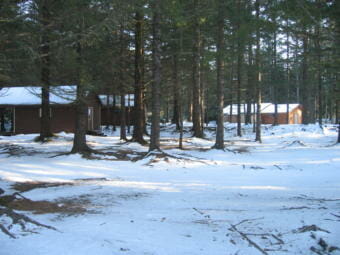
Camper cabins at Echo Ranch Bible Camp in winter. (Flickr photo by Kristin Harvey)

A Juneau summer camp closed recently over concerns about COVID-19. Now, staff say everyone who was tested for the virus received negative results. 

Echo Ranch Bible Camp welcomed campers back in late June, but canceled the two remaining sessions last week after two campers from a previous session became sick and were tested for COVID-19. 

Camp Director Randy Alderfer said both tests came back negative, as well as the results for several other people who were tested as a precaution. 

Alderfer said they had 285 campers over the four weeks of camp. 

They had a COVID-19 mitigation plan approved by the City and Borough of Juneau that included extra cleaning and social distancing, but not masks.

Tlingit & Haida proposes housing in Lemon Creek for people released from prison


The central council’s current designs for the Allen Court transitional housing facility include a central courtyard with space for cultural activities. (Image courtesy of Talia Eames)

The Central Council of Tlingit and Haida Indian Tribes of Alaska hopes to build not one, but two re-entry housing facilities in Lemon Creek for men recently released from prison.

Talia Eames is the re-entry and recovery manager for the central council. During a neighborhood meeting about one of the proposals last week, she said affordable housing is a major obstacle people face when trying to get their lives back on track after prison.

It’s one of the reasons they often end up going back. Eames said two out of three people released from prison in Alaska return within three years. They want to help change that. 

“We want people that are ready. We want them to be eager to come in and to have training, and resources, employment assistance,” Eames said. “We want to make sure that we are creating a cohort of peers that work together to be successful.”

She added that Alaska Natives are over-represented in state prisons. That’s why the designs for both buildings mimic the multi-generational, multi-family longhouses used in Southeast Alaska for thousands of years.

Residents would pay rent and serve the community by volunteering. They expect people to stay between six months and two years and plan to have 24-hour surveillance, with spaces for cultural activities and family time. 

Eames said they will work closely with parole officers and Lemon Creek Correctional Center. Plans include onsite case managers and resident managers and COVID-19 mitigation strategies. 

Sex offenders will not be accepted into the program. 

Designs for a transitional housing facility for men on Alaway Avenue in Lemon Creek. (Image courtesy of Talia Eames)

One of the properties is on Alaway Avenue near the Juneau Police Department headquarters and would have 16 residents.

The other would have 12 residents. It’s on Allen Court near Forget-Me-Not Manor, another supportive housing facility in Lemon Creek.

Wayne Coogan testified at the meeting, saying neighbors with young families near the proposed facilities are worried about the impact. 

“I acknowledge the noble and virtuous efforts that are involved in this thing, but there is another side to it,” Coogan said. “I think that the people that are trying to make a home down there in that neighborhood, the compatibility issue is a grave one.”

Other testimony was overwhelmingly supportive, with several members of the local social services community saying that housing support is extremely important for those reentering society. 

Mary Alice McKeen is president of the board for Haven House, a re-entry facility for women in the Mendenhall Valley. 

She said Haven House faced concerns from neighbors when it opened in 2015. But there have been virtually no complaints since then. 

“People who were opposed to the transitional housing have come around to support it. There used to be signs up, ‘Good idea, wrong place.’ None of those signs are up anymore,” McKeen said. 

The plans will be presented to the city planning commission on Aug. 11.

Eleven candidates file to run in Juneau’s Oct. 6 election

The Douglas Library is normally one of more than a dozen polling locations for Juneau’s municipal election. During this year’s by-mail election, in-person voting will only be offered at City Hall and the Mendenhall Valley Public Library. (Photo by Rashah McChesney/KTOO)

Monday was the deadline to run for local office in Juneau this fall.

The local ballot will feature three Juneau Assembly races and two school board positions. Eleven candidates filed to run — eight for assembly and three for school board. 

Current assembly members Maria Gladziszewski, Rob Edwardson and Alicia Hughes-Skandijs are all up for re-election.

Gladziszewski and Hughes-Skandijs will both run again. Rob Edwardson will not. 

Gladziszewski’s areawide seat is uncontested, but both of the other races are competitive. 

Edwardson’s District 2 seat represents the Mendenhall Valley, Auke Bay and Out the Road. Five candidates filed to run: Robert Shoemake, Lacey Derr, Derek Dzinich, Christine Woll and Emil Mackey III. 

In District 1 — which includes Lemon Creek, downtown, Thane and Douglas Island — Kenny Solomon-Gross filed to run against Hughes-Skandijs. 

Hughes-Skandijs was originally appointed by the Assembly in 2019 to take over for Jesse Kiehl when he resigned to take a seat in the Alaska Senate. She won election last year to finish out the final year of Kiehl’s term. Now she hopes to secure a full three-year term representing District 1. 

Although candidates running in Districts 1 and 2 must live in their respective district, registered voters can vote in all of the races on the local ballot.

On the school board, two three-year seats are up for grabs. Board President Brian Holst is running again. Martin Stepetin Sr. and Crystal Schmitz will also run. Board member Jeff Short is not running for re-election. 

The Assembly voted to hold this year’s election by-mail due to the pandemic. In-person voting will still be available at City Hall and the Mendenhall Valley Public Library from Sept. 21 through Oct. 6.  

Registered voters have until Sept. 6 to notify the clerk’s office of address changes. 

The city will mail ballots out about three weeks before the election. After completing them, voters can return their ballots to one of several secure drop box locations, an in-person voting center or mail it back.

Ballots need to be dropped off by 8 p.m. on Oct. 6 or postmarked by that day in order to be counted. 

Site notifications
Update notification options
Subscribe to notifications