Adelyn Baxter

Digital Content Director, KTOO

"I help inform KTOO listeners, viewers and readers by finding creative ways to bring our content to our audience wherever they are."

Lost and found: After the flood, Juneau residents return lost treasures to families

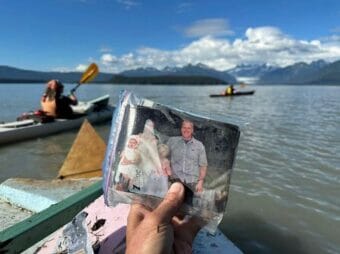
Juneau photographer Michael Penn holds a bag full of photos he found while kayaking with his family off Douglas Island the day after record flooding destroyed homes along the Mendenhall River. Also pictured are Penn’s son, Liam (left), and his wife, Iris Korhonen-Penn (right). (Photo courtesy of Michael Penn)

Local photographer Michael Penn was paddling back from a camping trip with his family Sunday when they entered a debris field just off Douglas Island, near where the Mendenhall River flows into the ocean. 

“I looked down in the water and there was this Ziploc bag just floating there full of pictures. Probably, I don’t know, between 60 and 80 pictures in there,” Penn said. “I know how precious pictures are.”

They’d been out of cell service range for the last few days. When they checked their phones, they learned about the glacial outburst flood and the homes destroyed along the river. 

Debris lies along the shore of Douglas Island on Aug. 7, 2023 following record-breaking flooding on the Mendenhall River. (Photo by Andrés Javier Camacho/KTOO)

The bag had “FAMILY” written on it in marker. The seal had broken, and the photos were soaked with saltwater. Luckily, Penn has a print dryer leftover from his darkroom photography days. 

He took the photos home, rinsed them and dried them off. He says they’re undamaged. He posted on Instagram, hoping to find the owners. On Monday evening, he said he’d found them — they owned one of the homes that collapsed into the river. 

The same day, Leticia McRae was walking along the tideline of a North Douglas beach, several miles from where the homes collapsed. She’s been picking up trash in Juneau for about a decade — she runs a community Facebook page where she posts about her pickups.

Leticia McRae holds debris she picked up along the shore of Douglas Island on Aug. 7, 2023 following record-breaking flooding on the Mendenhall River. (Photo by Andrés Javier Camacho/KTOO)

“There was a tree in the tideline, and kind of up against the tree was this box,” she said on Monday. “And I picked it up and lo and behold, that little latch with no lock, no nothing on it, was still closed.”

When she opened the wooden box, she found an old metal photograph and jewelry, including what looked like a wedding band with a name inscribed on it. She took it home and rinsed everything off, then posted a picture on Facebook asking for help locating the owner. 

A jewelry box found washed up on the shore of Douglas Island Aug. 6, 2023 the day after glacial outburst flooding destroyed homes along the Mendenhall River. (Photo courtesy of Leticia McRae)

Within a few hours, a commenter had connected her with someone who lost their home in the flood. She delivered the box back to its owner that evening. 

“That box made it in that turbulent river, and then it floated all the way across the channel and ended up on a beach – still closed,” McRae said. “It was meant to make its way back to the family.”

On Monday, Penn went back to North Douglas with his wife and son to continue the cleanup. He said they filled several bags. 

“Imagine a house that’s been ground up and spat out. We were finding roof material and ceiling trusses and broken furniture, and just bits of plastic,” he said. “There’s insulation everywhere.”

A hydraulic oil drum sits on the shore of Douglas Island on Aug. 7, 2023 following record-breaking flooding on the Mendenhall River. (Photo by Andrés Javier Camacho/KTOO)

Reports of furniture and building material are popping up along the waters surrounding Juneau. The Alaska Department of Environmental Conservation has asked Juneau residents to report any fuel or heating oil tanks that may have been swept away or found washed up on the shore. 

The cleanup will take some time. But on Monday morning, McRae was back out on the beach looking for more trash to pick up – or more treasures to reunite. 

“Sometimes we think it’s all lost, and it’s not all lost,” she said. “Sometimes the universe brings things back to you.”

Disclosure: Michael Penn works for KTOO’s Gavel Alaska during the legislative session.

Juneau Police Chief Ed Mercer retires after 31-year career

Juneau Police Chief Ed Mercer during a press conference on Sunday, December 29, 2019, at the Juneau Police Department headquarters in Juneau, Alaska. (Photo by Rashah McChesney/KTOO)

Juneau Police Chief Ed Mercer is retiring next week after three decades in law enforcement in Southeast Alaska. 

Mercer was born and raised in Sitka, and he started his career as a police officer there. He’s worked for the Juneau Police Department since coming to town in 2000, and he’s led the department for the last six years.

Mercer is Lingít of the Raven Coho clan. He was Juneau’s first Alaska Native police chief and received an award last year from the Alaska Federation of Natives for public service. His time in charge saw the department through major shifts in technology and the national and local conversation around policing, as well as a global pandemic. 
Deputy Chief David Campbell will serve as interim police chief until the next permanent chief is selected.

KTOO’s Adelyn Baxter spoke with Chief Mercer about his upcoming retirement. He says one of the biggest changes over his career is that it’s getting harder and harder to find people who want to do police work. 

This transcript has been edited for length and clarity.

Ed Mercer: It’s very hard to find the people to want to go into law enforcement and then go out and do the job. It is a tough job. But it’s a very rewarding job. I mean, you have to look for those small little, little things that are rewarding in the career, as far as it goes. So there’s one thing that I I feel that is surprising in today’s day and age. 

I think working criminal cases can be very complex – they’ve always been. And you know, I think we’ve tried different things in our state, like criminal reform, on dealing with societal issues and not just necessarily looking at putting people in jail as a means of fixing a problem. It just doesn’t go away. That made being a police officer and working cases and having habitual offenders repeat offend and continue to be out in the street. And then you have to contend with the victim in the case, and they’re the ones like going “Well, where do I go with all this? I feel like I was victimized.” And so we have seen different ideas and philosophies when it comes to how we police and what works. And I think we’re still working through that. 

A lot of education out there, I mean, we’re looking at a lot of mental health issues that we have to deal with, and maybe tackling that in a different way. CBJ and the city has done a really good job in regards to trying to provide programs and services, partnering with our homeless, Glory Hall and a cold weather shelter and all the different types of things that try to provide services the best we can to help people get back on their feet to go, go on their way, and hopefully get out of what they’re they’re doing. So just a few things that I didn’t ever think I would see in my career. 

And I saw that and … I never thought I’d ever have to work through a pandemic. And how that really was challenging for me. If you think about it, people were pulling back and staying in their homes. Well the police couldn’t do that – they had to be out there on the street, they had to be out there serving the public for calls for service. Nothing really changed in that arena. And things got challenging. I mean, people look out for their own well being and having your officers go out there and be the frontline and provide the service. I’m happy to say that we did it. And we did it like we were not in a pandemic. And we just tried to put precautionary things in place to protect our staff while they’re out there.

Adelyn Baxter: You brought up staffing and, obviously, that’s been a big challenge for police departments throughout Alaska and the country. But one of your staff was on Juneau Afternoon recently, and they brought up kind of a unique thing that I hadn’t thought about before. Which is the fact that officers in Juneau live and work in their community. And that’s not always the case in other communities around the country. How do you think it sort of impacts the way that policing happens in Juneau? 

Ed Mercer: I think it’s for the better, because you would, regardless, if you’re a police officer working at the police department, you’re part of the community. Your children go to those same schools, you go to the same setting, some of the same functions within the community, you engage in the community in that fashion. So you’re part of the community as opposed to going into a community and policing and then leaving, where you really don’t have that connectivity. 

And you’re absolutely right — I mean, throughout my whole law enforcement career, growing up in Sitka becoming a police officer there, and then having to help police that community with the people I grew up with. That was a little tricky, a little awkward initially. But I think you build trust and rapport with the people you serve. And they, you know, they get a little bit better over time. And I think that’s what the community in Juneau gets when you have a Juneau police officer show up to your door or you call and ask for their assistance, or you just see them out in the public. 

I always say that, you know, we police our community different than other communities. We have a lot more patience with our citizens and trying to listen to and be part of a solution to the problem as opposed to just “Well, I’m just going on another call for service, moving on, then I’m gonna go home and I’m gonna I’m going to be part of this community.”

Adelyn Baxter: Also, on the topic of recruitment, you were Juneau’s first Alaska Native chief of police, and probably one of the first in the state. And I wonder if you’ve noticed changes in terms of the recruitment and how that is reflected in the makeup of police forces in Juneau, and other parts of the state — more Alaska Native and Indigenous officers — and how that can lead to better policing overall?

Ed Mercer: Always trying to find people of all different races to come into the police department is a good thing, as far as it goes. At one time, I think we had upwards of five Alaska Natives with stateside Indian on the police force. Several of them retired, including myself coming up. So I think that’s an area that we need to continue to strive for, and try to solicit. We need women police officers to go out and do the job as well. I know we were above the national average when it came to that. And I think it’s important for us to try to get diversity within our police department so that, you know, you relate to the community in which you are out there serving and whatnot. But it’s a big challenge. It’s not a thing that’s going to be easy. I think you have to break barriers and stereotypes, as far as what a police officer looks like. And I hope that, you know, myself and other minority officers are doing that, so that people and young minds can look at that and go, “Maybe that’s something I can do,” and then be that role model in that, in that way.

Adelyn Baxter: What is most important for whoever replaces you to keep in mind when taking over the helm of the Juneau Police Department?

Ed Mercer: You know, we did a lot of good things at this agency. And I don’t take credit for it all. But you need somebody who’s going to be progressive in their thinking, as far as trying to stay ahead of things. I was very proud, especially when we went through the very controversial George Floyd incident. A lot of the demands that was asked of the Juneau Police Department, we already had those things put in place. We had body worn cameras, we had use-of-force reporting. We were able to articulate what we’re doing out there on a daily basis and provide that data to the public so that we could have reassurance in our trust that we are doing the right thing and whatnot. So having somebody that is always forward thinking. 

And what I’ve learned is, I can’t do it myself, I rely heavily on my staff, my command staff, my frontline supervisors, all the supervisors in the department, my line staff, my support staff to go out and do the job every single day. Have patience with them, you know, they do a tough job. And, you know, if it’s not them, it’s gonna be somebody else doing it. So having a leader – the next chief in office – that understands the community, understands Alaska and our regions and whatnot is going to be very valuable, not to say you can’t learn that. 

And be engaged. You know, I’m a pretty reserved person. And, you know, I had to come out of my shell in so many different ways to engage with different groups. But sit at the table with them and have conversations when it especially is needed, or even beforehand. So having that community engagement is very important.

18 candidates file to run in Juneau’s local election

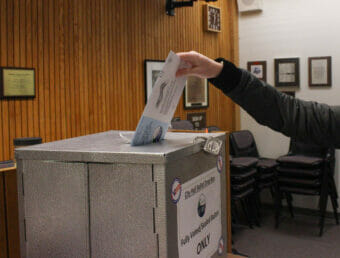
A voter casts a ballot in the 2022 municipal election on Oct. 4 in Juneau, Alaska. (Photo by Tasha Elizarde/KTOO)

Seventeen candidates are running for local office in Juneau this year after one dropped out.

Candidates had until 4:30 p.m. Monday to file to run for four open Assembly seats and two open school board seats in the Oct. 3 election. 

This year’s pool is far more crowded than last year’s, when five incumbents were the only candidates running and automatically won reelection. 

Juneau Assembly areawide seats

As of Monday’s deadline, candidates running for the two open areawide Assembly seats are Paul Kelly, Ivan Nance, Nathaniel “Nano” Brooks, JoAnn Wallace, Ella Adkison, Michele Stuart-Morgan, Emily Mesch, Dorene Lorenz, Laura Martinson McDonnell and Jeff Jones. 

The candidate with the most votes in that race will win a three-year term. The runner-up will finish the remaining two years of the seat that was occupied by Carole Triem until she resigned earlier this month

Assembly member Maria Gladziszewski holds the other areawide seat. Since she has served three terms on the Assembly, she is not allowed to run again. 

Assembly Districts 1 and 2

In District 1, incumbent Alicia Hughes-Skandijs is running for reelection against Joe Geldhof. In District 2, incumbent Christine Woll is running against David L. Morris. Dorene Lorenz originally filed to run in District 2 but withdrew and refiled to run for an areawide seat on Monday. 

Both of those seats are full three-year terms. Juneau residents can vote for any and all candidates regardless of where they live, but candidates must live in the district they’re running for. 

Juneau School Board races

Three candidates are running for two open seats on the school board. Incumbent Brian Holst originally filed to run, but later withdrew from the race. That leaves Paige Sipniewski, Britteny Cioni-Haywood and David Noon vying for seats. The top two candidates will win three-year terms. 

Once certified to run, candidates have until Friday to withdraw from the race. Write-in candidates have until Sept. 26 to file to run. Their names do not appear on the ballot, but can be written in by voters.

Voting in Juneau’s by-mail local election begins in mid-September. The deadline for Juneau residents to register to vote is Sept. 3. 

Editor’s note: This story was updated on Monday, July 31 to reflect that Brian Holst withdrew from the school board race. 

Áakʼw Rock festival brings Indigenous music to Juneau in September

Ya Tseen performs at Aak’w Rock in 2021. (Photo by KTOO)

The Áakʼw Rock Indigenous music festival returns to Juneau this fall. 

Billed as the only Indigenous music festival in the country, it will bring performers from Alaska and around the world to the newly renovated Centennial Hall Sept. 21 through 23. 

Quacung Blanchett, a member of the band Pamyua, is one of the organizers. He was inspired to create Áakʼw Rock after performing at Indigenous music festivals in Canada and Europe.  

“So there’s places that have them, and we’ve performed at those,” Blanchett said. “To see the pride and just the joy and connection that happens in those places over the years – it was like ‘God, we have to have one!'”

Blanchett appeared on Juneau Afternoon Tuesday with co-organizer Neilga Koogéi to preview the event. He said the goal is to celebrate Indigenous music by exposing it to a larger audience while also building relationships.  

“It’s not just about music. We’re actually going to have time for us to get to know each other,” he said. “We’re going to create a space that has this opportunity to have moments of connection with people from all over the world.”

This year’s lineup includes international performers including First Nations hip hop groups Snotty Nose Rez Kids and the Halluci Nation and Rob Ruha from New Zealand. It also includes NPR Tiny Desk Contest winner Quinn Christopherson from Anchorage and Juneau’s Air Jazz. 

KTOO is contracted to produce parts of the festival.

Four candidates certified to run in Juneau’s local election as of Sunday

A voter casts a ballot in the 2022 municipal election on Oct. 4 in Juneau, Alaska. (Photo by Tasha Elizarde/KTOO)

The candidate filing period for Juneau’s Oct. 3 municipal election opened Friday, and four candidates are certified to run for office so far. 

Prospective candidates for Juneau’s four open Assembly seats and two open school board seats have until 4:30 p.m. on Monday, July 24 to file their paperwork with the city clerk’s office. 

According to the city’s website, former school board member Paul Kelly and U.S. Coast Guard veteran Ivan Nance have filed to run for the two open areawide Assembly seats. 

One of the areawide seats is currently occupied by Maria Gladziszewski. She has served for three terms and is not allowed to run for a fourth. Carole Triem recently resigned from her areawide seat. Former Assembly member Loren Jones will fill her seat until the election. The areawide candidate with the most votes will win the full three-year term, and the runner-up will finish the remaining year of Triem’s term. 

Current Assembly members Christine Woll and Alicia Hughs-Skandijs have both filed for reelection in districts 1 and 2. No one had been certified to run for school board as of Friday afternoon. 

Areawide candidates can live anywhere in town, but candidates running in districts 1 or 2 must live in those districts. Candidates need to submit a declaration of candidacy form, a nominating petition with at least 25 signatures, a candidate statement and an Alaska Public Offices Commission financial disclosure form to run for office. 

If people have been thinking about running but aren’t completely decided, Andi Hirsh from the city clerk’s office says there’s still time to make up your mind. 

“I would say, if you’re on the fence, go ahead and get this paperwork in,” she said on Juneau Afternoon Friday. “And then you have until July 28 to withdraw your name from the ballot.”

Hirsch says the main mistakes she sees would-be candidates make when filing for office are having illegible handwriting on the candidate support forms, or not fully writing out supporters’ addresses on the nominating petition. 

Juneau’s local election takes place by mail. Ballots will be mailed out to registered voters in mid-September. Two vote centers will open Monday, Sept. 18 for in-person voting through Election Day, and secure dropboxes will be placed around town for completed ballots.

Correction: A previous version of this story identified Paul Kelly as a current school board member. His term ended in 2021. 

Dead landlines, spotty cell service leave some Juneau residents struggling to make calls

A view of the cruise ship docks in Juneau on June 6, 2023. (Katie Anastas/KTOO)

Juneau residents and business owners say they’ve been having phone problems for the last few days. Both GCI landline and AT&T cell customers have complained of interrupted or spotty service — and it’s not clear what’s causing the problems. 

Linda Kruger says her AT&T cell phone has been dropping calls lately, and her GCI internet has also been slow. 

“I’m a senior, and I’m worried about seniors. What happens when there’s an emergency?” she said.

Lauren Hulse lives in West Juneau. Her GCI landline stopped working early on Saturday morning and didn’t come back until Tuesday.

“Every day, I’d call them or I chat with them and say, what’s going on? Can you tell me a status?” she said. “They confirmed there’s an area-wide outage, but they couldn’t tell me when it could be fixed.”

Reecia Wilson owns the Juneau restaurants Hangar on the Wharf and Twisted Fish. She said landlines at both locations went down after she got a notice from GCI saying the company would be working on landlines Saturday night and Sunday morning.

“We didn’t realize that our landlines were going to be completely down, and obviously it caused us some issues with the restaurant business because we were unable to, you know, take reservations,” she said. “And obviously the to-go orders were impacted.”

Wilson said her phones came back today after she made a long call to GCI’s tech department.

In a statement on Tuesday afternoon, GCI said they had fixed the outage, but customers who were still having problems should contact technical support at 1-800-800-4800 or rcs@gci.com. The statement did not explain what caused the outage.

Juneau Tourism Manager Alex Pierce said she noticed her AT&T phone was slow in the morning on Tuesday, but it was fine shortly after. She said she’s aware of ongoing issues around cell phone service downtown when ships are in port. 

“We know that cruise ships definitely slow down the cell phone and internet, especially in the downtown area,” Pierce said. “We don’t know exactly the nature of the problem, and we’re trying to work with cell phone companies and internet providers to figure out what’s going on and figure out a solution.”

Six cruise ships were scheduled in port on Tuesday, with four arriving by 8 a.m. and two scheduled to arrive in the afternoon. 

Lt. Krag Campbell said the Juneau Police Department’s dispatchers had not experienced any issues receiving calls as of Tuesday. 

Representatives from AT&T did not immediately respond to requests for comment. 

Anna Canny and Yvonne Krumrey contributed reporting.

Site notifications
Update notification options
Subscribe to notifications