Adelyn Baxter

Digital Content Director, KTOO

"I help inform KTOO listeners, viewers and readers by finding creative ways to bring our content to our audience wherever they are."

Some legislators are still hoping for a special session to override budget vetoes

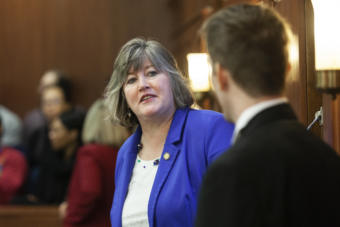
Rep. Sara Hannan, D-Juneau, talks to a page on Tuesday, January 21, 2020 in Juneau, Alaska. (Rashah McChesney/KTOO)

Juneau’s Rep. Sara Hannan has filed to run for reelection in 2024, nearly a year ahead of the deadline. 

“It is by far the earliest I’ve filed compared to my other terms,” Hannan said. 

Hannan is a Democrat who represents District 4, which covers downtown Juneau, Thane, Douglas and a small part of the Mendenhall Valley. She was reelected to a third term last year, but she says she and some of the other members of the minority Alaska House coalition are filing early so they can fundraise around a potential special legislative session. 

“I need to make sure that I am, quote, legal, if I decide that we’re going to raise money in a campaign way to talk about vetoes,” she said. 

Gov. Mike Dunleavy’s budget vetoes cut roughly half of a one-time school funding increase passed by the Legislature. That left some districts, including Juneau, struggling to close significant budget gaps.

Hannan and the other 15 members of the House coalition sent a letter last week to Speaker of the House Cathy Tilton, R-Wasilla, requesting a formal poll of membership “to determine whether the legislature shall call itself into special session for the purpose of overriding specific vetoes made by the governor.”

Hannan – who is a retired teacher – says they hope to override the veto before the next Legislative session in January to make it easier for districts at the start of the school year. 

“We know that it’s a long shot,” Hannan said. “But public pressure can change politicians’ minds.”

Tilton has yet to respond to the letter, according to coalition Press Secretary Graham Judson. Tilton previously told the Alaska Beacon she did not see enough support among legislators to hold a special session, which requires support from at least 40 of the 60 members per the state constitution. 

Alaska Public Offices Commission filings show several other coalition members also filed early in the last week. Rep. Cliff Groh, D-Anchorage, Rep. Maxine Dibert, D-Fairbanks, Rep. Genevieve Mina, D-Anchorage, and Rep. Rebecca Himschoot, I-Sitka, have all filed to run again in 2024. 

Looking ahead to the next election, Hannan says fiscal stability remains “the big picture goal” for the Legislature. She plans to continue advocating for the things she believes Juneau residents care about. 

“My constituents continue to request, you know, better services – better ferry service, better schools, better safe public safety, and all of that costs money,” she said. “So to get there, we need to talk about revenues and long term revenues.”

Rep. Andi Story, a Democrat who represents the Valley, Auke Bay and Out the Road, and the northern Lynn Canal, said she is not yet ready to announce her plans for reelection.

Juneau sends off Hōkūle‘a Thursday with global launch ceremony at UAS Rec Center

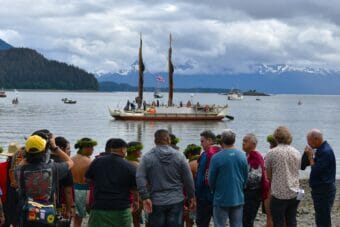
Members of the Hōkūle‘a crew look on from shore during the welcome ceremony at Auke Rec on June 10, 2023. (Photo by Yvonne Krumrey/KTOO)

Juneau residents have one more opportunity to hear from the crew of Hōkūle‘a before it sets off on its four-year journey throughout the Pacific Ocean.

After arriving in Juneau last weekend to a traditional Aak’w Kwáan welcome, the Hōkūle‘a has been anchored at Statter Harbor in Auke Bay awaiting the global launch of the Moananuiākea voyage.

The wind-powered canoe will visit 36 countries during its 40,000-nautical-mile journey through the Pacific as the crew practices traditional voyaging and navigation and learns about sustainability from other Indigenous communities.

Thursday’s event was moved indoors due to the weather forecast. It will take place at the UAS Recreation Center from 1 p.m. to 4 p.m. and feature traditional Alaska Native and Native Hawaiian ceremonies to bless the canoe and crew on their journey.
The public is welcome to attend the event, which will also air live on KTOO 360TV starting at 1 p.m.

Hōkūle‘a will visit other Southeast communities on its way south. Its progress can be followed on the canoe’s website and on social media.

Learn more about the historical connections between the Hōkūle‘a and Southeast Alaska here

Disclosure: KTOO was contracted by Sealaska to produced video coverage of the Hōkūle‘a arrival on Saturday and Thursday’s launch ceremony. This has no impact on news coverage of the event. 

Folk Fest headliner Lone Piñon delayed by volcanic ash

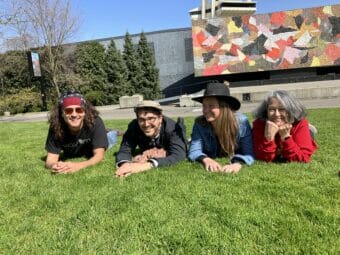
Lone Piñon band members Santiago Romero, Jordan Wax, Karina Wilson and dance caller Lucy Salazar lounge in the sun in downtown Seattle Friday after travel delays canceled their flight to the Alaska Folk Festival. (Photo courtesy of Lucy Salazar)

UPDATE Saturday 10 a.m.:

The remaining members of Lone Piñon and dance callers made it to town late Friday night and will perform Saturday and Sunday. See the Alaska Folk Festival schedule for updated times. 

Original story:

Alaska Folk Festival organizers scrambled to rearrange the mainstage lineup Friday as it became clear that headliners Lone Piñon and several other performers would not make their scheduled sets. 

Folk Fest brings artists from around the state and the Lower 48 to Juneau every year for a week of music and dancing, but this year’s event saw disruptions thanks to airborne ash from a volcanic eruption in Russia that impacted flights throughout the Pacific Northwest

Reached by phone in Seattle Friday, band members Santiago Romero, Karina Wilson and Jordan Wax said they were staying optimistic, but trying to be realistic too. 

“It sounds like a lot of ash cloud is still moving in,” Wax said from somewhere near the Space Needle. “And we’re just hoping that there is a, you know, a slight chance that the wind could shift and allow us to land.”

Lone Piñon’s travel woes began Wednesday when some of the band members tried to leave Phoenix but were delayed by mechanical problems. That brought them to Seattle just in time for the ash cloud to ground dozens of Alaska-bound flights. 

Lone Piñon describes their music as “orquesta típica”, a type of music traditional to northern New Mexico. Joining them in Seattle were Lucy Salazar and Alicia Gonzales, two dance callers who were set to lead a Saturday workshop on the style of dance that accompanies Lone Piñon’s music. 

For most of them, this would have been their first time in Alaska. Bandmate Tanya Nuñez actually managed to make it to town before the ash became an issue. Wax said they still hoped to make their Sunday mainstage appearance. 

“The best case scenario at this point is that we get there for the last day of the festival,” he said. “And it’d be awesome to spend 24 hours with everybody after so much work and planning.”

A lot of planning did go into getting them to Juneau. 

Folk Fest Board Member Miguel Rohrbacher has been trying to bring Lone Piñon to Juneau since seeing them play at a festival in Washington State five years ago. His mother’s side of the family is from northern New Mexico, so hearing them play in the style of that region was inspiring to him as a lover of folk music. He was determined to bring the band to town.

Then, the pandemic happened. Folk Fest was canceled in 2020 and 2021. He thought he had finally succeeded this week, but then …

“That volcano was not on my bingo card,” Rohrbacher admitted Friday. 

He added that this is the first time he’s aware of in Folk Fest’s 48 years that volcanic ash has caused travel delays. Luckily, there’s no shortage of talent already in town to fill in the holes. 

Friday’s mainstage acts were rearranged with local favorites. Organizers said they would continue to cover gaps as needed, with the hope that air travel would resume before the festival ends on Sunday. 

“If the dam breaks, and a bunch of people are here, the Sunday night concert might be one for the ages,” Rohrbacher said. 

And hey, he said, maybe next year’s official Folk Fest t-shirt will feature a volcano.

This post has been updated. 

Correction: A previous version of this story misidentified Lucy Salazar in the photo. 

After a decade away, dancers from St. Mary’s return to Cama-i

Moses Paukan Sr.’s wife receives a plaque in his honor from Cama-i Dance Festival organizer Linda Curda. (Katie Basile)

It’s the opening night of the annual Cama-i dance festival in Bethel, and most of the members of one of the featured dance groups aren’t here yet.

Inside the Bethel Regional High School green room, where dancers wearing qaspeqs and fur-lined headdresses gather to prepare for their performances, St. Mary’s dance group leader George Beans is trying to buy more time.

“The plane just got to St. Mary’s,” he tells festival organizer Linda Curda. Weather delayed the afternoon flight, which was scheduled to bring about half of the dancers from the Yukon River community.

Glancing at the printed schedule, Curda does some mental math. St. Mary’s was meant to be on stage already, but she moved up the Marshall dancers. Maybe she can move another?

“Ok, so guess what? I’m going to go talk to these guys and see if we can get them to move up,” Curda tells Beans.

St.Mary’s dancers perform at the 2023 Cama-i Dance Festival. (Katie Basile)

Travel hiccups are just another part of life on the Yukon-Kuskokwim Delta, and the St. Mary’s Dancers are used to delays at this point. Cama-i announcers said that they’re one of the oldest dance groups in the region, but it’s been over a decade since they’ve danced at the annual event.

This year’s event is the first full-scale festival since 2019, and it’s dedicated to Moses Paukan Sr., who helped start the St. Mary’s dance group about 50 years ago. He was also a former state representative and longtime school board member in St. Mary’s.

Paukan died in 2017 and was meant to be recognized at the 2020 festival, but it was canceled due to the COVID-19 pandemic. His wife, Martha, and some of his children traveled to Bethel to receive the dedication.

“We’ve been put off for five years, so now it’s got to be the real deal now,” Beans said.

Luckily, Cama-i’s organizers are no strangers to improvising. After rearranging the dancer schedule and inviting a few unplanned speakers to the stage, they’ve just about exhausted all their options when Curda takes the mic.

“Guess what? St. Mary’s is here!” she tells the packed auditorium. Applause erupts as dancers and drummers pour onto the stage. Without pausing, they take their places and the yuraq begins.

One of the songs they perform was written by Paukan Sr.: “Ataki Tang Wiinga.” He wrote many songs for children and encouraged the youth in his community to continue dancing. Today, the dance group he founded 50 years ago has more than 20 members, from youth up to Elders, including his wife and some of his children and grandchildren.

St.Mary’s dancers perform at the 2023 Cama-i Dance Festival. (Katie Basile)

Isabella Peterson is 16. This was her first Cama-i. She wasn’t on the plane that was delayed, but her grandmother was. Despite all the stress earlier in the day, she said that it was all worth it to step out on the stage in Bethel.

“It feels pretty amazing to dance in front of many other people and to see other dance groups dance and perform,” Peterson said.

Pausing from her dancing, Martha Paukan accepted a plaque for her husband and led the room in the Lord’s Prayer by way of thanks. The audience, young and old, joined in.

“Your legacy, Moses, your spirit lives on in the dances of St. Mary’s,” Curda said during the dedication.

Earthquakes last longer and feel stronger in parts of Interior Alaska, research finds

University of Alaska Fairbanks Ph. D. student Kyle Smith services a seismic sensor in 2018 on the bank of the Tanana River in the Minto Flats area. (Photo by Carl Tape/UAF Geophysical Institute)

Earthquakes in the Nenana Basin in Interior Alaska last longer and feel much stronger than quakes of comparable magnitude in other places.

University of Alaska Fairbanks scientists are studying why.

It’s all about the reverberation.

Below the beautiful lakes and swamps in the Minto Flats region is a giant bowl, and it’s filled with gravel. UAF Geophysical Institute seismology professor Carl Tape said to imagine the flat surface of the land like the surface of the ocean, and if you removed the water, you’d see interesting things revealed.

“If you remove all this dirt that’s been deposited, there’s a lot of interesting features,” he said. “These deep bowls, depression, exists west of the town of Nenana, where the Tanana River kind of takes a turn and flows north, toward the Minto Flats area before it goes west and eventually into the Yukon. So in that area of Minto Flats, what looks very flat and normal at the surface has a lot of really interesting features beneath.”

Tape worked with graduate student Kyle Smith, placing 13 seismic monitors across the area over four years, from 2015 to 2019. In that time, they collected data from 48 local and regional earthquakes. The monitors, the first seismic stations installed in Minto Flats, are part of the Fault Locations and Alaska Tectonics from Seismicity project funded by the National Science Foundation.

“That area has not been really studied that much,” said Smith. “And we wanted to know how the basin moved, because people want to do a lot of projects in that region. So it’s good to know what happens when there’s a big earthquake.”

They found that the seismic waves get amplified as they bounce back and forth off the sides and bottom of the sedimentary basin. So people in the flats perceive the earthquakes as bigger than they actually are. They also incorporated discussions with people who live and work in Minto into their research.

a person installing a seismic sensor outside
University of Alaska Fairbanks Ph. D. student Kyle Smith installs a seismic sensor in 2015 in the Minto Flats area. (Photo by Carl Tape/UAF Geophysical Institute)

The basin west of Nenana and south of Minto is 56 miles long and 7.5 miles wide. It was filled in over millions of years with sediment brought by the rivers from the Alaska Range. Smith said it could be the deepest such basin in Alaska.

“ It’s up to seven kilometers deep, so that maybe about four miles,” Smith said.

That is deeper than Denali is high.

a map shws deep basin depth around nenana
Map of the Nenana Basin and Minto Flats fault zone. Triangles show seismic stations that operated from 2015 to 2019 in the Tape/Smith study. (UAF Geophysical Institute)

The seismic monitors recorded earthquakes lasting longer on the gravel-filled basin than on harder ground. Both Tape and Smith noted the measured difference between the Nenana Ridge under the Parks Highway, and the flats below.

“The ridge between Nenana and Fairbanks, when you drive along that, you’re high up on pretty close to rock. The ground moves very differently in that kind of material than it does down in Minto Flats.”

“There’s certain places that, because of the exceptional topography below ground in this case, is big basin Bowl amplifies the ground motion and makes it last longer. And we know that because we put the stations out there to record earthquakes,” Tape said.

“The shaking is like 10 times less compared to if you were just downhill from that. So it’s pretty amazing how stark the difference is caused by whatever the underlying geology is,” Smith said.

Smith was raised in the Navajo Nation, got his Ph. D. at UAF, and is on a new research assignment in Taiwan.

Tape said many UAF scientists are targeting the basin for research.

“But the same features are what led, you know, like Doyon, for example, to drill exploratory wells and acquire geophysical data because of the prospects for oil and gas,” Tape said.

Although the research shows how the ground would likely move during certain kinds of earthquakes, Smith cautions that actually predicting earthquakes is a long way off.

“ We will have a better idea of how much the ground will be shaking from some kind of earthquakes, but that doesn’t tell us when and where the earthquake is occurring,” Smith said.

Smith will give a talk on the research at Sandia National Laboratories in May.

Watch: US Sen. Dan Sullivan addresses the Alaska Legislature

U.S. Sen. Dan Sullivan is set to deliver his annual address to the Alaska Legislature at 11 a.m. Tuesday, Feb. 7.

Watch a live stream here, on KTOO 360TV or tune into KTOO-FM.

Sullivan serves on four Senate committees vital to Alaska: the Commerce, Science and Transportation Committee; the Armed Services Committee; the Environment and Public Works Committee; and the Veterans’ Affairs Committee.

Prior to his election to the U.S. Senate, he served as Alaska’s Attorney General and Commissioner of the Alaska Department of Natural Resources.

Sullivan has been in office since 2015.

The Alaska Legislature has a tradition of inviting the congressional delegation in to deliver an address while they’re in session. They will hear from Alaska’s senior senator, Lisa Murkowski, later in February.

Site notifications
Update notification options
Subscribe to notifications