Adelyn Baxter

Digital Content Director, KTOO

"I help inform KTOO listeners, viewers and readers by finding creative ways to bring our content to our audience wherever they are."
STEM advocates build network for classrooms to connect with local experts

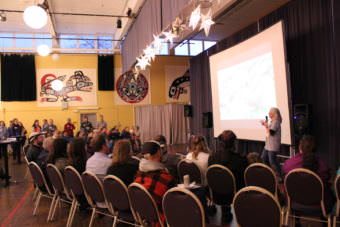
Brenda Taylor addresses teachers and would-be collaborators at a SouthEast Exchange STEM networking event. (Photo by Adelyn Baxter/KTOO)

Holding the attention of tomorrow’s scientists and engineers can be tricky. Fortunately, Juneau is rife with professionals who work in those fields every day.

A group of local STEM — or science, technology, engineering and math —  advocates is working on a database to make it easy for teachers to connect bookwork with real world work and find those professionals.

“From mining expertise and engineering, kind of geology, we have the glacial, we have University of Alaska Southeast, University of Alaska Fairbanks has fisheries here, we have NOAA fisheries, we have all the state organizations,” said Jordan Watson, a fisheries scientist at National Oceanic and Atmospheric Administration, or NOAA. “We have so many different expertise here and in such a small town, it would seem a shame to not be using it in the classrooms.”

He and other members of SouthEast Exchange, or SEE, wanted to find a way to bring all of those resources to teachers. They hosted a networking event recently to help bridge that gap.

About 150 educators and STEM professionals came to network and register in SEE’s directory.

The goal is to create a database where teachers can search a topic such as “glaciers” or “bridge building” and immediately find contact info for someone local with expertise in that field.

For science and math educators, the opportunity to bring a professional into the classroom is not just a respite from the daily grind of teaching.

Carol May used to be an engineer, but found herself drawn to education.

Now she’s an statistics and computer science teacher at Thunder Mountain High School.

“I can tell the kids, yeah, when I was an engineer I did this, but that was a long time ago and it doesn’t have the same credibility as somebody who’s actually doing it day to day,” May said.

Brenda Taylor is one of the co-chairs of the Juneau STEM Coalition and teaches math at Juneau Community Charter School.

She said the kind of professionals they want to join their community aren’t just scientists and engineers, but photographers, artists and members of the Native community.

“The thing I think is really wonderful when you say STEM is you’re thinking about the discipline of how do you look at the world and how do you ask questions and how do you think about it?” Taylor said. “Here are all these different people who look at the world in all these different ways, right? As a piece of that as well is Alaska Natives who are looking at the world not only in terms of what they see right now, but all of their stories and tradition that they have inherited and that are their ancestors kind of talking through them. So how have people been understanding and making sense of this specific world here for 10,000 years?”

Thunder Mountain High School already hosts one very successful STEM collaboration.

About eight years ago, UAF professor Shannon Atkinson approached the school administration about creating a partnership between the campus and school.

Professor Shannon Atkinson introduces her new class to DEMBONES, Thursday.
Professor Shannon Atkinson introduces her new class to DEMBONES in December 2016. (Photo by Quinton Chandler/KTOO)

It led to juniors and seniors rearticulating a marine mammal skeleton in class each semester. They learned about anatomy, ecology and environmental stewardship along the way.

Thunder Mountain marine sciences teacher Kristen Wells said somewhere between 300 and 400 students have taken the class to date, earning both high school and college credit.

“It’s a beautiful pairing that they actually get to work on a marine mammal,” Wells said. “There’s marine policies that don’t allow us that access, so it’s incredible that we actually get that access through this partnership and the kids really value that.”

The program has expanded to include field trips to NOAA’s labs, Berners Bay and cultural bearers from the Tlingit community.

They’ve also done similar classes at Yaaḵoosgé Daakahídi Alternative High School and Mount Edgecumbe High School in Sitka.

Students with Sitka Sound Science Center’s summer camp week finished assembling the skeleton of this California sea lion in 2016. (Katherine Rose/KCAW)

By the end of the coalition’s networking event, 80 teachers and 63 community members had registered in SEE’s directory, paving the way for more dissections and skeletal articulations to come.

Q&A: On re-election bid, Gov. Walker says he’s made difficult decisions that he must own

Gov. Bill Walker and Lt. Gov. Byron Mallott greet supporters gathered for the campaign kickoff event Oct. 22, 2017, at Elizabeth Peratrovich Hall in Juneau. (Photo by Adelyn Baxter/KTOO)

Gov. Bill Walker and Lt. Gov. Byron Mallott’s re-election campaign kicked off Sunday afternoon in Juneau. About 100 community members showed up to Elizabeth Peratrovich Hall for music, face painting and food, including a new ice cream flavor from Coppa made specially for the campaign, called Unity.

The independent governor took a few of my questions about his outlook for the upcoming 2018 campaign.


So I wanted to ask you specifically about, in your 2016 State of the State address, you said, “I did not run for governor to keep the job, I ran to do the job.”

Right.

And so I was wondering if when you were first running in 2014 if you had ever intended to seek re-election, if it was even in your frame of mind then?

You know, it wasn’t on my mind, and it isn’t now in the decisions I make. Many times people will say, “Well we can’t do this because we have an election coming.” I don’t believe in that. I was hired for four years I’m going to work hard for a solid four years. And if I get an opportunity to continue on for another four years, I will be greatly honored. If I don’t, I’ll be greatly honored I served as the governor of Alaska for four years. I just don’t believe in running for three years and then just sort of gliding for a year. That’s not what I was hired for.

And what are the biggest changes this time around, this campaign season or upcoming campaign?

Well, this time around I have made some difficult decisions and I need to own them. And I will own them. I mean, I don’t hide from anything I’ve done. And so what’s different for me now, you know when I began running, the first poll that was taken I had a name recognition of 2 percent. And I was pretty excited about 2 percent, “Hey that’s … you know!” So I had a long ways to go. Now that’s not the issue anymore. The issue is I need to talk about what I’m going to do and I also need to justify the decisions I’ve made.  

So, you know for me, I can, whatever happens on election or re-election, I need to live the rest of my life living with the decision I’ve made. And I can do that. It’s the decision I didn’t make that I don’t want to worry about. I don’t want to ever look back and go, “You know, I didn’t do this because I was worried about that. I didn’t do this …” No. I’m all in. And so that’s not a politically wise thing to do, I understand that. But I would much rather lose fighting for Alaska every day than be very careful and increase my chances by not doing this. I just don’t believe in that. I think that’s how we got into the situation we’re in right now, the fiscal situation. People so focused on their next election. It’s the next generation we need to focus on, not the next election.

And so was the decision to run again as an independent in the next election an obvious one, given the success last time?

It is. That’s how we got here and it feels very comfortable because I can draw from all different sides of the aisle for input. I’ve never felt that any particular party had a monopoly on good ideas. I think everybody should have an equal say on that. So we, uh, foster that. We encourage that.

And has there been any discussion given the recent ruling about open primaries and the Democratic primary to running in that primary?

You know, we haven’t had any discussion about that. Of course we’re not involved in it at all because of the obvious conflict (of interest). So we haven’t had any discussions about that and as I stand here today I’m not, uh — we’re doing it the way we did it last time and until that changes we’ll keep doing that.

OK. And final thoughts on how this event went?

I thought it went very well. I was very, very pleased with it. Juneau had been a big part of our campaign last time and it certainly will be this time. So on a Sunday afternoon with a lot of things competing, with the Seahawks football game going on and the Juneau Symphony, you know, having events today, I was very, very pleased with the turnout. Very happy.

U.S. Coast Guard issues warning of derelict vessel

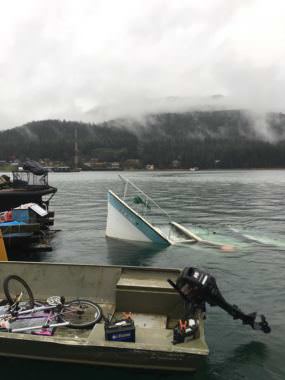
The bow of a partially-submerged vessel afloat in the Gastineau Channel Saturday. (Photo courtesy of Matthew Creswell)
The bow of a partially submerged vessel afloat in the Gastineau Channel Saturday. (Photo courtesy Matthew Creswell)

The bow of an abandoned boat could be seen this weekend drifting up and down the Gastineau Channel between Lemon Creek and the Douglas Bridge.

The 28-foot vessel broke free of its mooring and became adrift, according to a Facebook post by the U.S. Coast Guard Sector Juneau. A broadcast warning to mariners was issued Saturday, but no further action was being taken as of Sunday afternoon.

The U.S. Coast Guard said they will not get involved unless the vessel becomes a pollution hazard, which has not been reported at this time. Until then, the vessel falls under the jurisdiction of the City and Borough of Juneau. CBJ Harbor and Operations Manager Matthew Creswell said there would likely be no further action until Monday.

“Technically, responsibility for it should fall on the responsible party,” Creswell said.

As of noon, the vessel could be seen drifting just south of the Douglas Bridge.

Juneau’s 2 high school football rivalry may end with teams merging

football closeup
(Creative Commons photo by charamelody)

The Juneau School District wants to consolidate its two high school football programs and cheer squads.

Superintendent Mark Miller said at a press conference Thursday afternoon that the decision to send a formal request to the Alaska School Activities Association has been two years in the making. If approved, Thunder Mountain High School students would be able to play for the team at Juneau-Douglas High School.

“Financial sustainability was kind of the tipping point and what led us to go with one school versus the other,” Miller said. “With the state of finances that we are in in the state of Alaska and what we’ve had to do with reducing activities, we had to look at which of the two programs had the best shot at financial sustainability.”

Both schools have struggled to fund their teams in recent years, coupled with a decline in participation that has forced coaches to play freshmen and sophomores against larger and more experienced junior and senior players from other teams. Travel has been reduced to only three away games per team.

The estimated annual budget for each of the football teams is about $70,000, Miller said. At the beginning of the 2017 season, the Juneau-Douglas High School football program’s account had a negative balance of $5,689. Thunder Mountain High School’s account was short $100,821.

The district will send the formal request to ASAA by the Nov. 1 deadline and expects a decision by the end of the month.

Director of Student Services Bridget Weiss said this decision is not permanent.

“This would actually be on an annual basis, that we would go back to ASAA and request this waiver, as far as I’m aware at least,” Weiss said. “As in any decision, we just have to be responsive to the needs of a community, of our students, of our programs, of our fundings.”

Miller said the district looked at a number of factors to make the decision. It wanted students to be able to attend the school of their choice without limited activities influencing that choice.

“We don’t the football tail to wag the dog, right? We’re worried about students’ academic success first, the academic support we can give them and then activities is extra. So we want to make sure that their academic needs are met first and then the activities are supported in any way we can,” said Miller.

If ASAA approves the request, Miller said consolidating the football teams would likely move the district back into Division I in the Railbelt Conference.

Decisions on team uniforms, coaching staff and other details would be determined later.

Same building, new name: Sayéik Gastineau Community School

Gastineau Community School
Gastineau Community School in 2013. (Photo by Heather Bryant/KTOO)

Gastineau Community School has been renamed Sayéik Gastineau Community School. The Juneau School Board voted unanimously Tuesday to add the traditional Tlingit name, which loosely translates to “spirit helper.”

The Douglas Indian Association says the word reflects the original Tlingit name of the land the school stands on and a need to acknowledge historical trauma the T’aaku Kwáan of Douglas Island experienced.

Several Tlingit community members at the Juneau School Board meeting asked the board to go further. Some suggested simply changing Gastineau’s name to Sayéik. The board ultimately decided to augment the name.

Douglas Indian Association Vice President Paul Marks, or Kinkaduneek of the Lukaaxh.ádi clan, spoke during public comment and said emphasizing Sayéik would be more meaningful for students and the community.

“Whenever we speak our language, our ancestors are listening and become present with us. And so with that understanding then they start to guide us,” Marks said. “We believe that our language is taught to us by our Creator, so our language is a language to strengthen, encourage and to give comfort to each other and to one another.”

The idea to change the school’s name first came up in 2012, when workers renovating Gastineau unexpectedly unearthed the remains of five people buried on the grounds. Gastineau was built on the site of a T’aaku Kwáan graveyard in 1957.

Construction was halted, the remains were reinterred elsewhere and the city asked the Douglas Indian Association to choose a name to better reflect the site’s history. The association finally brought their suggestion back in August.

Barbara Cadiente-Nelson coordinates Juneau schools’ K-12 Native Student Success program and is an executive member of the Douglas Indian Association. She said the tribe considered several names, but ultimately settled on Sayéik. She said elders who first responded to the unearthing of the graves did not want the incident to be forgotten.

“This significant event unearthed many, many things for us to address and resolve,” Cadiente-Nelson said. “‘Do not let it ever be forgotten.’ And so by putting the name first, Sayéik, I believe really honors their intent. And again it was a dynamic process. Very authentic in presenting the voices of several and the board being responsive to that.”

Juneau Schools Director of Teacher and Learning Support Ted Wilson said the school’s website and signage will be updated to reflect the new name. But the school nameplate may take a bit longer.

“Because that is concrete, so I don’t know what they’re going to do about that at this point,” he said.

A renaming ceremony is expected to take place sometime in the spring.

Site notifications
Update notification options
Subscribe to notifications