Adelyn Baxter

Digital Content Director, KTOO

"I help inform KTOO listeners, viewers and readers by finding creative ways to bring our content to our audience wherever they are."

Thunder Mountain football players ask district to create new football identity for Juneau

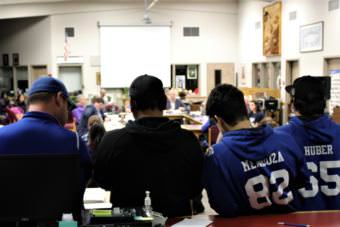
Thunder Mountain High School football players listen as other team members address the Board of Education over the plan to combine with Juneau-Douglas High School on Tuesday, Nov. 14, 2017. (Photo by Adelyn Baxter/KTOO)
Thunder Mountain High School football players listen on Tuesday, Nov. 14, 2017, as other team members address the Board of Education over the plan to combine with Juneau-Douglas High School. (Photo by Adelyn Baxter/KTOO)

Thunder Mountain High School students, coaches and parents came together Tuesday night, but not for a game.

They showed up to the Board of Education meeting to voice concern over the recent decision to merge their football team with Juneau-Douglas High School’s.
The district cited high travel costs and safety concerns in making its decision.

Declining participation meant younger students were playing varsity against larger and more-experienced players from other teams.

Some asked the board to reconsider its request, which already was approved by the Alaska Student Activities Association less than two weeks ago.

Many said they supported the decision, but encouraged the district to move forward in a way that benefited students from both schools equally.

Michelle Strickler’s sons have played football for both Juneau teams. She’s an accountant, and said her examination of the teams’ budgets showed that Thunder Mountain takes on disproportionate travel costs because of the teams they’re assigned to play.

“If we could just control the costs, it’s very feasible that we could have two successful cross-town rivals and enjoy the beauty of that twice a season, free, no travel game,” Strickler said.

About 20 Thunder Mountain football players and student government members showed up in their school colors.

They asked the district not to choose one school’s uniforms, mascot or name to represent the new team, but suggested creating a unique identity both schools can come together to support.

Junior Alvin Hubert plays defensive line for Thunder Mountain. His brother played for Juneau-Douglas.

“I don’t want to lose the traditions I’ve had over the past three years, because you are your identity, your name is who you are and a Thunder Mountain Falcon is who I am,” Huber said. “So that’s not gonna change my senior year, I will play as a Falcon. But I will also play under whatever team name it is. And hopefully I can be a senior that sets us up for success as a new team of Juneau football.”

Superintendent Mark Miller said at the meeting he thinks it’s unlikely the district will buy all new uniforms for 80 potential players.

“All those discussions, I think, are up in the air,” Miller said. “We’ve had to get permission first and now we have to look at the details to put them together.”

Miller said the district will begin the process of determining team details once ASAA decides which conference the team will play in later this month.

University of Alaska approves tuition increases, budget amid uncertain fiscal future

The University of Alaska Board of Regents met in Anchorage for an executive session. At the end of the meeting, they went into public session and voted 9-1 to rescind President Pat Gamble’s retention bonus. (Photo by Josh Edge, APRN – Anchorage)
(Photo by Josh Edge, APRN – Anchorage)

Most University of Alaska students will see a 10 percent tuition increase during the next two academic years.

The university Board of Regents approved the hike with a 9-1 vote at Thursday’s meeting in Anchorage.

A 5 percent increase will take effect for most campuses in both the 2019 and 2020 academic years.

At the University of Alaska Southeast, the cost per credit will increase by about $10 each year. Currently, lower-division courses cost $202 per credit hour.

Student board member Joey Sweet called the decision a “bitter pill.”

“I’m not necessarily thrilled about that,” Sweet said. “But I think in terms of the long term this is a responsible course of action for us to be taking, and I support it.”

Tuition at Kodiak College and Prince William Sound College will increase by about twice as much as other campuses in order to even out tuition rates across the university system.

Regents also approved the university’s operating and capital budget for the 2019 fiscal year, including a request for $50 million from the state for deferred maintenance projects.

The likelihood of receiving any of that money from the Alaska State Legislature this year rides largely on its ability to address the state’s deficit.

Associate Vice President of Government Relations Miles Baker said the upcoming legislative session poses “major cause for uncertainty.”

He said legislators will face a $2.6 billion deficit, and revenue alternatives are few.

The current special session is unlikely to pass Gov. Bill Walker’s proposed tax of 1.5 percent on wages and self-employment income.

“We’re not going to come out of the special session with a long-term revenue solution even in the unlikely event this wage bill passes,” Baker said.

Several regents raised concerns about enrollment at the meeting. The system has seen a 15 percent decline since 2014.

Most campuses saw even lower enrollment this fall, including University of Alaska Southeast.

Regents also approved an extension to University of Alaska President Jim Johnsen’s employment contract. They heard reports on Strategic Pathways cost-cutting measures and Title IX compliance for sexual discrimination, harassment and assault.

The regents will conclude their meeting Friday afternoon.

University of Alaska regents to discuss budget and tuition increases

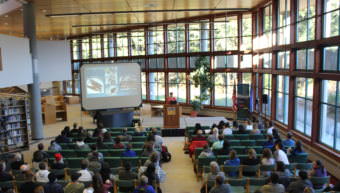
The University of Alaska Board of Regents meets today and Friday in Anchorage to vote on the university budget and proposed tuition increases.

The agenda includes approval of the university’s budget for the next fiscal year.

The total proposed budget is just under $920 million, including a requested $341 million appropriation from the state. That’s a $24 million increase from last year’s request.

State funding to the university has declined by about $60 million since 2014, forcing cutbacks in academic programming, faculty and staff across campuses.
Regents also will consider a request for $50 million from the state to address the university’s deferred maintenance backlog.

A 10 percent tuition increase over the next two years also is on the table.

Regents will decide whether to raise tuition at most campuses by 5 percent in both the 2019 and 2020 academic years.

Tuition at Kodiak College and Prince William Sound College would increase by nearly twice as much, in order to even out tuition rates across the University of Alaska system.

University of Alaska President Jim Johnsen also will present on phase three of Strategic Pathways, the university’s comprehensive cost-cutting plan.

Regents also will receive an update on how the university has improved its response to sexual harassment and assault allegations.

The full board meeting, aside from executive session, will be livestreamed online.

UAS community discusses power and privilege at all-day symposium

Forest Haven, a Ph.D. candidate in cultural anthropology at U.C. Irvine from Metlakatla, gives a keynote address at the second annual Power & Privilege Symposium at the University of Alaska Southeast. (Photo by Adelyn Baxter/KTOO)

Students, professors and members of the Juneau community gathered Tuesday at the University of Alaska Southeast for a day-long discussion of societal imbalances.

The second annual Power & Privilege Symposium brought together thinkers, educators and undergraduate students to talk about topics ranging from climate change to Alaskan Native issues.

Some of the sessions and keynote speakers were live-streamed, including the morning address by Alaska Writer Laureate Ernestine Hayes.

A poster hangs in a hallway at the University of Alaska Southeast during the second annual Power & Privilege Symposium on Nov. 7, 2017. (Photo by Adelyn Baxter/KTOO)

Undergraduate student Haley Shervey volunteered at the symposium because she felt the subjects being addressed are important, especially in today’s climate.

“I think a lot of the events here kind of address violence and some of the issues going on in the communities,” Shervey said. “Alaska has a really high rate of domestic violence and other issues and a lot of these things have a lot of historical precedence that it’s really important to address, so I think it’s really good that this event is going on.”

Most classes were optional Tuesday so students would be free to attend sessions.

Some students even presented on topics relating to their own experience, like being Muslim amid growing Islamophobia in the national landscape.

First-year student Gloria Conteh also volunteered for half the day so she could attend breakout sessions.

She was particularly interested in discussions dealing with climate change and abortion.

There are so many things going on right now that we wanted to talk about, so it was really great that they put on this event and the community members can also listen and give their input on things they think that we should talk about,” Conteh said.

Organizers said they hope the symposium encourages more discussion of privilege and its role in society for the broader Juneau community.

Deputy Mayor Nankervis announces primary run for Alaska House

Jerry Nankervis, July 30, 2015. (Photo by Jeremy Hsieh/KTOO)

Juneau Deputy Mayor Jerry Nankervis announced Tuesday that he wants to represent the Mendenhall Valley in the Alaska House of Representatives.

Nankervis filed a letter of intent to run in the August 2018 Republican primary for District 34, one of two House districts in Juneau.

Nankervis listed jobs and cost of living among his top reasons for running.

If he secures the Republican nomination, he expects to challenge Democratic Rep. Justin Parish in the Nov. 6 election next year.

Nankervis said he differs with the incumbent on resource development and economic issues.

“I disagree with the positions he’s taking,” Nankervis said. “We have different approaches to the problem. I think I would do a better job statewide garnering support for our district and working cooperatively with folks in the rest of the state.”

First elected to the Juneau Assembly in 2012, Nankervis has served as deputy mayor for more than a year.

He has lived in Juneau for 30 years and was a captain with the Juneau Police Department up until his retirement in 2011. He now works as a commercial fisherman and referees hockey games in his spare time.

“Hopefully folks have watched what I’ve done on the Assembly and appreciate the experience that I bring to it,” he said.

Parish narrowly unseated former Republican Rep. Cathy Muñoz in 2016.

“I welcome a deeper conversation about the issues that matter to us,” Parish said. “Something to look forward to.”

Nankervis said he has been considering his run since last year’s election, and doesn’t expect to start campaigning until the summer.

Newscast — Monday, Nov. 6, 2017

In this newscast:

Site notifications
Update notification options
Subscribe to notifications