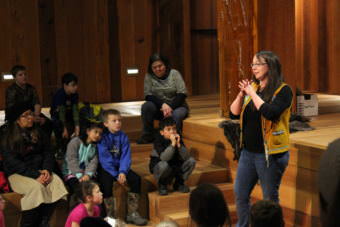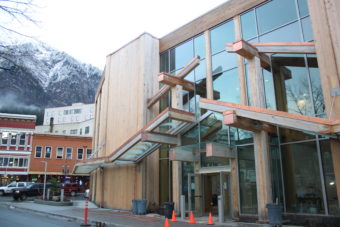
Culture Bearer Daaljíni Cruise tells Juneau second-graders a traditional Alaska Native story during an excursion to the Walter Sobeloff Building on Nov. 16, 2017. (Photo by Adelyn Baxter/KTOO)
At the Walter Sobeloff Building on Thursday, Sealaska Heritage Institute Culture Bearer Daaljíni Cruise started off a visit from Juneau second graders by reviewing some concepts they learned in class.
“And what usually happens in our Tlingit culture, we have what we call moieties,” Cruise said. “Say moiety.”
“Moiety,” replied the students gathered around her.
“Moiety means half. OK? So we have two moieties. We have the Eagle and the …”
“Ravens!”
“Very good!”
For the third year in a row, more than 300 Juneau second-graders visited the building’s clan house and exhibit for a cultural excursion.
The field trip is part of Any Given Child Juneau, an initiative to expand arts education locally and backed by the John F. Kennedy Center in Washington, D.C. The program’s goal is to provide equitable access to the arts and cultural opportunities for all Juneau students.
Jennifer LaRoe is the Juneau coordinator for Any Given Child. She said the program is determined to provide excursions like this to all grades K-8, but that they’re looking for ways to expand.
“We’re still trying to understand how we can meet these kinds of goals for high school students, so that’s something that the community input is really valuable for,” LaRoe said.
In addition to the second grade excursion, students in fifth grade attend a performance of the Juneau Symphony in February. For the last two years, eighth graders have gone to Perseverance Theatre. Sixth grade students will see the Juneau Dance Theatre’s spring showcase and plans are being made with the Alaska State Museum for a fourth grade field trip.
The second-graders also listened to Cruise tell traditional stories in Shuká Hít, Sealaska’s model clan house. Before their visit, students designed their own clan house screens based off Shuká Hít’s glass screen designed by Preston Singletary.
TMHS Falcons and JDHS Crimson Bears fight it out in the 2011 Glacier Bowl.
Instead of consolidating Thunder Mountain High School’s football team and cheer squad into Juneau Douglas High School’s as planned, the Juneau School District will create a completely new team.
In a statement, district Chief of Staff Kristin Bartlett said the new football team will not sport the name, colors or mascot of either school. Instead, Juneau students will play on a team representing the entire district.
On Tuesday night, Thunder Mountain football players, students, coaches and fans showed up to the Board of Education meeting to voice concern over the consolidation. Many said they did not want to lose their school’s identity by being forced to play for Juneau-Douglas. Several suggested creating an entirely new team.
The Alaska School Activities Association Board voted 4-1 on Nov. 2 to allow TMHS students to play for Juneau-Douglas, as requested by the school district.
The district said it will seek participation from all stakeholders — including players, coaches and parents — as it moves forward with the merger. The new team will take the field next fall.
On Facebook, Juneauites were already chiming in with suggestions for the new team name. “Juneau Thunder,” “Crimson Falcons” and “Thunder Bears” were among the proposals.
University of Alaska Southeast National Student Exchange students Eva Collazo-Montanez, Nikyshaliz Velasquez and Gabriela Hernandez-Ramirez pose with the supplies they gathered to send home to Puerto Rico. (Photo courtesy of Eva Collazo-Montanez)
Three Puerto Rican students came to study at the University of Alaska Southeast this fall in search of an adventure.
But their semester abroad turned into a stressful ordeal after Hurricane Maria left them cut off from their families.
What do you do when disaster strikes at home, but you’re more than 4,000 miles away?
That’s the question three visiting students to UAS faced this fall.
Their school, University of Puerto Rico Humacao, was severely damaged when Hurricane Maria hit the island in September.
Every year, students from other parts of the United States travel to Juneau as part of the National Student Exchange program. That includes students from U.S. territory Puerto Rico.
“I’m studying marine biology and I wanted a total different environment. I like humpback whales and we can see them in Puerto Rico, but not as much as we can see them here,” said Gabriela Hernandez-Ramirez, who arrived in Juneau on Aug. 24 along with Eva Collazo-Montanez and Nikyshaliz Velasquez.
Less than a month later, Hurricane Maria made landfall in Puerto Rico.
When it hit, Hurricane Irma had just skirted the island weeks before. Collazo-Montanez said they felt relieved when Irma was less destructive than predicted. Then they woke up Sept. 20 to radio silence.
“All of the media was out because there was no power so we couldn’t like see what was happening until like two days after that we were hearing stuff and trying to communicate but there was no communication,” Collazo-Montanez said.
It took almost two weeks for them to reach their families.
Thankfully, no one was seriously hurt.
Their homes were mostly safe, although Velasquez said her family’s garage was destroyed. But now their loved ones are dealing with the aftermath.
“My family doesn’t have electricity yet, and water, anything,” Velasquez said.
Power was knocked out for the entire island.
FEMA says about 60 percent still has no electricity. The biggest problems now are access to clean water, food and health care.
“We’re just so concerned that people are dying because they’re not getting medical attention, because they can’t get to the nearest hospital, or the nearest hospital is closed because they don’t have any electricity,” Collazo-Montanez said.
Classes at the Humacao campus were suspended for a month. Students returned Oct. 30, but with millions of dollars in damages and limited electricity, most classes are being held in large tents.
“I’ve heard from a lot of friends that the heat, it’s a lot,” Collazo-Montanez said. “They’re suffering from heat strokes, they cannot concentrate. Professors are trying to give their classes normally like they did it back when there was no hurricane, but they cannot do it.”
Feeling homesick and helpless from so far away, the students wanted to find a way to help. They held a bake sale.
“We had brownies, cupcakes, everything. We made some and people of the community also brought pastries to us,” Hernandez-Ramirez said. “We were like three hours in the cafeteria, and many people went and they helped us.”
They also collected supplies like medical masks, batteries and flashlights.
UAS Assistant Professor of Marine Fisheries Michael Navarro helped them figure out how to fly five free bags of supplies on Alaska Airlines to Florida.
Collazo-Montanez accompanied them and met her mother at the airport, who brought it all back to the island.
In total, they gathered about 600 pounds of supplies and $700 in donations.
Now, the visiting students are faced with what to do once the semester ends.
Do they return to Humacao, where facilities are limited and the semester has been pushed back to January? Do they transfer to Florida International University, which is taking in Puerto Rico students whose schools are damaged? Or, is there another option?
UAS Academic Exchange and Study Abroad Coordinator Marsha Squires has worked with the three of them since they first decided to come study in Alaska.
Known as “Mama Marsha” to many in the exchange program, she makes it her job to help students feel at home on campus.
When Maria struck, she took that role even more seriously.
“It wasn’t just me, there was a lot of faculty and other staff that were very supportive of the students, knowing that they were stressed, and still are really,” she said. “This isn’t something that just happens overnight and then it’s over with.”
Squires is working to help them stay.
UAS will provide financial assistance to allow Hernandez-Ramirez to continue studying there in the spring. Collazo-Montanez also is considering staying.
What is it about Juneau that three young women from a tropical Caribbean island like so much, exactly?
“Whale watching,” Hernandez-Ramirez said.
“Yeah, I love the mountains and the snow,” Collazo-Montanez replied.
“The glacier” is a favorite for Velasquez.
The three of them took a backpacking class earlier in the semester.
For two of them, it was the first time they’d ever seen snow. But are they looking forward to when the snow really begins?
“I hate the cold but I’m really waiting for it,” Hernandez-Ramirez said.
The Juneau School District has completed its annual count of student attendance: about 4,679 students attend school this year — 105 fewer than last year.
While the difference may seem small, the impact could be significant.
District-wide enrollment determines how much money the Alaska Department of Education gives the district each school year.
“That number was based on, I’ve been keeping track of enrollments every Friday for the last four or five Fridays there,” said Director of Administrative Services David Means.
The district averages student attendance for the month of October to arrive at its count. It’s not quite the same as an enrollment report, since pre-school students are not included in the total.
The state will complete its own count to verify the district’s numbers.
Means told the Board of Education on Tuesday night that he expects the count will translate to about $810,000 less in combined funding from state and local sources.
The final number was about 122 less than what the district had projected for enrollment this year.
Projecting student enrollment is important to figuring out the annual budget.
The district will need to look for ways to make up that funding.
Luckily, it has about $500,000 in reserves from last year’s budget.
The 2018 budget also has the district ending with $1 million leftover.
“We’re going to be using the carry-over money from last year, and we’re going to be having to reduce this year’s ending fund balance to make up for that shortfall in revenue,” Means said.
At the start of the school year, low enrollment numbers suggested the budget implications for this year’s count would be considerably worse.
But an increase in the number of special education students, for which the district receives additional intensive needs services funding, helped offset the impact of lower enrollment overall.
Last year, the school district actually ended up with more students than expected, leading to increased funding that helped close budget gaps.
After several years of steadily declining enrollment that came as a surprise.
The final number the district sent to the state last week was about 122 less than what it projected for enrollment this school year.
Projecting student enrollment is important to figuring out the district’s annual budget.
Chief of Staff Kristin Bartlett explained that the district takes a number of steps to gauge how many students it can expect each school year.
However, she said, some factors remain difficult to forecast.
“The kindergarten is always a kind of a difficult estimate to make than all the other grades,” Bartlett said. “In the past we seem to lose more seniors. Fortunately, now the graduation rate is increasing and we’re keeping more of those students. But those are usually the most variable.”
That’s why they hire an expert to help figure things out.
For the past five years, economist Gregg Erickson has provided the district with a low, medium and high enrollment forecast for the coming years to base its budget on. And they’re usually pretty close.
His mid-case forecast for the 2017 school year was 4,643 — off by 36.
Erickson takes a number of factors into account.
He checks birthrates four or five years out to predict kindergarten enrollment and looks at the local economy to determine population trends.
He said the state’s struggling economy has impacted districts throughout Alaska, although Juneau may be fairing better than others.
“I certainly can’t say immune by any means, but there have been some other factors that have made Juneau perhaps less subject to the … decline in the overall economy,” Erickson said. “I think Juneau has perhaps not been quite so heavily affected as other places in Alaska.”
The final count was presented to the Board of Education at its meeting Tuesday.
In the coming weeks, the board may decide to ask the city for more money to help cover the funding reduction from the state.
Close
Update notification options
Subscribe to notifications
Subscribe
Get notifications about news related to the topics you care about. You can unsubscribe anytime.