Adelyn Baxter

Digital Content Director, KTOO

"I help inform KTOO listeners, viewers and readers by finding creative ways to bring our content to our audience wherever they are."

What’s it like to drive a 54,000 pound DOT plow truck?

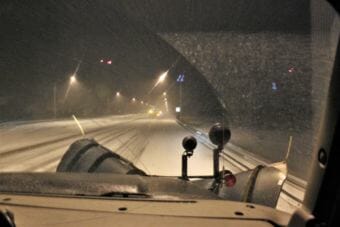
A view from the front seat of a DOT plow truck as it makes its way south on Egan Drive. (Photo by Adelyn Baxter/KTOO)

It’s winter, and that usually means plenty of snow and ice.

Or at least it did in November, when I had the chance to ride shotgun in a 54,000-pound plow truck to learn a little about how roads in Juneau are cleared.
We were scheduled to leave at 4 a.m. from the Department of Transportation’s maintenance bay off Glacier Highway.

Snow was falling and four huge trucks were idling in the parking lot when I arrived, ready to head out for the early shift.

It was one of the first snowfalls of the season, and I was excited to live the dream of every truck-loving little kid.

“Do you get a lot of people asking for rides?” I asked my driver, Richard Asplund, before we set out.

“No, we don’t get a lot of requests,” he replied, laughing. “I have a daughter and no, there’s no way I’d bring her out here. It’s too dangerous.”

I climbed up into the front seat of Asplund’s truck and we set off into the early morning darkness.

A brine truck pre-treated the roads in anticipation of the snow the night before.

Egan Drive was almost empty as Asplund fell into diagonal formation with the other three trucks.

Each plow picked up the snow leftover by the previous one, gradually pushing all of it onto the right shoulder in a flurry of white.

“The snow’s real light today, so as long as we’re not going too fast, we shouldn’t blast any mailboxes or garbage cans over,” Asplund said as we drove. “But if it’s wet snow and there’s a lot of it, it’s a real hazard. If you forgot and you just started driving, you’d rip them all off.”

Ahead of the trucks, graders worked the intersections clearing berms.

Asplund grew up on Prince of Wales Island and came to Juneau two years ago from Petersburg. He got started as an equipment operator in the logging industry, but started working for DOT after the jobs dried up.

A view inside the cab of a DOT plow truck, where an array of controls allow the driver to adjust their plow level and release brine or sand onto the road as they drive. (Photo by Adelyn Baxter/KTOO)

It was quickly clear that he had a lot more to worry about than just driving.

In addition to watching the other trucks in front and behind, he also periodically adjusted the plow level using a brightly lit joystick that also controlled the truck’s belly blade and the sander.

“It does take some practice,” Asplund said. “Most of us have been around equipment for a long time, so that helps.”

The biggest hazard for plow drivers comes when cars try to pass them while they’re plowing in formation. The trucks are heavy to begin with and the extra winter equipment makes stopping quickly impossible.

“It’s just more things I have to watch and be careful for,” Asplund said as a pickup truck began to pass us on the left. “He’s not gaining anything. If he would just stay back he would be much better off.”

Even driving as slowly, it’s stressful when other drivers get between the trucks.

At one point, Asplund pointed out the long tow plow attached to the back of the truck ahead of us.

“You can see that that tow plow’s pulled out sideways now,” he said. “When he has to turn or pull it back in, it’s going to lengthen out and it’s going to swing out behind him. If that car’s out behind him it’ll smash the car, or cause a wreck.”

Drivers like Asplund work 7-and-a-half-hour days, five days a week, not counting overtime during snowstorms. He said they worked 10 hour days last winter.

The rest of the year, he is a foreman on DOT’s chip-sealing crew, traveling around the Southeast fixing roads.

He’s been to just about every town in Southeast.

While plowing is not his favorite part, Asplund said he enjoys his job because “it’s always something different.”

“You’re always learning something,” he said.

After a few hours, Asplund dropped me back at the garage and immediately headed back out.

The next shift would be in at noon.

Southeast District Superintendent Scott Gray said Egan Drive is the only Priority Level 1 road in Southeast Alaska.

That designation has to do with traffic volume. It also means when snow falls, that’s where the plow trucks head first.

After Egan, the trucks split up to tackle other state roads; Thane Road, North Douglas Highway, out the road, etc.

Gray tries to line up work schedules with the weather, but state budget cuts have limited overtime.

“They go out and they work a shift in the morning and then in the afternoon they’re back at home,” he said. “It’s difficult for them because they can’t go back out and take care of it again. They have to wait for their next shift.”

At the start of the season, Juneau’s plow team was short a full-time heavy equipment operator and a winter seasonal employee.

“We do definitely feel it when we’re not fully staffed,” Gray said.

Gray echoed Asplund’s concerns over motorists passing plow trucks.

He also said pedestrians should wear reflective clothing and carry a flashlight whenever they’re walking along the roads in winter, anything to let drivers know you’re there.

Plow drivers often can’t see pedestrians until the last moment.

“It’s a huge safety concern for them, they don’t want to hurt anybody,” he said. “They want to go home safe. They want everybody else to go home safe.”

As I drove home on freshly plowed roads that morning, I had a new respect for the folks who keep them clear.

The team doesn’t get a lot of attention, but they keep Alaska’s capital running.

Watch what it’s like to sit shotgun in a plow truck:

Randy Quinto named head high school football coach for merged Juneau team

Thunder Mountain High School football coach Randy Quinto oversees his team at the Juneau Maritime Festival on Saturday, May 6, 2017.
Thunder Mountain High School football coach Randy Quinto oversees his team at the Juneau Maritime Festival on Saturday, May 6, 2017. (Photo by Quinton Chandler/KTOO)

Juneau’s combined high school football team has a new head coach.

The Juneau School District announced this week that Thunder Mountain High School head coach Randy Quinto will lead the fledgling team next season.

This fall, the district announced the decision to combine the Juneau-Douglas and Thunder Mountain teams and cheer squads in order to save costs and address declining rosters. The Alaska School Activities Association approved the request in November, allowing the district to move forward with the merger.

Director of Student Services Bridget Weiss said a committee of coaches, boosters, activities directors, administrators and football players from both high schools held interviews and made the coaching decision.

“We had two quality coaches both with experience in our system and the committee did their best to make a decision that put a football program for our community in the best position possible,” Weiss said.

Juneau-Douglas head coach Kevin Hamrick was the other candidate.

Quinto has served as head coach for the Falcons the past three years, leading them to the playoffs the last two seasons. He teaches weight training and conditioning and work readiness at Thunder Mountain.

Quinto was named 2016 State Coach of the Year in the medium schools category.

Weiss said another committee made up of district staff, parents and students will present two or three options for the new team’s mascot and colors in January. The student bodies of both schools and Yaakoosge Daakahidi High School will then vote on them.

“Kids are excited about the opportunity of coming together,” Weiss said. “We’re getting decisions made as efficiently as we can so that we can move forward.”

The district still awaits a final decision on which conference it will be playing in from ASAA.

UA president: Flat funding limits education, training and economic development

The University of Alaska's budget and enrollment have been in decline since 2014. (Graph courtesy University of Alaska)
The University of Alaska’s budget and enrollment have been in decline since 2014. (Graph courtesy University of Alaska)

Gov. Bill Walker is proposing flat funding for Alaska’s university system for the budget year that begins in July.

University of Alaska President Jim Johnsen said in a statement Friday, “A status quo budget will compound the impact of four straight years of budget cuts, and limits our ability to make much needed investments in student education, training programs and the economic development our state needs.”

The university’s annual budget has declined by more than $60 million since 2014, forcing cutbacks. The university employs 1,183 fewer people than it did three years ago. Student enrollment has declined 15 percent.

The University of Alaska Board of Regents had requested a $341 million budget. Walker’s proposal is for $317 million.

The regents also requested $50 million for a maintenance backlog of more than $1 billion. The governor proposed $70 million.

In November, the regents approved a 10 percent tuition increase for most campuses over the next two academic years.

Local athletes hope to represent Juneau at Native Youth Olympics

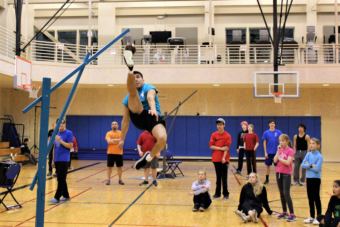
Kyle Worl demonstrates the One Foot High Kick, and event in the Native Youth Olympics. (Photo by Adelyn Baxter/KTOO)

Every year, hundreds of students from around the state gather in Anchorage for the Native Youth Olympics. But Juneau hasn’t sent a team in more than 30 years.

Recently, athletes gathered in a gym on the University of Alaska Southeast campus to test their skills.

For the Alaskan high kick, one of the main events in the Native Youth Olympics, athletes position themselves one by one beneath a small, furry ball hanging from a pole about 5 feet off the ground, squatting on one foot while holding the other with their hand.

Each athlete pushes off suddenly, kicking one foot into the air above their head while still holding the other, in a kind of pretzel-handstand.

Their foot meets the furry ball, leaving it swinging as they fall back to the ground.

The statewide competition tests strength, agility and, in some cases, pain endurance.

For the first time since 1983, Juneau is putting together a team.

Athletes compete in the Eskimo Stick Pull. (Photo by Adelyn Baxter/KTOO)

Kyle Worl is the coach and leader behind the effort.

“The long term goal is to introduce NYO as a sport in the high school at the same level as any other sport where students can take part in this year after year,” Worl said. “And they can travel to state regionals, just like other events.”

Worl has been visiting Juneau high schools and recruiting students since the fall.

About a dozen of them practice twice a week at each school, mastering the events they hope to compete in at the state competition in April.

The games began in 1972 and are open to all high school students. One boy and one girl from each team compete in each event.

The games test skills that were key to survival for Alaska Natives.

Many events reflect subsistence hunting practices, like the Eskimo Stick Pull, the favorite of Juneau-Douglas High School senior Derrick Roberts. The game involves two opponents seated across from each other trying to pull a stick from the other’s grip. Roberts is undefeated so far.

“The event relates to pulling a seal up from the water after you harpooned it,” Roberts said. “I guess I’d be really good at helping people pull up seals.”

Sportsmanship is central to the games, because working together was traditionally critical to survival.

Worl said it’s part of what drew him to Native Youth Olympics.

“The games in a sense are very individualistic, since you’re competing against yourself,” he said. “But they’re done in a community setting so you have all the other athletes around you and they’re there to help you and support you.”

Worl didn’t get into Native sports until he was a senior in high school, but now he competes with other adults every year.

The World Eskimo-Indian Olympics are every summer and the international Arctic Winter Games take place in March. He routinely medals and holds a world record for an event similar to the high kick.

This winter, he’ll demonstrate several Native games at the National Museum of the American Indian in Washington, D.C.

Thunder Mountain High School senior Josh Sheakley attempts the Alaskan High Kick at a community event at UAS. (Photo by Adelyn Baxter/KTOO)

“I don’t think I would be as involved with my community if I didn’t get into Native games,” Worl said. “I don’t think I would be as concerned with my health and my fitness and that’s something that Native games has given me, is that motivation to stay in shape, to always challenge myself, to build my personal bests in each game.”

Kyle’s uncle Ricardo Worl was Juneau’s coach back in the 1980s. He said the games offer an alternative to typical high school sports. But, there’s more to it.

“The other important reason to have Native Youth Olympics in the schools, even though it’s open to non-Natives, is for the Native kids and for that Native identity,” he said. “It’s athletic, it’s positive, and it’s actually kind of cool.”

Tryouts for the team are March 30-31.

Worl hopes to bring between 10 and 20 high school students to Anchorage, so he plans to step up recruitment after winter break.

They’ll also look for ways to pay for the trip.

The team will fundraise and search for local sponsors. The Sealaska Heritage Institute already is helping out.

Watch a video showcasing the different events:

Site notifications
Update notification options
Subscribe to notifications