The National Weather Service has issued a high wind warning beginning Sunday morning for Juneau.Wind gusts could be as high as 70 mph at times.
Taku winds are expected to start increasing Saturday night, Juneau meteorologist Wes Adkins said, and will blow through the areas of Thane, downtown Juneau, West Juneau and Douglas.
Adkins added that neighborhoods in Lemon Creek and near the Juneau International Airport also may experience about 40 mph winds. The wind may cause flying debris.
“People should look around their yards, look around the parking lot if you’re a business,” Adkins said. “If you have anything in the wind-prone areas that could be lifted or transported in the strong gusty winds then you might want to pick that up or secure it.”
Snowfall is expected Sunday evening with accumulations of about 2 to 4 inches possible, Adkins said. Drivers and pedestrians should exercise precaution.
“In places like downtown Douglas, Thane, West Juneau, if you’re a pedestrian you could get some brief bouts of blowing snow and that has a tendency to make the visibility go way down,” he said.
The warning lasts until 9 p.m. Sunday. Winds should die down by Monday night.
Many Juneau residents were relieved to learn that offshore tsunamis, like the one anticipated Tuesday morning in the Gulf of Alaska, pose little threat to communities not situated on the coast.
But a different type of tsunami, one generated by a nearby earthquake or landslide, for example, could quickly pose a problem.
The biggest threats to Juneau will come with no warning, according to Tom Mattice, Juneau’s emergency programs manager.
“We recognize here in the city that our greatest threat is from a localized tsunami. That’s going to be a no-notification event,” Mattice said. “That would be a landslide, whether submarine or above ground into a nearby body of water creating an event that’s not going to go past buoys and it’s not going to be an hour from now, it’s going to be minutes or seconds.”
Juneau does not have a tsunami warning system, like in Sitka and Kodiak where sirens blared Tuesday.
Juneau has never qualified for federal funding for those systems because our offshore tsunami threat is low.
“If an earthquake is big enough to knock you down, then you should consider going to higher ground,” Mattice said, back in October. “If an earthquake is longer than 20 seconds or more, it’s estimated to be greater than a 6.0, and if you live in an area that you feel is compromised, you should seek higher ground.”
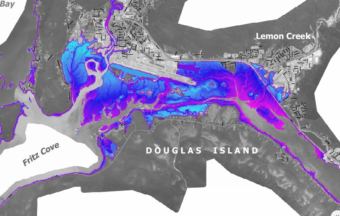
One map predicts the highest potential flooding after an offshore tsunami caused by an earthquake.
The other does the same, but for waves from an inshore tsunami caused by submarine landslide or a seiche, or when water in an enclosed area sloshes back-and-forth as if it were being carried in a bucket of water.
The offshore tsunami map shows up to 16 feet of flooding around much of Gastineau Channel. The inshore tsunami map predicts up to 50 feet of flooding along the channel.
“The most important thing for people to recognize in Juneau is, you need to look at the maps, you need to know where the affected areas are and if you feel an earthquake, you need to take it upon yourself to evacuate,” he said.
While Juneau hasn’t experienced any tsunamis in recent memory, areas nearby have.
Lituya Bay is known for being a tsunami prone area.
In 1958, an earthquake triggered a landslide that forced a huge wave out the mouth of the bay, sinking two fishing boats.
Skagway experienced a landslide-generated tsunami in 1994 that killed one person and caused more than $25 million in damage.
Former Juneau Rep. Beth Kerttula stands with other lawmakers on the steps of the Alaska State Capitol on Jan. 20, 2018. (Photo by Adelyn Baxter/KTOO)
Hundreds gathered outside the Alaska State Capitol Saturday morning for the 2018 Women’s March on Juneau. They held signs saying “The Future is Female,” “Time’s Up” and “We need a leader, not a tweeter.”
This year’s local contingent of the international event saw upwards of 800 people come together. They came to voice their dissatisfaction with President Donald Trump and many of the policies enacted during his first year in office.
Former Juneau Rep. Beth Kerttula told the crowd what they can do to fight back.
“My family’s run for office at least 20 times, and now it’s your turn,” Kerttula said. “I want every one of you to think about it and if you have the time and you can do it, I want you to run. It’s the only way we’re going to change things.”
Juneau-Douglas High School senior Skye Van Valin spoke about the need for a more inclusive society and to continue working for causes you believe in. Van Valin is involved in numerous social justice groups at school and in the community.
“It wasn’t like a conscious decision for me, you know? I feel like it’s less difficult to be an activist than just sit back and watch bad things happen,” Van Valin said.
March emcee Sara Hannan said outlooks like that were exactly what Saturday’s march was all about. She said she and other organizers hope it inspires more women to run for office in 2018 and push for progressive action in their communities.
“I think we had more people than we thought might show up with such little advance notice, and so many young people,” Hannan said. “To women of the retirement age it is good to see the baton being passed and the willingness to take up the fight.”
After the program, the crowd marched down Main Street to Marine Park. Some speakers went to nearby coffee shops afterward to continue the conversation with participants.
Women’s March participants march down Main Street in downtown Juneau on Jan. 20, 2018. (Photo by Adelyn Baxter/KTOO)
A child looks on at the Women’s March event in Juneau on Jan. 20, 2018. (Photo by Adelyn Baxter/KTOO)
Protesters gather at the steps of the Alaska State Capitol on Jan. 20, 2018, for the Women’s March on Juneau. (Photo by Adelyn Baxter/KTOO)
Singer Jocelyn Miles serenades protesters at the 2018 Women’s March on Juneau on Jan. 20. (Photo by Adelyn Baxter/KTOO)
Protesters gather outside the Alaska State Capitol for the Women’s March on Juneau on Jan. 20, 2018. (Photo by Adelyn Baxter/KTOO)
Protesters march down Main Street in downtown Juneau on Jan. 20, 2018. (Photo by Adelyn Baxter/KTOO)
Skye Van Valin and Tasha Elizarde pose as they complete their march from the Alaska State Capitol to Marine Park on Jan. 20, 2018. (Photo by Adelyn Baxter/KTOO)
Correction: In an earlier version of this story, we misstated that Rep. Ivy Spohnholz spoke at the rally. She was sick and did not attend.
Graduating Juneau-Douglas seniors walk to Harborview Elementary School in 2017. (Photo courtesy Juneau School District)
Education will once again be at the front of many Alaskans’ minds, including Southeast legislators, as the legislative session gets underway.
Gov. Bill Walker is proposing $1.26 billion in education funding for the budget year that begins in July, which maintains the current year’s base student allocation used to determine K-12 funding.
The numbers are one matter.
Whether or not the budget will pass in a timely fashion is another.
Last year, fiscal uncertainty forced many school districts across the state to hand out pink slips, only to rehire many of those teachers once the final budget passed in late June.
A pre-filed bill from Kodiak Republican Sen. Gary Stevens, Senate Bill 131, would require the Legislature to pass an education budget by April 1.
The Legislature used to plan out several years’ worth of education funding in advance, but that ended with the state’s fiscal crisis.
Juneau Democrat Sen. Dennis Egan said he supports reimplementing forward funding for education.
“I think we oughta do it again, because municipalities have to know what teachers are going to be paid and how many teachers municipalities will have,” Egan said. “But we pass it late, then municipalities have to go back and readjust things.”
Rep. Dan Ortiz, an independent from Ketchikan, serves as chair of a subcommittee on the state’s education budget.
A former teacher, Ortiz supports the idea of forward funding education and feels cautiously optimistic that other legislators do too.
“I think there’s a possibility,” Ortiz said. “I’m hearing that there might be some support for that from the Senate. I know there will be some support for that from the House Majority side. So we’ll see if it happens, but I’m hopeful.”
The governor’s budget also proposes flat funding the University of Alaska’s operations.
Separately, it calls for $70 million for the system’s substantial deferred maintenance backlog.
Sitka Republican Sen. Bert Stedman said he supports the governor’s budget proposal. He believes the university system needed to go on a “financial diet.”
Legislators are constitutionally obligated to fund K-12, and they should prioritize that, he said.
“But if the university wants a huge budgetary increase when we’re losing — have a deficit of $2.5 billion plus — my response to that meeting when they come to my office is, ‘Good luck,’” Stedman said. “Fix the problem first.”
But some legislators may push back against that outlook.
Rep. Justin Parish said investing in higher education allows more Alaskans to stay in the state for school and, later, their careers. And that’s good for the state’s economy, the Juneau Democrat said.
“It’s very frustrating to know that 20 percent of our workforce right now is coming from outside the state,” Parish said. “And if we fail to invest in good, post-secondary education that number will only climb.”
SB 131 has been referred to the Senate’s Education and Finance committees. Regular budget hearings will be underway for weeks to come.
Juneau Community Charter School alumnae Lindsay Clark and Hannah Wilson places flowers on the stage at the school’s 20th anniversary celebration Jan. 13, 2018. (Photo by Adelyn Baxter/KTOO)
Twenty years ago, a group of parents in Juneau banded together to establish a school where they could be more directly involved in their children’s education.
Ever since, the Juneau Community Charter School has offered an alternative learning environment.
Generations of Juneau Community Charter School students, parents and teachers gathered Saturday to celebrate two decades of community learning.
Parent and volunteer Tony Newman organized the event at Juneau-Douglas High School.
“We are here to recognize those founders for their work 20 years ago and to spend time together and reflect on how far we’ve come,” Newman said.
A 1995 state law established charter schools in Alaska, and the Juneau school opened its doors in 1997. The charter school operates under contract with the Juneau School District, but curriculum and administrative decisions are left up to an elected council of parents.
The original founders, including Frankie Pillifant, saw the potential for a charter school to take a different approach to education.
“I felt that arts integration and teaching to the whole child, not just having math or just art or just history but using the arts to bring math and science, in particular, to a place where different kinds of learners could touch it and maybe learn better,” Pillifant said.
The school also emphasizes community involvement and small class sizes.
Two of Pillifant’s children attended the school, which offered kindergarten through fourth grade when it first opened.
The school operated out of a portable at Glacier Valley Elementary School for the first semester. Then, it moved to the Arcticorp building downtown where it remains today.
The school gradually expanded up to eighth grade.
Parent and community volunteers still teach many of the classes.
Enrollment is capped, and its roughly 90 students are taught in mixed-grade classrooms.
Pillifant always hoped the school would become a permanent part of the community. She said that if it weren’t for generations of parents who came after her and helped it grow, then it wouldn’t have been possible.
“The founding documents of anything, whether the U.S. Constitution or the JCCS, are interpreted along the way,” Pillifant said. “Those of us who put in the first years of giving birth to the school are now seeing how it’s grown. It’s gone through the crawling stage and the toddling stage, is it in high school now walking on its own and about to graduate? Hard to say.”
Saturday’s event also helped raise funds for this year’s eighth-grade trip to Denali National Park in May.
Student Marilla Blatnick designed T-shirts to sell for the fundraiser. I asked her what she likes most about attending the charter school.
“We don’t get grades,” Blatnick said.
Instead of letter grades, teachers provide parents with narrative reviews of student progress. But she also enjoys the emphasis on the arts.
“That’s pretty nice too, cause most schools don’t have stuff like that,” she said.
Alumni from the charter school’s first-ever class attended the celebration.
Lindsay Clark, who now teaches music at Auke Bay Elementary School, fondly remembers visits from local character Dee Longenbaugh, who captivated students with stories of Alaska history, as well as the music instruction she received.
Clark now plays the violin in the Juneau Symphony.
“I like to be involved in the community through music,” Clark said. “And then I also teach as part of Juneau Alaska Music Matters, and the director of it is actually my fourth grade teacher from the charter school, so it’s kind of come full circle.”
Saturday’s celebration felt more like a family reunion than a school function.
By all accounts, that’s exactly what the school’s founders were aiming for.
Close
Update notification options
Subscribe to notifications
Subscribe
Get notifications about news related to the topics you care about. You can unsubscribe anytime.