Suicide Basin, pictured on June 29, 2016, from a U.S. Geological Survey webcam.
Water began draining Monday from Suicide Basin into Mendenhall River, but officials don’t yet know if it will cause flooding.
City Emergency Programs Manager Tom Mattice said residents who live along the Mendenhall River should be on alert in case water levels suddenly begin to rise.
“There’s as much water or more as there was in 2016, so if this turns into a traditional jökulhlaup we could see record flooding,” Mattice said.
“Jökulhlaup” is an Icelandic term for a flood from a glacial burst.
The U.S. Geological Survey and the National Weather Service are monitoring water levels in Mendenhall Lake and the Mendenhall River. So far, no significant rise has been recorded.
Glacial flooding in the Mendenhall area has become a routine summer occurrence the last few years.
Nico Bus lives along the Mendenhall River in a neighborhood where many backyards have seen a significant increase in erosion. He said they keep an eye out for flooding, but there’s not much else they can do.
“Sometimes, like last year, I think it was five times. Some of them are insignificant and you’re just waiting for the big one,” Bus said.
In June, researchers reported that the basin was draining rapidly, which usually signals the start of flooding. They later found that a glacial calving event likely caused water levels to rise suddenly.
Mattice said residents should exercise caution.
“Obviously it’s starting as a slow event and it could stay that way we just really don’t know,” Mattice said.
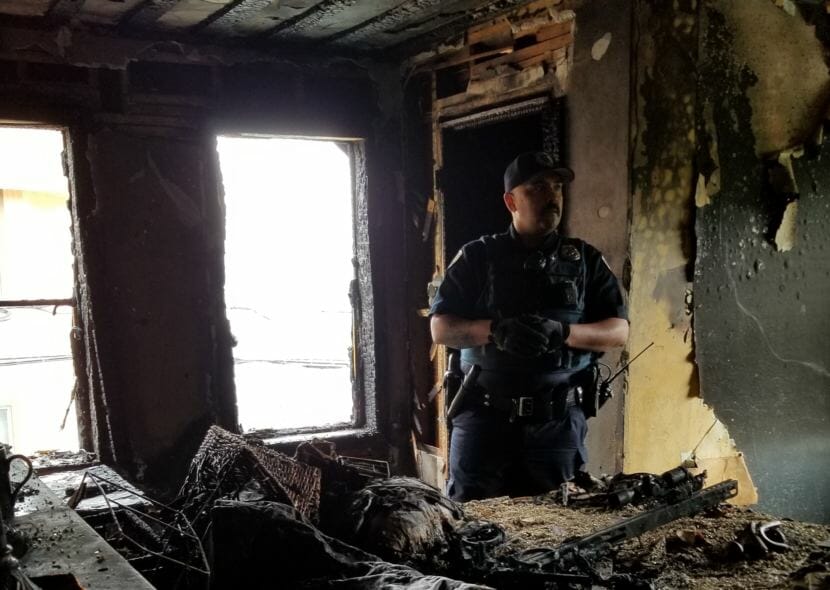
A Juneau Police Department officer stands in the burned third-floor bedroom where the fire that damaged the Dapcevich House began. (Photo courtesy of Ernestine Hayes)
When a fire broke out at a historic home in downtown Juneau in late May, the owners were relieved no one had been hurt. More than a month later, they’re still a long way from moving back in.
Alaska state writer laureate Ernestine Hayes had owned the home for about a month when she learned on May 28 that it was on fire.
She and her family were still moving their belongings into the three-story home at 505 Franklin Street, known as the Dapcevich House to many people in Juneau. It would allow Hayes to realize her dream of living in a multi-generation home.
But that plan will have to wait while insurance and rebuilding efforts play out in the coming months.
“We’re still in the preliminary stages, which is a little difficult to believe after these weeks,” Hayes said.
Hayes’ son Joshua Stephenson and his wife were in the home cleaning and unpacking when they noticed smoke pouring from the master bedroom. They got out safely before the fire department arrived.
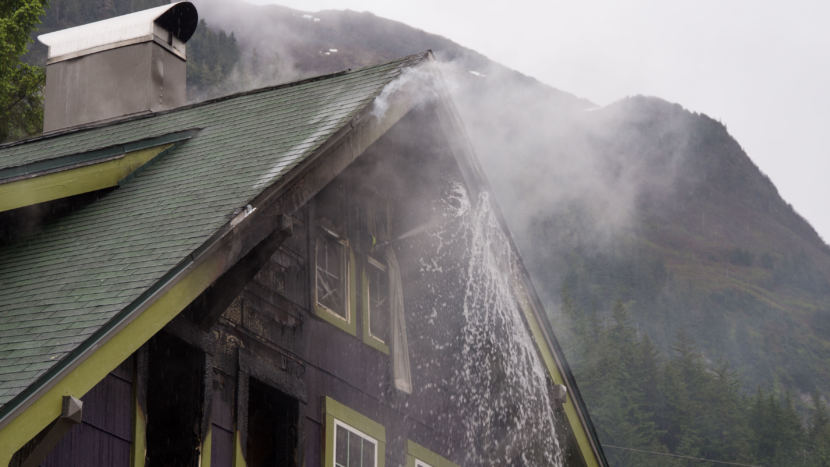
A firefighter aims a hose at the eaves of the house on Fifth and Franklin streets that caught fire May 28, 2018. (Photo by David Purdy/KTOO)
Crews quickly put out the flames, but Hayes said there’s a lot of damage.
“All the floors received water damage, actually,” Hayes said. “The main floor is the second floor, the third floor is where it started and then the attic also received a lot of water damage and smoke damage.”
Damages were estimated at $100,000.
The source of the fire hasn’t been determined, but an initial investigation by Capital City Fire/Rescue found two potential heat sources — improperly discarded smoking materials and electrical wiring. Hayes believes the home’s aging wiring was to blame. The house was built in 1913.
“When we purchased it the month before … during inspection the inspection person found a number of electrical issues that needed to be corrected before we bought it,” Hayes said.
The home was insured, and Hayes and her family are now living in a house they recently bought in the Flats.
Originally, they planned to rent that property to help pay the mortgage on the Franklin Street home.
Before they can rebuild, they need to clean up the damage inside. Before that, the house needs hazmat testing. And the insurance company has to sign off on every step.
Hayes said the third and fourth floors will need to be rebuilt.
“We’ve been given an estimate that it will probably be between six and nine months after permits are received,” she said. “Inside they will probably knock it down to studs and joists because of all the water damage.”
Though the process is long and often frustrating, Hayes said she knows they were lucky, all things considered.
Many of their possessions had not been unpacked, so they didn’t lose as much as they could have.
Still, they were worried about the boxes of Tlingit regalia that were in the attic.
Their button blankets and other items had been subjected to a lot of smoke, so they took them to a local company for ozone treatment.
“Virtually everything came out usable and in good condition, except for just a few things,” Hayes said.
Hayes said their insurance adjuster bought and read one of her books on his way up from Seattle.
When he arrived to evaluate the damage, he reminded her that her clan, the Kaagwaantaan, are known as the Burnt House People.
“To me it seems it adds value to our blankets to smell a bit of smoke,” she said. “It’s like a person having scars — it adds to their story.”
Hayes and her family still haven’t received any money from their insurance company to help with costs in the meantime.
But a local GoFundMe campaign raised more than $4,700 to help them. Hayes said the North Words Writers Symposium in Skagway also took up a collection.
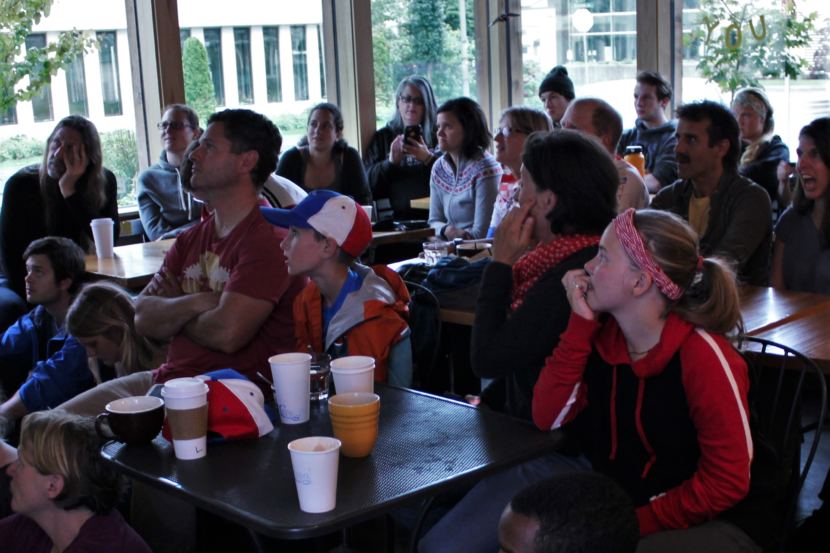
Soccer fans watch the World Cup final in Coppa on Sunday. (Photo by Adelyn Baxter/KTOO)
Soccer fans in Alaska’s capital city had few options to watch Sunday’s World Cup final.
Fortunately, a local ice cream shop opened early to screen the match between France and Croatia.
Coppa owner Marc Wheeler opened at 7 a.m. to screen the game live from Moscow. He served croissants and potica, a nut roll his Croatian grandmother used to make every Christmas.
“Croissants were more popular it seems, but we had the two tip jars and there were quite a few more tips in the Croatian tip jar,” Wheeler said.
Tip jars encourage Coppa patrons to show which team they supported in Sunday’s World Cup final on July 15, 2018. (Photo by Adelyn Baxter/KTOO)
They’re usually closed on Sundays, but Wheeler said he made an exception for the final. He screened most of this year’s World Cup games.
“It’s just part of being kind of a neighborhood café and it’s been fun to have the Cup here,” he said.
More than 50 people crammed into the small space shoulder to shoulder. Many sat on the floor when the chairs ran out. They were so intent on the game, a few would jump whenever the espresso machine was turned on.
Despite the dreary Juneau weather, a few people even ordered ice cream.
There were jerseys representing both teams present, but the crowd’s allegiance definitely leaned toward the underdogs.
“When Croatia scored the place went wild, both times,” Wheeler said.
It was a hard-fought game, but in the end France won 4-2.
John Sisk wore his Croatia jersey, purchased when he visited the country two months ago.
“Croatia did one heck of a job in the World Cup to get to this point, and France is a great team,” Sisk said. “Croatia just gutted out game after game. It was really fun to follow them.”
The soccer fans cleared out quickly as staff began to clean up. It was National Ice Cream Day, after all, and Coppa needed to get its cart ready to hand out cones.
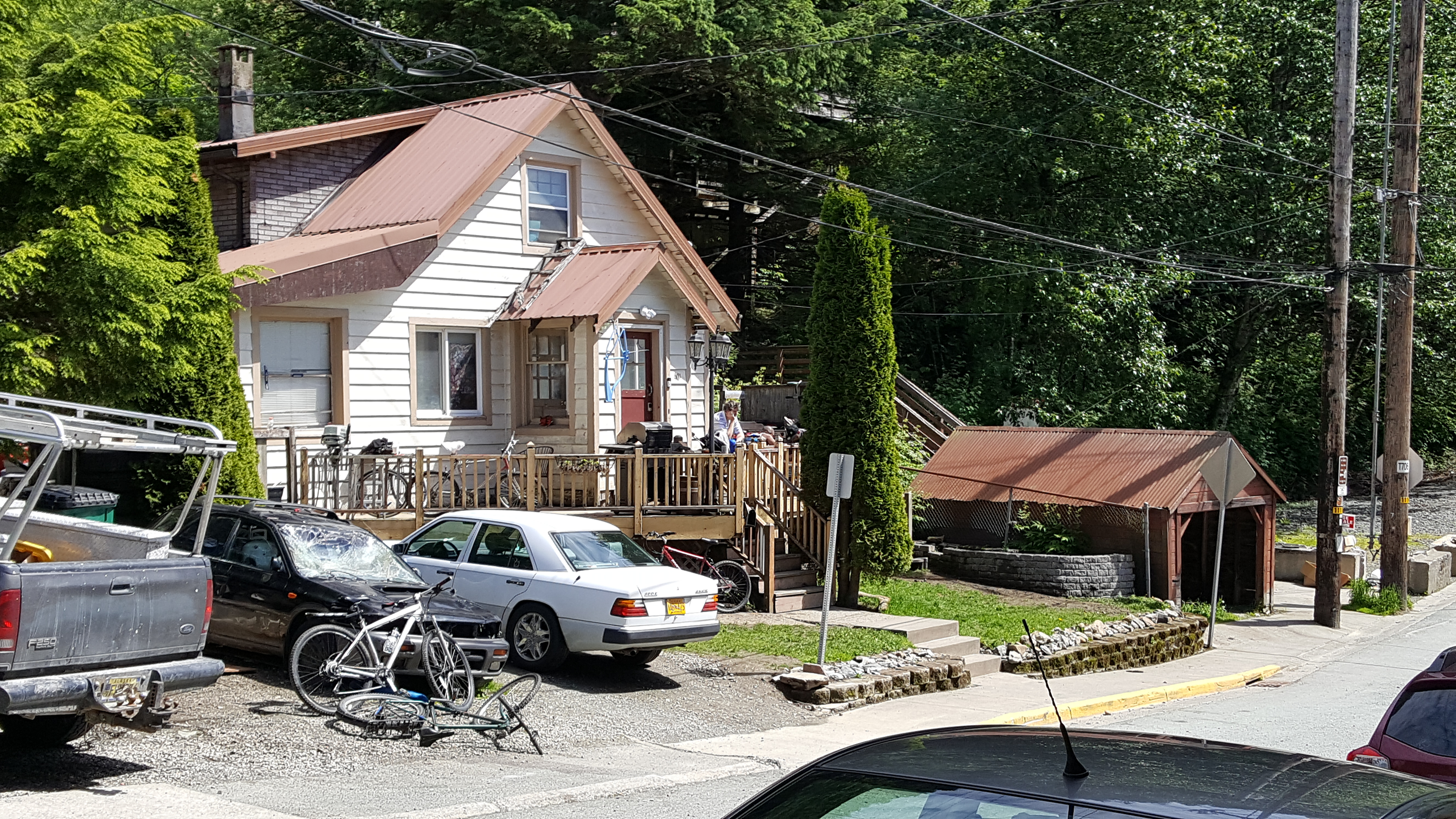
This house at 401 Harris Street in Juneau is the frequent subject of police calls, the Juneau Uptown Neighborhood Association says. (Photo by Tripp J Crouse/KTOO)
A legal conflict between the mother-son owners of a Harris Street “problem property” in downtown Juneau complicates one owner’s cleanup efforts.
Co-owner Camilla Barrett’s power of attorney David D’Amato explained Tuesday night the legal issues surrounding 401 Harris Street at an Uptown Neighborhood Association meeting at Holy Trinity Episcopal Church.
More than 60 community members attended the meeting with questions for representatives of the Juneau Police Department and the City and Borough of Juneau.
She said the building will install 12 new cameras outside the building to deter crime.
“The neighborhood is really, really concerned about these problems,” Tupou said. “We’ve tried to be a good neighbor and put in lots of good cameras because sometimes good neighbors involve having good cameras, and that’s kind of where we’re at with our neighbors there.”
Tupou’s building sits across the street from the house at the center of the neighborhood’s concerns.
The Harris Street house is owned by Juneau resident James Barrett and his mother, Camilla Barrett, who lives in Washington state.
In recent years, the residence has become a regular fixture in the city’s police logs.
Juneau police have logged more than a hundred incidents — ranging from parking complaints to drug activity — at the address since the beginning of 2017.
Neighbors asked police at the meeting why all the calls, search warrants and arrests associated with the home have not been enough to shut it down.
Juneau Police Chief Ed Mercer understood their frustration, but said police must build a solid case to convict anyone.
Receiving 911 calls doesn’t help them unless they can get good evidence.
“We need good witnesses, we need people to say ‘that person did that’ … If we were able to build a solid case on it, we would move forward with it,” Mercer said. “I know it’s frustrating, I know it’s scary.”
Camilla Barrett pays D’Amato to be her power of attorney and to make decisions on her behalf regarding properties she owns in Juneau.
Camilla Barrett hired D’Amato in 2016 to help address problems with some of the Barretts’ other properties nearby — the Bergmann Hotel and two rental homes.
He oversaw the eviction of tenants from those properties, but told neighbors Tuesday that it appeared some of them had merely moved in with James Barrett.
After the meeting, D’Amato rushed to catch a flight but speaking by phone from the airport said that his goal is to get 401 Harris Street cleared out in the coming months.
“We cleaned up the Bergmann; we cleaned up the rental houses; we got the lot squared away,” D’Amato said. “We’ve done tremendous, tremendous work in the last 18 months. We still need to get this one done. … We’ll get this done, I’m not worried about it.”
Camilla Barrett previously attempted to file for legal guardianship of James in court in December 2017, D’Amato said, due to his health problems and concern that he could not take care of his property. The case was dismissed in February.
Now they’re trying to another legal tactic, called partition — a kind of divorce between property owners, but not quite.
“The problem is, right now, two parties have half of a cake and they say we can’t agree on how to eat or distribute this cake,” he said.
The judge will decide whether one party buys the other out or the property will be sold and the profits split.
D’Amato is confident the partition will be successful. Then several steps will be taken to legally evict and remove James Barrett and the other people living at the house.
Camilla Barrett wants to see the property cleaned up just as badly as the neighbors do, D’Amato said.
James Barrett could not be reached for comment.
The Uptown Neighborhood Association will hold a follow-up meeting Aug. 7.
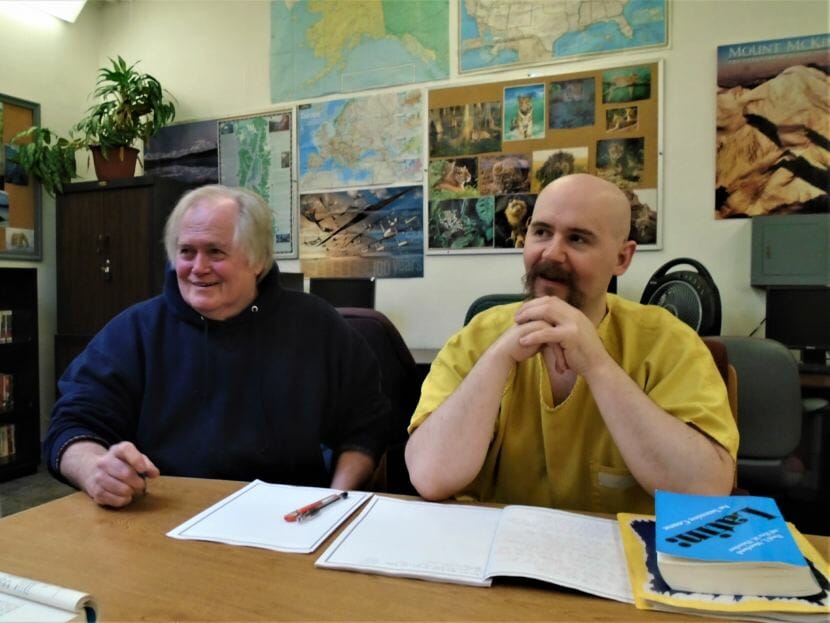
Jim Hale and Lowell Ford sit in the library at Lemon Creek Correctional Center after Latin class. (Photo courtesy Paul McCarthy/Alaska Department of Corrections)
Taking GED or vocational classes in prison is not unusual. But at Juneau’s Lemon Creek Correctional Center, a small group is studying Latin, a language that’s been dead for centuries.
Visitors to Lemon Creek Correctional Center pass through three locked gates. You surrender your phone, keys — pretty much everything but your ID.
Once you pass through the final door, you’re locked in with 200 inmates.
“I call them my captive audience,” said Jim Hale, a former college professor who teaches writing at the prison.
He began teaching at Lemon Creek about four years ago. Over time, he grew closer with some of his more dedicated students. A few months ago one of them approached him with an unusual request: Would he consider teaching Latin?
Hale learned Latin years ago as a graduate student studying Renaissance literature, but he hesitated.
His Latin was rusty, and why would anyone want to learn a dead language, let alone in prison?
“The one thing about Latin is, you’ll see anybody who’s been to jail or has to deal with legal process, you see a lot of Latin words a lot of people are not understanding,” said Lemon Creek inmate Lowell Ford.
He’s had enough experience with legal proceedings to recognize a number of Latin phrases, but that’s not why he asked Hale to teach the class.
Since joining Hale’s writing class four years ago, Ford has worked hard to improve his style. But he’s a perfectionist — constantly editing and revising his work, never quite feeling satisfied with it.
He likes to write as concisely as possible, which makes choosing his words carefully very important.
“With no grasp of Latin then the grasp of English seems to be kind of fleeting and you lose where the word came from or what the word truly is supposed to mean,” Ford said.
In his writing classroom, Hale peppers his lectures with discussions of Latin etymology.
He always told his students that understanding the original meaning of the words you want to use is the only way to really get across what you want to say in writing.
Knowing that, he said yes. The former professor and freelance writing instructor even bought the Latin textbooks out of pocket.
“It was a way of honoring our friendship,” Hale said. “And then, he found other guys who wanted to do it!”
The class meets weekly for an hour in the prison library.
During a recent lesson, they examined a poem about Dido, queen of Carthage.
Four men in faded yellow jumpsuits took turns translating lines of text into English. Sometimes they paused on a tricky word until Hale offered up a gentle hint to get them going again.
Ford says the vocabulary is particularly tricky for new learners. So much of English evolved from Latin, as did the meanings of many words.
“When you’re memorizing Latin original words, sometimes the English words try to superimpose themselves over the Latin,” Ford explained.
“For instance, our words ‘fact’ and ‘fiction’ come from two Latin words meaning the same thing,” Hale added.
Ford said he spends more than an hour each night in his cell going over vocabulary and conjugation. He’s been reading the Aeneid in his spare time.
“It’s like learning how to spell for a spelling bee; you take a list of words and you repeat them numerous times and then you write them and you write them and you write them,” he said.
They don’t spend much time on pronunciation — Latin hasn’t been spoken as a native language for more than a thousand years, after all. The goal is simply to understand the texts they study.
Hale said teaching the class forced him to revisit a subject he thought he’d never study again.
“It’s an old axiom that you never really learn a subject until you have to teach it,” Hale said. “I feel like I’m learning Latin again with the guys.”
Ford has been at Lemon Creek for about six years. He’s not due for release until 2020.
He’s 39 now, and he knows learning new languages and subjects will only get harder. But he said he’s grateful for the opportunity.
“It makes a section of time that would normally not have much value for me, turn into something that can be positive,” he said.
The class may go on hiatus later this summer while Hale is out of town, but Ford said he plans to continue practicing alone and with his classmates.
Early Friday morning, Juneau police arrested three people after an altercation with officers responding to a report of gunshots downtown.
According to a police news release, when officers got to the 400 block of Harris Street, they found the noise likely came from fireworks. They found the man believed to set off the fireworks, and issued him a citation.
That set off its own series of events that led to the following arrests:
While officers wrote the citation, 33-year-old Kelly Stephens came out of a nearby residence and screamed at officers. Police say he fought as he was being arrested for interfering. An officer suffered minor injuries in the scuffle and some police equipment was damaged.
During the struggle, police say two other people came out of the residence and acted aggressively toward officers. Police warned one of them, Felicia Evenson, to move away. Officers used a Taser on her when she refused to comply and arrested her.
The second person, David Fuchs, ignored commands to move away during the investigation. According to police, officers subdued Fuchs with a Taser when he reached for something in his pocket. They arrested him and found a knife and another sharp metal object in his pockets.
Stephens, Evenson and Fuchs are being lodged at Lemon Creek Correctional Center. Online court records do not list attorneys for the them.
Police Lt. Krag Campbell would not confirm the address, citing department policy.
Residents in the area plan to hold a neighborhood meeting on Tuesday, July 10, at Holy Trinity Church to discuss problems associated with 401 Harris Street. They invited the police, the mayor and members of the city development office to discuss ongoing issues with safety.
Police records indicate more than a hundred calls related to 401 Harris Street were made since 2017.
Correction: A previous version of this article stated that the meeting with neighbors would be held June 10. It is being held July 10.
Close
Update notification options
Subscribe to notifications
Subscribe
Get notifications about news related to the topics you care about. You can unsubscribe anytime.