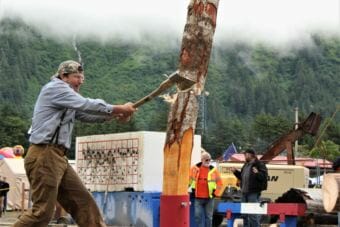
A competitor participates in the men’s vertical chopping event on Sunday. (Photo by Adelyn Baxter/KTOO)
Juneau residents gathered at Savikko Park this weekend to celebrate the region’s mining and logging industries once again.

According to Gold Rush Days organizers, 76 competitors signed up to take part in the two-day event.
Speed climbing, hand mucking, axe throwing and choker setting are just a few of the contests that test the skills used by miners and loggers past and present.
“It’s basically to keep the history going of what we’re doing and put on a show for the locals,” said Bob Chernikoff, the self-designated “Log Boss” at Gold Rush Days.
He’s been part of the event for more than 20 years and is the vice president of the group that organizes the event, now in its 28th year.
Chernikoff grew up in logging camps in Southeast and now works at Kensington Gold Mine.
He said it takes about two weeks to set up the festival grounds on the softball field.
“Probably my favorite event is watching the log rolling,” Chernikoff said. “I’m not any good at them.”
April Hoy’s whole family competes each year. She came in first in the women’s stock power saw bucking event on Sunday.
She also competed in axe throwing and the speed climbing event, where she donned climbing spurs and a harness to pull herself 25 feet up a log pole. She did it in 55 seconds.
“The Gold Rush Days is a ton of fun,” Hoy said. “I have three teenagers and they have been taking part in this since they were in the children’s events, the teens’ event and now our oldest is 19 and she competes in the adults’ event, the women’s.”
The event is free and family friendly.
All of the logs used this year were donated by Ralph “Animal” Austin.
Ralph “Animal” Austin competes in the men’s speed climbing event at Gold Rush Days on June 17, 2018. Competitors ascend a 50-foot log pole as quickly as possible. (Photo by Adelyn Baxter/KTOO)
Dominic Hoy, an employee of Coeur Mining, demonstrates setting chokers for competitors in the children’s choker setter race at Gold Rush Days on Sunday, June 17, 2018. (Photo by Adelyn Baxter/KTOO)
A competitor participates in the men’s vertical chopping event on Sunday, June 17, 2018. (Photo by Adelyn Baxter/KTOO)
The Arcticorp building, pictured here in 2014, has housed the Juneau Community Charter School for most of its 20 year history. Now, the charter school is moving into the north wing of Juneau-Douglas High School. (Photo by Lisa Phu/KTOO)
With the help of parents, professional movers and a dozen or so football players, the Juneau Community Charter School moved desk by desk into Juneau-Douglas High School this week.
The school has operated out of the Arcticorp building on Harris Street for about 20 years. It’s an aging building with a growing list of maintenance issues.
With more than 90 students from kindergarten through eighth grade, the school has been looking to move for some time, according to Principal Caron Smith.
Safety and security have become a concern as crime continues to be a problem in the neighborhood. When David Means, the school district’s outgoing director of administrative services, brought up the idea to move into JDHS, Smith said they jumped at the opportunity.
“It is definitely more than time to be out of the Arcticorp building,” Smith said.
Smith took over as the school’s first principal last year. While cleaning out her office recently, she said she found documents related to plans to move into the Marie Drake building 10 years ago. Others detailed a potential move to the building that now houses the Juneau School District administrative offices.
The school will move into five classrooms in the north wing of JDHS. It will share certain facilities like the cafeteria, gym and home economics classroom with JD students and staff.
“Everybody is going in in good faith knowing that the first year there’s going to be challenges and we can’t just base everything on a few bumps in the road,” Smith said.
Smith said the charter school will start earlier at 8:30 a.m. to simplify pick up and drop off. The high school will still start at 9:15 a.m.
The charter school signed a five-year lease with the school district with an option to renew after three years.
The $130,000 per year lease is the same amount they paid in the Arcticorp building.
“They’re all Juneau-Douglas kids and they all deserve to be in a really safe and, you know, caring environment and I think that’s what we’re getting with this location and so I’m really excited,” Smith said.
Smith said she hopes to be completely out of the Arcticorp building by Monday.
She looks forward to settling into the new space and making it feel like home for the charter school before school starts again on Aug. 20.
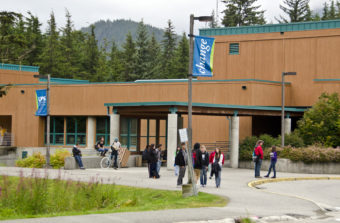
Students gather outside at the UAS Auke Lake Campus on Tuesday, Sept. 4, 2012. (Photo by Heather Bryant/KTOO)
The City and Borough of Juneau is looking to the community for help meeting the remainder of its $1 million commitment to the University of Alaska’s new education college.
The city pledged to create an endowment when the University of Alaska Board of Regents was considering where to put the new school.
So far, it has contributed $500,000 toward its $1 million pledge. Stock market gains and individual donations mean it’s now worth a little over $600,000. The budget that takes effect July 1 includes another $250,000.
The city hopes to make up the remainder of its pledge — about $150,000 — with community donations.
Assembly member Jesse Kiehl said the goal is to have 150 community donors make personal or business contributions.
“It’s important that the city started that off and started very strongly, and so this is an opportunity to broaden that throughout the community and get lots of people involved,” Kiehl said.
There have already been several $10,000 donations.
The Alaska College of Education, based at the University of Alaska Southeast in Juneau, is now the administrative center for teacher education in Alaska.
Although degree programs will continue at the Anchorage and Fairbanks campuses, the university hopes the new structure will help it reach its goal to produce 90 percent of Alaska’s teachers by 2025.
UAS Chancellor Rick Caulfield said that money will support coordination among UA’s teacher education programs, with UAS in the lead.
“It’s a significant investment by the regents of new funds into UAS and teacher education,” said Caulfield. “That’ll include additional money for marketing and recruitment of students into our undergraduate and graduate programs, our master of arts in teaching program, for example.”
The decision to base the college in Juneau was controversial.
Its creation came out of Strategic Pathways, an initiative aimed at consolidating programs and saving money in the midst of state budgets cuts.
Fairbanks was the original recommendation, but the regents ultimately voted in December 2016 to base the school at UAS.
That resulted in votes of no-confidence in UA President Jim Johnsen’s leadership last year by the faculty senates at UAF and UAA. They said faculty was not consulted prior to the decision.
Kiehl was one of the main cheerleaders in the push to choose UAS.
“It was important that the University of Alaska Southeast take the lead on teacher education because it really was the most successful program, it was the most innovative, it was the most efficient,” Kiehl said.
Kiehl pointed out that the Fairbanks and Anchorage campuses have more master’s degree programs than UAS.
He said it’s important for each of UA’s three main universities to have areas of expertise.
“Without that, the potential threats in the budget cutting times to UAS as a standalone university were tremendous,” Kiehl said.
Besides its educational importance, the campus is also one of Juneau’s biggest local employers and an economic driver in the region.
Kiehl said there’s no firm deadline for meeting the fundraising goal, but the sooner the fund is established, the better.
He and the other members of the Assembly have all agreed to contribute. The same goes for board members of the Alaska Committee, a capital city booster organization.
The Juneau Community Foundation is handling donations. The city will send out letters to potential donors in the coming weeks.
Caulfield said the university looks forward to putting the CBJ Teacher Excellence Fund to work building future generations of Alaskan educators.
“I envision that those funds will be used for scholarships and to support programs, not only here in Southeast Alaska, but all over the state,” Caulfield said.
Summer programs at the Alaska College of Education are already underway.
Steve Atwater, the new Executive Dean of the college, starts July 1.
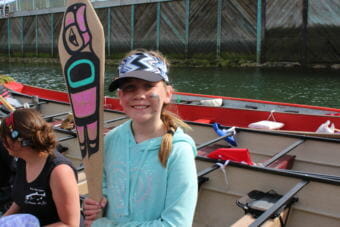
Nellie Vale of Yakutat (Photo by Adelyn Baxter/KTOO)
This week, Celebration 2018 kicked off. The festival is held every two years to celebrate Southeast Native culture, and it begins with canoes arriving into Juneau representing various tribes. This week we’re hearing from Nellie Vale who arrived in the Yakutat canoe. 10-year-old Vale introduced herself with her Tlingit name.
“My dad had me go on it once, and the first time I went on it was really fun. And also, I wanted to learn how our ancestors traveled and what it was like for them.”
“The first day we were on the canoe, it was super fun, and we only had to go nine miles. We practiced a bunch before we went, so we got to get there quickly because whenever we practiced, we tried going as fast as we can.”
“It was really fun. On the first night, we had to build a campfire. And there was one big campfire, and somebody’s socks got burned. It was so funny. Oh yeah, and somebody put their sweater by the fire, and it was literally steaming because it was drenched.”
“The first we camped out at my cousin Alejandre’s teacher that teaches kids how to carve. And he’s white, so that’s pretty good cause their trying to learn our culture.”
“The rest of Celebration … I’m probably just gonna be hanging out with my family when I have free time, and the rest of the time I’m going to be dancing at Centennial Hall and on the streets when we’re doing the parade. There’s a couple other places, I think. I forgot.”
“I think it’s just trying to keep our cultural spirit alive and making sure we don’t forget it. So I’m happy we get to do this every two years.”
Owen James poses with his daughter Leah Moss. James and Moss both came to Celebration 2018 from Hoonah. (Photo by Adelyn Baxter/KTOO)
Celebration 2018 came to a close on Saturday.
What began 36 years ago as an attempt to save Tlingit, Haida and Tsimshian cultures has become a vibrant reminder that Alaska Native traditions are alive and thriving.
In many ways, Celebration is a reunion. Indigenous people from all over Alaska, Canada, even Hawaii, come to Juneau every other year for the cultural festival.
Dancing along the parade route in downtown Juneau on Saturday, Owen James of Hoonah paused to hug friends in the crowd.
“Folks I haven’t seen in years. Maybe see them only once every two years,” James said.
This was James’ 17th Celebration. He only missed one.
“It feels great, because seeing all these younger generations pick up where we left off and to see and hear them singing the songs and drumming, and stepping up and taking the lead too, it’s awesome,” James said. “Makes you feel good inside.”
That’s significant, because there was a time when some feared their cultures wouldn’t survive.
Marlene Johnson, who spoke Friday on “A Juneau Afternoon,” said she was reluctant when she first heard the idea to host a cultural gathering for Southeast Alaska Natives. But she knew their cultures needed saving.
“It took a long time to get us to the point where we were able to convince the outside world that our culture is not bad, it was a thing of celebration,” Johnson said.
Johnson is the chair of Sealaska Heritage Institute’s Board of Trustees.
When Celebration first began, decades of cultural oppression and government schools had all but wiped out Native languages in the region.
Johnson said you never saw children wearing regalia or singing traditional songs in public just a few decades ago.
“When I saw those kids yesterday, the little boys from Yakutat, to see them dancing the way they did, I thought to myself, ‘Everything we’ve done the last 30 years has been worth it,’ when I see that,” she said.
Celebration brings thousands of people to Juneau every other year. It’s become one of the largest gatherings in Alaska.
Nearly every community in Southeast is represented on the main stage in Centennial Hall, where about 50 dance groups perform new and traditional songs.
Film screenings, traditional food contests, art shows, workshops and the ever-popular Toddler Regalia Review keep the crowds busy.
As efforts to revitalize Alaska Native languages continue, elders like James and Johnson can take comfort in seeing the younger generations take on a bigger role in Celebration each time.
James’ 11-year-old daughter Leah Moss has never missed one. She can’t wait for Celebration 2020.
“I just wish it would come more soon,” Moss said. “I don’t want to wait two years every time.”
Editor’s note: 360 North is under contract with Sealaska Heritage Institute to produce television and online video coverage of Celebration.
John Morris, a member of the Yanyeidí clan who once called the site home, raises his arm in triumph after helping to install the Gooch (wolf) totem pole at Savikko Park in Douglas. June 6, 2018. (Photo by Adelyn Baxter/KTOO)
Members of the T’aaḵú Ḵwáan gathered Wednesday at Savikko Park in Douglas for the raising of the Yanyeidì Gooch kootéeyaa, or Wolf totem pole.
The Yanyeidì Gooch (wolf) totem pole is raised in Savikko Park on June 6, 2018. (Photo by Adelyn Baxter/KTOO)
What began as a somber, rainy event became a sunny celebration of resilience as the pole was raised into position where the Douglas Indian Village once stood.
Clan members danced and sang around its base.
“This is great occasion for me. It’s been a long time coming,” said John Morris.
He was a young man in 1962 when the City of Douglas destroyed his village to make way for a harbor and park. He watched his home burn, along with the nets and fishing gear that were his family’s livelihood.
Now 78 years old, Morris said he and the other members of Yanyeidì have had to live with the pain of that day for the last 56 years.
“It represents the beginning of the healing for our people, and our people really appreciate the occasion today,” Morris said. “It has been a long time [since] our people have been able to gather together in such a way, and it’s a good way.”
The project to erect the 40-foot totem pole has been in the works for several years.
A similar totem pole went up last year in front of Sayéik: Gastineau Community School in recognition of Tlingit graves that were unearthed there during a construction project in 2012.
Goldbelt Heritage Association and the Douglas Indian Association sponsored the project.
The totem pole was funded in part by a grant from the Department of Health and Human Services.
A member of the Yanyeidí clan dances to celebrate the raising of the Gooch (wolf) totem pole at Savikko Park. June 6, 2018. (Photo by Adelyn Baxter/KTOO)
Members of the Yanyeidí clan dance in celebration around the new Gooch (wolf) totem pole at Savikko Park. June 6, 2018. (Photo by Adelyn Baxter/KTOO)
Members of the Yanyeidí clan hold pictures of their mothers and grandmothers as they watch the installation of the wolf totem pole at Savikko Park. June 6, 2018. (Photo by Adelyn Baxter/KTOO)
The Yanyeidì Gooch (wolf) totem pole is raised in Savikko Park on June 6, 2018. (Photo by Adelyn Baxter/KTOO)
Editor’s note: 360 North is under contract with Sealaska Heritage Institute to produce television and online video coverage of Celebration.
Close
Update notification options
Subscribe to notifications
Subscribe
Get notifications about news related to the topics you care about. You can unsubscribe anytime.