Alaska Beacon is part of States Newsroom, a network of news bureaus supported by grants and a coalition of donors as a 501c(3) public charity. Alaska Beacon maintains editorial independence. Contact Editor Claire Stremple for questions: info@alaskabeacon.com. Follow Alaska Beacon on Facebook, Bluesky and Twitter.
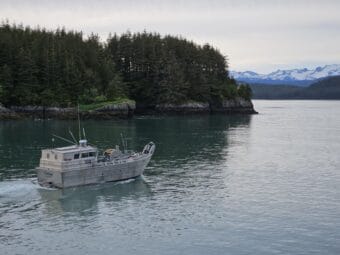
A Forest Service ranger with the Mendenhall Glacier Visitor Center acts as bear crossing guard as visitors look on. (Photo by Cam Byrnes)
The Trump administration is planning to close some U.S. Forest Service offices in Alaska under a national reorganization announced this summer by the U.S. Secretary of Agriculture.
The Forest Service, which is part of the U.S. Department of Agriculture, currently has offices in Anchorage, Juneau, Cordova, Valdez, Girdwood, Seward, Craig, Hoonah, Ketchikan, Petersburg, Sitka, Thorne Bay, Wrangell and Yakutat. It isn’t clear how many of those offices will remain open after the reorganization.
The status of the Forest Service’s tourist-focused visitor centers in Portage, Juneau and Ketchikan also isn’t clear.
Contacted for details, a spokesperson for the U.S. Department of Agriculture said by email on Friday, “Some aspects of the reorganization will take place over the coming months, while others will take more time. We will continue to provide updates as the reorganization moves forward.”
They added, “We recognize this may be difficult, but we are hopeful that affected employees will remain with us through this transition as we work to improve and continue delivering benefits to the people and communities we serve.”
In a July memo outlining the basic details of the plan, U.S. Secretary of Agriculture Brooke Rollins said she intends to close the Forest Service’s nine national regional offices “over the next year” but “will maintain a reduced state office in Juneau, Alaska, and an eastern service center in Athens, Georgia.”
Research stations, like the Juneau Forestry Science Laboratory in Auke Bay, will be closed and “consolidated into a single location in Fort Collins, Colorado.”
Nationally, Rollins said she intends to scatter more than half of the Agriculture Department’s 4,600 Washington, D.C.-based administrators to five regional hubs; one each in Utah, Colorado, North Carolina, Missouri and Indiana.
Cottongrass wafts over the tundra in the Arctic National Wildlife Refuge on Sept. 2, 2006. (Steve Hillebrand/U.S. Fish and Wildlife Service)
A U.S. District Court judge in Anchorage has ruled against the state of Alaska in an 11-year-old legal dispute that has significant implications for the Arctic National Wildlife Refuge and state finances.
There are 20,000 acres of potentially oil-rich land between the two waterways, and the state of Alaska had sought ownership of the area — sited just to the east of the Prudhoe Bay oil field — for oil and gas drilling.
This map, published by the Alaska Department of Law as part of its summary judgment motion, shows the area contested between the state of Alaska and the federal government. (Screenshot from Alaska Department of Law)
While the federal government is now advancing plans for oil and gas leasing in the disputed area, the decision to keep it under federal control means that if oil and gas are discovered there, the state of Alaska would receive far less revenue than it would if it were state-owned land.
“The state of Alaska is disappointed that the court failed to recognize the state’s ownership of this disputed area on the border of the Arctic National Wildlife Refuge,” said Patty Sullivan, communications director for the Alaska Department of Law, which brought the case against the federal government.
“This land may hold significant resource potential for the future of energy for Alaska and the United States and would likely be thoroughly explored and developed under state management. We will evaluate our options and are glad to, at least, have a federal administration currently in place that recognizes the importance of responsible resource development in this area,” she said.
Attorneys for the U.S. Department of the Interior and the U.S. Department of Justice did not return messages seeking comment.
The state’s dispute with the federal government revolves around whether federal mapmakers viewed the Staines River as a separate river from the Canning, or simply a “distributary,” a different channel of the same river, in 1957.
The Bureau of Land Management used the boundary drawn that year to create the Arctic National Wildlife Range in 1960, and it became the refuge in 1980. Maps published at that time show the border running along the Staines River.
As Gleason explained in her 74-page order, “If the Staines River was considered to be part of the Canning, then the extreme west bank would follow the west bank of the Staines distributary of the Canning River. But if the Staines and the Canning were considered to be two separate rivers, then the boundary would follow the west bank of western-most channel of the main Canning River.”
The dispute also included a marker designating the northwest, seaward boundary of the refuge, but the main issue was about the river-defined border.
In 2014, the Alaska Department of Natural Resources requested ownership “of certain lands west of” the Arctic National Wildlife Refuge.
In 2016, the U.S. Bureau of Land Management responded to the state’s request, saying the state had already selected all available land in the area. The state protested, saying that federal officials were drawing ANWR’s border west of where it should have been because they were relying on the Staines River, not the Canning.
The state appealed to the U.S. Interior Board of Land Appeals, which ruled in favor of the BLM. The state sued over the issue in 2022 and won an early victory when Judge Gleason ruled the following year that the land appeals board failed to consider a 1951 map that showed the Staines as a separate river from the Canning.
But in 2024, the land appeals board again ruled against the state, which promptly renewed its case in the U.S. District Court and requested summary judgment, a request that was answered Wednesday.
Explaining her order, Gleason noted a 1906 U.S. Geological Survey dictionary that labeled the Staines and the Canning as the same river, but “on the other hand, some contemporaneous maps label the two rivers separately, indicating that the Staines and the Canning may have been considered to be two separate rivers. And yet other contemporaneous maps do not label the Staines or do not separately label the Canning River at the mouth,” she wrote.
While that might have favored the state’s position, Gleason concluded that the land appeals board’s interpretation of the border was reasonable, not arbitrary, was supported by substantial evidence and wasn’t contrary to law, meaning that the state doesn’t have grounds to overturn it.
Gleason concluded, “the court upholds the IBLA’s finding that the northwest boundary of the refuge follows the Staines River, a distributary of the Canning River.”
If the state chooses to appeal Gleason’s decision, it will have 30 days after final judgment.
Gov. Mike Dunleavy discusses his new proposed omnibus education legislation at a news conference on Jan. 31, 2025. (Photo by Corinne Smith/Alaska Beacon)
Alaska Gov. Mike Dunleavy on Monday vetoed Senate Bill 54, a bill that sought to extend and expand the duties of the State Board of Registration for Architects, Engineers and Land Surveyors, including licensing interior designers.
Sen. Matt Claman, D-Anchorage and the bill’s sponsor, said he learned of the veto Tuesday and said it could come up for a possible override vote in January, when lawmakers convene for the regular session.
As written, SB 54 would have allowed interior designers to register with the board, enabling their work on large, public-use projects to be submitted to permitting agencies without an engineering review.
In his veto message, the governor said the bill does not define “interior design,” and said “there is no public safety rationale for creating a new title and bureaucracy. The expansion increases cost and confusion without a demonstrated benefit.”
Claman said the bill deliberately left the definition of “interior design” to the board as part of a legislative compromise.
The governor also offered two other reasons for his veto, saying that one section could eliminate the state’s ability to select contractors on price, and that another section could require residential wastewater work to be done by licensed professional engineers, increasing costs for housing.
Claman said the governor’s reasoning appears to be based on different legal interpretations than ones he relied upon when drafting the bill.
“Obviously, I was very disappointed,” he said of the governor’s veto. “I can’t say I was expecting it, but I just wasn’t sure where the governor was.”
The governor’s veto of SB 54 is his eighth veto of a policy bill so far this year. Two of those vetoes have been overridden. While the number of vetoes is low in absolute terms, it represents a record-high percentage of vetoed bills.
Lawmakers passed 33 bills through both House and Senate this year, meaning the governor has vetoed almost a quarter of all passed bills. No other governor has come close to that veto rate.
One bill remains pending on the governor’s desk. That’s Senate Bill 113, which would boost vocational-technical education and student reading programs with proceeds from a revised state corporate income tax.
The governor has previously expressed skepticism of the bill, and at a news conference in May, he implied he would veto it. That was before lawmakers overrode his veto of a separate bill that allocates funding from SB 113 to education projects.
Dunleavy has until Oct. 1 to decide whether to veto it, sign it, or allow it to become law without signature.
Gov. Mike Dunleavy discusses his new proposed omnibus education legislation at a news conference on Jan. 31, 2025. (Photo by Corinne Smith/Alaska Beacon)
Alaska’s governor will not withdraw an executive order proposing to create a new state Department of Agriculture, he said in a letter sent Monday to the leaders of the state House and Senate.
Gov. Mike Dunleavy’s letter comes days after a joint House-Senate panel voted to spend up to $100,000 on a lawsuit against the governor if he goes ahead with his proposal to create the department unilaterally.
Alaska is one of only two states without a cabinet-level state Department of Agriculture, and legislators have spoken favorably about the idea of creating one, but a majority of the House and Senate want to authorize that new department through law, not by the governor’s executive order.
In March, the Legislature voted 32-28 to reject an administrative order that would have created the Department of Agriculture by splitting off part of the Department of Natural Resources, the agency that currently oversees agriculture.
Shortly before the vote, lawmakers in the House and Senate introduced new legislation to create the department. Neither the House bill nor the Senate bill advanced to a final vote, and either could be taken up during the next regular legislative session, which begins in January.
When Dunleavy called lawmakers into special session in August, he reissued the executive order, but the leaders of the state House and Senate declined to accept the order as valid, saying that the Alaska Constitution does not grant the governor the power to issue an order during a special session.
Lawmakers also say they believe that it isn’t legal to reintroduce a previously rejected order.
“There clearly exists a disagreement between the executive and legislative branch as to the governor’s ability to introduce an executive order in a special session,” the governor wrote in Monday’s letter. “When such a dispute exists, it is appropriate to seek clarification from the courts.”
The governor’s letter notes that lawmakers could have met during the special session to vote down his executive order. Legislators have previously said they did not wish to do so, because taking the vote would have been the equivalent of acknowledging that the governor has the power to issue an executive order during a special session.
Rep. Sara Hannan, D-Juneau, is chair of the Legislative Council, the joint House-Senate committee that authorized the lawsuit against the governor.
By phone on Tuesday, she said she isn’t sure when the suit will be filed, but she expects it to move quickly.
The executive branch is preparing to launch the new department by Jan. 1, and legislators want to stop it before then.
“We have two prime legal issues that we think need to be addressed by a court, because the executive branch is interpreting them completely different,” she said.
Hannan said she expects that once a trial judge decides the issue, the losing party in the case will rapidly appeal to the Alaska Supreme Court for a final determination.
Regardless of who wins the case, Hannan said the state may still end up with a Department of Agriculture by June because legislators are advancing bills that would create the department.
“The 34th Legislature still may create a Department of Agriculture, but the executive order action of creating that and attempting to do it in a special session and after an executive order has been rejected, those are the legal questions that we need addressed,” she said.
Jared Nelson, left, and Adam Olson, right, show off their haul of albacore tuna caught off the Sitka coast on Sept. 7. Waters near Sitka were warm enough to draw tuna from the south, and residents took advantage of the rare opportunity to hook a type of fish not normally seen in Alaska. (Photo by Rebecca Olson/Used By Permission)
In Alaska, a state famous for abundant salmon and huge, cold-water-loving crab, another type of fish is making a splash: tuna.
Incursion of warm waters into Southeast Alaska coastal areas off Sitka and Baranof Island created a brief tuna jackpot earlier this month for sport fishers.
One of the first of those anglers was Troy Tydingco, who happens to be the Sitka sportfish area management biologist for the Alaska Department of Fish and Game.
He took a day off from work when conditions were just right to search for tuna, a type of fish suited to more southern latitudes: beautiful weather, with calm waters and water temperatures that reach 60 degrees.
About 30 miles offshore, the search was successful. Tydingco and his six companions caught 44 albacore tuna in all. Other fishers followed.
“I think this is probably the first time sport anglers have really successfully targeted them and harvested them out of Sitka,” he said.
Another successful Sitka tuna angler was Adam Olson, operations manager at the Northern Southeast Regional Aquaculture Association.
What makes it fun, he said, is that it is “incredibly unique and unusual.” It is a big change for Sitka, he said. “We’re very salmon-centric here in Southeast Alaska,” he said.
Steve Ramp, Troy Tydingco, Isabel Platten, and Alex McCarre pose on Sept. 4, 2025, with some of the albacore tuna they caught that day about 30 miles offshore from Sitka. (Photo provided by Troy Tydingco)
Olson enjoyed eating the tuna as well as catching it, grilling it with a little salt and pepper. “It was phenomenal,” he said.
Tydingco said there is no precise count for the tuna haul. Based on anecdotal reports, social media posts and general talk around town, he estimates that there were 200 caught out of Sitka.
Anyone with a sportfishing license is allowed to harvest tuna in Alaska, as long as they use legal means. Most anglers use rod-and-reel gear that would typically be used to catch salmon. It is also legal to use a spear gun, which one man employed successfully to get a skipjack tuna in the Sitka harbor.
Commercial opportunity?
The Sitka tuna flurry generated enough interest to prompt the Department of Fish and Game to issue an advisory on Friday laying out the rules for a commercial harvest.
There is no federal fishery for tuna in Alaska, so it is up to the state to regulate catches if they occur, said Rhea Ehresmann, a Sitka-based groundfish project leader for the Department of Fish and Game.
Though no one may have tried it yet, commercial tuna fishing is legal in Alaska. There are requirements for permits, gear types and record-keeping. Trolling and jigging gear, which uses hooks to catch fish, is allowable for tuna, but nets are not.
So far, the department has issued a couple of permits to interested fishers, Ehresmann said.
Any commercial catch of tuna – whether deliberate or accidental bycatch during a harvest targeting another species — is required to be reported to the state. There had been no such reports as of Monday, said Grant Hagerman, a Sitka-based troll management biologist for the Department of Fish and Game.
The Sitka tuna bounty may be new. But the occasional presence of tuna in Alaska waters is not.
Sea surface temperature departures from normal across the oceans as of Sept.14, 2025. (Map provided by the National Oceanic and Atmospheric Administration)
Up to now, Prince of Wales Island, at the far southern tip of Southeast Alaska, has been the site of most of the state’s tuna fishing, Tydingco said.
There are also isolated cases of tuna catches farther north, such as a skipjack tuna fished off Yakutat in 2015.
History indicates that the presence of tuna in Alaska waters is ephemeral. They might linger for a few weeks if waters are warm enough, then swim south.
Excitement over tuna in Alaska and rumors of their appearances date back to the 1920s, according to a 1949 report by the U.S. Fish and Wildlife Service. There was a Ketchikan-based commercial harvest in 1948, though that tuna appears to have been caught off British Columbia’s Queen Charlotte Island, according to the report.
Whether tuna fishing will become a trend in Alaska is yet to be determined.
Tydingco said this year’s successes are likely to encourage more fishers to look for tuna, but that people should not count on having tuna-friendly conditions every year.
“That warm water temperature doesn’t even always make it up this far,” he said.
There are signs that Alaska will be more hospitable to tuna in the future, due to warming waters caused by climate change and other factors.
While sea surface temperatures have increased in almost all of the world’s marine areas, temperatures in the North Pacific Ocean are rising faster, according to National Oceanic and Atmospheric Administration scientists. That includes the Gulf of Alaska, which has had recent marine heat waves.
An albacore tuna is hooked on a bait pole on Oct. 9, 2012, in waters off Oregon. Tuna are normally found along the U.S. West Coast but occasionally stray into Alaska waters if tempertures are high enough. Sport anglers catch them with gear similar to that used to hook salmon. (Photo provided by the National Oceanic and Atmospheric Administration/West Coast Fisheries Management and Marine Life Protection) Offshore in Oregon
The Alaska State Capitol is seen during the last week of the 2025 session on May 19, 2025. (Photo by Corinne Smith/Alaska Beacon)
A panel of state lawmakers voted 9-2 on Wednesday to approve spending up to $100,000 on a lawsuit against Gov. Mike Dunleavy.
The lawsuit, if filed, would challenge the governor’s decision to press ahead with plans to create a cabinet-level Alaska Department of Agriculture via executive order.
The governor issued an executive order in January, but lawmakers rejected it in a 32-28 vote in March, saying they preferred to create it through legislation instead. Creating the department through legislation, legislative leaders said, would allow lawmakers to debate and structure the department how they wish, instead of relying on the governor’s plans alone.
Dunleavy disagrees with that approach and in August filed a new executive order during a 30-day special session.
The leaders of the House and Senate refused to accept the filing, saying that it was not within the governor’s power to issue an executive order during a special session, or to reintroduce an already-rejected order.
The governor’s office has said that lawmakers’ failure to vote down the new order means that it will take effect and allow the executive branch to create the cabinet-level department at the start of 2026.
Why does the Legislature’s failure to vote on the executive order matter?
Article III, section 23 of the Alaska Constitution says that executive orders automatically take effect “unless disapproved by resolution concurred in by a majority of the members in joint session.”
The question that could be decided in court is whether lawmakers need to take that vote if an order is issued during a special session. Is issuing an order in a special session even legal? And does it matter if the order is identical to one that’s already been issued and voted upon?
Under Article III, section 23 of the Alaska Constitution, the “legislature shall have sixty days of a regular session, or a full session if of shorter duration, to disapprove” executive orders that would make a change to the functions of the executive branch.
For almost two hours on Wednesday, members of the joint House-Senate Legislative Council — a committee that makes decisions for the Legislature when it is out of session — heard about the dispute behind closed doors, then debated it briefly in open session before voting.
“It’s a disagreement between the Legislature and the governor about whether or not the governor has the authority under the Alaska Constitution to introduce an executive order during a special session,” said Emily Nauman, director of Legislative Legal Services, the legal department for Alaska’s legislative branch.
Because the House and Senate’s presiding officers returned the order to the governor without taking action, “the governor is asserting that he will give effect to the executive order because it was not specifically rejected or disapproved by the legislature, thus causing a conflict in the interpretation of the Constitution between the Legislature and executive branch.”
Rep. Louise Stutes, R-Kodiak, voted in favor of authorizing the Legislature to prepare and, if necessary, file a pre-emptive lawsuit to keep the governor from enacting the executive order.
“It’s just a question, to me, of, we said, ‘No. Don’t you understand what no means?’”
Rep. Calvin Schrage, I-Anchorage, also voted in favor of moving forward with a lawsuit. He said that while there is still time for the governor to back away from his position, “I really see it as our prerogative to protect ourselves procedurally, and for us to do that, I believe we need to file litigation.”
The two votes against Wednesday’s proposal came from Reps. Chuck Kopp, R-Anchorage, and Mike Prax, R-North Pole.
Prax said he feels as if it could set a precedent that could allow lawmakers to disapprove of a future governor’s actions in a “more urgent” situation by simply not taking action.
“We would establish a precedent that the Legislature can do something by doing nothing, and that just does not seem like a very good practice to have established for any organization,” Prax said.
Sen. Jesse Kiehl, D-Juneau, said he doesn’t think that’s a correct interpretation of the lawsuit.
“With great respect to Representative Prax, no one is asserting here that the Legislature may act by inaction. What is before us is the question of whether the second shot at an executive order came in a way that the Constitution allows. I am convinced it did not.”
Kopp said he believes the governor may be prepared to change course on his executive action, and he’s reluctant to approve a lawsuit unless the governor attempts to take action and actually create the department.
“I would like to see us not initiate this until there’s some overt action by the administration that clearly indicates their intent to move unilaterally on this issue outside of the legislative process,” he said.
As of Friday, there was no estimate as to when a lawsuit might be filed.
Under the Alaska Constitution, the executive branch may not sue the legislative branch. Lawsuits by the Legislature against the governor are rare; this would be the fourth against Dunleavy during his two terms in office beginning in 2018.
In 2019, lawmakers sued the governor over a school funding issue. The governor won that case in the Alaska Supreme Court. The following year, legislators sued Dunleavy over their failure to consider some of his appointees during the COVID-19 pandemic emergency. The Alaska Supreme Court again ruled in Dunleavy’s favor.
In 2022, lawmakers filed a ‘friendly’ lawsuit against the governor in a dispute over the proper handling of oil and gas tax settlements. That dispute, which dates to the administration of Gov. Bill Walker, has yet to be decided by the Alaska Supreme Court.
Close
Update notification options
Subscribe to notifications
Subscribe
Get notifications about news related to the topics you care about. You can unsubscribe anytime.