Alaska Beacon is part of States Newsroom, a network of news bureaus supported by grants and a coalition of donors as a 501c(3) public charity. Alaska Beacon maintains editorial independence. Contact Editor Claire Stremple for questions: info@alaskabeacon.com. Follow Alaska Beacon on Facebook, Bluesky and Twitter.
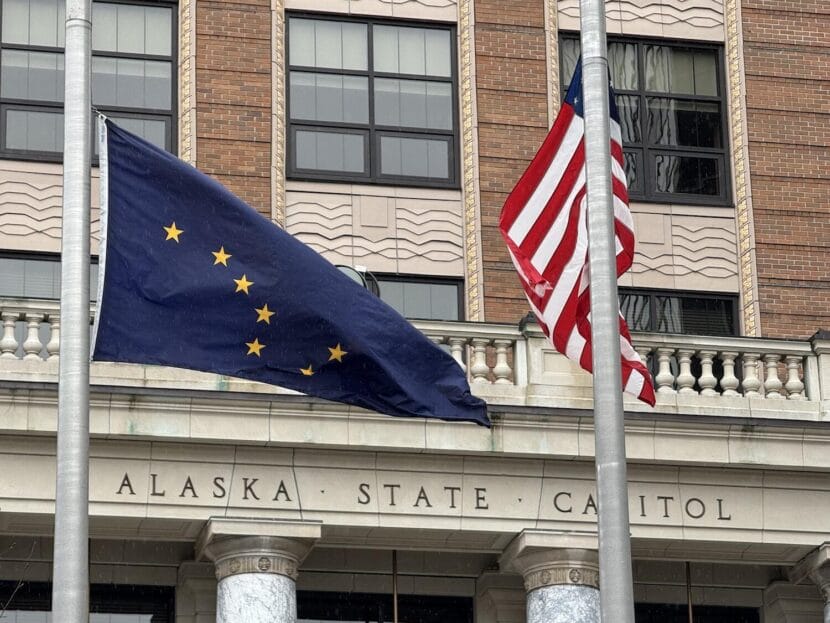
The Alaska and American flags fly in front of the Alaska State Capitol on Tuesday, April 22, 2025. (Photo by James Brooks/Alaska Beacon)
The Alaska Legislature has approved state funding for child advocacy centers, which support child victims of physical and sexual abuse.
Alaska’s 20 centers were in limbo, facing a $5.5 million shortfall after federal grants were ended or cut, as well as uncertainty over whether operations and services would continue past June.
On Friday afternoon, the budget conference committee – tasked with hammering out the final budget between the House and Senate versions – approved the funds to fill the gap and provide $5.5 million in state funding.
Rep. Andy Josephson, D-Anchorage and chair of the committee, said it was made clear that funding for the centers was a priority. “They’re critically important, and they rose to the very, very top of my list,” he said. “In other words, there was no ask, given their financial predicament and importance, that I thought was more significant.”
Mari Mukai, executive director of the nonprofit Alaska Children’s Alliance, said she was grateful for the funding. The alliance provides support, training and technical assistance to Alaska’s 20 child advocacy centers around the state. “I know what a difficult fiscal situation we’re in right now and understand that many difficult decisions needed to be made,” she said in a phone interview on Monday.
Child advocacy centers provide services for children and their caregivers after suspected physical or sexual abuse, including trauma-informed interviewing, forensic services, streamlined investigations, and victim advocacy through the life of the case. They served 2,061 families statewide last year, Mukai said.
The centers are funded at $10.9 million through a mix of federal and local grants, as well as other funding they raise. Mukai said the state’s backstop funding will make up about half of their budget, and enable the centers to continue current operations and services.
“Unfortunately, Alaska is consistently on the top of the nation for rates of child abuse and violence, and domestic violence, and so unfortunately, yes, I do think that there’s still a lot of need, but this would be a great first step,” she said.
The Alaska Legislature voted to approve the final operating budget on Tuesday, and Gov. Mike Dunleavy will issue budget vetoes of individual line items before July 1.
Mukai added that another federal grant the centers rely on is in danger – the Victims of Crime Act, provided by the U.S. Department of Justice through penalties related to crimes. Alaska advocates are urging the congressional delegation to push the U.S. Congress to protect this funding, as the Trump administration has moved to cancel hundreds of grants and millions of dollars supporting victims services through the Department of Justice.
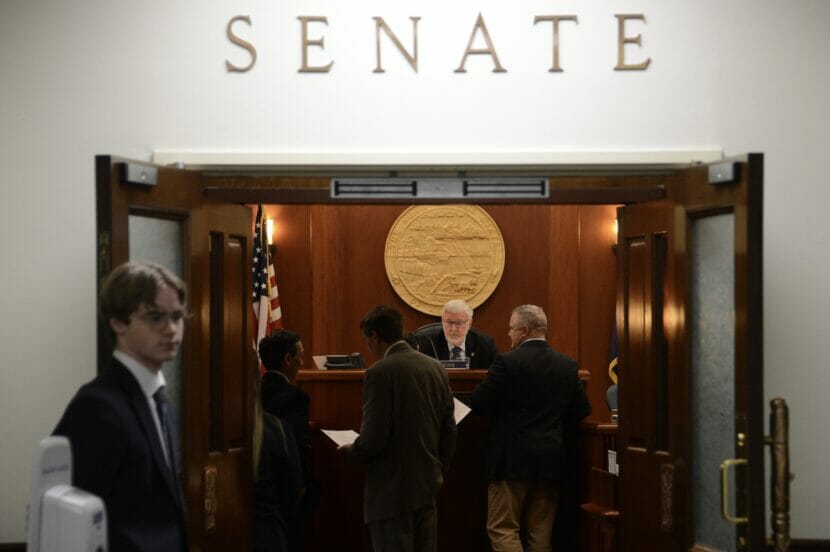
Senate President Gary Stevens, R-Kodiak, is seen before the start of a session of the Alaska Senate on Monday, Feb. 27, 2023. (Photo by James Brooks/Alaska Beacon)
After 22 years in the Alaska Senate, Senate President Gary Stevens is retiring.
Stevens’ decision has been discussed in the Alaska Capitol for more than a year, but on Tuesday, it became official as Kodiak Republican Rep. Louise Stutes became the first person to announce that she will run for Stevens’ seat.
“I certainly will endorse Louise any way I can to help her out,” Stevens said on Wednesday. “She should be a really fine senator. She’s had a lot of experience in the House, and I think she’d do a great job, and I’d be glad to help her out in any way I can.”
Stutes filed a letter of intent with the Alaska Public Offices Commission shortly after the Alaska Legislature adjourned its regular session for the year.
Legislators are forbidden from campaigning during the session, and the day after the first year of the legislative session typically marks the informal opening of the candidate filing period.
Campaigning typically doesn’t begin in earnest until after the second year of the legislative session.
Stutes’ early start may be a foreshadowing of things to come in the district: Stevens has represented the area covering Kodiak and the southern Kenai Peninsula since being appointed to the seat in 2003, making next year’s election a generational shift for the district.
Stutes said on Wednesday that fundraising doesn’t come naturally to her, “so I thought that I’d better get a jump start on it. You can’t get a jump start on it until you file your letter.”
Stutes said she doesn’t know whether there will be many candidates in the race.
Each of Alaska’s Senate districts includes two House districts. Rep. Sarah Vance, R-Homer, represents the other half of Stevens’ district and hasn’t filed a letter of intent for next year’s elections. She did not return a phone call seeking comment on Wednesday afternoon.
Stutes noted that her husband, commercial fisherman Stormy Stutes, grew up in Anchor Point, and they still have family members who live in Vance’s district, so she has connections to that part of Alaska.
This isn’t the first time that Stevens has said he will retire, but it’s certain this time.
“I’m 83 now. I’ll be 85 when I retire, and I think that’s just enough,” he said by phone. “I have other plans, things I want to do. I wrote a play about Ted Stevens that was successful in Anchorage; I want to do another one. I’m a bit of a painter, and I want to go on and do painting and writing and concentrate on those things, as well as spend time with my grandkids.”
Stutes said she’s been interested in running to replace Stevens since that first abortive retirement.
“I’m really lucky. Gary and I get along really well. … He’s been wonderful to work with. I’ll really miss him, of course, because we have such a great working relationship,” she said.
Voters elected Stutes to replace longtime Kodiak lawmaker Alan Austerman in 2014 and reelected her five times since then. She has governed as a moderate Republican, frequently joining the House’s predominantly Democratic coalition and once served a term as speaker of the House.
“I’m like every legislator. I really feel like I’m helping my district and Alaskans. Right or wrong, I feel like I’ve been able to make a difference with the Marine Highway System. I believe I’ve been able to help bring fisheries to the forefront,” Stutes said. “When I first got elected years ago, I told Stormy that the one thing I want to do is take fisheries from the back burner and put them on the front burner. And I think that I’ve been somewhat successful in moving it forward.”
The Alaska Senate is currently controlled by a 14-person bipartisan coalition that includes nine Democrats and five Republicans. Three of those Republicans are up for reelection next year, and all are in potential swing districts.
Sen. Bert Stedman, R-Sitka, and Senate Majority Leader Cathy Giessel, R-Anchorage, said they will run for office again. Stevens is the third.
Among the coalition’s Democrats, Sens. Elvi Gray-Jackson, D-Anchorage, and Löki Tobin, D-Anchorage, both confirmed that they will run for reelection.
Sens. Bill Wielechowski, D-Anchorage, and Lyman Hoffman, D-Bethel, have not yet filed letters of intent. Hoffman has been in the Legislature since 1987 and in the Senate since 1991, making him the longest-serving legislator in state history.
Senate Minority Leader Mike Shower, R-Wasilla, said on Wednesday that he hasn’t yet decided whether he will run for reelection.
Sens. Shelley Hughes, R-Palmer, and Rob Myers, R-North Pole, also face reelection next year. Neither returned a text message seeking comment on Wednesday.
Among incumbent members of the state House, Reps. Maxine Dibert, D-Anchorage, Carolyn Hall, D-Anchorage, and Donna Mears, D-Anchorage, have all filed letters of intent for reelection.
Former Rep. Cliff Groh, D-Anchorage, announced that he will again seek to challenge Rep. David Nelson, R-Anchorage, in 2026. Nelson had been elected in 2020, lost to Groh in 2022 and defeated Groh in 2024.Through Wednesday afternoon, Groh was the only nonincumbent to file with the Public Offices Commission.
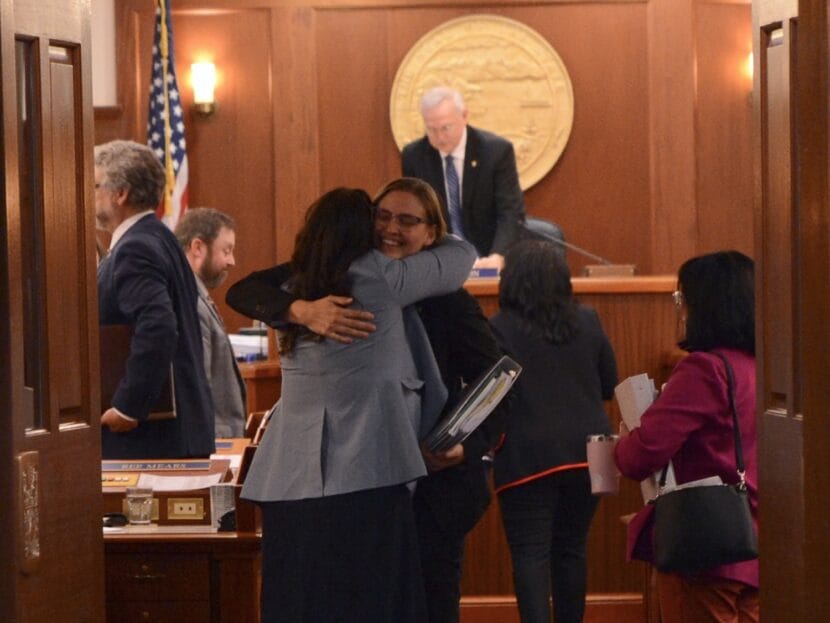
Rep. Ashley Carrick, D-Fairbanks, hugs Rep. Jamie Allard, R-Eagle River, after the Alaska House of Representatives adjourned its session on Tuesday, May 20, 2025. (Photo by James Brooks/Alaska Beacon)
The Alaska Legislature adjourned its regular session on Tuesday, one day earlier than expected, after passing a “maintenance level” state budget that contains a $1,000 Permanent Fund dividend. Legislators do not expect a special session this year.
“I would like to thank all of you for getting to this point: a day early, and before midnight. Pretty remarkable,” said Senate President Gary Stevens, R-Kodiak.
This year, the first of the two-year 34th Alaska State Legislature, 32 bills were passed by both the House and the Senate.
After the House ended its formal work for the year, legislative aides began celebrating with music and pizza, filling the Capitol’s fourth floor with singing and cheering.
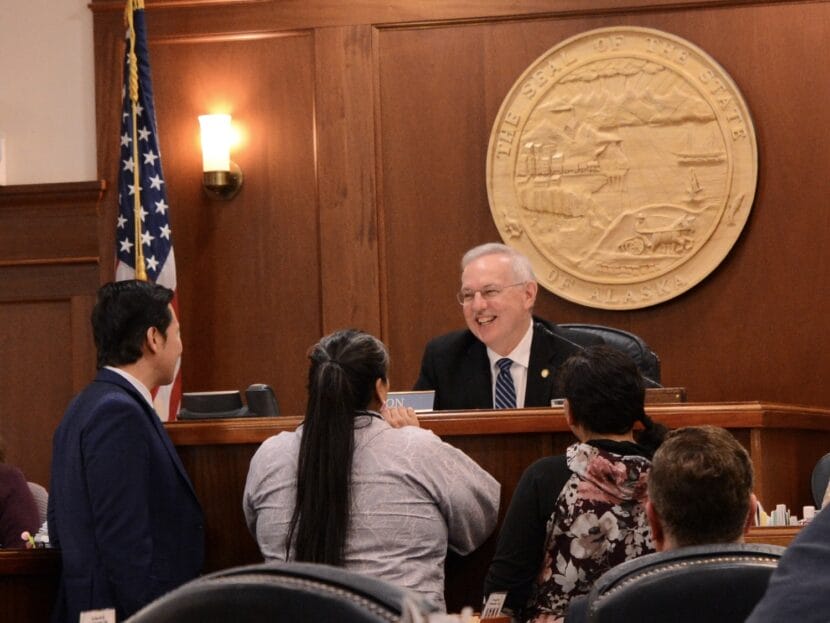
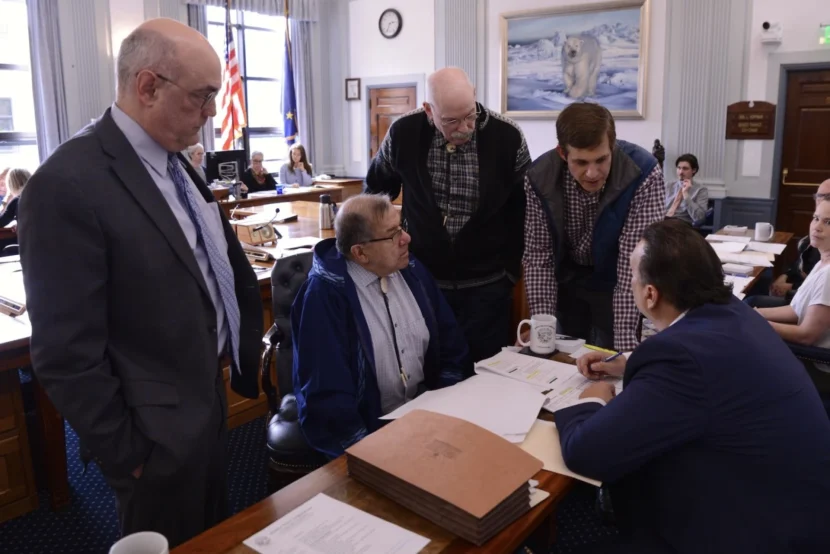
Speaker of the House Bryce Edgmon, I-Dillingham, talks with fellow lawmakers from rural Alaska on Tuesday, May 20, 2025, shortly before the Alaska House of Representatives adjourned for the year. (Photo by James Brooks/Alaska Beacon)
A narrow House majority didn’t stumble
During the session, legislators contended with falling oil revenue. Legislators didn’t pass any tax increases, instead adopting significant budget cuts. The Alaska House navigated partisan divisions that left its majority coalition — 14 Democrats, 5 independents and 2 Republicans — with only a one-vote margin over a 19-person House Republican minority.
That coalition majority, and a similar one in the Senate, had to negotiate with a governor who has significantly different policy views from the coalitions.
Speaker of the House Bryce Edgmon, I-Dillingham, said the early adjournment is something to be proud of.
“I’m pretty pleased that we achieved it,” he said.
It was the first time since 2018 that the Legislature did not reach the constitutional limit of 121 days to complete the session, though the 2020 session was interrupted by a seven-week break due to the COVID-19 pandemic.
“In a year where the House was sharply divided in terms of numbers, oil prices sank, we did our best to work with the governor, who, at many times, was not seemingly here in the building, and we put it all together,” Edgmon said.
House Minority Leader Mia Costello, R-Anchorage, said her caucus wasn’t satisfied with the result.
“I think we’re disappointed that we didn’t address more issues related to energy and the challenges we have and the opportunities that we have with resource development and energy and dovetailing with the president and our congressional delegation,” she said. “So we wanted more legislation in that area. But as far as adjourning, it is what it is, and we’re just going to gear up for next year.”
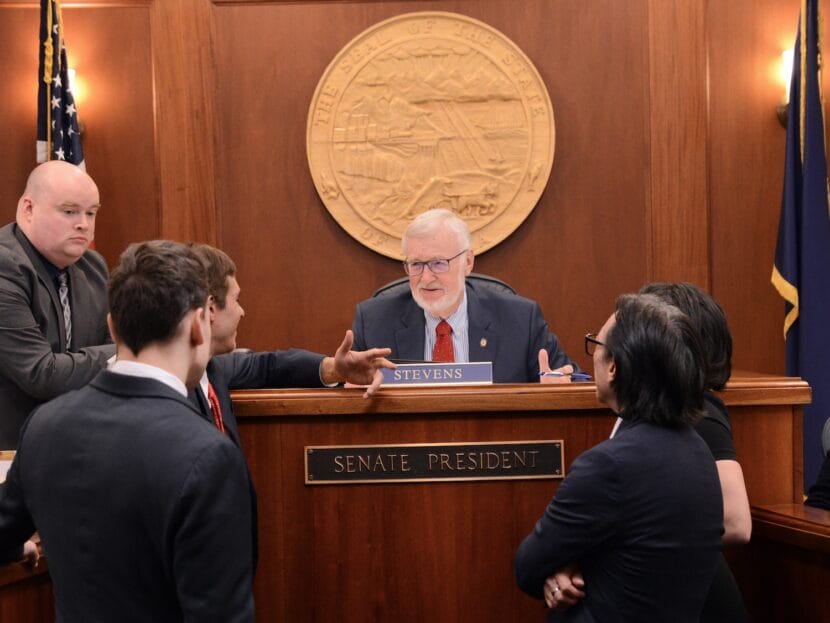
Senate President Gary Stevens, R-Kodiak, talks to fellow legislators shortly before the Alaska Senate adjourned for the year on Tuesday, May 20, 2025. (Photo by James Brooks/Alaska Beacon)
Spending plan has limited increases
One of the Legislature’s final acts before adjournment was to pass the state’s operating budget for the fiscal year that starts July 1.
“You could say that both the operating and the capital budget, the two main budgets, were maintenance-level budgets,” Edgmon said.
The capital and operating budgets, including money for next fiscal year and changes to the current fiscal year, spend $6.2 billion, when looking only at general-purpose state spending. If federal funding and things like fees, college tuition and other money is included, the budget bills spend $16.3 billion.
General-purpose state spending is down significantly. The enacted budget bills from last spring totaled more than $6.5 billion.
Legislators started the budget-drafting process with the expectation that North Slope oil prices would average $68 per barrel in the next fiscal year.
By the end, that expectation had dropped to $64, and the federal government — which pays for about 40% of the combined budget bills — had begun cutting its contributions.
A relative handful of budget increases made it through the process — money for mental health treatment in Anchorage, early childhood education programs, and child advocacy centers, which help the survivors of child sexual abuse.
Those increases — and all other parts of the budget — are subject to approval by the governor, who has the power to veto individual line items. Every year of his term, Dunleavy has vetoed significant amounts from the budget.
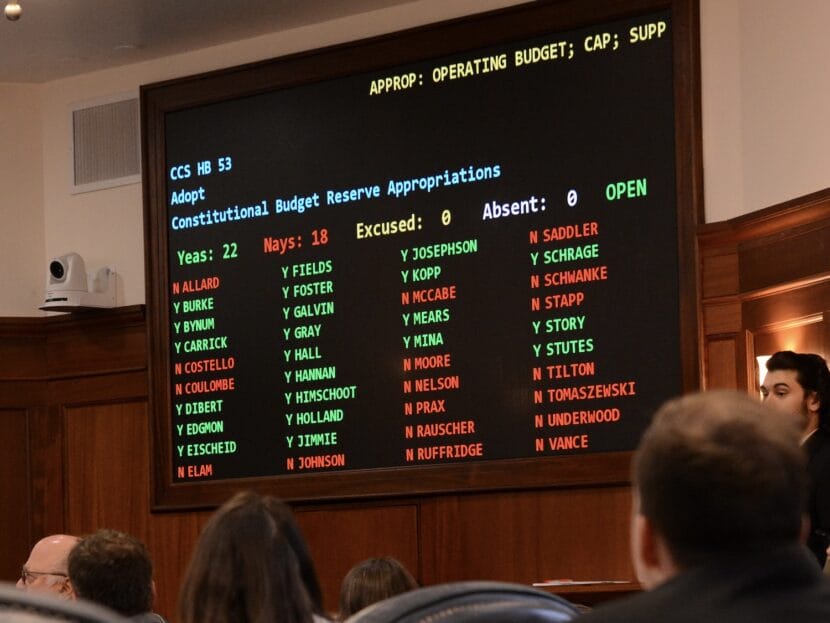
In the House, legislators failed to pass one part of the budget — a roughly $200 million draw from the state’s principal savings account, the Constitutional Budget Reserve, in order to pay for a deficit in the current fiscal year, which ends June 30.
Conditional language in the budget says that if the CBR vote fails, the state will instead take up to $100 million from the accounts of the state’s investment bank — the Alaska Industrial Development and Export Authority — and the state’s higher education investment fund.
The vote failed after members of the House Republican minority opposed it. Thirty votes are required to spend from the reserve.
The tally board in the Alaska House of Representatives on Tuesday, May 20, 2025, shows votes for and against spending from the Constitutional Budget Reserve. Thirty votes are needed to spend from the reserve. (Photo by James Brooks/Alaska Beacon)
“I wasn’t comfortable going into savings,” said Costello. “I felt like we could have done more work on the budget and involved our House Finance Committee team, which has a lot of experience, so I just wasn’t willing to give my CBR vote to go into savings.”
Costello said she feels that other members of the minority felt similarly.
Next year, legislators expect that they will need to spend heavily from the CBR in order to balance the budget.
In addition, legislators are expected to pass major policy bills, including a revival of the state’s pension program for public employees, and election reform bills.
“Hold on to your hat, Nellie, for next session, because it could be much more challenging, as we all know,” Edgmon said.
Members of the Alaska Legislature’s budget conference committee are joined by Sen. Bill Wielechowski, D-Anchorage, as they discuss a budget amendment with aide Pete Ecklund, right, on Sunday, May 18, 2025. (James Brooks/Alaska Beacon)
This year’s Permanent Fund dividend will be $1,000, according to a final draft state budget approved Sunday afternoon by six House and Senate negotiators.
The dividend was among the biggest items in a $5.9 billion document that will fund state services from July 1 this year through June 30 next year.
The draft approved Sunday is scheduled for a final vote as soon as Tuesday in the House and Senate and will advance after that to Gov. Mike Dunleavy, who may reduce or eliminate individual line items. He may not increase a line item.
The Legislature’s regular session reaches its constitutional limit on Wednesday.
The latest forecast from the Alaska Department of Revenue expects significantly lower oil and gas revenue over the next year, and lawmakers significantly cut services and programs during the budget drafting process.
Unlike in previous years, the amount of the Permanent Fund dividend was not a contentious issue for budget negotiators at the end of the legislative session.
Rep. DeLena Johnson, R-Palmer, said on Sunday that lawmakers had already argued the issue earlier in the session, and even though she unsuccessfully voted for a $1,400 dividend on Sunday, she knew the $1,000 figure would be final.
“From my perspective, I already knew what this number was going to be,” she said.
Compressing the dividend is the state’s precarious budget situation.
In December, Dunleavy handed lawmakers a budget draft with a $2.1 billion deficit and a $3,900 dividend; the budget will leave the Capitol with a surplus of about $55 million. Legislators expect that surplus will evaporate in the coming months — oil prices are running below the Department of Revenue forecast, and Republican members of Congress are planning to reduce the amount the federal government pays for major programs, including food stamps and disaster relief.
The Senate approved a budget draft with deeper cuts than the final document, but during the compromise process, lawmakers added individual line items preferred by the House, which proposed higher levels of spending and a draw from the Constitutional Budget Reserve, the state’s main savings account, to pay for that spending.
The final version of the budget eliminates that draw from savings, except as needed to cover a deficit remaining in the current fiscal year.
If lawmakers don’t approve the CBR draw, money would be taken from the state investment bank — better known as the Alaska Industrial Development and Export Authority, or AIDEA — and the state’s Higher Education Investment Fund.
That will put pressure on members of the House’s 19-person Republican minority caucus, who previously voted against drawing from the CBR. Thirty votes are needed in the 40-person House to spend from the CBR.
The final version of the budget includes an additional $13.7 million for child care programs, $5.7 million more for infant early learning programs and 15 new full-time positions to help process public assistance applications.
The conference committee, in charge of negotiating the compromise budget, also approved a House proposal to increase funding for behavioral health services used by mentally ill homeless people by $13.75 million.
“The Alaska Behavioral Health Association made a strong case that they need that,” said Rep. Andy Josephson, D-Anchorage and chair of the conference committee.
In future years, the state will try to obtain behavioral health funding through federal Medicaid grants.
A $1 million grant to food banks — proposed by the House — was rejected in the final version of the budget, as was funding for public radio.
There will be no new troopers for the Matanuska-Susitna Borough; the committee voted 4-2 to eliminate a section of the House budget that would have re-established the trooper post in Talkeetna. Sen. James Kaufman, R-Anchorage, and Johnson voted in favor of the addition.
Sen. Lyman Hoffman, D-Bethel and a vote against the addition, said that the reopened trooper post was suggested by Gov. Mike Dunleavy who withdrew that proposal — and all of his other proposed budget increases — before the conference committee met.
Johnson said the failure to include the troopers, who could be used to curtail the Railbelt drug trade, was “probably one of the bigger disappointments for me in there.”
The final version of the budget also eliminates a paragraph that sought to restrict gender dysphoria treatment, the kind used by transgender Alaskans. That paragraph was inserted by the House in its budget draft, but the Senate didn’t include it.
Conversely, a paragraph limiting abortion care, adopted by the Senate but rejected by the House, was included in the final budget draft.
That paragraph has been repeatedly challenged in court, and the effect of including it in the budget is a small cut to Medicaid funding.
Josephson said the result of the two decisions is a return to the status quo — the Legislature has included the anti-abortion language in its budget for years, and the anti-transgender language was new this year.
Correction: This article has been updated to correct the name of the education fund that the state would potentially draw from if the Constitutional Budget Reserve vote fails.
On Monday, the Alaska Legislature joined the call for help by passing House Joint Resolution 5, which asks Congress to reauthorize the Secure Rural Schools and Community Self-Determination Act of 2000.
That act sent $12.6 million to Alaska schools in federal fiscal year 2023, but Congress has thus far failed to reauthorize the program.
The state Senate passed HJR 5 by a 19-1 vote on May 9 after modifying a version originally written by Rep. Jeremy Bynum, R-Ketchikan. The House agreed with the changes, 37-3, on Monday.
The votes against the resolution came from conservative Republicans who generally oppose federal spending.
The Secure Rural Schools Act, as it is commonly known, was designed to compensate rural school districts for tax revenue lost as the federal government began to restrict logging in the 1990s.
In 2023, the law provided more than $250 million to districts nationwide, with about 5% of the funding coming to Alaska.
For some of Southeast Alaska’s rural school districts, the money was a big part of the local budget. Yakutat, for example, received more than $6,500 per student. Wrangell had almost $3,500, and the money was worth $584 for each of Ketchikan’s 2,045 students.
HJR 5, which will be sent to every member of Congress, asks for retroactive funding and for a permanent funding source to pay for the bill.
It also encourages Congress to open more federal land to timber cutting “in a manner that supports rural economic revitalization, conserves habitat, and promotes forest health.”
A staffer at Foodland IGA in Juneau scans groceries on Friday, February 10, 2023. (Photo by Tasha Elizarde/KTOO)
Following a request by the federal government, the state of Alaska has turned over the personal information of roughly 70,000 Alaskans enrolled in the federally funded Supplemental Nutrition Assistance Program, commonly known as food stamps.
As first reported by NPR, the federal government normally collects information to determine a SNAP applicant’s financial eligibility for the program. The new request goes beyond that, to cover name, date of birth, address, contact information, Social Security number, citizenship status and information about people living in a recipient’s household.
It affects nearly 1 in 10 Alaska residents, who participate in the program.
In a May 6 memo, the USDA said it was requesting that information because of an executive order by President Donald Trump. Numerous news agencies have reported that the Department of Government Efficiency — part of the executive branch under Trump — has used that order to combine personal data collected from several agencies to help the federal government track and arrest immigrants they want to remove from the country.
“Alaska is complying with the federal government’s requirement to share the information as requested,” said Alex Huseman, a public information officer for the Alaska Department of Health.
“Per the USDA guidance on May 6, 2025 … all data related to SNAP is being shared with the federal government,” he said. “This includes any information on a client’s application or renewal, any documentation sent in as part of their application or renewal, or other data acquired by DPA staff while processing applications and renewals.”
The USDA is specifically requesting “records sufficient to identify individuals as applicants for, or recipients of, SNAP benefits, including but not limited to personally identifiable information in the form of names, dates of birth, personal addresses used, and Social Security numbers.”
Huseman said the federal government has not requested that information before.
The Alaska Legislature has previously expressed concerns about the federal collection of Alaskans’ personal data but has not addressed the SNAP data-sharing arrangement.
In 2008, the Legislature forbade the state from spending money to implement the post-Sept. 11 REAL ID program, and only begrudgingly reversed course years later.
In 2017, lawmakers said they did not trust federal government data collection and requested additional privacy protections. Among those lawmakers was then-Sen. Mike Dunleavy, R-Wasilla.
“Federal contractors, businesses, everyone’s a victim here, of the federal government,” Dunleavy told the Anchorage Daily News about the REAL ID program.
Close
Update notification options
Subscribe to notifications
Subscribe
Get notifications about news related to the topics you care about. You can unsubscribe anytime.