Alaska Beacon

Alaska Beacon is part of States Newsroom, a network of news bureaus supported by grants and a coalition of donors as a 501c(3) public charity. Alaska Beacon maintains editorial independence. Contact Editor Claire Stremple for questions: info@alaskabeacon.com. Follow Alaska Beacon on Facebook, Bluesky and Twitter.
Child support comes first when considering debts owed in foreclosure, Alaska Supreme Court rules

Students swing on a playground at Meadow Lakes Head Start in Wasilla, Alaska. It closed in 2024 due to funding and staffing challenges.
Students swing on a playground at Meadow Lakes Head Start in Wasilla, Alaska. It closed in 2024 due to funding and staffing challenges. (Lela Seiler | CCS Early Learning)

The Alaska Supreme Court has ruled that the state’s child support system has first priority when a foreclosed property is sold to pay multiple debts.

The court issued its opinion on Nov. 28, resolving a long-running lawsuit brought by Global Federal Credit Union (formerly Alaska USA) against the state and several other defendants.

“This is a pretty important case from my client’s perspective,” said Jonathan Clement, a senior assistant attorney general who represented Alaska’s child support system.

“This is the first time that a court has actually decided that child support gets priority over all other judgment lien holders, even liens recorded earlier, when there’s surplus funds at issue,” he said.

The case decided by the court involved property in Eagle River that was mortgaged by Wells Fargo. In 2017, Global levied a lien against the property for unpaid debt. Shortly afterward, the state’s child support division recorded another lien against the property for unpaid debt.

Typically, liens are repaid in chronological order: First filed, first paid.

In 2018, a law firm sold the property through foreclosure and paid off the remaining Wells Fargo mortgage. There was money left over, but not enough to pay both Global and the state.

The state protested the law firm’s plans to pay Global first, and the firm complied with a state order that required it to pay the state first.

Global sued in state court, but a district court judge and a superior court judge each ruled against the credit union before it appealed to the supreme court.

Writing on behalf of the court, Justice Jude Pate concluded, “Our interpretation of (state law) provides an effective priority for CSSD liens over competing judgment liens.”

Alaska’s Child Support Services Division (CSSD) is now known as the Child Support Enforcement Division (CSCD).

That priority doesn’t put the state above a bank holding a mortgage or “deed of trust” but it does give the state priority over other liens on the property.

“The important thing for this case is that it gives CSCD another tool where they can try to collect money that’s owed by the obligors,” Clement said.

“I would say of all the cases I’ve worked on, this is the one that will have the most impact in my career going forward,” he said.

An attorney representing Global declined comment on behalf of the credit union.

In a footnote attached to the case, Pate wrote that the court’s ruling could cause people to behave differently during foreclosure auctions.

He suggested that if the Legislature disagrees with the court’s interpretation, it might want to pass a law clarifying two conflicting statutes interpreted by the court.

“If our interpretation is contrary to the legislature’s intent,” he wrote, “amendments to the relevant child support statutes could clarify the interaction between child support liens, other liens, and mortgages.”

Hepatitis vaccines credited as life-saving for Alaska children may be upended

Dr. Brian McMahon, medical and research director of the liver and hepatitis program at the Alaska Native Tribal Health Consortium. stands outside at the constortium's campus on Oct. 8, 2025. McMahon tried to convince members of the federal Advisory Committee on Immunization Practices to keep in place a recommendation for universal Hepatitis B vaccination of newborns. McMahon has spoken of his experiences treating patients in Western Alaska, which in the 1970s had the world's highest rate of hepitiatis-caused childhood liver cancer. Newborn vaccinations have been critical to stopping the spread of Hepatitis B among Alaska Native children, McMahon said.
Dr. Brian McMahon, medical and research director of the liver and hepatitis program at the Alaska Native Tribal Health Consortium stands outside at the constortium’s campus on Oct. 8, 2025. McMahon tried to convince members of the federal Advisory Committee on Immunization Practices to keep in place a recommendation for universal Hepatitis B vaccination of newborns. McMahon has spoken of his experiences treating patients in Western Alaska, which in the 1970s had the world’s highest rate of hepitiatis-caused childhood liver cancer. Newborn vaccinations have been critical to stopping the spread of Hepatitis B among Alaska Native children, McMahon said. (Yereth Rosen | Alaska Beacon)

Western Alaska, where almost all the residents are Indigenous, used to have the world’s highest rate of childhood liver cancer caused by Hepatitis B. After decades of screenings and vaccinations, that problem has been eliminated; since 1995, only one person under the age of 30 has been diagnosed with hepatitis-caused cancer.

Now the Trump administration is seeking to end one of the key tools credited with accomplishing that goal: Hepatitis B vaccinations of newborns.

The federal Advisory Committee on Immunization Practices on Friday voted to drop a longstanding recommendation for universal hepatitis vaccines for newborns. That is in accordance with the controversial views of U.S. Health Secretary Robert F Kennedy Jr., a vaccine skeptic who fired all members of the previous committee and appointed like-minded members to replace them.

Current federal childhood Hepatitis B vaccination guidelines recommend one dose of the vaccine at birth, followed by additional doses at intervals through 18 monthsThe recommendation for newborn vaccinations has been in place since 1991.

The advisory committee, part of the U.S. Centers for Disease Control and Prevention, determined that children under 2 months should not be vaccinated unless their mothers are infected or could be infected by Hepatitis B.

Some vaccine critics in the administration, including Kennedy and President Donald Trump themselves, argue — contradicting medical experts and years of medical research — that Hepatitis B vaccines for young children are unnecessary, claiming that it is spread primarily or exclusively through adult behavior like sex and sharing of needles for illegal drug use.

“Hepatitis B is sexually transmitted. There’s no reason to give a baby that’s almost just born Hepatitis B. So I would say wait till the baby is 12 years old and formed and take Hepatitis B,” Trump said at a Sept. 22 news conference.

Those claims are false, said Dr. Brian McMahon, medical and research director of the liver and hepatitis program at the Alaska Native Tribal Health Consortium.

There is no credible evidence of a link between the vaccine and autism of any other health problem, McMahon said.

And sexual transmissions accounted for only a tiny percentage of Alaska’s Hepatitis B cases, he said.

Aside from mother-to-infant transmissions, which occur during childbirth, Hepatitis B was predominantly spread in Western Alaska through normal daily activities. That is because, unlike the HIV virus or other hepatitis viruses, the Hepatitis B virus can live for seven days on surfaces in schools and homes, like tables and personal-grooming items.

“The virus can be found all over, on school luncheon tabletops, counters and homes,” McMahon said. “Kids have open cuts and scratches from bug bites or anything else, and then they shed millions of particles of the virus on environmental surfaces. And then another kid comes along with an open cut or scratch.”

Such risks are exacerbated in rural Alaska, he said, where homes can be crowded and people pursue traditional subsistence lifestyles with a lot of outdoor activities.

“They’re hunting, fishing, cutting up meat, etcetera, and mosquito bites are real prominent,” he said.

Hepatitis B virus particles, in orange, are seen in this microscopic image captured in 1981.
Hepatitis B virus particles, in orange, are seen in this microscopic image captured in 1981. (Dr. Erskin Palmer | U.S. Centers for Disease Control and Prevention)

Nationally, only 12.6% of chronic Hepatitis B cases recorded from 2013 to 2018 were attributable to sexual transmission, according to a 2023 CDC study. Transmissions of all forms of hepatitis, including Hepatitis B, are possible through contact sports like football, rugby and hockey, researchers have found.

Alaska’s disease and vaccination success

Before the past decades of vaccination and screening, Hepatitis B was so prevalent in Western Alaska that it was classified as endemic there. It was the only part of the United States with such a classification. In some villages, 20% to 30% of the residents were infected, McMahon said.

Geography and ancient migration patterns accounted for historically high rates of the disease in Western Alaska, as well as other Indigenous regions of the Arctic.

Various strains have been carried from Asia to Alaska over millennia, according to scientists. And the remoteness of Indigenous communities meant isolation from medical services, making early diagnosis difficult in the past, allowing infections to linger and be passed down through generations, according to scientists.

In Alaska, children infected with the virus early in life had a high likelihood of winding up with chronic infections that caused serious complications latersuch as liver failure. The worst cases resulted in cancer, and even death.

For McMahon, now in his 80s, treating cancer-stricken children in the Yukon-Kuskokwim region, where he worked in the 1970s, was harrowing.

One of his patients was a 17-year-old high school valedictorian. A few months earlier, she started having abdominal pains, but she ignored them.

“She was really busy with school, and she’d gotten a full ride scholarship and was excited about going to the University of Alaska, representing her community,” McMahon said.

The pains turned out to be cancer, caused by a hepatitis B infection that she had not known she had. Too sick to be flown home, she died in the Bethel hospital.

“It was horrible,” McMahon said.

Another patient was an 11-year-old boy, also diagnosed after he complained of similar abdominal pain. McMahon visited him at home, where the boy was “in horrible pain” and yellow from jaundice.

“He was just crying. He said I know I’m going to die. Just help me with my pain,'” McMahon said.

“My wife was with me. She was a public health nurse. She was in tears. The community health aid practitioner was in tears. I was fighting my tears and pulling everything I could out of my bag to try to help this patient sedate. It was just something I’ll never forget. Never.” McMahon said.

He has relayed these and other experiences to the vaccine advisory committee in hopes of persuading members to keep the infant recommendations in place.

“I said, ‘Do you want to be responsible for children getting liver cancer because of this decision?'” McMahon said. “So I’m probably not very popular right now.”

Alaska was one of the first places in the world where the Hepatitis B vaccine was used as soon as it became available in 1981.

Epidemic Intelligence Service Officer, Victoria Balta of the U.S. Centers for Disease Control and Prevention prepares to ride a snowmachine between villages in rural Alaska in 2024. She and other epidemiologists traveled to villages to draw blood from participants in a long-term study of the Hepatitis B vaccine. Use of the vaccine began in Alaska in the early 1980s. Alaska was one of the first regions in the world where the vaccine, then newly developed, was administered. The Alaska study is the world's longest-standing cohort study of this vaccine.
Epidemic Intelligence Service Officer, Victoria Balta of the U.S. Centers for Disease Control and Prevention prepares to ride a snowmachine between villages in rural Alaska in 2024. She and other epidemiologists traveled to villages to draw blood from participants in a long-term study of the Hepatitis B vaccine. Use of the vaccine began in Alaska in the early 1980s. Alaska was one of the first regions in the world where the vaccine, then newly developed, was administered. The Alaska study is the world’s longest-standing cohort study of this vaccine. (Jonathan Steinberg | U.S. Centers for Disease Control and Prevention)

The pilot vaccination project was at the insistence of Alaska Native organizations, along with the state government and the Alaska congressional delegation. Under that pilot program, according to newly published study by McMahon and other researchers from the ANTHC and the CDC’s Arctic program, tribal health organizations and their partners screened 53,860 Alaska Native people for infection and gave vaccines to 43,618 Alaska Native people who tested negative, along with starting the universal newborn vaccinations.

Health officials have followed the outcomes since then, and the new study lists several achievements 40 years after universal newborn vaccination started.

Since 1995, according to the study, there have been no new symptomatic cases of Hepatitis B among Alaska Natives under 20 anywhere in the state. Since 2000, no new cases of hepatitis-related liver cancer have been identified among Alaska Natives of any age in the Yukon-Kuskokwim Delta, a region where prevalence was concentrated in the past, the study said. And follow-up surveillance has revealed that childhood Hepatitis B vaccinations remain effective for at least 35 years, the study said.

Successes are also reflected in the trend of acute hepatitis, the form of infection that is short-lived and can be cleared from the body.

There have been no identified cases of acute hepatitis among Alaska Native children since 1992, according to Johns Hopkins University. The rate of acute hepatitis among Alaskans of all ages and ethnicities dropped from 12.1 cases per 100,000 people to 0.9 per 100,000 in the 2002-2015 period, according to the state Department of Health’s epidemiology section.

Alaska’s rate of chronic hepatitis B – the long-term and persistent infection that can lead to serious liver problems – remains higher than the national average. As of 2020, Alaska’s rate of chronic Hepatitis B was 14.2 cases per 100,000 people, nearly triple the national rate of 5 cases per 100,000 people, according to a report by the state Department of Health’s epidemiology section.

McMahon said that is partly because of the legacy of infections in the older Native population, people whose childhood predated widespread vaccination, and prevalence among foreign-born residents who come from countries without widespread vaccination.

Debate over Hepatitis B risks

This year, vaccine skeptics who are members of the Advisory Committee on Immunization Practices, however, along with people who are advising the committee, have argued that the risks of Hepatitis B among children are too low to justify universal infant vaccination.

One of the officials making that argument at Thursday’s committee meeting was Dr. Cynthia Nevison, a vaccine skeptic hired as a CDC consultant. She contradicted McMahon’s description of children spreading the virus through casual contact with contaminated surfaces – a process known as “horizontal transmission.”

“There’s very little evidence that horizontal transmission has ever been a significant threat to the average American child, and the risk probably has been overstated,” she said at the meeting. Also overstated, she said, are the risks of “vertical transmission,” the viral transmission between mothers and their newborns.

The committee’s new recommendation must be approved by the CDC administrator before it becomes federal policy.

McMahon said that no matter how national policy might change, Alaska Native tribal health organizations will continue administering Hepatitis B vaccines to newborns.

“I know they’re not going to stop. Even if they have to pay for it. They’re so aware of this,” he said.

His fears, he said, are for low-income families who depend on free vaccinations through state programs that might lose funding and for parents who are getting conflicting messages that may lead to conclusions that the vaccine is not necessary.

“It could be a real mess,” he said.

Changes in the incidence rate of acute Hepatitis B from 1980 to 2015 are shown in thjs graph. The rate is for all Alaskans and based on state health data. The graph notes key dates in the development and use of the Hepatitis B vaccine.
Changes in the incidence rate of acute Hepatitis B from 1980 to 2015 are shown in thjs graph. The rate is for all Alaskans and based on state health data. The graph notes key dates in the development and use of the Hepatitis B vaccine. (Graph provided by Epidemiology Section of the Alaska Division of Public Health/Alaska Department of Health)

Planned fiber-optic cable will add backup for Alaska’s phone and high-speed internet network

A commercial bowpicker is seen headed out of the Cordova harbor for a salmon fishing opener in June 2024
A commercial bowpicker is seen headed out of the Cordova harbor for a salmon fishing opener in June 2024 (Corinne Smith/Alaska Beacon)

One of Alaska’s smallest telecommunications companies is about to provide a critical backup for the entire state.

On Wednesday, Cordova Telecom Cooperative and GCI announced a partnership to lay an undersea fiber optic cable from Juneau to Cordova and a second cable from Cordova to Seward.

When open for service in fall 2027, the two cables will provide high-speed internet to small communities in Prince William Sound and northern Southeast Alaska.

The development matters to the rest of the state as well, because when combined, they will provide a route for internet traffic between the Railbelt and Outside. Currently, four undersea cables through the Gulf of Alaska are the principal routes for internet and phone traffic between Alaska and the rest of the world.

Matanuska Telecom Association opened the state’s first overland fiber connection in 2020 as an alternative, and the new route will give the state another redundant option, said Cordova Telecom CEO Jeremiah Beckett.

“With what we’ve built out, scalability wise, we could put all the current Alaska traffic on our network if needed,” Beckett said.

This map, provided by Cordova Telecom Cooperative, shows the route of the proposed FISH in SEAK cable that will come online in fall 2027. Cordova’s existing fiber route is shown in green. (Image courtesy Cordova Telecom Cooperative)

While satellite internet services like Starlink have transformed life in rural Alaska, ground-based fiber internet remains the backbone of worldwide telecommunications, delivering service faster and in volumes that satellites can’t provide.

“It’s kind of like rural communities that don’t have the ferry,” Beckett said. “Places without fiber don’t have the same access that folks with fiber do. So this is really to help connect those rural areas and give them the same access to the digital economy and marketplace as the rest of the world.”

Despite their advantages, fiber-optic cables can be vulnerable.

“Up north, it’s ice scouring … and in our area, it’s typically ship anchors and earthquakes,” Beckett said.

Alaskans have become intimately familiar with the consequences of broken cables in recent years.

Northern and northwest Alaska are particularly familiar: Quintillion’s fiber-optic cable has been severed three times in two years. The latest break wasn’t fixed for more than seven months because sea ice precluded repairs. That caused widespread problems in areas served by the cable.

In March, a break in a subsea cable left the Alaska Legislature to do business on paper for a day and knocked out both cellphone and internet service for much of Juneau. Juneau had alternatives; a temporary fix was in place within days.

When the cable leading to Sitka broke in 2024, it took weeks to repair. People canceled surgeries and businesses went cash-only until internet service was restored.

Adding a backup fiber route reduces the odds of blackouts like those. Currently, Cordova is served by a single undersea fiber line through Prince William Sound to Valdez.

When the project is complete, internet and phone traffic will have three possible routes: north, west, and east.

The two cables will cost roughly $88 million combined, according to figures provided by Beckett, and the project is principally funded through two federal grants. Cordova Telecom is paying for part of the project, as is GCI, which will be what Beckett calls an “anchor tenant and partner.”

“It was a good matchup for both of our long-term goals,” he said.

In a prepared statement, GCI senior vice president Billy Wailand praised the plan, which is formally known as Fiber Internet Serving Homes in Southeast Alaska, or FISH in SEAK.

“Critical state services require network diversity,” he said. “GCI turned up the first subsea cable to Alaska in 1999 and landed a second diverse fiber in 2008. We are thrilled to partner with CTC on its FISH in SEAK project, which includes a next-generation cable that ensures Alaska and its capital city continue to benefit from the newest technologies and adds another crucial layer of redundancy to the network.”

Communities along the cable route will see huge changes, Beckett said. Residents of Pelican on Chichagof Island in Southeast Alaska, who use boardwalks instead of roads and four-wheelers instead of cars, will be able to get fiber internet access directly to their homes.

The island village of Chenega in Prince William Sound, which has about 50 year-round residents, likewise will have new access to fiber internet.

Alaska’s Lost Coast, between Glacier Bay and Yakutat, could be dotted with cellphone towers.

Beckett, who grew up in Cordova, returned to the town with his spouse 12 years ago, “basically when Cordova got its subsea fiber,” he said. “We were both teleworkers, and that created the opportunity for us to move back to Alaska, essentially.”

Since then, he’s seen internet service improve and has become head of his local telecom, which has just 20 employees.

Because it’s a cooperative, it’s run as a nonprofit, he said. That means the telecom’s goal is to deliver faster service and low rates, not necessarily generate a profit.

In Yakutat, “a few years ago, you couldn’t get cell service anywhere,” Beckett said.

“We’ve upgraded the cell service there to 4G and outside of the fishermen complaining because their wives can get hold of them, it was a huge boost for the community,” he said.

“If someone gets hurt, they can call the paramedics and not have to drive 20 miles before they get to service. … It’s giving people reasons to think about moving home, because it’s one less inhibitor to be back in Alaska,” Beckett said.

“Yakutat actually got a new clinic a couple years ago, and then with this, I think they’re going to see some good growth. Everyone likes core services, right?”

U.S. Department of Energy lab, active in Alaska, drops ‘renewable’ from name

Solar panels at the Cold Climate Housing Research Center campus in Fairbanks are seen on June 5, 2025. The Cold Climate House Research Center, which became part of the National Renewable Energy Labortory system in 2020, is focused on designing sustainable and energy efficient housing that is resilient to climate change in the far north.
Solar panels at the Cold Climate Housing Research Center campus in Fairbanks are seen on June 5, 2025. The Cold Climate House Research Center, which became part of the National Renewable Energy Labortory system in 2020, is focused on designing sustainable and energy efficient housing that is resilient to climate change in the far north. (Yereth Rosen/Alaska Beacon)

The federal government research organization that has been devoted for half a century to renewable energy development has had the word “renewable” stripped from its name.

The Trump administration, which broadly opposes renewable energy projects, changed the name of the Colorado-based National Renewable Energy Laboratory to “National Laboratory of the Rockies.”

The U.S. Department of Energy announced the name change on Monday, effective immediately.

“The energy crisis we face today is unlike the crisis that gave rise to NREL,” Assistant Secretary of Energy Audrey Robertson said in a statement. “We are no longer picking and choosing energy sources. Our highest priority is to invest in the scientific capabilities that will restore American manufacturing, drive down costs, and help this country meet its soaring energy demand. The National Laboratory of the Rockies will play a vital role in those efforts.”

NREL has a prominent presence in Alaska. The agency in 2020 joined into a partnership with the Cold Climate Housing Research Center at the University of Alaska Fairbanks. The UAF facility is one of four NREL centers; two campuses are in Colorado and there is an office in Washington, D.C.

Jud Virden, the laboratory’s director, said the new name “embraces a broader applied energy mission entrusted to us by the Department of Energy to deliver a more affordable and secure energy future for all,” according to the statement.

However, the name change is a troubling sign to one Alaska organization involved in projects promoting renewable energy and energy affordability.

“Removing ‘Renewable’ and ‘Energy’ from NREL’s name raises concerns. Renewables are key to affordable, secure energy and deliver long-term economic benefits, especially for rural communities,” Bridget Shaughnessy Smith, communications director for the Alaska Public Interest Research Group, a non-profit consumer advocacy group, said by email.

“While it’s not yet clear if this name change signals a broad mission shift, any refocus cannot come at the expense of renewable energy or by prioritizing already well-funded fossil fuel industries. Remote microgrid communities in Alaska are working with NREL to innovate toward affordable, reliable energy, and this name change must not disrupt that critical work,” Shaughnessy Smith continued.

NREL’s history started in 1974, when the organization was established as the Solar Energy Research Institute. In 1991, President George H.W. Bush elevated it to national lab status and changed the name to the National Renewable Energy Laboratory.

The Cold Climate Housing Research Center was established in 1999 with a mission of improving housing and building conditions in Alaska’s extreme climate. The center has focused on renewable energy, along with energy efficiency, structural integrity for buildings on permafrost, indoor air quality and designs that are sustainable in the far north. The center headquarters is the world’s farthest-north building with a platinum rating, the highest possible, bestowed by the U.S. Green Building Council Leadership in Energy and Environmental Design.

The NREL-Cold Climate Housing Research Center partnership has participated in numerous recent energy and environmental innovations, including the development of non-plastic housing insulation made from a fungi-wood pulp blend.

The NREL name change adds to a list of government agencies and geographic sites changed by the Trump administration this year to align with the president’s agenda.

On the day he was inaugurated for his second term, President Trump issued an executive order directing that the Gulf of Mexico be renamed “Gulf of America” and that Denali, North America’s tallest peak, revert to its previous federal name, Mount McKinley.

The Denali name comes from the traditional name for the Alaska peak used by the Koyukon people, the region’s Indigenous residents. The name, which translates to “the high one,” has been the official state of Alaska name since the 1970s. The McKinley name, for former president and Ohioan William McKinley, has been widely panned in Alaska, and state lawmakers passed a resolution asking for the Denali name to be restored for federal government use.

In September, Trump issued an executive order directing that the U.S Department of Defense be renamed “Department of War.” That resurrected a department name that was dropped in 1947.

Gov. Dunleavy approves Alaska National Guard assisting ICE in Anchorage

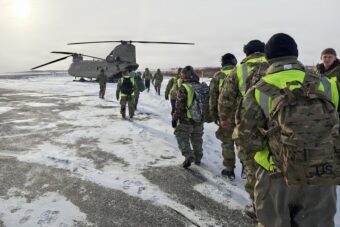
Members of the Alaska Air and Army National Guard, Alaska Naval Militia, and Alaska State Defense Force work together to load plywood onto a CH-47 Chinook helicopter, in Bethel, Alaska, Nov. 2, 2025, bound for the villages of Napaskiak, Tuntutuliak, and Napakiak. The materials will help residents rebuild homes and restore community spaces damaged by past storms. (U.S. Army National Guard photo by Spc. Ericka Gillespie)

Gov. Mike Dunleavy has approved a U.S. Defense Department request for Alaska National Guard service members to assist the U.S. Immigration and Customs Enforcement office in Anchorage with “administrative support,” the guard office announced Tuesday.

The Alaska National Guard said five service members will assist with “administrative and logistical” duties at the Anchorage ICE office for up to a year.

“The Alaska National Guard members are administratively supporting the Enforcement & Removal Operations section and Homeland Security Investigations section, ensuring seamless operations at the Anchorage ICE office. Their mission includes a wide range of duties, from vehicle fleet management and safety compliance to office support and processing purchase orders,” the Guard statement said.

The announcement included a list of clerical duties, including data entry and creating reports, answering phones, managing fleet vehicles and checking fire extinguishers. Officials said the partnership is authorized by Title 32 Section 502(f) of the U.S. Code, which enables National Guard members to perform additional duties under the direction of the President or Secretary of Defense.

Grant Robinson, Dunleavy’s deputy press secretary, confirmed the governor approved the request.

“The Alaska National Guard members joined the guard to serve our nation. This support they are providing the Anchorage ICE office is in service of the nation,” he said by email Tuesday.

Grant did not say whether the National Guard would provide further assistance with immigration enforcement actions.

“Any future requests for administrative and logistical support will be considered on a case by case basis,” he said.

The Trump administration has continued to accelerate immigration enforcement operations, and officials have promised to “limit legal and illegal immigration,” after the shooting of two National Guard service members in Washington, D.C. last week. The Trump administration has also continued to roll back humanitarian programs for immigrants, including ending the temporary protected status of 330,000 nationals from Haiti last week.

While ICE has been conducting mass raids, court house arrests and large-scale detentions and deportation operations across the United States, in Alaska ICE has focused enforcement efforts on specific individuals identified through the U.S. Citizenship and Immigration Services or having interactions with law enforcement, according to the ACLU of Alaska. 

Rep. Andrew Gray, D-Anchorage is the co-chair of the Alaska Joint Armed Services Committee and has been outspoken about his concerns about the Alaska National Guard being deployed domestically for “civil disturbance operations.”

“I see it’s a long list of boring, banal administrative tasks that are in no way controversial or concerning in and of themselves,” he said of the National Guard announcement. “What’s concerning is that Alaska ICE is requesting additional support, and the assumption that I make is that it’s because Alaska ICE intends to be doing more detainments, and intends to be doing more field operations in which they’re going to need this administrative support behind them. So that’s my concern.”

Gray was reached by phone Tuesday leaving a meeting with U.S. Sen. Dan Sullivan in Washington, D.C. Gray said he expressed his concerns at the meeting about the leadership of U.S. Department of Defense, which the Trump administration has renamed the “Department of War,” and Secretary Pete Hegseth.

Gray said he’s also concerned about a wider chilling effect of ICE activity and increased immigration enforcement in Alaska.

“It’s going to increase fear, not only in the undocumented folks that might be in Anchorage and the rest of Alaska, but also fear in people who are here legally, and even U.S. citizens who might be mistaken for someone who might be undocumented,” he said.

An October investigation by ProPublica found that more than 170 U.S. citizens were detained by ICE in raids and at protests, and the government does not track how many citizens are held by immigration agents.

Dunleavy’s office did not respond to requests for comment on the concern around ICE overreaching its authority, and arresting and detaining U.S. citizens.

“It seems that Alaska’s notorious SNAP backlog caused by a lack of workforce doing many of the tasks in this memo would be much better use of our Guard,” Gray added. “Why not deploy Guard members to feed Alaskans instead of deploying them to earn brownie points with the Trump administration?”

Cindy Woods, senior staff attorney on immigration rights with the ACLU of Alaska, said they have tracked at least 70 ICE arrests this year, as reported in the custody of the Alaska Department of Corrections. That’s an almost 500% increase from last year.

“We have been seeing a growing ICE presence in the state and a growing trend of ICE enforcement,” she said. The ICE activity has been largely in Anchorage, she said.

“We are very concerned about what this signals in relation to our state government’s willingness to cooperate with federal law enforcement, specifically in relation to ICE enforcement operations,” she said of the National Guard announcement. “I think it can’t be overstated the negative impact that increased enforcement has had across the country and Alaska, unfortunately, is not immune to that.”

An estimated 7.7% of the population, or more than 57,000 people, in Alaska are foreign-born, Woods pointed out, and the Trump administration’s continued restrictions on paths to legal immigration and citizenship, as well as humanitarian and refugee resettlement programs are impacting Alaskans.

“It’s kind of an assault from both sides, and so we’re really concerned about that as well,” she said.

Woods said the ACLU is not aware of any U.S. citizens being detained by ICE in Alaska, but there is heightened scrutiny.

“One case that we have heard of recently is of a longtime Anchorage resident who has been happily married and was going to their interview for their green card based on that marriage, and being arrested with basically accusations of marriage fraud,” she said. “And so we’re seeing folks who are in affirmative applications, who are not in any sort of civil enforcement proceedings, who are also being subject to heightened scrutiny and enforcement actions.”

Skagway’s lone paramedic is suing the city, alleging retaliation by fire department officials

Downtown Skagway, with snow dusting its streets, is seen in this undated photo. (Photo by C. Anderson/National Park Service)

This article was reported and published in collaboration between the Chilkat Valley News and the Alaska Beacon.

Skagway’s former paramedic is alleging wrongdoing by the Southeast Alaska town, saying in a newly filed lawsuit that she was illegally fired after submitting a grievance against the city’s fire chief and deputy fire chief.

In a lawsuit filed Nov. 20 at Juneau Superior Court, Samantha Philemon — the town’s lone licensed paramedic for much of her employment since 2023 — alleges she was fired due to disputes over recordkeeping and the department’s decision to purchase an all-terrain vehicle known as an Argo.

According to Philemon’s complaint, at the time of her firing, Skagway officials said she was being let go due to violations of HIPAA, the federal medical-privacy law. Philemon’s attorney says in the complaint that the accusation “was a sham.”

Philemon filed a formal complaint against the chief and deputy and was fired by Skagway’s deputy borough administrator the day after the complaint was resolved.

“We’re excited to have our day in court, so to speak, and we think that a jury who hears Sam’s story is going to do the right thing and understand what happened here, and we’re just looking for this to never happen again,” said her attorney, Miye D’Oench of the Anchorage-based Northern Justice Project.

Philemon said her firing has left Skagway, a town of roughly 1,100 year-round residents, without a trained paramedic.

“There are firefighters with EMT 1 and EMT 2 and some (EMT) 3 training, but there are no paramedics, and that harms the community because paramedics are trained and licensed to do things that EMTs are not,” she said.

Neither Fire Chief Emily Rauscher nor Borough Manager Emily Deach responded to requests for an interview that would allow them to respond to Philemon’s complaint.

The borough denied a public records request by the Chilkat Valley News. Robert Blasco, the city’s hired attorney, did not return messages left at his office on Friday and Monday.

Philemon moved from Mississippi to Skagway in 2023, she said, and enjoyed working with the department at first.

“I wanted to be between the mountains and the ocean,” she said.

According to the complaint, she encouraged a friend to work for the department this past summer, but when he arrived, he was told his position had funding for only one week. Philemon believed that was because the department had recently purchased an Argo.

When she raised the issue, according to the complaint, “Rauscher and Mead then turned on Ms. Philemon,” and “began silencing and excluding her from department business.” There were additional disputes about medical procedures performed by the fire department and accounting at the department..

Philemon submitted a formal grievance to the borough manager in July. The manager, Emily Deach, said in an August memo that Skagway “will take action to address the behavior and prevent reoccurrence” as well as take steps toward formalizing fire department training.

“The actions of the department supervisors do not require termination of those supervisors, as

you requested verbally,” Deach wrote to Philemon.

Philemon, who had been placed on administrative leave while the grievance was investigated, was ordered to return to work under a separate plan. She objected, concerned that she would be returning to work under the same supervisors and conditions as before, and appealed to a committee that included the Skagway Mayor.

The committee upheld Deach’s work on Sept. 10. Philemon planned to return to work, but the deputy borough manager fired her the following day.

Philemon said she’s been looking for work since then but hasn’t found success.

“I’m looking for a new job after being fired from a job that I never wanted to leave. I’m devastated because I love my job, and I love Skagway,” Philemon said.

Online court records show the case has been referred to Judge Amy Welch. No additional proceedings have yet been scheduled.

Site notifications
Update notification options
Subscribe to notifications