Alaska Public Media

Alaska Public Media is one of our partner stations in Anchorage. KTOO collaborates with partners across the state to cover important news and to share stories with our audiences.

Alaska flu cases spike, causing at least 3 deaths and high numbers of hospitalizations

A syringe, bandage and alcohol pad lie on a blue plastic tray.
An influenza vaccine and supplies, at Anchorage Health Department’s clinic, on Feb. 25, 2025. (Rachel Cassandra/Alaska Public Media)

At least three Alaskans have died from complications of influenza so far this season, amid a surge in cases happening earlier than last year, according to state epidemiologists.

Alaska has seen about 1,100 reported flu cases so far this season, the state Health Department reported.

This flu season is dominated by a new variant of the flu virus, but getting the existing flu vaccine is still the best way to prevent getting infected, said Joe McLaughlin, who heads the state Section of Epidemiology.

“Historically, even when there are new variants of influenza that are circulating, people who are vaccinated tend to still have some protection against flu cases,” McLaughlin said. “But more importantly, they still seem to be quite well-protected against hospitalization and death compared to those who have not been vaccinated.”

Symptoms of the flu include fever, cough, sore throat, headache, a runny or stuffy nose and tiredness.

Those most vulnerable to have severe cases or be hospitalized include anyone age 65 and older, kids under 2, those with underlying medical conditions, obese people, pregnant women, and Black, Latino and Alaska Native people, according to the Centers for Disease Control and Prevention.

Benjamin Westley, an infectious disease physician in Anchorage, said he and his colleagues are concerned about the high number of patients they’re seeing with severe cases of the flu.

“Most of us are saying that we’ve never in our careers seen so much, both volume of flu coming into the hospital rapidly, as well as how ill people are,” Westley said.

It can be hard to tell the flu apart from other respiratory illnesses, but people at higher risk for complications should consider getting treatment right away, Westley said. Doctors can prescribe Tamiflu, also called oseltamivir, which is a medication that can reduce the flu’s severity.

“If you have a risk factor for a bad outcome of flu, and you have an influenza-like illness, meaning you have symptoms consistent with flu, you do not need a test and shouldn’t even really get a test,” Westley said. “You should just get treated.”

People sick with the flu need to talk to a medical provider to get a prescription, but they don’t necessarily need a doctor’s visit, Westley said. It’s best to take Tamiflu within 48 hours of experiencing flu symptoms, but Westley said it can still be effective for those with risk factors after that.

Alaskans can also protect themselves by washing their hands, staying away from coughing people and staying away from crowds, he said.

And if you get the flu, according to the CDC, you should stay home until you’ve been fever free without medicine for at least 24 hours.

Western Alaska evacuees in Anchorage slowly moving to temporary housing

People stand outside a hotel with cars are parked in front
Evacuees of ex-typhoon Halong in Anchorage are moving out of hotels where they have been sheltering for months, and into temporary housing around the city. (Matt Faubion/Alaska Public Media)

Western Alaska residents who evacuated to Anchorage after the remnants of Typhoon Halong battered their villages are now moving out of city hotels and into temporary housing.

They’re looking forward to having more privacy, being able to cook for themselves and having more space, said Jeremy Zidek, public information officer for the Alaska Division of Homeland Security and Emergency Management.

“Hotel rooms are small,” Zidek said. “They’re meant to be someplace that you stay temporarily. These folks have been living there for quite some time.”

The state moved evacuees into hotel rooms around Anchorage in early November, after some had stayed in mass shelters for several weeks following the storm.

Ex-Typhoon Halong slammed into Western Alaska in October with wind, rain and flooding that devastated some communities, including Kipnuk and Kwigillingok, where homes floated off their foundations. One woman in Kwigillingok was found dead in the aftermath, and more than 1,000 people were displaced.

More than 500 people who evacuated to Anchorage are still in hotel rooms. But, as of the end of the year, the state had moved more than 150 people into temporary housing.

There are financial and logistical hurdles that slow down the process, Zidek said.

“With a diverse group of people with different capabilities, we have to really do that case by case and do that case work,” he said. “So it’s a complicated process, and to do that with 600 people is taking some time.”

Each move requires background and credit checks, and the homes need to be furnished, which Zidek said has been a challenge: They’re routinely buying out stores around the city. The state is also working to keep extended families close to each other. The cold weather this winter makes moving more difficult as well, Zidek said.

Another hurdle is the tight housing market in Anchorage. But housing is tight across the state, and Zidek said Anchorage actually has more availability than the rest of Alaska.

The state of Alaska has a cost-sharing agreement with the Federal Emergency Management Agency to fund the hotel stays, with FEMA paying 75% of the cost and the state covering the rest. Once people move into temporary housing, Zidek said, that changes.

“Most people moving into temporary housing are taking advantage of that FEMA rental assistance,” he said. “And then as we move down the road, there will be other housing assistance funding that could be brought to bear for people. It’s based on a case-by-case basis.”

Some people have started working and are able to pay their own rent, Zidek said.

There are some people who won’t qualify for temporary housing because they don’t pass background checks or credit requirements, Zidek said. The state plans to find alternative housing for those people, he said.

The state will focus on rebuilding in Western Alaska in the spring, Zidek said, so that those who want to return home can do so as soon as possible.

Hey Alaskans, it’s time to file for your PFD

The glass door to the entrance of the PFD office. In black lettering is "PFD State of Alaska, Lobby hours Monday-Friday 10 a.m. to 4 p.m."
The State of Alaska’s PFD and Child Affairs Office is located in downtown Anchorage and pictured here on August 31, 2022. (Valerie Lake/AKPM)

For many, the New Year signals a fresh start. But for Alaskans, it also means it’s time to apply for the Permanent Fund dividend.

Applications for the 2026 PFD opened Thursday, with online filing starting at 9 a.m. Over 600,000 Alaskans receive the PFD each year, which is usually paid out in October.

It’s not yet clear how much the 2026 dividend will be.

In 2025, Alaskans received $1,000 — the smallest PFD in state history when adjusted for inflation.

The Legislature and Gov. Mike Dunleavy will determine the 2026 PFD amount during the upcoming legislative session, which starts Jan. 20.

Dunleavy’s budget proposal would pay roughly $3,600 per eligible resident, but passing it through the Legislature is a long shot. It would require using about half of the state’s savings — more than $1.5 billion from the Constitutional Budget Reserve, which is the state’s main rainy-day fund.

Already, some lawmakers have raised concern about withdrawing that much from savings, arguing that a large PFD is unwise given low oil prices. Others say the money would be better spent on priorities such as public school funding.

To be eligible for a PFD, you must be an Alaska resident for the entire calendar year, and intend to stay in the state.

Alaskans have until March 31 to apply. You can file online at mypfd.alaska.gov or pick up an application at any Permanent Fund Division office.

Dunleavy fills 2 Mat-Su Republican vacancies in state House

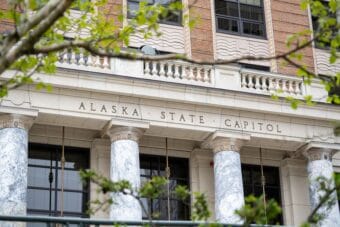
the Alaska State Capitol
The Alaska State Capitol doors on June 16, 2021. (Andrew Kitchenman/KTOO & Alaska Public Media)

Gov. Mike Dunleavy has chosen two Mat-Su Republicans to fill vacant state House seats.

In a statement Wednesday, Dunleavy announced the appointment of Wasilla resident Steve St. Clair and Sutton resident Garret Nelson to the state House of Representatives.

Both seats were vacated when George Rauscher of Sutton and Cathy Tilton of Wasilla were chosen by the governor to fill two vacancies in the Senate. Republican Senators Mike Shower and Shelley Hughes both vacated their seats to focus on gubernatorial campaigns: Shower for lieutenant governor and Hughes for governor.

Nelson will replace Rauscher as representative of House District 29. He’s currently the chair of the Sutton community council and has lived in the area for seven years, according to the governor’s statement. St. Clair will fill Tilton’s seat representing House District 26. Officials with the governor’s office said St. Clair is a retired military police officer who’s lived in Wasilla for 15 years.

Both Nelson and St. Clair will have to be approved by a majority of House Republicans in order to be confirmed. Alaska’s next legislative session begins on Jan. 20 of next year.

Alaska federal employee unions want their rights back. The U.S. House passed a bill to do that.

moonrise over Capitol, with dome to the left and purple sky.
Moonrise over the U.S. Capitol on Oct. 18, 2021. (Brett Davis)

WASHINGTON — It’s been a rough year for Alaska’s 15,000 federal employees. Along with job losses and funding uncertainty, in March President Trump signed an executive order to take away union protections from a large swath of the federal workforce.

But the U.S. House gave public employee unions a ray of hope last week.

The Republican-led House delivered a rare rebuke of Trump and passed a bill to restore union rights for federal employees.

Twenty Republicans joined Democrats to pass it. Alaska Congressman Nick Begich wasn’t among them.

Stephanie Rice, a federal worker from Anchorage, said she was surprised by his vote, given Alaska’s high number of federal jobs.

“That’s 4.6% of the state’s total employment. That’s a huge chunk of his constituents that are directly impacted by this legislation,” she said. “And so I was very disappointed to see that he didn’t vote to restore our collective bargaining rights.”

Rice is president of National Federation of Federal Employees Local 1945. She works for the Bureau of Land Management’s National Operations Center but said she’s speaking for herself and her union, not the agency.

Begich didn’t respond to an interview request nor provide a statement explaining why he voted no.

But James Comer, R-Ky., who led the debate against the bill on the House floor, said Trump got rid of union contracts to provide more effective personnel management and “more streamlined disciplinary procedures” for federal employees.

“The reality is that pre-existing union agreements the president never signed onto can subvert these efforts,” Comer said. “They provide barriers to accountability beyond basic employee protections that exist in law.”

Begich’s vote, and his position on organized labor more generally, align with most Republicans in Congress, but it marks a departure for Alaska’s congressional delegation.

The AFL-CIO ranked Alaska’s Dan Sullivan and Lisa Murkowski as the Republican senators who most often voted pro-union in the last Congress. And unions were big contributors to the late Congressman Don Young’s political campaigns.

“Congressman Young always said that the unions weren’t the enemy. They were the canary in the coal mine telling Congress when things were wrong in the facilities or the agency,” recalled David Traver, chief steward of AFGE Local 3028, which represents employees at the Veterans Affairs medical center in Anchorage.

Traver said Begich hasn’t shown an inclination to be the champion of organized labor that Young was.

Begich last year won the endorsement of the National Right to Work Committee, a counter force to union power, while the AFL-CIO endorsed his opponent.

Unions like the one at the Anchorage VA are still representing employees, but Trump’s order in essence tore up their contract. Travers said it leaves workers vulnerable to unfair treatment.

The House-passed bill to restore union contracts hasn’t gone before the Senate yet. Labor leaders say a likelier route for becoming law would be as part of a government spending bill next year.

Alaska Gov. Dunleavy says he’ll propose a property tax break for planned gas pipeline

Gov. Mike Dunleavy speaks to reporters during a news conference on Feb. 7, 2024. (Eric Stone/Alaska Public Media)

Gov. Mike Dunleavy is eyeing a property tax break for the long-planned Alaska LNG project. The Republican governor said he plans to propose a two-mill property tax for the 800-mile natural gas pipeline and associated infrastructure, a 90% lower rate than the state typically charges in property tax for oil and gas infrastructure.

Dunleavy described his plans in an interview with the Anchorage Daily News. The Republican governor’s spokesperson confirmed the governor’s plans but declined to make Dunleavy or another member of the administration available for an interview.

The state shares a portion of the property tax revenue it collects with local governments, and some local leaders are raising concerns about Dunleavy’s proposal.

“We can’t subsidize that project,” said Kenai Peninsula Borough Mayor Peter Micciche. “We at least have to cover our costs.”

Micciche said he expected the project would be a boon for the state and his region, bringing thousands of jobs to the Kenai Peninsula. But a low property tax rate for the project would essentially push some of the project’s cost onto local taxpayers, he said.

“We’re going to have impacts on our schools. We’re going to have impacts on emergency services, for sure,” he said. “We’re likely going to be the agencies they turn to for their emergency response plans, like all the other oil and gas facilities do.”

Plans for a North Slope gas pipeline and Southcentral export terminal have been in the works for decades but have taken new life in the second Trump administration. The state turned the project over to a private developer, Glenfarne, which has put out a steady stream of announcements about agreements with potential customers, investors and suppliers. But the project has plenty of skeptics, who argue the project last estimated to cost $44 billion would be too expensive to make financial sense.

A consulting firm contracted by the state Legislature to examine the project, GaffneyCline, told lawmakers last month they may need to make a variety of changes to help the pipeline become a reality, including to property taxes.

In a statement, Glenfarne spokeperson Tim Fitzpatrick said the developer had not seen the specifics of Dunleavy’s proposal and couldn’t offer an opinion.

Micciche said he’s open to tax breaks that would support a pipeline, but he said local governments need to be involved in determining what exactly those might be.

At least so far, he said, that hasn’t happened.

“There is a deal to be had here, but it has to be born from facts, real math, local impact data,” Micciche said. “It has to be transparently and fairly negotiated between all involved in good faith.”

In an email, Dunleavy’s spokesperson, Jeff Turner, said the bill hasn’t been drafted, so it was premature to say the proposal was developed without their input. He said the deal was better than nothing.

“Right now, the state collects no property tax at all because the LNG pipeline does not exist,” he wrote.

Fairbanks Rep. Maxine Dibert, a Democrat who co-chairs the state House Resources Committee, says she plans to discuss Dunleavy’s bill with local officials. But she says she plans to focus much of her attention on a separate bill that would require the project to include a smaller lateral pipeline to supply Fairbanks with gas to cut energy costs.

“For me, that is a line in the sand, that it needs to be guaranteed part of the project,” she said.

Republican Sen. Jesse Bjorkman, who represents the central Kenai Peninsula, says he’s on the fence about Dunleavy’s proposal. He said he’d like to learn more about the project’s finances to determine what’s necessary. But in any case, he said, it would make little sense to cut the project a break on property taxes after Glenfarne makes a final investment decision, or FID.

“If they’re gonna have an FID decision in January next month, then that cake is already baked, like the financials are already in place.

Glenfarne declined to say whether it would reach FID before the legislative session begins Jan. 20, but said it continues to work toward making the pipeline a reality. The company has previously said it expected a decision by the end of 2025.

“Glenfarne is rapidly progressing toward a final investment decision, as seen through our progress with numerous Asian commercial announcements and strategic partner agreements. We expect additional announcements in the next several weeks,” Fitzpatrick said. “Our overall project schedule, including completing the pipeline in 2028 and delivering first gas to Alaskans in 2029 is proceeding on schedule.”

Site notifications
Update notification options
Subscribe to notifications