Annie Feidt, Alaska’s Energy Desk

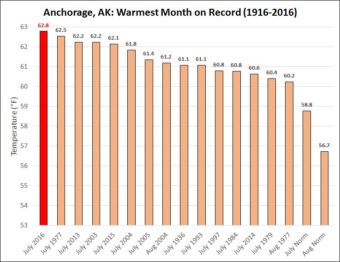
Anchorage logs warmest month on record

Graphic courtesy of Brian Brettschneider

Anchorage just recorded its warmest month on record. July was four degrees above normal, with an average temperature of nearly 63 degrees.

Brian Brettschneider is a climatologist in Anchorage who closely tracks Alaska climate data and trends. Alaska’s Energy Desk is checking in with him regularly as part of a new segment- Ask a Climatologist.

Brettschneider told Energy Desk editor Annie Feidt the record or near record warmth has extended across the state from January through July.

Interview transcript:

Brian: When you add all that up, it puts 2016 way out in front in first place for the warmest year on record. In fact, it’s the first time for the first seven months of the year that Alaska has been, on average, above freezing. And there’s a large gap between the first and second place year.

Annie: And what does that mean for the rest of the year?

Brian: Well, the fact that it’s been so warm for the first seven months, doesn’t necessarily mean anything for the next few months, but if you ask yourself why it’s been so warm for the first seven months, the factors that have made it so warm, are continuing. So we would expect warm months for the rest of 2016 and for 2016 to almost certainly become the warmest year on record for Alaska.

Annie: Why has it been so warm, what are those factors?

Brian: There are several factors. One is globally, the last few years have been the warmest on record. So globally, we’re starting with this very high baseline. And then here locally Alaska is surrounded by waters that are at or near all time record highs, like the Gulf of Alaska and Bering Sea. So we’re just surrounded by this envelop of warm, moist air over this record warm sea surface temperature. And there’s really no place this air can cool off before moving over Alaska.


Audio: Alaska’s Energy Desk

Now playing:
Warm ocean water leads to heavy rain in Alaska

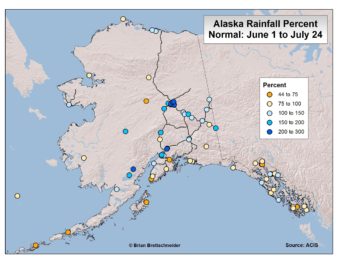
Graphic courtesy of Brian Brettschneider

It’s been unusually wet across a large section of the state this summer.
Brian Brettschneider is a climatologist in Anchorage who closely tracks Alaska climate data and trends. Alaska’s Energy Desk is checking in with him regularly as part of a new segment- Ask a Climatologist.

Brettschneider told Energy Desk editor Annie Feidt that some parts of the state, especially near Fairbanks, have had double their normal rainfall since June. That has been good for tamping down wildfires, but it has its own ties to a warmer world.

Interview transcript:

Annie: Why has it been so wet?

Brian: Well, there’s been a couple of reasons. First and foremost, the ocean temperatures around Alaska have been quite warm, near record warm, and those warm waters provide a nearly endless supply of moisture, much more moisture than is typical for the summer. So when we’ve been having rain showers, all that additional moisture is fuel for these storms and it turns a light to moderate storm into a moderate to heavy rain event.

Annie: At least in Southcentral Alaska, in Anchorage, we haven’t thought of this as a rainy summer. What accounts for that?

Brian: Sometimes the perception can be a little bit different than the reality. So here in Anchorage we had a big rain event in June, over an inch in one day. But even if you back that out, it’s been an above normal rainfall summer. So it’s not just the last few days, it’s not just that one storm, there have been a number of events that have contributed rain and those all add up.

Annie: What about Southeast Alaska, are they in the same boat?

Brian: The switch has been flipped a little bit from the first half of the year. The southern Alaska coast and Southeast were quite wet from January though May. But this summer so far, they’re all below normal for precipitation.


North Slope records fall with ‘unprecedented warmth’

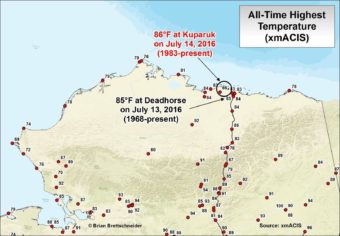
(Graphic courtesy Brian Brettschneider)

Climate change is a daily reality in Alaska. Those changes are happening across forests, tundra, in the Arctic ocean and in your backyard.

Brian Brettschneider is a climatologist in Anchorage who closely tracks climate data and trends in the state. Alaska’s Energy Desk is going to be checking in with him regularly.

Two all time temperature records were set on the North Slope on July 13 and 14. Deadhorse hit a record high of 85 degrees on July 13, exceeding the previous record by 2 degrees. The next day, Kuparuk recorded a temperature of 86 degrees.
“That is the highest temperature ever recorded in Alaska within about 50 miles of the Arctic ocean,” Brettschneider said. “So really unprecedented warmth for Alaska.”

The normal for Alaska’s northern coast is the mid to upper 50s. Brettschneider calls the last few years in Alaska “relentlessly warm.”

“In 2016, only one day in the entire year has been below normal and that was only a very small amount,” Brettschneider said. “So the temperatures have been warm from basically last Christmas onward and it’s really been peaking in the last few weeks.”

(Graphic courtesy Brian Brettschneider)

Brettschneider says the seasonal outlooks show it’s going to remain above normal in the state for the foreseeable future.

Gov. Walker adds cabinet level oil and gas adviser

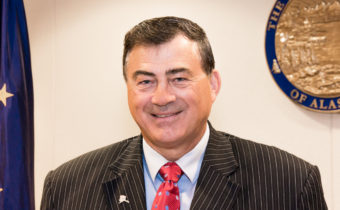
John Hendrix is the state's new oil and gas adviser. (Photo courtesy of Gov. Walker administration)
John Hendrix is the state’s new oil and gas adviser. (Photo courtesy Alaska Governor’s Office)

Gov. Bill Walker created a new cabinet level position Monday in his administration, an oil and gas adviser. He appointed John Hendrix to the job, who most recently worked as general manager for Apache Alaska, a company that pulled out of the state this spring, citing low oil prices.

Walker made the announcement during a speech Monday at an Anchorage Chamber of Commerce lunch event. He said he has long believed the state needs a good working relationship with the oil and gas industry.

“I’ve created a new cabinet position — working within our budget, we’re not adding anything to our budget — to bring a person on that would act as my liaison and my adviser on all oil and gas issues,” Walker said.

Walker said Hendrix understands Cook Inlet, where Apache mainly operated, as well as the North Slope. Walker angered many in the industry last month when he vetoed more than $400 million in tax credit payments the state-owed companies.

Monday is Hendrix’s first day on the job.  His annual salary is $185,000. Hendrix is an adviser, not a commissioner, so he doesn’t have a department.

Video: A recent college grad lands a job but worries about the future

The last decade saw a remarkable run-up in oil and gas employment as high oil prices led to record numbers of energy industry jobs in Alaska. That meant young people had an easier time getting started in oil and gas.

Hannah Vuppula was lucky enough to land an engineering job last year at an Anchorage firm that works on the Trans Alaska Pipeline. She had just graduated from college in Texas.

But now that Alaska is in its first real recession in nearly three decades, Vuppula doesn’t know what the future holds.

This week, Alaska’s Energy Desk is spotlighting those who have been affected by the downturn, as part of the series An Uncertain Future.

Site notifications
Update notification options
Subscribe to notifications