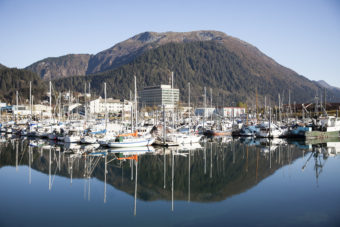
Boats lined up in Harris Harbor on a sunny, clear day Wednesday, Oct. 12, 2016 in downtown Juneau, Alaska. (Photo by Rashah McChesney/Alaska’s Energy Desk)
The weather has been beautiful in Southeast Alaska for two weeks straight.
That is very unusual. September and October are normally the rainiest months in the region.
Brian Brettschneider is a climatologist in Anchorage who closely tracks Alaska climate data and trends. Alaska’s Energy Desk is checking in with him regularly as part of the segment, Ask A Climatologist.
Brettschneider says the two week stretch of sunny weather has been remarkable.
Transcript:
Brian: This is the wettest time of year for almost every place in Southeast and it has just been bone dry and quite sunny since about September 28th.
Annie: And give us an example. Pick one of those weather stations.
Brian: Well, in places like Yakutat and Juneau there’s been no precipitation since September 28th or 29th. And for Yakutat, they should have had 11.5 inches of rain; for Juneau they should have had about four inches of rain during that time period. And neither of those places have ever been completely dry for this time of year before.
Annie: Are we looking at any records here?
A Kayaker on Sitka Sound, Sunday, Oct. 9th, 2016 (Photo by Emily Kwong/KCAW)
Brian: Well, a lot of times records are kept over a month long period, so it’s too early to say if we’re going to have the record driest October, but for most major stations in Southeast it has been the least rainy period, for say- half a month, during this time of year. Definitely a historic dry spell.
Annie: What might be causing the long dry spell?
Brian: There’s been a high pressure system that’s really been anchored over the eastern half of the state extending down all the way into Southeast. And that prevents any storms from moving in. It’s unusual to have it be so strong and so stable in one spot this time of year. So that’s really led to the record dry spell.
Annie: So can we make any predictions based on that, on what this winter will be like down there?
Brian: It’s really hard to say. We count on these storms to churn up the water and dissipate heat in the Gulf of Alaska and so without these storms it may take longer for that heat to be dissipated which would possibly lead to warmer temperatures. But that could change in a hurry so we just need to keep an eye on that.
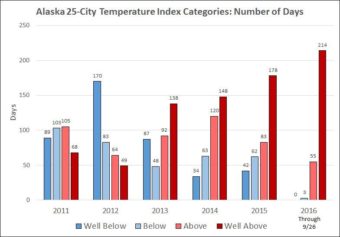
For the first time since February, the statewide temperature index for Alaska dipped below normal earlier this week. Sunday and Monday were both slightly below normal, interrupting a 218 day stretch of above normal temperatures.
Brian Brettschneider is a climatologist in Anchorage who closely tracks Alaska climate data and trends. Alaska’s Energy Desk is checking in with him regularly as part of the segment, Ask A Climatologist.
Brettschneider told Energy Desk editor Annie Feidt that the below normal temps didn’t last long.
Transcript:
Brian: The mid and long range forecasts are indicating we’re going to go right back to an above normal situation, so it’s a brief respite from the long trend of above normal temperatures.
Annie: And when you look at that long trend, what do you see?
Brian: Well we see that there’s been a regime shift in the last few years, where we’ve been above normal the vast majority of the time. It’s been especially acute this year. So there’s really no way to envision where 2016 isn’t the warmest for Alaska by a wide margin.
Annie: What do you mean regime shift?
Brian: So beginning in June 2013, we saw a shift toward a warmer temperature regime. And there’s a lot of reasons that’s happened and a lot of reason we don’t know why it’s happened, largely probably a result of the Pacific Ocean water temperatures and circulations, but since mid-2013 we’ve been way above normal for extended periods of time, only broken occasionally by short duration below normal stretches.
Annie: And when you talk to your colleagues who are looking at Alaska and also seeing that, what reaction do you get?
Brian: It’s a sense of alarm, because the arctic in general is considered the canary in the coal mine, with reductions in sea ice, shorter periods of snow cover, the global temperature shifts are magnified in Arctic areas, so what we see going on in high latitudes can be a harbinger of the acceleration of temperature regime changes globally.
The utility says deregulation would save time and money and give it more local control. But it would also allow HEA’s board to raise rates as high as they want.
Brad Janorschke, general manager for Homer Electric Association, says the vote is about local control.
“Giving the Homer Electric Board of Directors the ultimate say or the final authority in the direction of the cooperative, and the rates we set,” Janorschke said.
HEA began the campaign to convince its members to vote “yes” for local control in late August. The cooperative is the only power provider for most of the Kenai Peninsula, with around 23,000 members.
Under the Regulatory Commission of Alaska, or the RCA, cooperative utilities already have a lot of local control. For example, they can can raise their rates up to eight percent, not to exceed 20 percent in a three-year period.
But Janorschke says going before the RCA for final approval of things like tariff changes, line extensions and more, adds an unnecessary layer of bureaucracy and expense.
“Somebody asked me the other day, ‘How much do you think you would save?’ And I said, ‘We’d save a half million a year, easy, just in staff time and attorney fees,’” said Janorschke. “And I had one of the employees I worked with who is involved in a lot of these processes — [he] looked at me and said, ‘No, it’s probably double that.’”
Janorschke says that about 80 percent of cooperatives in the Lower 48 are not regulated.
Unregulated electric cooperatives have elected boards of directors that determine policy matters and approve rates and fees.
But part of the RCA’s job is to look out for ratepayers.
That’s something Homer resident Mike O’Meara feels strongly about. He was a spokesperson for the HEA Members Forum for years. The watchdog group formed in 2009 to counter the cooperative’s efforts to introduce coal power. They were successful and the group stopped meeting regularly in 2013.
“With the issue of deregulation, I’ve started getting emails and telephone calls from people,” said O’Meara.
O’Meara is skeptical of deregulation. He says that, without the RCA, there would be no consumer protection.
“A big part of its job is making sure that ratepayers are treated fairly, that the prices that are charged are within reason, that if there are significant ratepayer complaints, the RCA can intervene,” said O’Meara.
Mike Pate, also from Homer, was on the HEA board for 22 years. But he resigned in 2009 because he says he felt he could no longer trust the administration.
He’s a strong advocate for local control, but has reservations about what HEA is pushing for.
“I will be voting against deregulation. The final reason that I resigned from the board was I did not feel comfortable with the quality, integrity of the information that the board was receiving from the administration,” said Pate.
Bob Pickett is chair of the RCA.
“I would suggest it’s probably the most important deregulation election that the commission has ever been involved with,” said Pickett.
Pickett says other utilities have deregulated in Alaska. Matanuska Telephone Utility went independent earlier this year, but they have competition. HEA is a monopoly.
HEA claims regulatory operating costs could decrease with deregulation. Pickett says that’s very unlikely. He says the cooperative’s debt has grown from 172 million dollars to more than 350 million dollars in five years. He says that debt is having an impact on ratepayers.
“At this point, HEA has, on a per-kilowatt hour charge, the highest rates in the railbelt,” said Pickett.
Janorschke says HEA’s bylaws protect ratepayers from unreasonable rate increases. And he says members can trust the board.
HEA board members respond to the cooperative members, Janorschke says, but he acknowledges their fiduciary responsibility is to the viability of the cooperative.
If the co-op members feel their board is not making the right decisions, they always have the option to vote them out, Janorschke says.
Informational meetings are scheduled for Kenai Peninsula communities in September and October. Ballots will be mailed out in October and must be returned within 30 days. Election results will be made public in December.
Bob Pickett, the chair of the RCA, says he plans to attend both the upcoming HEA informational meetings in Homer on Wednesday September, 28 and in Soldotna on October 10.
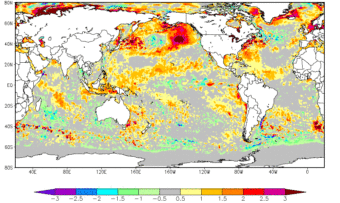
A map of sea surface temperatures from Sept. 19th shows the blob below Alaska. (Graphic courtesy of NOAA)
The Blob is back. The term was coined a few years ago to describe a warm patch of water in the Gulf of Alaska and northern Pacific Ocean. It can turn the weather warm and dry in the state.
Brian Brettschneider is a climatologist in Anchorage who closely tracks Alaska climate data and trends. Alaska’s Energy Desk is checking in with him regularly for the segment- Ask a Climatologist.
Brettschneider says earlier this year, it looked like the Blob was gone, but that wasn’t quite right.
Interview Transcript:
Brian: It’s always been there, it’s just been hovering below the surface, so if you looked at sea surface temperatures, it kind of looked like it was getting back to normal, but all that warmth was just kind of pushed down a little bit and now it’s making its way back to the surface. And it really looks like the blob again.
Annie: And when you look at a map of this, it’s really striking, can you describe it?
Brian: When you look at these maps of sea surface temperatures- the ones that have been released the last few weeks- they really show this very pronounced warm water anomaly sitting just south of mainland Alaska in the Gulf of Alaska. Of course the colors they use in the maps in general for above normal conditions are red, so you have this red circle sitting below Alaska and it really does look like a blob.
Annie: What effect does this have on Alaska?
Brian: When there’s warm waters that surround Alaska it really promotes warm surface temperatures in the state. It also affects the upper level patterns. The last time the blob was this pronounced we had a strong upper level high pressure that set up and that really kept us dry. And then to the downstream side of that in Canada and the northern part of the lower 48, that actually drove their winds, made [them] come from the North, so it made it colder and snowier over there. But over here, in our part of the world, it promoted above normal temperatures and below normal precipitation.
Annie: And what is the connection between the blob and global warming?
Brian: Global warming, I like to say, adds a baseline. It’s like a background noise that gets slightly louder every year. But the blob is something that sits on top of that. So for example, at some point in the past, a blob pattern may have only been two or three degrees above normal, whereas now its four or five, maybe six degrees above normal. So it’s just something that adds on to the background conditions.
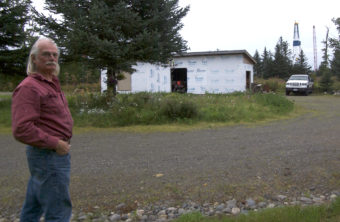
Herff Keith lives next door to BlueCrest Energy’s oil drilling pad. A construction crane and new oil drilling rig can be seen in the background. (Photo by Jenny Neyman/KBBI)
Residents of a tiny Kenai Peninsula subdivision near Anchor Point thought they had a little slice of peace and quiet. But a tract of homestead land to the south held an oil test well. And now it’s home to 38 acres of an active oil well, processing train, natural gas flare, workers’ camp, truck filling station and a five-story rig that is about to start drilling 30 more wells.
When Herff Keith retired from The Alaska Railroad in Anchorage in 2007, he wanted a change of pace. Somewhere he could fish, enjoy the view and relax. He found the perfect spot in a tiny subdivision on the bluff above Cook Inlet, seven miles north of Anchor Point, where he lives with his girlfriend, Colette Bewick.
There’s only one other full-time neighbor. The rest of the handful of houses are vacation properties. To the south is the Hansen homestead, which was mostly vacant when Keith built his house, except for on old test well drilled by ConocoPhillips in 2001. Keith didn’t worry much about it- one capped well, abandoned for years.
But the site is now the centerpiece of BlueCrest Energy, an independent oil company based in Fort Worth, Texas, which is constructing a full-blown oil drilling and production operation on the 38-acre pad.
“And it’s just nonstop. They’ve been building a facility,” he said. “There’s a 52-room hotel next door now. It’s less than 1,000 feet from my property to their property. That’s close.”
Unbeknownst to Keith, BlueCrest confirmed a sizable reservoir of high-quality crude and natural gas out below Cook Inlet. Construction on the pad began in September 2015, with plans to directionally drill for oil from onshore. The company expects the project to last 30 years.
BlueCrest reached out to area residents early on. It’s not the company’s preference to set up shop in a residential area. Representatives keep in touch with neighbors and have held several community meetings to give project updates, answer questions and address concerns.
Larry Burgess, health, safety and environmental manager for BlueCrest, has been the community liaison.
“They could see the well when they moved in over there. They could see this existing well,” he said. “And, unfortunately, they thought that this would never occur. And now it has. I mean, I feel for them… I would hate it if I was them.”
BlueCrest has made efforts to mitigate its impact on the neighborhood.
Ten thousand gallons of water a day are trucked in for use in the camp, rather than drilling a water well in the local aquifer. BlueCrest built a 20-foot earthen berm around the site to dampen the noise. And the company schedules pipe deliveries during the daytime, so the inevitable clanging and banging doesn’t disrupt sleep.
But Burgess acknowledges mitigation can only go so far.
“Those little things, they help. They know we’re doing what we can, but we’re not going to shut this thing in and stop,” he said. “There’s millions of dollars that have been spent here. But we’re not going to ignore them, either. ”
Burgess gave me a tour of the facility in late June. It was a calm day at the site. The well was shut in and the natural gas compressors were off. The gas flare was just a pilot light.
“It’s pretty quiet right now. But it can be noisy,” he said.
The compressors are one of the noisiest things on the pad, even with hospital-grade mufflers installed. Burgess says BlueCrest paid to have a sound survey done to measure noise levels on and around the pad. Even with the compressors running full speed, the highest decibel reading on top of the berm was 61.5, which is about as loud as a conversation.
But Burgess says the noise will get worse when the new rig starts drilling, which should start in mid-October.
“Without question. And I have not pulled any punches with them,” he said. “I told them straight up, this is going to get worse.”
Herff Keith doesn’t want to be around to hear it.
“I am 66 years old. I put my life savings into this place,” he said. “I’ve got a good retirement. And I do not want to sit here next to this noise factory for the next 30 years.”
He can’t imagine who would want to buy his house now, but he plans to list it for sale anyway.
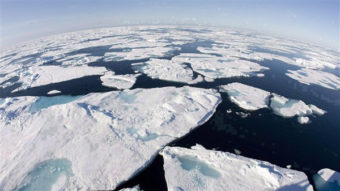
(Graphic from the National Snow and Ice Data Center)
Arctic Sea ice retreated to it’s second lowest level on record this summer. Scientists announced today the ice likely reached its lowest extent on Sept. 10. The Arctic Ocean ended the summer season with 1.6 million square miles of ice, tying 2007 for the second lowest amount.
Mark Serreze is director of the National Snow and Ice Data Center. He says sea ice extent has been on a downward trend since 1979.
“But it looks like over the past decade the loss rate is starting to accelerate,” he said. “It probably has to do with the fact that the ice cover is thinner now, so it doesn’t take as much energy to melt out big portions of it. So we do seem to be in the fast lane, so to speak.”
Serreze says at this rate, the Arctic Ocean is headed for ice free summers sometime in the next few decades.
There was so little Arctic sea ice at the end of the winter, scientists thought 2016 may beat the previous record low, set in 2012. But conditions over the Arctic Ocean this summer were generally cool and cloudy, limiting the rate of sea ice loss.
The ice near Alaska in the Chukchi Sea is still holding up over an important walrus feeding area called Hanna Shoal. Anthony Fischbach is a walrus biologist with the United States Geological Survey.
“The regional presence of sea ice here makes a big difference for Alaskans and the wildlife that we have that depends on it,” he said.
Fischbach doesn’t expect walrus to haul out this year on shore in Northern Alaska in huge numbers like they have most years since 2007. The U.S. Fish and Wildlife Service says there haven’t been any reports of a large haul out near Point Lay.
Close
Update notification options
Subscribe to notifications
Subscribe
Get notifications about news related to the topics you care about. You can unsubscribe anytime.