Caroline Halter, KTOO

Gov. Walker supports credit score insurance bill he vetoed last year

Alaska governor Bill Walker is supporting legislation allowing the use of credit scores to determine personal insurance rates, except in the case of health insurance. Walker vetoed this legislation last year, saying it did not adequately protect consumers.

Lori Wing-Heier, director of Alaska’s Division of Insurance, explained how incorporating credit information could affect consumers in the bill’s first hearing on March 28.

“The majority of Alaskans do have good credit and do have an advantage to get a preferred rate or a preferred program in personal lines insurance,” she said.

Wing-Heier’s data comes from insurance companies in Alaska, who can use credit scores to determine initial rates under current law. Alaskans must sign a waiver each year in order to include their credit score as one of the factors that determines their rate upon renewal.

“We have had more instances of people calling our office and saying they don’t understand why their insurance went up 25 or 30 percent. And sometimes it’s because they receive the form for the waiver, they were travelling, they didn’t understand the seriousness of the waiver to allow their company or their broker to order their credit history,” she explained.

Insurers and brokers called in to the hearing with similar anecdotes.

Some House Democrats opposed last year’s bill on the grounds that it could adversely affect low-income consumers, who generally have less credit history and lower credit scores.

The new bill requires insurers to notify consumers when they begin using credit scores and prohibits them from denying coverage based solely or in part on the absence of credit information.

Wing-Heier cited a 2007 study by the Federal Trade Commission (FTC) showing little to no impact on low-income consumers when credit information is used in the automobile insurance market.

That study was criticized by two FTC commissioners and consumer groups, but the head of the FTC defends its reliability. Previous studies by the Missouri and Texas Departments of Insurance found the use of credit information by insurers discriminates against low-income and minority consumers.

Wing-Heier insisted that would not be the case in Alaska.

“When this bill was being drafted…we looked at various demographics to see if it did make a difference,” she said. “Based on what we received from insurance companies we could not find where it would be a benefit to exclude rural Alaska, lower income, under 26… it did not matter.”

The legislation comes at a time when some states are seeking to limit the use of credit history by insurers. In 2016, legislation related to the subject was introduced in almost a dozen states, according to the National Conference of State Legislatures.

Some states sought to add consumer protections that Alaska’s bill already includes. Others sought to completely prohibit the use of credit information in response to complaints of discrimination and price optimization. That’s a practice in which insurers use credit information to determine price sensitivity rather than risk and charge different rates for people in the same risk level.

This year’s bill is starting off in the Senate. There is no companion bill in the House, but House Majority Leader Chris Tuck voted in favor of the bill last year.

Newscast- March 28, 2017

In this newscast:

  • There was a power outage over the weekend at Eaglecrest Ski Area.
  • Hilcorp has reduced the amount of natural gas flowing into Cook Inlet.
  • President Donald Trump signed an executive order aimed at reversing his predecessor’s plan to reduce carbon emissions and creating jobs.
  • A Russian billionaire said he’s willing to take part in U.S. Congressional hearings regarding President Trump’s campaign ties to Russia.
  • Mitch McConnell said the Senate has no plans to address health care.

Newscast- March 27, 2017

In this newscast:

  • Journalist Roger Wilkins has died at age 85.
  • Democrats forced a one week delay on a Senate committee vote on President Trump’s Supreme Court nominee.
  • Trump signed several pieces of legislation rolling back Obama-era regulations.
  • Hilcorp says it could begin repairs on a broken gas line in the next 10 days.
  • A moderate earthquake was detected underneath the Aleutian Islands.

Newscast- March 24, 2017

In this newscast:

  • Republican leaders abruptly pulled their troubled health care overhaul bill off the House floor shortly before its scheduled vote
  • The Alaska House of Representatives has introduced a new version of a statewide income tax.
  • Business and labor groups are at odds over Alaska Governor Bill Walker’s proposed worker’s compensation reform, and
  • The retrial of a man accused of fatally shooting another man in the Mendenhall Valley will go ahead as scheduled.

Labor and business at odds over Walker’s worker’s compensation reform

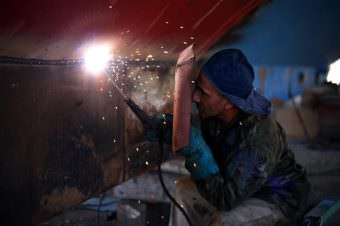
A welder shields his face from sparks. (Pixabay photo by Fernando Fleitas )

Governor Bill Walker is sponsoring legislation he says would make it easier to determine if someone is an employee or an independent contractor.

Walker’s legislation creates a new definition for independent contractors that would determine whether employers have to pay to insure against on-the-job injuries.  The issue is particularly important to trade unions that supported Walker in the 2014 governor’s race.
Alaska’s Small Business Association says the new definition is too narrow for industries that rely heavily on independent contractors, namely construction. But construction workers, as well as a few employers, testified in favor of the new definition in a March 20 hearing in the House Labor and Commerce Committee.

I am speaking to you today in support of House Bill 79, specifically the part that pertains to misclassified workers,” said Charlie Young.”I’ve been working in the painting and drywall finishing trade my entire adult life, and have never seen the abuse of this so high”

For the most part, those who testified said the same thing: some employers purposely misclassify workers to lower their cost of labor and gain an unfair competitive advantage in the bidding process.

“More and more, these cheating contractors are winning the bids on projects, as I watch the amount of work for me get less and less,” Young told legislators.

Paul Grossi, a lobbyist for the Alaska Pipe Trades Union, said workers don’t often think about misclassification until after-the-fact.

“I can tell you this: These independent contractors, once they have this injury and they have $200,000 worth of medical bills, they seldom think of themselves as independent contractors,” he said. “So they go to the Worker’s Compensation Board…”

Rhonda Gerharz is the chief investigator for the Division of Worker’s Compensation Special Investigations Unit.  When employers fail to pay workers compensation insurance, whether it’s missing a payment or misclassifying workers, it’s her job to fix it.

“There are some who are very well versed and are deliberately trying to save money and trying to underbid their competitors,” she explained. “And there are others who are just not, perhaps not savvy business people and they think that they can just call someone an independent contractor and issue them a 1099… and that’s not how it works.”

Gerharz said a lot of her cases come from the construction industry, but the issue is ubiquitous.

“We have to educate people all the time that the state of Alaska actually determines employee status by a very difficult and confusing test,” she said.

That’s where this new definition would come into play. Gerharz said it would not change the number of workers who qualify for worker’s compensation. Rather, it would make it very clear to both employers and workers who is an independent contractor and who is not.

After pushback from the small business association, broader language was adopted, but it hasn’t satisfied the group. Their concern is that it would raise the cost of business and that this new definition would eventually come into play for other benefits such as unemployment insurance and minimum wage.

Grossi said he hopes that will be the case.

“If this passes, then it’ll give a blueprint for … so that they have similar elements,” he said, referring to other employee benefits that his union would like to see more workers get. “But you gotta start somewhere, and this is the biggest problem.”

He’s not sure if Walker’s bills will pass. He’s been working on this issue for more than 20 years, and it’s never been successful.

The house bill passed out of the Labor and Commerce Committee, but it has to make it through two more committees before it moves to the floor. Its senate counterpart faces one fewer committee.

The session is scheduled to end on April 16, but this issue has triggered special sessions in the past.

[Correction: The end date of the legislative session was previously misstated. It has been corrected.]


Alaska high school students address gun violence and prevention

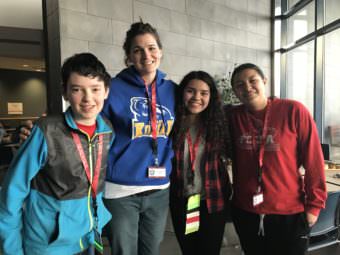
Kodiak student council members Solomon Himelbloom, Beatriz Recinos-Pineda and Esmerelda Lopez with their advisor Lindsey Glenn (Photo by Caroline Halter/KTOO)

High schoolers from across the state wrapped up an annual student government conference at Juneau’s Thunder Mountain High School this week. This year, they tackled a serious topic: gun violence at school.

Mark Barden addressed the auditorium full of students from across Alaska by video.

“In 2012, I lost my sweet little son Daniel in the Sandy Hook School Shooting in Newtown, Connecticut,” he told them. “Daniel was just seven years old, and the youngest of our three children.”

Following his loss, Barden founded an organization called Sandy Hook Promise.

“Through my work with Sandy Hook promise, I have learned that Daniel’s death was preventable and that so many deaths to gun violence and other forms of violence are preventable, if we know the signs.” he said.

Barden’s address was part of a presentation by Paula Fynboh, Sandy Hook Promise’s field director. Fynboh spoke to the students in person about preventing social isolation and recognizing the warning signs of violence.

“Most school shootings are planned at least six months ahead of time. And in 4 out of 5 cases, the attacker told somebody their plans before it happened,” she explained.

After the presentation, students headed to the cafeteria to have dinner and discuss.

Lillian Martin attends Hutchinson High School in Fairbanks, and she said she thought the presentation was “pretty cool.”

She said it’s possible to feel lonely even when you’re surrounded by peers.

“When I’m sitting in a big group it seems like sometimes I’m not really ‘in’ the group and I don’t really have anyone to talk to,” she said.  “So I think it’s a really good idea to just go to someone who’s sitting alone and just sit with them because it really helps out.”

Simple acts, such as making sure no one eats lunch alone, are what Sandy Hook Promise teaches kids to do. That’s in addition to speaking up about typical warning signs of violence.

Students at Kodiak High School have already started. In February they participated in Sandy Hook Promise’s “Start With Hello” week– 5 days of events designed to foster inclusivity at school.

“On Monday, we decided to greet all of the students, and it went so great that we ended up staying for the rest of the week. Every morning, student council members would come in early in the morning and say hi,” said student council member Esmerelda Lopez.

Lopez noticed some changes after the week was over.

“I’ve had a couple students come to me about a particular student. It reached administration… everybody’s starting to speak up and that’s what we needed,” she said.

Solomon Himelbloom, the sophomore class secretary, put together a video to share with the conference attendees. In it, student council members at Kodiak High School give high fives to students as they walk onto campus before school starts.

“It had a positive impact on our school. And I hope that other schools, not only in Alaska, but other schools throughout the nation and maybe the world they echo what happened,” said Himelbloom.

The Kodiak students say they will do more events in the future.

Site notifications
Update notification options
Subscribe to notifications