Alaska Health and Social Services Commissioner Valerie Davidson and Alaska Congressman Don Young expressed concerns about the replacement bill for the Affordable Care Act.
The Sitka Sound Sac Roe herring fishery opened Mar. 19.
The lawsuit brought against the U.S. Environmental Protection Agency by the group pursuing a gold-and-copper mine in southwest Alaska was put on hold.
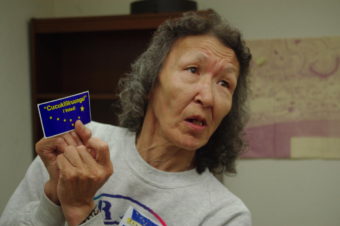
Sally Williams uses a sticker that says cucuklillruunga, or “I voted” in Yup’ik to teach the phrase at the Togiak voting site on Aug. 16, 2016. (Photo by Molly Dischner/KDLG)
In the last Legislature, a Democrat-sponsored bill aimed at increasing voter turnout in Alaska, especially in the Bush. It didn’t get a single hearing in the Republican-led House of Representatives.
Now, Rep. Chris Tuck, an Anchorage Democrat, is in a powerful position leading the new House majority, and has reintroduced the legislation and the bill is making some progress.
Cindy Allred works for Get Out the Native Vote, an organization that has been active registering and encouraging voting among Alaska Natives, many of whom live in rural areas.
“We do have a big concern that there are more challenges to registering to vote in rural Alaska, to voting in rural Alaska as well,” she commented. “There are communities in Alaska that don’t even have a polling station.”
Get Out the Native Vote put their weight behind passing PFD voter registration and has been working with Tuck on House Bill 1.
“There’s a couple of us who just got together and said “How can we help modernize Alaska’s system? How can we try to make it more equitable?” said Allred.
Tuck’s bill is comprehensive. It would give people the option to permanently vote by mail and allow for same day registration, among other things.
Grace Mulipola worked on Get Out the Native Vote in Bristol Bay.
“Some of the people are not there on election day, either because they have doctors appointments or they’re out doing their subsistence. So, I think that’s one of the biggest barriers in the rural areas,” she said.
In addition to getting people registered to vote, Mulipola helped set up early voting stations in Bristol Bay, part of District 37, for the 2014 general election. According to Division of Elections data, general election turnout there has fluctuated. Increases in early voting sites and registration haven’t always coincided with higher voter turnout.
Tuck’s bill ensures that early voting stations stay the same year after year, but it doesn’t directly address the number or placement of such voting sites. According to Division of Elections, since 2010 the number of early voting sites in Alaska has increased from 73 to 169.
This animated heat map shows sites where voters could vote early in recent general elections. It’s based on data from the Alaska Division of Elections. (By Ashwin Kiran)
So why didn’t this bill go anywhere last session? Tuck chalked it up to partisan politics.
“Well, we had a different makeup of the Legislature. We had a different majority, minority situation,” he said. “This year, I went from being minority leader to majority leader. And uh… we’re not going to be treating people the way we were treated because we weren’t allowed to have our bills heard, even though some of them were good ideas.”
Rural Alaska tends to vote blue, which means higher turnout in the Bush may help Democrats in statewide races.
Former Democratic U.S. Sen. Mark Begich invested heavily in rural Alaska in his 2014 campaign against Republican Dan Sullivan. His brother, Tom Begich worked on the campaign before being elected last year to represent District J in the Alaska Senate.
“In my brother’s U.S. Senate race, early voting was a critical issue for us,” said Tom Begich said.
The campaign hired organizers in 40 villages and set up 16 offices from Barrow to Bethel and put a big emphasis on early voting in hopes of increasing rural turnout.
“When we analyzed where there was early voting and where there wasn’t at the time, we noted that where there wasn’t early voting, turnouts tended to be a little bit lower,” he noted.
The rural vote was instrumental in Begich’s 2008 win against longtime Republican incumbent Ted Stevens, but Begich lost to Sullivan in in 2014, despite investing heavily in rural Alaska.
Early voting is only one part of Tuck’s bill, but it has the potential to make voting more accessible for rural communities. For now, House Bill 1 is being workshopped in the House State Affairs Committee.
In the Mat-Su and other places along Alaska’s Railbelt there is growing tension between trappers and dog owners, some of whose pets have been caught in traps.
State Rep. Andy Josephson wants to solve the problem by regulating trapping in public use areas.
For the first time, lawmakers are considering statewide regulations on trapping in response to complaints about pets getting caught in traps, particularly along the Railbelt.
“You let your dog off your leash and poof, suddenly it’s caught in a trap,” Josephson said. “I’m not opposed to trappers. I just want a reasonable accommodation for other user groups.”
House Bill 40 would make it illegal to set traps within 200 feet of public trails, but Josephson is getting a lot of pushback from the trapping community.

Peter Buist has been trapping since he was a kid.
“I’m a product of public school math, but to me that works out to about 50 acres closed to trapping for every mile of trail … You ultimately … take millions of acres out of, close to it trapping,” he said. “The one-size-fits-all approach of just limiting trappers, it’s not fair.”
“We kinda saw the handwriting on the wall and what was coming in a, sort of a more urbanized Alaska here and there,” he said. “We were starting to see that people didn’t understand what went on in the rest of Alaska, particularly bush areas.”
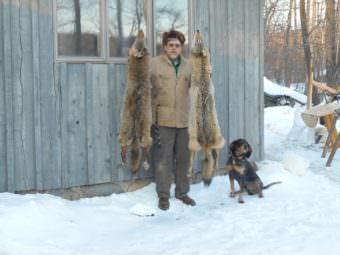
Peter Buist, one of the original founders of the Alaska Trappers Association, holding two coyotes.
In addition to better observance of leash laws, Buist thinks the issue is best resolved at the local level, an opinion that other legislators have echoed in public hearings.
Josephson is skeptical of that approach.
“That leaves people who criticize the problem of dogs getting caught in traps with only having one remedy and that is the board of game,” the Anchorage Democrat said. “They’re basically a voice piece for trappers … They will 99 percent of the time side with trappers. That’s just what they do.”
So that leaves both sides at odds.
For Buist, this proposed legislation is evidence of a common misunderstanding of the trapping community. He says this misunderstanding hasn’t been helped by the media, who often portray trappers as “Neanderthals.”
Tyler Freel, a trapper in Fairbanks, agrees.
“Especially the more urbanized type of people or people who don’t have exposure to it in general think that we’re just brutal and we like torturing animals and stuff,” Freel said. “The vast majority of trappers, you avoid setting traps on public, high use trails.”
“Most trappers understand that everybody, everybody has the right to be out there,” he said. “No trapper wants to catch somebody’s dog or anything like that.”
But Josephson doesn’t buy the urban-rural divide argument.
“Although I don’t trap, I understand Alaska very, very well. I mean, I’ve lived here 52 years. I’ve lived twice in rural Alaska,” he said. “I’m troubled by this belief that the trappers have a right to trap wherever they want whenever they want to. It’s very much an all-or-nothing type of position.”
Josephson is determined to do something at the state level.
He’s reworking his bill, but if he can’t get it through, then he says he’ll settle for a law that explicitly gives local governments the authority to regulate trapping.
Alaska lawmakers held the first hearing Wednesday on a bill that seeks to bring estate planning into digital age.
House Bill 108, or the Fiduciary Access to Digital Assets Act, is designed to help loved ones get access to online accounts of the deceased, from Facebook to digital photo libraries and financial investments, without having to go through a lengthy legal process.
Uniform Law Commission is a nationwide nonprofit that drafts model legislation to keep laws consistent across states and the brains behind HB 108.
Commission member Deborah Behr explained the need for the law using her own life to illustrate her point.
“My husband’s the one who takes all the family photos,” she said. “If my husband passes away and I ask Google for those pictures, Google’s going to say basically ‘Who are you? My contract was with your husband, your husband has deceased. Go get a court order.’ Which, as any of you know, if you’ve had involvements with the court, it’s expensive. It’s time consuming.”
The law works best with cooperation from companies.
“Online providers, Google, Facebook, will adopt what’s called an online tool,” Behr said. “When you open a new account with them, they will have a page that says ‘and if I pass away or I get incapacitated, this is what I want done with these assets.’ The main thing with that to remember is that you may say no, and if you say no that means no one gets it.”
In the absence of an online tool, the legislation specifies how people can legally transfer online assets in their written will, power of attorney or trust.
The AARP, a national nonprofit that advocates for retirees and has 95,000 members in Alaska, is in strong support of the bill, and there has been no pushback from legislators thus far.
If passed, Alaska would join 23 other states who have adopted this model legislation.
Alaska state Rep. Matt Claman is picking up where he left off last year with legislation that would require public and private insurers to cover 12-month prescriptions for birth control.
The Anchorage Democrat said it’s good for Alaska women, but he’s pitching it as a way for the state to save money. Lizzie Kubitz, his chief of staff, explained in a hearing on Feb. 28.
“When women have greater access and availability to contraceptives, unintended pregnancies are reduced,” she said. “Reductions in unintended pregnancies have a direct cost savings to the state.”
According to the Guttmacher Institute, 48 percent of pregnancies in Alaska are unintended. That’s slightly higher than the national average of 45 percent.
Kubitz said that in 2010 more than 90 percent of Alaska’s unintended pregnancies were publicly funded, costing the state $42.9 million.
Jessica Cler, who manages public affairs at Planned Parenthood Votes Northwest, said that women in Alaska face unique circumstances that can make it difficult to access birth control.
“Women anywhere face a number of different challenges, whether it’s busy work lives or families to take care of ,” she said. “I think in Alaska, specifically, women can face additional barriers, particularly when women who are living in remote communities or perhaps work on a boat or work in tourism to get to a pharmacy or a local provider to refill your birth control every month or every three months.”
Small businesses and private insurers oppose the bill. Their concerns include patient safety, medication storage and cost and waste.
The bill does not change the requirements for covering birth control in Alaska, which is mandated at the federal level by the Affordable Care Act. It adds the same requirement to state law, plus the 12-month prescription rule.
Last year, the legislation died in committee, but this year’s new leadership in the House could increase its odds of passing.
State Rep. Ivy Spohnholz is a co-sponsor of House Bill 25.
Close
Update notification options
Subscribe to notifications
Subscribe
Get notifications about news related to the topics you care about. You can unsubscribe anytime.