Caroline Halter, KTOO

No pre-trial office in Douglas, says Department of Corrections, which also clears up misconceptions

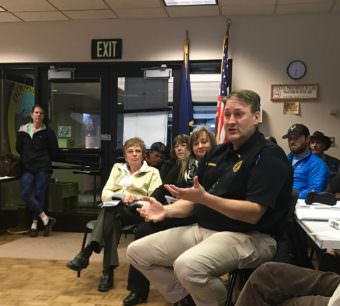
Juneau police Lt. David Campbell spoke to Douglas residents before Alaska’s Director of Pre-trial Services Geri Fox at a special neighborhood association special meeting. (Photo by Caroline Halter/KTOO)

Rumors of a “pre-trial facility” for parolees on Douglas Island sparked concern among residents last week.

Alaska’s Department of Corrections’ Geri Fox attended a special meeting of the neighborhood association Tuesday evening to assuage fears and offer clarification.

“We are not housing offenders on Douglas Island,” she said firmly.

Fox explained that there was a plan to establish an office in downtown Douglas for pre-trial officers.

“We were going to bring in six officers onto Douglas Island, every day, who would have their offices here,” Fox said. “There was no holding facility or handcuff bar or anything like that.”

But that’s now off the table.

“I do not have intentions of putting my officers on Douglas Island at this point,” Fox said. “I have heard you. I’m not interested in doing that at this point.”

Pre-trial officers will be in charge of monitoring people who’ve been arrested for a crime, but have yet to appear in court or be convicted.

They’re not parolees, as some residents believed.

Occasionally these people will come in for scheduled appointments, but for the most part, officers will go out into the community to check in with people at home.

The pre-trial program doesn’t yet exist. It’s one piece of a criminal justice overhaul passed by the legislature last year that seeks to divert people from prisons and jails to cut costs.

“I don’t think you’re the only community that misunderstands or maybe has ideas about what this is,” she said. “We need to educate Alaskans about what it is.”

Fox still doesn’t know where the office will be, but she shared her timeline for getting the program up and running.

One big piece of the puzzle is developing a risk assessment tool to determine who is eligible for pretrial services.

“We will be piloting the tool in September, so I need to have a good portion of my officers hired and in place somewhere, right?” Fox asked.

After that, the next phase will begin in January 2018.

“We’ll start assessing and then those defendants will be supervised. But the real kick-start date is January 2018,” Fox said.

The meeting ended on a lighthearted note. People offered suggestions of where the office could go. One attendee joked of putting the office on a boat called Australia.

Despite not wanting the office in their neighborhood, several residents expressed approval of the state’s new approach to criminal justice and the effect it could have on public safety.

Correction: Pre-trial officers will be in charge of monitoring people who’ve been arrested for a crime, but have yet to appear in court or be convicted. A previous version of this story incorrectly said officers would be monitoring people who have been charged with a crime.

Git Hayetsk uses dance to revise indigenous history

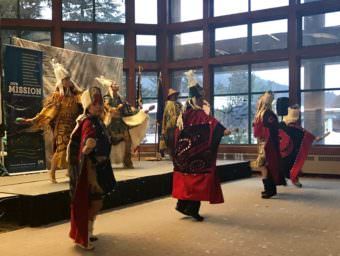
Git Hayetsk dancers perform their chief’s headdress dance honoring Smgyigyet (chiefs) and Sigidmhana̱’a̱x (matriarchs) on  March 25 at University of Alaska Southeast in Juneau. (Photo by Caroline Halter/KTOO)

If you’re a longtime resident of Southeast Alaska, you may have heard the story of the founding of Metlakatla, a community in the Annette Islands Reserve, Alaska’s only reservation.

It’s usually told like this: in the wake of a growing rift with the Anglican Church, missionary William Duncan led more than 800 Tsimshian people on a canoe voyage from British Columbia to establish their own devout community in Alaska.

University of Alaska assistant professor Mique’l Dangeli tells a very different version of that history.

The dancers of Git Hayetsk share a common ancestry to the Sm’algyak speaking peoples of the Nisga’a, Tsimshian, and Gitxsan nations.

The dancers recently traveled from British Columbia to perform at University of Alaska’s Juneau campus. It’s a journey similar to one their ancestors made in the late 1800s.

Dangeli leads the group with her husband, Mike, and uses the performance to tell the version of Metlakatla’s founding told to her by prominent oral historians in the Tsimshian community.

Dangeli put it bluntly: “We didn’t follow William Duncan, William Duncan followed us.”

“It was our people’s decision to come back to Alaska and to argue for land rights with the U.S. government,” she continued. “We’d been denied by the Canadian government (and) it led to our decision to move.”

The song that tells the story is called “Paddle to Metlakatla.” It describes a particular moment on the canoe journey when one woman stood to rally the group who was grieving the choice to leave home.

“The words in that song are ‘Wha! T’iina tleexgn!” which is one way of saying ‘stop crying,'” Dangeli said.

From there, the dynamic of the dance changes.

The drum starts beating faster.

The dancers look up, and they start paddling harder.

“They let go of their fear of starting all over again,” Dangeli said.

As for William Duncan, well, Dangeli said he wasn’t even present on that journey.

“We celebrate our founder’s day in Metlakatla on August 7th. Our people started coming over in March, so the day that we celebrate as our founders day is the day that William Duncan finally arrived,” Dangeli said. “He came on a steamer.”

That’s one piece of what Dangeli calls a counter narrative, in contrast to the story that has come to represent the Tsimshian, even within parts of their own community.

“William Duncan, he’s always portrayed as this pied piper and we were just these rats scurrying along behind him,” she said. “Unfortunately, some of our people have internalized this colonial narrative.”

Git Hayetsk invited audience members to participate. (Photo by Caroline Halter/KTOO)

According to Dangeli, the idea that the Tsimshian people completely converted to Christianity, abandoning their own customs, also is false.

She explained that while most history books focus on the Tsimshian’s conversion to Christianity, her people continued their cultural practices “under the guise of Christian practices like Christmas parties and Easter parties.”

Some of those cultural practices have been absorbed into Tsimshian culture, but Dangeli said the cultural survival story was strategically hidden by Duncan.

He tightly controlled the flow of information in and out of Metlakatla to preserve his reputation as a missionary that had complete control over the community. He even went so far as to burn books that documented their ongoing cultural practices.

Toward the end of the Git Hayetsk performance, the group performs a victory song belonging to Dangeli’s husband.

“After war, they would line the beach and they would laugh and taunt their enemies because they had survived,” she said. “Now we use that song to talk about survival … in a much larger way.”

Newscast- April 4, 2017


In this newscast:

  • President Donald Trump signed legislation siding with Alaska’s request for predator control on federal wildlife refuges,
  • Alaska marijuana regulators are expected to resume debate over onsite consumption,
  • A company that sought to develop a major coal mine 45 miles (southwest of Anchorage has suspended applications for state permits, and
  • Fairbanks police have opened a homicide investigation after discovering a man dead near the downtown business district.

Juneau superintendent questions funding plan

Sen. Shelley Hughes, a Wasilla Republican, held a series of  committee hearings on virtual education and school funding beginning  last year. It culminated in the release of broad education reform bill.

One of the its 28 provisions  limits funding for schools operating below 80 percent capacity. That’s one of several factors that determines how much money schools receive from the state each year.

Rep. Shelley Hughes speaks at a legislative “Lunch and Learn”, March 12, 2014. (Photo by Skip Gray/Gavel Alaska.)
Rep. Shelley Hughes authored education legislation that concerns Juneau’s school superintendent. (Photo by Skip Gray/Gavel Alaska.)

Juneau School District Superintendent Mark Miller is one of many administrators unhappy with the school-size-funding provision in Senate Bill 96.

“That would force districts like ours to have to shut down schools and bus the kids across town,” he said.

The Juneau Empire reported seven out of the district’s 10 traditional schools operated below 80 percent capacity in 2016.

Miller’s staff calculated what the change would mean in dollars.

“It would be a significant hit to our budget,” said Miller. “Over the long run, about $4 million.”

That loss would occur over a 10-year period.

Districts could be facing additional cuts. Senate Republicans said they will reduce public education funding by 5 percent in their budget proposal.

Prior to the release of SB 96, Sen. Hughes said in an interview that Alaska has one of the highest per-student expenditures in the nation, yet results continue to disappoint. Her goal is to reduce administrative costs and boost outcomes at the same time.

Juneau Superintendent Mark Miller worries education funding-formula changes will hurt local schools. (Photo by Lisa Phu/KTOO)

Miller doesn’t think it makes a lot of sense to compare Alaska to other states in this context.

“Is education in Alaska expensive? Yes, education in Alaska is expensive. So are the hamburgers,” he countered. “Getting things here is expensive and you know we are so spread out that there are a lot of schools with 15 or 20 kids in them … those are expensive to run.”

Hughes’ bill addresses rural school areas by exempting those further 25 miles driving distance of another school from the 80 percent rule.

Rep. Harriet Drummond, an Anchorage Democrat, chairs the education committee in the House.

“There are some good provisions in SB 96,” she said “But the thing that I know is bothering most people is the school-size-factor piece and that needs to be addressed separately.”

She’s not opposed to changing the state’s school funding formula, but thinks it will take much longer than the two weeks legislators have left before the end of the regular session.

“It needs to be addressed slowly and thoughtfully and not squeezed out of the legislature at the last minute … I’m not going to push it out of my committee. That’s for sure,” said Drummond.

She said she reached out to Sen. Hughes to work on the issue in the interim.

For now the bill remains in the Senate Education Committee, where it has already had seven hearings since its first reading on March 20.

Site notifications
Update notification options
Subscribe to notifications