Caroline Halter, KTOO

USGS overhauling inaccurate, outdated Alaska maps

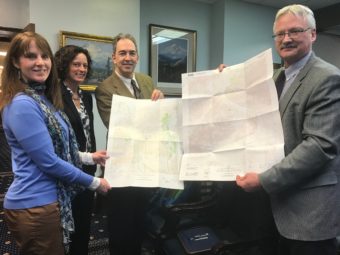
Sen. Natasha von Imhof, Kevin Gallagher, Ed Fogels hold new topographic maps of Alaska created through the Alaska Mapping Initiative.
Sen. Natasha von Imhof, Kevin Gallagher, Ed Fogels hold new topographic maps of Alaska created through the Alaska Mapping Initiative. (Photo by Caroline Halter/KTOO)

Unlike other states, Alaska is using topographic maps that were created over 50 years ago. These maps, some of which were hand-drawn, are rife with inaccuracies. Rivers flow upstream, mountains are out of place and some features are missing altogether.

These mistakes affect everything from aviation to back country hiking. This year, Alaska hopes to take a big leap forward by completing new maps for over half of the state.

The US Geological Survey (USGS) began updating topographic maps in the United States in the 1940s, but not in Alaska. When mapmakers match modern satellite imagery with Alaska’s old, imperfect elevation data strange things happen.

It’s kind of like trying to put a banana peel over cauliflower and make it fit seamlessly. It just doesn’t work,” said Nick Mastrodicasa, a project manager at the Department of Transportation, at a legislative hearing on Feb. 8.

In 2012, Alaska partnered with USGS to produce something called a Digital Elevation Model — a banana that fits today’s peels — and create over 11,000 topographic maps covering the entire state. The little-known project has been slow moving, but Ed Fogels, deputy commissioner at the Department of Natural Resources, explained why it’s so important.

“Alaska is the most poorly mapped state in the nation … some claim that we’ve spent more time and energy and money mapping some planets than we have the state of Alaska,” he said

Mapping Alaska is expensive, due to the sheer size of the state and temperamental weather. In the rest of the country, topographic maps were updated using a technology called LIDAR. In Alaska, new maps are being produced using a slightly cheaper alternative.

“The digital elevation model is actually created by flying a sensor around in an airplane, and it’s a technology called IFSAR. And so that’s just a lot of data that comes in that tells you what the shape of the earth is,” explained Fogels.

Fogels said that USGS then takes that data in combination with new satellite photos and uses it to create the topographic maps you see sold at national parks and outdoor stores. The digital elevation model is 77 percent complete.

USGS has plans to map new areas in Alaska in 2017.

So far, USGS has created 3,731 up-to-date topographic maps. Kevin Gallagher, the associate director at USGS, has set the bar high for 2017.

“This year we are ramping up our production,” said Gallagher. “We are going to try to produce 3,038 in 2017 alone and reach a status of 60 percent of the state covered with these new topographic maps.”

One particularly difficult part of the state to map is the Aleutian Islands. This 1,200-mile stretch of volcanic islands is too expensive to map, even with IFSAR.

“We’re looking at the IFSAR costing probably twice as much in that area,” said Gallagher, “So we’re actually considering some alternative technologies…”

Completing the digital elevation model for the remaining 23 percent of Alaska will cost about $14 million dollars according to Gallagher. There’s no date for completing the entire project, but the state is hoping for continued federal support.


State consultants recommend consolidating state corporations

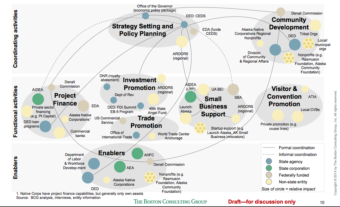
This is one of many slides the Boston Consulting Group presented to the Senate Labor and Commerce Committee on Thursday, Feb. 9, 2017.

Last August the state of Alaska hired consultants under an $800,000 contract to study opportunities for savings and consolidation in three state corporations: Alaska Industrial Development and Export Authority, the Alaska Energy Authority and the Alaska Housing Finance Corporation.

The corporations collectively manage over $3 billion in assets, according to the Alaska Dispatch News. Thursday the consultants’ presented their findings to the Senate Labor & Commerce Committee.

Nicole Bennett, a principal with Boston Consulting Group, explained the recommendations.

“We were asked the question of whether or not the three agencies could combine and consolidate into one. Ultimately our recommendation was for AIDEA to remain independent … but we did think there may be some opportunity for AHFC and AEA,” she said. 

The group believes that AHFC and AEA could benefit from closer collaboration on development efforts in rural Alaska. They also recommended that AIDEA be less subject to the influence of the Legislature.

“Today many of AIDEA’s projects actually come from the Legislature. We’d actually like to see them have a lot more insulation and be able to focus only on the projects that are going to have the highest return in terms of both jobs and economic development and financial return from the state,” stated Bennett.

Bennett mentioned statutory changes that would make AIDEA more independent, such as lengthening board member terms and eliminating legislative approval of large projects.

Administration Commissioner Sheldon Fisher said that the consultants’ final report will be available in the coming days.

Gov. Bill Walker signed an administrative order in March that led to the study.

University of Alaska president addresses lawmakers after no-confidence votes

The faculty senate at the University of Alaska Fairbanks voted no-confidence in University President Jim Johnsen’s leadership on Monday, Feb. 6. The vote followed the same move by the Anchorage faculty Jan. 13.

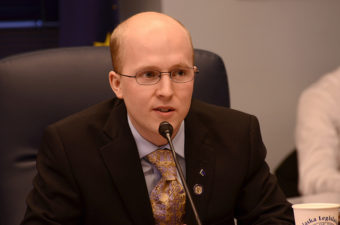
Johnsen addressed the issue this morning at a meeting of the Senate Education Committee.
After absorbing more than $50 million dollars in budget cuts over the past two years, Johnsen and the Board of Regents are in the process of consolidating the university’s administration through what they call the “Strategic Pathways” program.

The no-confidence votes came after Johnsen reversed his recommendation to headquarter the school of education in Fairbanks after the City and Borough of Juneau offered a $1 million contribution to support the school. The faculties say they were not involved in that decision, as well as others.

Sen. Gary Stevens raised the issue.

“I think you made the right decision on moving the school of education headquarters here to the Juneau campus, but still, in all, as a former faculty member I am quite concerned of where you’re going in relationship to the faculty. … They apparently feel they’ve been left out. … How are you going to bridge that gap?” he asked.

Johnsen responded that 89 faculty have been involved in the Strategic Pathways process thus far, and there will be more involvement in the next phase.

Going forward, there will be two rounds of consultation with every affected organizational unit … In addition to that we’re scheduling time with the faculty senates themselves, so that they have an opportunity to weigh in,” he said. “You know change is very, very difficult and you’ve given us budgets that are tough to meet, and I can’t take seven years to go through processes to make decisions about how we’re going to move forward. We have to make those decisions expeditiously.”

Stevens’ response was light-hearted.

“There’s an old joke that I didn’t like when I was a professor and that is ‘how many professors does it take to change a light bulb?’ and the answer is ‘change?'” he said. “But, I say that in humor because I love the faculty … and we can get beyond this, I believe.”

Sen. Shelley Hughes, who chairs the committee, ended the hearing by encouraging faculty involvement in the consolidation process.

Johnsen is scheduled to talk about the university’s recruitment strategy, the land grant deficit and other issues at 4:30 p.m. Thursday, Feb. 9, in the House Finance Subcommittee on the university.

Correction: An earlier version of this story misstated which subcommittee University President Jim Johnsen is scheduled to speak in. Johnsen is scheduled in the House Finance Subcommittee on the university, not the Senate. 

After Alaska lawmaker’s fundraising controversy, Senate considers tighter rules

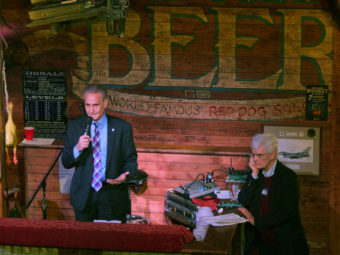
Alaska state Sen. Kevin Meyer, left, is sponsoring Senate Bill 5, which would extend state campaign finance rules to PACs controlled by individual legislators. Meyer recently spoke at a Policymakers' Fiscal Forum, Red Dog Saloon, Jan. 31, 2017. Cliff Groh was the moderator. (Photo by Skip Gray/360 North)
Alaska state Sen. Kevin Meyer, left, is sponsoring Senate Bill 5, which would extend state campaign finance rules to PACs controlled by individual legislators. Meyer recently spoke at a Policymakers’ Fiscal Forum at the Red Dog Saloon in Juneau on Jan. 31, 2017. Cliff Groh was the moderator. (Photo by Skip Gray/360 North)

The issue of money in politics got a lot of media attention this summer when Republican Rep. Gabrielle LeDoux formed Gabby’s Tuesday PAC.  It’s the first political action committee in Alaska controlled by an individual legislator.

Former Alaska Senate President Kevin Meyer is going after PACs such as LeDoux’s in what he says is an effort to improve public trust. Others see it as partisan politics.
Sen. Meyer hopes to change Alaska’s campaign finance law to address PACs controlled by individual lawmakers and candidates.

Senate Bill 5 will close the loophole that allows lobbyists to contribute to political action groups that are controlled by a legislator or a candidate for the Legislature and places a restriction on when these groups can engage in political fundraising,” he said at a Jan. 31 public hearing.

Under Alaska’s 1996 campaign finance law, candidates and elected officials are not allowed to receive contributions from lobbyists outside their home district, and they are not allowed to fund raise during the legislative session. SB 5 would extend these same rules to PACs controlled by individual legislators.

PACs like LeDoux’s cannot contribute to the candidate or legislator that controls them, but Meyer says it’s the appearance of impropriety that worries him.

“I just think that the inference of misbehavior is so great,” he said “Whereas when it goes to other parties where I as the legislator can’t control, then that’s kind of out of our hands,” he said when asked about lobbyist contributions to PACs controlled by political parties versus individual legislators.

Democratic Sen. Bill Wielechowski is a strong proponent of campaign finance reform. He supports Meyers’ bill in principle, but thinks it could go much further.

“If we’re concerned that lobbyists giving money to legislators is a problem, there’s probably some other areas that we need to close in this system,” he said. “For example, what if a lobbyist gives money to his wife … and then lets the wife write checks to the legislator? Should that be allowed? What about lobbyists giving money to political parties and then having political parties give money to legislators? Should that be allowed?”

Wielechowski is actively working on an amendment to SB 5 to make it more comprehensive.

A lot has been made of the Gabby’s Tuesday PAC, but LeDoux has pushed back, saying it’s no different than PACs run by state political parties.

Casey Reynolds, a former GOP spokesman-turned-blogger, agrees with LeDoux’s position.

“Each political party, the Republican and the Democrat have groups, have PACs that are set up to support House Democrats, House Republicans, Senate Democrats, Senate Republicans, and so those caucus leaders can raise money into those PACs from the same interests that Gabrielle LeDoux is raising money into her PAC from, and then distribute it out to people as they see fit to people who are aligned with them,” he said.

In Reynold’s opinion, the bill isn’t really an effort to get money out of politics, but rather an attempt by the state’s political parties to maintain power after LeDoux and two other Republicans joined forces with 17 Democrats and two independents to form a new majority in the House this year. It’s the first time since 1993 that a Republican has not held the top position in that chamber.

“Gabrielle LeDoux has been disavowed by the Republican Party, and they’ve made it very clear they’re going to run someone against her in a primary because she organized in a nonpartisan, in a bipartisan coalition,” he said. “I suspect this is a messaging component of that, trying to vilify her and make her seem like she’s more tainted and less ethical than anybody else and trying to use that against her to get her un-elected.”

LeDoux refused to speculate about the underlying motivations of Meyers’ bill, but she did acknowledge the shifting power dynamics between individual lawmakers and political parties.

She thinks it’s a positive development.

“I think sometimes the parties have too much influence in politics, and so if more people had individual PACs, that could kind of curtail some of the influence that the parties had on people,” she said.

Senate Bill 5 is scheduled for public testimony at its next hearing in the Senate State Affairs Committee on Thursday, Feb. 9.

Juneau delegation meets with Tlingit and Haida leaders

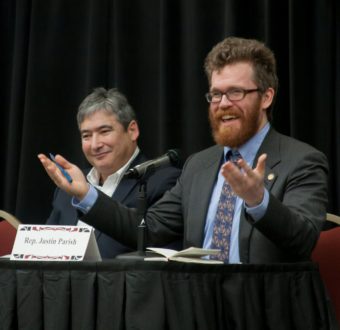
Rep. Justin Parish, D-Juneau, speaks at a Native Issues Forum in Juneau on Feb. 2, 2017. Rep. Sam Kito III, D-Juneau, is also pictured.
Rep. Justin Parish, D-Juneau, speaks at a Native Issues Forum in Juneau on Thursday. Rep. Sam Kito III, D-Juneau, is also pictured. (Photo courtesy Alaska House Majority Coalition)

Juneau’s three state legislators spoke at the Native Issues Forum on Thursday.

Representative Justin Parish, a first-time legislator, introduced himself in Tlingit and acknowledged his own Native heritage. His paternal grandmother is a member of the Dog Salmon clan. The introduction garnered applause from the audience.

Parish was joined by Rep. Sam Kito III and Sen. Dennis Egan. All three are Democrats. They spoke about their respective policy priorities, as well as the state’s budget crisis.

Mique'l Dangeli asks a question of the Juneau's state legislators at a Native Issues Forum in Juneau on Feb. 2, 2017.
Mique’l Dangeli asks a question of the Juneau’s state legislators at a Native Issues Forum in Juneau on Thursday. (Photo courtesy Alaska House Majority Coalition)

A question from Mique’l Dangeli in the audience prompted discussion about relations between Alaska and British Columbia. Dangeli, who teaches Alaska Native Studies at the University of Alaska Southeast, questioned the transboundary agreement signed in October. She expressed concern over the lasting environmental damage caused by Imperial Metals’ Mount Polley Mine tailings dam failure in 2014. The mine is still in operation.

“How is it that you come into an agreement with the Province of British Columbia when they haven’t cleaned up the disasters, the continuous spills within their own province? How is it that our relationship here in Alaska is going to be different with the B.C. government?” she asked.

Sen. Egan responded.

“The trans-boundary agreement is a first step. I agree about Mt. Polley… It’s a major issue with us. It’s a major issue with the Canadians. What I hope happens, and the lieutenant governor is being very forceful on this, is that our boundary agreements escalate to the federal level. So we get the U.S. State Department involved and also their counterpart in Ottowa, to make this a real issue,” Egan said.

Egan said he is worried about further progress if Canada’s Minister of Indigenous and Northern Affairs, Carolyn Bennett, retires.

The Native Issues Forum is sponsored by the Central Council of the Tlingit and Haida Indian Tribes of Alaska.

Lawmakers consider protecting ‘ballot selfies’ as part of free speech

I Voted Today stickers were popular accessories on Tuesday, election day in Alaska. (Photo by Maggie Schoenfeld)
I Voted Today stickers may not be the only popular form of social media expression for voters if an Alaska measure passes. A measure going though the Alaska House could add so-called ballot selfies to recognized forms of political speech. House Bill 7 is sponsored by state Rep. Jonathan Kreiss-Tomkins, D-Sitka. (Photo by Maggie Schoenfeld)

In Alaska it’s illegal to “exhibit” a picture of a marked ballot. Sharing a ballot selfie isn’t a criminal offense as in some states, but it is technically grounds for invalidating that vote.

Now, Alaska may be joining 22 other states who have legalized ballot selfies as a form of political speech.

On Oct. 27, 2016, former Alaska Governor Sarah Palin expressed her support for presidential candidate Donald Trump by posting a picture of her ballot on Facebook. The picture got 17,000 reactions, 560 shares and 616 comments.

It also generated news articles questioning whether Palin had violated state law.

Jonathan Kreiss-Tomkins
Rep. Jonathan Kreiss-Tomkins, D-Sitka, says that ballot selfies should be recognized as a form of political speech in Alaska. (Photo by Skip Gray/Gavel Alaska)

State Rep. Jonathan Kreiss-Tomkins, D-Sitka, thinks that it’s time for the so-called “ballot selfie” to be recognized as a form of political speech in Alaska.

“Ballots and voting are, in a certain sense, an expression of what your view of society should be, in terms of who you believe in electing in order to sort of effect that vision of society,” he said. “I think that’s an incredibly important form of speech and should be free and should be protected.”

The 27-year-old state representative is sponsoring House Bill 7, which would make it legal to share ballot selfies, as well as pictures of marked ballots such as Palin’s.

Josie Bahnke, director at the state’s Division of Elections, said that Alaska’s current law is both unclear and impossible to enforce, and she’s supports the ballot selfie bill.

For the Division, we support clarifying language,” she said. “This is just going to give us clarification to give direction on ballot selfies, and of course, we support any legislation that promotes the act of voting.”

In states where they do enforce bans on ballot selfies, such as New Hampshire and Colorado, federal courts have ruled that ballot selfies are protected under the First Amendment.

Rick Hasen, a professor at the University of California Irvine who specializes in election law, is a strong opponent of the legalization of ballot selfies.

He said concerns about vote buying and coercion are still relevant.

We’re not worried so much about people taking pictures and posting it on social media and then selling their vote, but people taking those pictures and just sharing them privately with whoever might be coercing them or paying them,” he said. ” A law doesn’t have to be perfect in order for it to be constitutional, and so even if it’s not perfect, it could be a useful way, even if not a perfect way, to deter such conduct.”

Kreiss-Tomkins acknowledged concerns about vote buying in his bill sponsor statement, but he thinks his bill will be well-received.

I may be more familiar and exposed to the way people express themselves online then perhaps some of my colleagues, but I remain pretty confident that all of my colleagues will find the current law pretty dumb and want to change it, because it is. So, I suspect that this will have multi-generational appeal,” he said with a laugh.

For him, the legislation is simply a matter of keeping up with the times.

I think on election day, or even prior to election day with absentee ballots, I would say my Facebook feed is pleasantly populated with ballot selfies, and the first time I was on the ballot I took a photo … it it was a meaningful memento to me. So, here I am, a criminal. I’m trying to emancipate myself,” he joked.

Kreiss-Tomkins also is working with state election officials on an amendment that would address concerns about electioneering.

The House State Affairs Committee plans to hold another public hearing on the bill.

Site notifications
Update notification options
Subscribe to notifications