Caroline Halter, KTOO

Fairbanks Four may receive dividends for 18 years of wrongful imprisonment

A Fairbanks Four banner at the 2015 Alaska Federation of Natives Conference. Two measures moving through the Alaska House would compensate the four men for the 18 years spent in prison. (Photo by Mikko Wilson/KTOO)

It took the work of journalists, lawyers, tribal leaders and citizens to release the Fairbanks Four after they wrongfully convicted on a murder charge and other serious crimes in 1997.

Now, an effort is underway to compensate the men for the 18 years they spent in prison in the form of two state House measures.

These bills would apply to others who are freed after a wrongful imprisonment, but the Fairbanks Four are the only ones who meet the conditions right now.

On Dec. 17, 2015, hundreds gathered at the Chief David Salmon Tribal Hall in Fairbanks to celebrate the release of the Fairbanks Four. That night three of the four men were released. The fourth, Marvin Roberts, was released on parole the summer before.

Attorney Bill Oberly led the effort to free the Fairbanks Four. After it was all over, he became involved in an effort to give Permanent Fund dividends back to the four men for the time they spent behind bars.

“Don’t let the door hit ya’ in the rear end on the way out is all they got for their 18 years of wrongful conviction,” Oberly said. “It seems only fair that the dividends that were taken away from them wrongfully should be provided to them and give them a little monetary help trying to restart their lives.”

Roberts wrote a Facebook post about what he thinks of the bill.

“What did the Facebook post say?” I asked.

“It’s basically giving a first-hand account of what my first night in prison was like,” he said.

Roberts wasn’t willing to read the post aloud over the phone.

“I don’t know. I don’t think so,” he said. “It was difficult for me to write it, so it would be more difficult for me to read it to you.”

“I actually cried when I wrote certain parts of the story, ‘cause that’s how much, um, that’s how deep that wound is,” Roberts said.

The post is long, but here is a snippet:

“I told the Guard that I wasn’t supposed to be in there, that I was innocent. Nobody heard me. I layed down on that torn mattress and had sad thoughts. Who could sleep in a situation like that? I prayed and asked God to get me out … please get me out. I prayed and still my spirit was breaking. I was hurting real bad. I don’t know when I started crying or how long it lasted. My world was upside down. I’d love to say I was released the next day and that was that. No, this is not a happy ending. We spent over 18 years trapped in that nightmare.”

He goes on to thank his supporters, and then he asks for people to please call their representatives to support two bills: One that would give them their dividends for the years they were wrongfully imprisoned (House Bill 127) and another that goes even further, requiring the state to pay $50,000 for each year of wrongful imprisonment, with a cap of $2 million (House Bill 118).

I asked Roberts what the bills would mean for him, if they pass.

“I realize now after being away for so long how valuable being with family is and, receiving all those back dividends would … I’d just be so happy. I’d be able to see my family. I’d be able to maybe start my own business. I’d be able to stay ahead of my bills. I mean, it would help out a lot.” he said, adding that he was staring at his 6-month-old daughter as he spoke.

Roberts lives in Fairbanks. He has two jobs — he works at a company that makes and installs granite counter tops during the week and delivers pizza on the weekends.

Alaska Innocence Project Director Bill Oberly (L) and Marvin Roberts (R) at the Alaska Federation of Natives

I asked him, “Do you think that this is part of carrying out justice?”

“I don’t really know too much about all of that. All I know is, it would help us a lot,” he said.

Oberly, who pushed to free the Fairbanks Four, has a stronger opinion.

“It is the right thing to do,” he said. “These men should have gotten it because they shouldn’t have been in prison, so it’s the right thing to do at this point.”

Last year, Oberly’s effort to get dividends paid to the Fairbanks Four didn’t really go anywhere. He’s hopeful that this year will be different.

Lawmakers press ahead with Uber legislation

Taxi drivers in Budapest protest Uber in 2016. (Photo by Wikimedia Commons)

Ride-sharing company Uber left Alaska in 2015, agreeing not to return until a state law was in place that exempted the company from paying workers’ compensation insurance for its drivers.

Now, three state legislators are leading the effort to lay the groundwork for the company’s return, including a measure moving through the House and one in the Senate.

An Uber commercial from 2016 depicted a young guy splitting his time between his regular job, occasional Uber driving and just hanging out.

But for many drivers, Uber is a full-time job.

Drivers can work up to 40 hours per week — sometimes more — without being considered a full-time employee.

It’s become a point of contention between drivers and the company in some cities, but there is still high demand for ride-sharing.

“A while ago, I’d have friends and constituents come up to say we need Uber, can you get Uber up here … So, I think there’s a demand for it,” said state Rep. Adam Wool. “I was in Seattle. I took Uber one way and a cab the other way, and there was really no comparison.”

Wool is joining state senators Mia Costello and Anna MacKinnon in an effort to bring Uber, and companies like it, back to Alaska.

Wool’s bill is nearly identical to the one in the Senate. Both classify drivers that work for Uber and similar companies as independent contractors.

That doesn’t sit well with Barbara Huff, who handles legislative affairs for Teamsters Local 959.

“Our concern with the bill is with respect to removing them from worker’s compensation, unemployment insurance and other employee-employer related benefits,” she said. “We’re not anti-Uber or anti-Lyft, we just want to make sure that the workers are protected.”

Huff said there’s no way her union will support a bill that doesn’t count Uber drivers as employees.

In an interview, Wool, a former taxi driver, pointed out that taxi drivers are also independent contractors, meaning they too are exempt from things like workers compensation.

His vision of Uber is more in line with the commercial from 2016.

“Taxis usually are contracted to drive 12-hour shifts, and if you drive for Uber of Lyft you can drive whenever you want or not drive whenever you want,” he explained.

As in other states, the taxi industry also opposes the Uber legislation, but for different reasons.

Juneau Taxi owner James Harris is concerned about the future of his business, but he also thinks that all drivers, not just his own, will be worse off if Uber comes back to Alaska.

“We’re already not very busy, and then you add several drivers going after those same customers. So, their drivers will get less. Our drivers will get less. And then before you know it, and this is well documented, these guys are making minimum wage,” he said. “Everybody around is going to start losing money, except for Uber.”

In recent years, Uber drivers across the country have protested over wages as the company has slashed fares.

Huff pointed to one case in Seattle, where the independent contractor issue spurred an ongoing legal battle over wages and the right to collective bargaining.

She said the Teamsters have not been consulted about the Uber legislation.

Uber on the other hand, has been fairly involved.

“We have a sense of what legislative approach works,” said Mitchel Matthews, Uber’s senior operations manager for the Pacific Northwest. “So Sen. MacKinnon and Sen. Costello’s office would approach us with questions that may have come up during the committee for clarification and, so that’s how we’ve consulted with the senators.”

Matthews sounded optimistic about returning to the state.

“In 2016, we had over 20,000 Alaskans with the Uber app on their phone,” he said. “We do want to serve the entire state of Alaska and we’re excited to come back.”

The Senate bill will likely make it to the floor. Wool’s bill had its first hearing Feb. 23.

Lawmakers debate impact of government cuts on Alaska’s economy

Lawmakers are divided on what to do about Alaska’s fiscal crisis.

Some want to continue to shrink the size of state government, but this week there was pushback over how additional cuts would affect the economy.

This week two state lawmakers voiced very different opinions on government spending. Their comments illustrate the depth of the divide over Alaska’s fiscal and economic crisis.
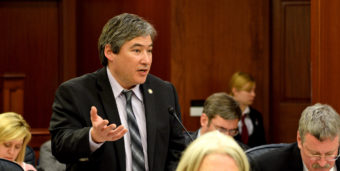
Rep. Les Gara, D-Anchorage, has introduced a new business tax. (Photo by Skip Gray/360 North)
Rep. Les Gara, D-Anchorage. (Photo by Skip Gray/360 North)

“Do you want a state where people move from? Or do you want a state where people want to live? That’s the question this year. If you’re just going to cut a billion dollars and sort of play to the sound bite game, you’re going to cause a 10-year recession, just admit that to your constituents,” said  Rep. Les Gara earlier this week at a press conference.

Gara got his numbers from Northern Economics, a private consulting firm in Anchorage that presented to the Legislature in early February.

Jonathan King, the firm’s vice president, said that a 10-year recession isn’t really accurate, but that additional budget cuts will have an impact on the state’s economy.

“Whether or not we’ll be in recession, that’s not clear, but what is clear is that if we cut that billion dollars we end up at a lower level of employment, and that’s probably worth about 10,000 jobs additional in losses above the 24 to 25,000 jobs that we expect to lose from 2015 to 2018 or 2019,” he explained.

The other scenarios that King modeled don’t look great either. Neither broad-based taxes nor changes to the Permanent Fund dividend will save the state from a few more years of steady job losses and recession.

Sen. Mike Dunleavy is shopping around his own fiscal plan.  It’s even more aggressive than the Senate’s budget proposal, which would cut the budget by about $750 million.

“You can reduce this budget. You can eliminate programs. You can reduce spending. I’m not going to pretend that it’s not going to be politically difficult, because you will have constituent groups attached to some of these programs … And that should be a lesson for all of us that it’s a lot easier to grow government than it is to reduce it,” he said at a hearing in the Senate State Affairs Committee on Feb. 23.

Dunleavy’s proposal calls for $1.1 billion in cuts, which is about a 25 percent reduction from current spending. That’s essentially the scenario that King said would cost the state an additional 10,000 jobs.

“It’s a gradual reduction, which is important. It’s not $1.1 billion in one year, because I think all of us would agree that that would be a shock to the economy. That would be very serious and it could be detrimental. So what this plan does is it gradually reduces the spend in government over four years,” Dunleavy said, acknowledging the role that government spending plays in Alaska’s economy.

The senator’s proposal would keep the Permanent Fund dividend intact, which he said is an important part of generating economic activity.

Whichever plan the Legislature adopts, things don’t look good for Alaska’s economy according to King.

“When we talked with the Legislature in the last couple weeks we were asked, ‘How do you stop this recession in its tracks?’ And unfortunately that is largely out of the hands of the state at this point,” he said. “Really the only thing that can turn us around is a substantial injection of money into the economy. And if you look at the Alaska economy that has traditionally come from one of two things: government or the world oil market.”

According to King, Alaska’s economy will continue to shrink under any scenario. The question is: By how much?

broken dollar cash pieces
(Photo illustration by photosteve10)

New holiday would honor contributions of black soldiers to Alaska Highway

The Alaska Highway was constructed during World War II after the bombing of Pearl Harbor, but it remains vitally important to Alaskans.

Yet, many are unaware of its unique history.

State lawmakers are considering making a new holiday to honor the contributions of black soldiers who helped build what is still the only road connecting Alaska to the Lower 48.

Reginald Beverly turned 102 two weeks ago. He is one of over 4,000 black soldiers who helped build the Alaska Highway.

On Feb. 14, Beverly called Juneau from his home in Virginia to say a few words to legislators who are considering commemorating his and his comrades’ efforts.

“I would like to say thank you for honoring the soldiers who worked on the Alcan Highway,” he said.

Jean Pollard has been in touch with Beverly for the last few years as part of the Alaska Highway Memorial Project, a group that wants to see the highway’s unique history honored.

“I’m a retired educator, and I had graduated from high school here and college here and never had heard that story this way,” she said. “Because of what these soldiers did in 1942 in Alaska in all the harsh conditions, on July the 26th, 1948, then President Truman declared all military would be integrated.”

In addition to this milestone in civil rights history, 1948 was also the year that the Alaska Highway opened to the public.

Pollard first learned about the contributions of black soldiers through a journalist named Lael Morgan. Morgan wanted to write about the highway 25 years ago when she worked for National Geographic, but things didn’t go as planned.

“When I discovered that the bulk of the troops who built the part in Alaska were black, and discovered what they had gone through to do that job, I wanted to focus on it and that’s not the kind of story that National Geographic wanted to do,” she said.

The story cost Morgan her job, but she didn’t give up.

She put together a museum exhibit that toured the country and hosted a reunion for the black soldiers that she was able to contact.

“The black soldiers who I found and located were on ‘Good Morning America’ and we got a write-up in the New York Times. And so, and then, people just sort of kind of forgot … It’s time to remind people again who built our highway,” she said.

The legislation is sponsored by Sen. David Wilson, and it would make Oct. 25 African American Soldiers’ Contribution to Building the Alaska Highway Day. It’s quite a mouthful, but it definitely gets the point across.

It was Oct. 25, 1942, that black troops building south met white troops building north.

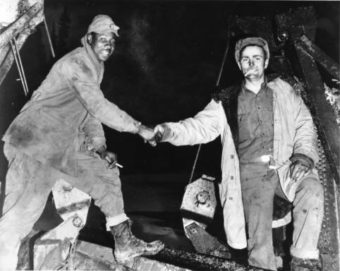
One of the few photographs of the black soldiers depicts their meeting. Gary Zepp, staff to Sen. Wilson, explained the picture to legislators Feb. 14.

“This is a picture of Cpl. Refines Sims Jr., an African-American from Philadelphia. He was driving his bulldozer south when he saw trees starting to topple over him,” he said, pointing to the picture. “He slammed his vehicle into reverse and they backed out just as another bulldozer, driven by Pvt. Alfred Jalufka of Kennedy, Texas, broke through the underbrush. A wire service photographer captured this image, standing on their respective bulldozers, and this occurred 20 miles east of the Alaska-Yukon border.”

Both men are beaming as they shake hands.

The Alaska Highway Memorial Project’s website refers to the highway as the “Road to Civil Rights.” They hope to turn Oct. 25 into a day reminding all Alaskans of how their highway paved the way for desegregation in the United States.

So far 16 senators have signed on to co-sponsor the bill.

Alaska farmers push for hemp legalization

Jack Bennett of Homer harvests hemp in Oregon. (Photo by Maggie Hegarty and Nicholette Sutton)

Alaska became the third state to legalize recreational marijuana in 2015, but it’s not exactly ahead of the curve on hemp, which comes from the same plant.

Now, with growing pressure to diversify Alaska’s economy, lawmakers are talking about legalizing hemp for commercial purposes — something at least 30 other states have already done.

For the past year, home builder Jack Bennett of Homer, Alaska, has been working on a model home that he sees as a potential solution to affordable housing and energy in rural parts of the state.

He’s using building materials made from hemp.

“We acquired a facility for the year, imported the hemp insulation material and started to run experiments to build a brick for cold climate Alaska,” he said.

There’s just one problem: it’s illegal to grow hemp in Alaska, so Bennett imports his product from the Netherlands.

He’d like to source the product locally.

The 2014 federal Farm Bill allows states to grow and harvest hemp through pilot programs.

Sen. Shelley Hughes is sponsoring legislation that would establish such a program in Alaska.

“I think this is one more opportunity for farmers and Alaskans … and that it’s due time,” she said at the bill’s first hearing on Feb. 8.

But moving forward with the program is not as simple as waving a wand and making hemp legal. Lawmakers will have to decide on a regulatory framework that complies with federal regulations without stifling the industry before it even takes off.

Sen. Bill Wielechowski criticized the legislation at a Feb. 13 hearing.

“It’s uh, requiring that individual to register. It’s requiring that they list their global positioning coordinates where they’re going to be producing the hemp. They’ve gotta register every year. They’ve got to pay fees for applications and the fees have to cover the regulatory costs,” he said. “So, this is big government. I mean, this is extremely onerous.”

Don Hart, a farmer from the Mat-Su Valley, also is concerned about over-regulating the new industry.

“In order to benefit the farmers in the state of Alaska, it would be better to be able to remove it entirely from AS 17.38,” he said.  “It allows anyone who does not want to see hemp growing in Alaska to be able to raise the issue by initiative or to propose their borough, administrative or municipality to be able to exclude it.”

The statute that Hart referred to, AS 17.38, lumps marijuana and hemp together under the same definition, allowing for local control over where the plant can be grown.

Alaska cultivated hemp until its ban in 1937 under the federal Marijuana Tax Act.

Bennett said the plant did well in Alaska, where it’s not always easy to grow things.

He’s committed to helping the industry grow.

“Alaska is, uh, it’s said to be in a fiscal crisis, but it’s a positive, it’s our opportunity. It’s our generation that gets to fix it. And hemp might not be the solution, but it’s a solution,” Bennett said. “Give them the freedom to farm, and let’s find out.”

The legislation will go to the Senate Judiciary Committee next, pending referral from Senate Resources.

Lobbyist tax gets pushback in Alaska state House

State Rep. Sam Kito III wants to close a $200,000 funding gap at the Alaska Public Offices Commission, or APOC, which oversees the activities of candidates, political groups and lobbyists.

His solution: a selective income tax on lobbyists. The revenue, he says, would help with accurate and timely oversight of lobbying activities.

Over the recent couple of years we’ve actually, because of budget cuts, lost two lobbying staff people in Juneau … So this would be trying to bring some support back,” he explained in a recent interview. 

In 2016, the state increased the amount that APOC can collect through fees to make up for budget cuts. The problem is that APOC doesn’t have the legal authority — called a receipt authority — to raise the amounts they collect to meet the new limit.

Kito wants to replace the $250 registration fee that lobbyists currently pay per contract with a 2.5 percent income tax on lobbyists. The tax would allow APOC to meet its receipt authority and provide some extra revenue for hiring staff.

In a hearing on Feb. 14, Heather Hebdon who directs APOC, said the tax would apply to approximately 132 registered lobbyists in the state. 

The bill is stuck in the House State Affairs Committee.

Rep. Chris Birch, who sits on the committee, made it clear that he is not comfortable levying a tax on a specific profession.

“I would be much more comfortable to retain some sort of a flat rate,” he said. “I think that’s a much more manageable approach than instituting an income tax on the lobbyists … It’s certainly more consistent with what I would see as fair and equitable.”

Kito, a former lobbyist himself, admits that Alaska’s constitution, which prohibits earmarking tax revenue for specific purposes, presents a problem for the bill in its current form.

There is not a way to clearly identify that the lobbyist tax revenue will directly benefit the Alaska Public Offices Commission,” he admitted in a Feb. 14 hearing. 

Kito said he’s open to changes to the bill that would ensure more funding for APOC.

The bill has not been scheduled for another hearing, but there is a committee substitute in the works.

Site notifications
Update notification options
Subscribe to notifications