Casey Kelly

Kids learn chemistry through cooking

What makes dough rise? How do you preserve milk? Twenty-seven young chefs are learning the answers to those questions and more this week at a Juneau Economic Development Council summer camp designed to teach kids the science of cooking. Casey Kelly has more.

Young chefs learn about the science of cooking at the Juneau Economic Development Council's Kitchen Chemistry camp. (Photo by Casey Kelly/KTOO)

Its day three of the Kitchen Chemistry camp and students are making mozzarella cheese in the culinary classroom at Thunder Mountain High School. Working in groups of four or five, they start by warming a gallon of milk and just over a teaspoon of lime juice – a substitute for citric acid – in a large pot on the stove. But most of the kids are a little unsure about the next step.

“After I think we cook it, we just gotta wait awhile or bake it or something,” says Hunter Hill, a fifth grader at Gastineau Elementary School. He says he signed up for the camp because he really likes cooking at home – mostly desserts.

“I like making crepes for my family that I get from a library book. And yeah, other than that, I like making cookies, brownies and cake, stuff like that,” Hill says.

JEDC Education Specialist Bob Vieth says the purpose of the cheese making exercise is to teach kids one way to preserve milk. During the week they also learn how to preserve cucumbers by pickling them, about leavening agents by making pizza dough, and about sweeteners by making fudge.

Making mozzarella cheese at JEDC's Kitchen Chemistry science camp. (Photo by Casey Kelly/KTOO)

“And along the way we’ve been trying to emphasize the science aspects and the chemistry aspects of the various cooking techniques that they’re using,” says Vieth.

Simon Smith learned what happens when you use baking soda instead of baking powder to make scones.

“The whole class tasted them and wasn’t so good,” Smith says.

Vieth admits there have been a fair number of failures. All the kids are going into either fourth or fifth grade, but he says some of them are pretty good chefs already, and they’re learning advanced science years before they would in school.

Budding chefs at JEDC's Kitchen Chemistry science camp. (Photo by Casey Kelly/KTOO)

“They’re learning concepts and vocabulary terms here that they normally wouldn’t be exposed to until high school chemistry,” Vieth says. “So when they do get them in chemistry, they’ll say ‘Oh yeah, I remember that from the cooking class.'”

Sophia Harvey says there’s another benefit of going to a cooking summer camp.

“I like eating the stuff after,” Harvey says.

Kitchen Chemistry is the last of this year’s JEDC Summer Camps. Previous camps include building underwater gliders, rocketry, and LEGO robotics. All the camps are part of JEDC’s STEM education program, which stands for Science, Technology, Engineering and Math. In Juneau, I’m Casey Kelly.

Fairweather ends sailing, repairs expected soon

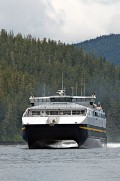
The FVF Fairweather. (Photo courtesy Alaska Marine Highway System)

The fast ferry Fairweather ended its Sitka sailing today (Wednesday) due to problems with its automated engineering system.

The ship left Juneau for Sitka in the morning, but turned around before entering Sergius Narrows, which can have strong currents. It returned to Juneau for repairs.

The ferry’s engine room is un-staffed, and the equipment is controlled and monitored via computer. Ferry chief Mike Neussl says the problem is with that system, not the engines.

He expects the Fairweather to be ready in time for its Thursday sailing to and from Sitka.

Sanford wants CBJ to withdraw support for Tongass Roundtable

Juneau Deputy Mayor Merrill Sanford wants the city to pull its support for the Tongass Futures Roundtable.

Sanford believes the roundtable has changed direction since the assembly passed a resolution backing its work in 2007. Most logging advocates left the group earlier this year, and Sanford says he’s no longer comfortable giving it the city’s blanket support.

Deputy Mayor Merrill Sanford wants to withdraw Juneau’s support for the Tongass Futures Roundtable. (Photo courtesy City and Borough of Juneau)

“If they wish to come before us and ask for approval on some topic, that’s fine with me. But I can’t sit here as an assembly member any longer and let this move forward in a different direction than what we thought it was going to be,” said Sanford.

The Tongass roundtable is a group of stakeholders that came together five years ago in an attempt to find consensus in the often contentious public policy debates surrounding the nation’s largest national forest. It includes the US Forest Service, conservation groups, and Native organizations, including regional Native Corporation Sealaska. Juneau Mayor Bruce Botelho is the group’s facilitator.

At this week’s assembly meeting Sanford made a motion directing the city attorney to draft a resolution rescinding the assembly’s earlier declaration of support. Botelho recused himself from discussion, because he felt his role as facilitator presented a conflict of interest. Reached by telephone Tuesday while out of town on business, Botelho declined to comment.

Sanford’s motion passed unanimously. But Assembly member Karen Crane expressed concern that the city not ditch its support for the roundtable without a thorough review.

“I don’t know enough about it to say yay or nay at this point,” Crane said.

The assembly’s 2007 resolution supporting the roundtable was approved unanimously, and signed by Sanford, who was deputy mayor at the time. The largely symbolic declaration talks about the effort to create a “steady, reliable, and predictable” timber supply to “support an integrated manufacturing industry.” It also discusses protecting “watersheds with important values” and “maintaining the natural values and ecological integrity of the forest.”

Earlier this year the State of Alaska and timber industry representatives quit the roundtable, citing its inability to increase logging in Southeast Alaska. Representatives of Petersburg, Wrangell, Craig and Coffman Cove also pulled out of the organization. In its place the Parnell administration formed a state Timber Jobs Task Force that includes no representatives from the conservation community.

New sweeper will only sweep valley streets

The City and Borough of Juneau is getting a new eight cubic yard, vacuum street sweeper.

But as City Manager Rod Swope explains, it can only be used in the Mendenhall Valley.

“Funding for this was acquired through a federal government congestion mitigation/air quality program transferred through the Department of Transportation and Public Facilities to us,” said Swope at Monday’s CBJ Assembly meeting. “And the funds are to be used to improve air quality in federally designated non-attainment areas, of which the Mendenhall Valley is one.”

Assembly members appropriated a 250-thousand dollar grant for purchase of the street sweeper.

Woodstoves are the main contributor to the valley’s air quality problem. That’s why the city periodically prohibits their use when the level of fine particulate matter in the air is high. But CBJ Lands Manager Heather Marlow says dust is also a factor, which the vacuum street sweeper should help mitigate.

“These street sweepers have a particular design to them where they don’t kick up as much dust if you will as they go through and clean the street. It’s more of a contained cleaning, rather than the exterior broom type that you typically see,” says Marlow.

Other factors that contribute to particulates in the air include vehicles and power plants.

The city and state Department of Environmental Conservation monitor air quality in the Mendenhall Valley from atop Floyd Dryden Middle School.

Plastic bag tax, sales tax extension placed on ballot

A citizens’ initiative to impose a “plastic bag tax” on certain stores in Juneau will go to voters this fall.

The CBJ Assembly last night had the option of adopting an ordinance in place of the initiative. But instead of passing the ordinance or delaying action on it past August 22nd, which would have put the initiative on the ballot in October 2012, the assembly simply declined to act on it. That puts the initiative on the municipal election ballot this year.

Mayor Bruce Botelho, participating by telephone, said some in the community had urged the assembly to table the ordinance and delay the vote.

“We’ve all received emails and I suspect calls arguing in opposition to it. I think that explains why it would be inadvisable for us to forgo the initiative process by attempting to adopt the initiative by ordinance itself,” Botelho said.

The initiative would require a 15-cent per bag fee, levied at the point of sale, for all retail outlets in Juneau with annual gross sales of 15-million dollars or more. Stores would remit the tax to the city, just like the CBJ sales tax, and the revenue would go into the city’s general fund.

Dixie Belcher is with Turning the Tides, a local nonprofit concerned about the effect plastic bags have on the environment – especially the ocean. She says the goal of the citizens’ initiative is to encourage people to give up plastic bags in favor of reusable ones.

“It’s something that is just a habit, and we can just as soon get into a habit of taking our own reusable bags,” says Belcher. “They do that in many other parts of the world. They’re actually banned, because of their impact on the ocean they’re banned in 25 percent of the world, and they’re taxed in many other parts of the world. And generally the taxation lowers the use of plastic bags by about 90 percent in the first three months.”

As the mayor pointed out the initiative sponsors will have a tough time convincing many in Juneau to support the tax. Mendenhall Valley resident Geri Swanson thinks the proposal is unfair and won’t have the intended effect.

“Personally, I own several reusable bags and I always forget to bring them with me when I go shopping,” Swanson says. “I recycle those small shopping bags in my garbage in my bathrooms and some I even take to the recycle center. So, I think 15-cents is just a silly idea for the city.”

Joining the “plastic bag tax” on the October municipal election ballot will be a proposition to extend the CBJ’s temporary 3 percent sales tax another five years. Assembly members voted unanimously to put the issue to a vote in October.

The 3 percent tax is due to expire July 1, 2012. The current 5 percent CBJ sales tax has three components – the temporary 3 percent tax, a temporary 1 percent tax, and a permanent 1 percent tax. Among the city functions covered by the 3 percent tax are police, fire, street maintenance, parks and recreation, libraries, and some capital project expenses.

Assembly passes rezone, Freer asks for reconsideration

The Juneau Assembly on Monday narrowly voted to approve a controversial request to rezone a property in the Mendenhall Valley from D-10 Residential to Light Commercial. But Assemblyman Peter Freer asked for reconsideration, so the issue will be back before the assembly at its next regular meeting.

The vote to rezone was 5 to 4, with Freer in the minority. He says he’s concerned that the zone change goes against the city’s Comprehensive Plan, which calls for the property to be zoned medium density residential, and thinks the assembly could benefit from a more thorough discussion of the differences between the MDR and Light Commercial zones.

CBJ Community Development Director Dale Pernula (left) explains zoning concepts to the Juneau Assembly on Monday. (Photo by Casey Kelly/KTOO)

“As the zoning progresses upward if you will from D-10 through D-15, D-18 and Light Commercial the intensity of uses that can occur on the property also increases. And some uses may not require a review before the Planning Commission, but may be simply approved as building permits – for example, offices of up to 10-thousand square feet,” Freer says.

Assembly member Mary Becker made an attempt to amend the ordinance so the property would be rezoned D-18 – still medium density residential, but with more allowable uses than D-10. But her amendment was voted down.

The 2.68 acre property in question is on Atlin Drive where it intersects with Mendenhall Loop Road. Developer Richard Harris bought it in 2010 from the US Forest Service. The northeast corner is bordered by Duck Creek Pond, making 40 percent of the property unusable due to required setbacks. Harris hasn’t said what he intends to build on the parcel, but says he’ll have more opportunity to do something nice for the neighborhood with a Light Commercial zone.

“There is no plan at all. At this point we know that we can build 20 apartments. But we don’t want to spend money to design 20 apartments if there’s something bigger and better that can be done here,” said Harris. “And not necessarily bigger, but mostly better. It’s going to be the face of the community. I personally would not be proud to build 20 apartments right there. I think it’s a waste.”

Developer Richard Harris wants to rezone his 2.68 acre lot in the Mendenhall Valley from Medium Density Residential to Light Commercial. (Photo by Casey Kelly/KTOO)

Homeowners on Atlin and nearby Teslin Street are against the rezone. They say Harris ought to submit a plan before receiving a Light Commercial designation. The city’s Planning Commission also recommended against the change at the urging of the CBJ Community Development Department.

Reconsideration of the assembly’s vote will occur at its next regular meeting, scheduled for August 22nd.

Site notifications
Update notification options
Subscribe to notifications