Casey Kelly

Juneau Assembly, legislative delegation talk session priorities

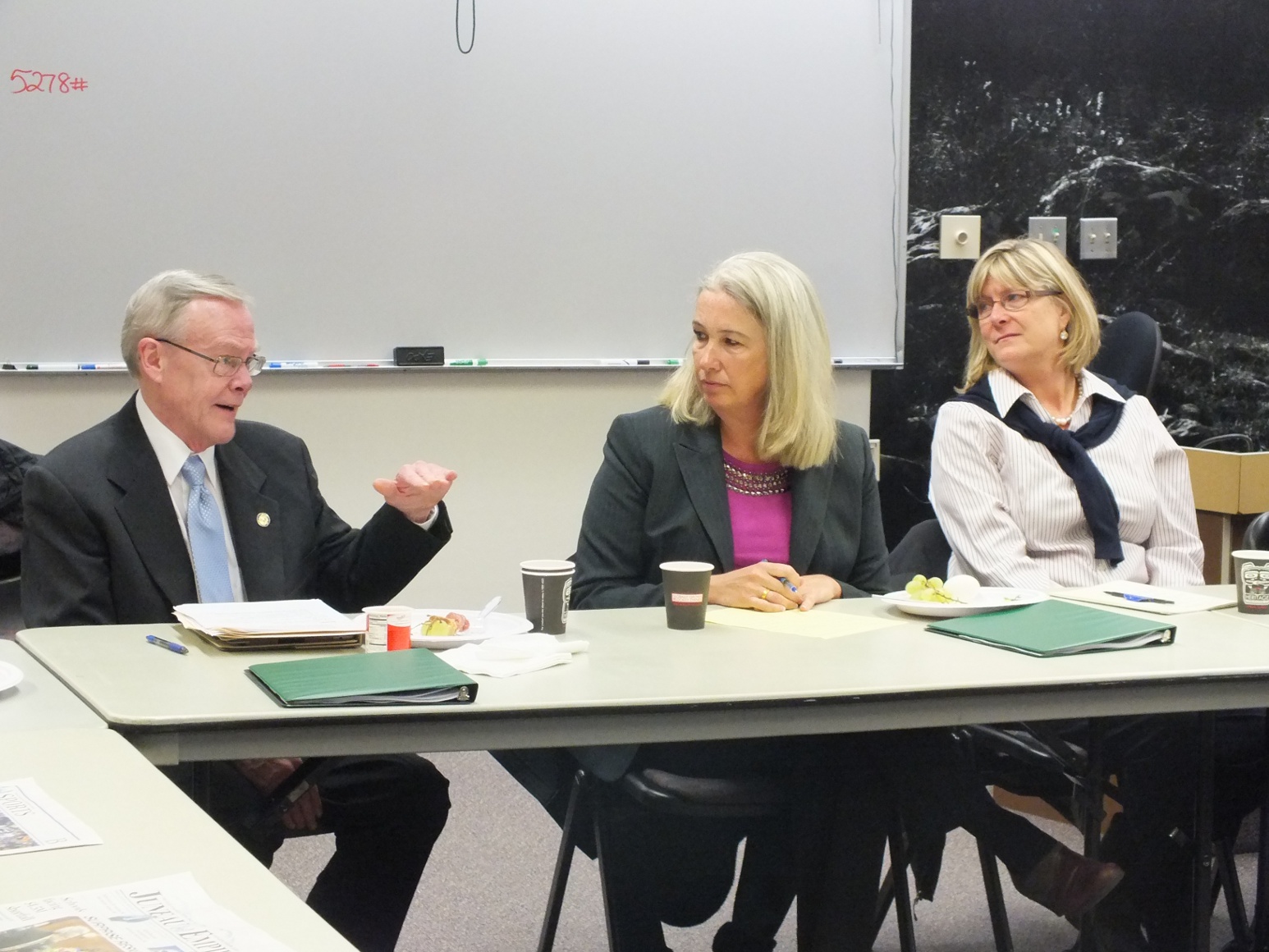
Juneau's legislative delegation, Sen. Dennis Egan, Rep. Cathy Munoz, and Rep. Beth Kerttula discuss the 2014 legislative session with the Juneau Assembly. Photo by Casey Kelly/KTOO.
Juneau’s legislative delegation, Sen. Dennis Egan, Rep. Cathy Munoz, and Rep. Beth Kerttula discuss the 2014 legislative session with the Juneau Assembly. Photo by Casey Kelly/KTOO.

Education funding and the state’s unfunded public employee retirement obligation topped the list of topics discussed by the Juneau Assembly and the Capital City’s legislative delegation on Wednesday.

Assembly members also bid farewell to Representative Beth Kerttula, who announced her resignation Tuesday after accepting a position at Stanford University.

The Juneau School District’s most recent budget forecast includes a $4.5 million deficit, meaning possible cuts to 35 full time positions. Mayor Merrill Sanford says the Assembly wants legislators to increase the state’s foundation formula, which gives money to local districts for each student enrolled during a particular school year. The amount has not gone up since 2011.

“That’s one of our big goals this year is to support increased school funding,” Sanford said.

Mendenhall Valley Representative Cathy Munoz and Senator Dennis Egan will be it for Juneau’s legislative delegation until a replacement can be named for Kerttula. Both support increasing the state’s foundation formula. Munoz says comprehensive education funding proposals are expected to be on the table during the 2014 legislative session.

“I do think that education funding will be a key issue, and I think the details of an educational package will not become really clear until the last probably two to three weeks of the session,” Munoz said.

Governor Sean Parnell wants to put $3 billion from state savings toward paying down Alaska’s unfunded public employee pension liability. Munoz and Egan both support that measure as well. Munoz says an infusion of cash now could save the state millions of dollars later as it seeks to pay down its public employee retirement system debt.

This year Juneau is expected to receive about $22 million in state support for its public employee retirement obligations, according to the city Finance Department.

Congress could include PILT funding in farm bill

A major source of federal money for Alaska communities has become a political bargaining chip in Washington, D.C., says a lobbyist working for the City and Borough of Juneau.

Congress established the Payment in Lieu of Taxes program, or PILT, in 1976 to compensate local governments for lost taxes on federal land within their boundaries. The program expired last year and was not renewed in the recently passed $1.1 trillion dollar omnibus budget bill.

Juneau’s federal lobbyist Katie Ketchel says some western lawmakers, including Alaska’s Congressional delegation, only voted for the budget after being assured PILT would be included in the federal farm bill.

“It just shows you how important that program is,” Ketchel said. “It could have started another federal government shutdown if those members didn’t vote for the omnibus bill.”

Ketchel says the farm bill is expected to be reauthorized soon. She’s in Juneau this week meeting with city officials and spoke to the Juneau Assembly on Wednesday.

Juneau received about $1.2 million in PILT payments during the 2013 fiscal year. The money was not factored into this year’s budget, because the program expired.
First draft budget includes $4.5M shortfall for Juneau Schools next year

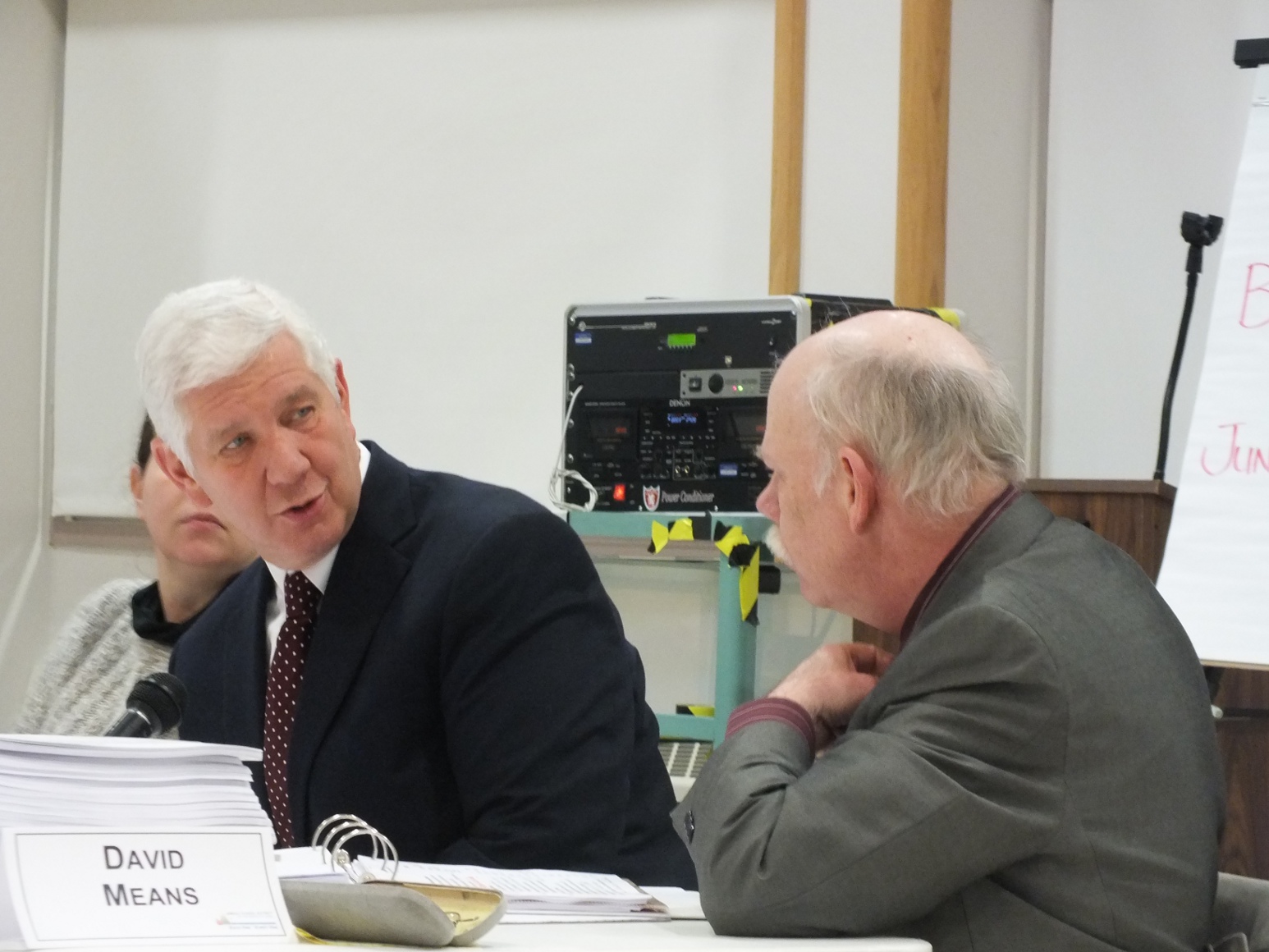
Juneau School District Superintendent Glenn Gelbrich talks with district Administrative Services Director David Means Tuesday at the district Budget Committee meeting. Photo by Casey Kelly/KTOO.

The Juneau School District faces a $4.5 million deficit next school year, according to an updated budget projection from Superintendent Glenn Gelbrich.

In a presentation to the district’s budget committee Tuesday, Gelbrich offered a blunt assessment of what the latest numbers mean.

“The cumulative effect of previous cuts and the projected deficit for next year is far too real and far too great,” he said. “The challenge this year is daunting at best and in many ways demoralizing for people who care about student success.”

Gelbrich’s initial proposal calls for addressing the shortfall by cutting about 35 full time positions, including more than 20 teachers.

The district is currently engaged in negotiations with the Juneau Education Association teachers’ union for a new contract. Gelbrich said the latest offer from the Board of Education would increase the budget by about $1.3 million when the district factors in salary and benefit obligations to all of its employees. The teachers’ latest one-year contract included no financial increases and expired last June.

As a result of the proposed cuts, he said, class sizes would go up, and programs and services for students would be reduced. But the plan would continue to put money toward professional development and instructional materials designed to help students meet new, tougher graduations standards.

“Through the next few weeks, we may with the committee’s help find better solutions to matching our resources to the mission,” Gelbrich said. “We hope that one thing that won’t get lost in our collective dialog is how important it is for us, for our students, and for our community to pursue that mission and to improve our capacity to ensure the success of each child.”

In the past three years the Juneau School District has reduced its budget by about $11 million as enrollment and state funding for education have remained largely flat.

The district budget committee is scheduled to submit its final report to the Juneau Board of Education on March 4th.

The committee will take public comment at its next meeting, January 28th.

Link:
Juneau School District budget committee meetings

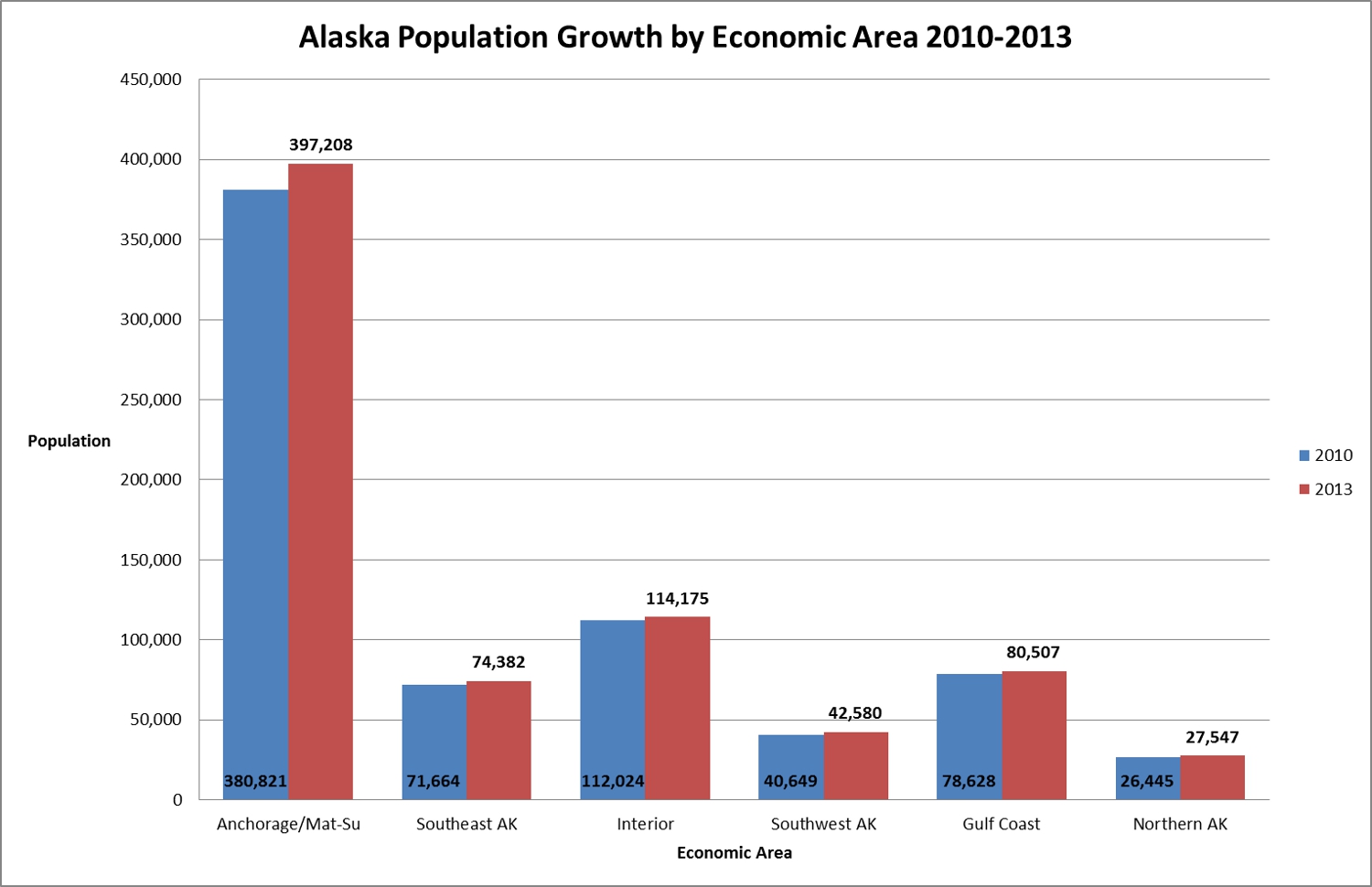
SE Alaska population grows 3.8 percent from 2010-2013

Source: Alaska Department of Labor and Workforce Development. Click to enlarge.

In the first three years of this decade, Southeast Alaska reversed a trend of anemic population growth that defined the previous 10 years for the region.

Southeast had the second largest population increase of any area in Alaska from April 2010 to July 2013, according to figures released Friday by the Alaska Department of Labor and Workforce Development.

The panhandle added about 2,700 residents over the three year period, for a 3.8 percent increase.

“Southeast for the past few years has been seeing population growth both through what we call births minus deaths we call natural increase, and then also net migration,” said State Demographer Eddie Hunsinger. “The last decade, the 2000s, Southeast would typically see net outmigration. So even though lots of people were moving to Southeast, a few more were moving out. But these last few years have been positive for Southeast.”

The growth in Southeast was on par with the state’s population as a whole, which grew by 3.7 percent from 2010 to 2013.

Hunsinger says Juneau added nearly 1,800 people for a total population of 33,000, up about 6.7 percent from the end of the last decade.

“Other communities in Southeast are also gaining population, but primarily through natural increase – the births minus deaths,” Hunsinger said. “Juneau is the one area that’s in Southeast that’s been gaining both through some net migration increases as well as natural increase.”

Juneau Economic Development Council Executive Director Brian Holst says population growth is a positive for the Capital City and Southeast. But he says there are some things to be concerned about looking into the future. Holst says job growth in the region stalled, and the number of people moving to Southeast slowed in the first half of 2013.

“Something that we’ve been thinking about for the past few years, is that as the economy picks up in the Lower 48, the relative attractiveness of living here in Southeast Alaska diminishes,” Holst said.

He notes that a strong private sector has buoyed the region’s economy in recent years, while important public sectors like the federal and local governments have dealt with budget cuts.

“If those budgets turn around soon I think we’ll see government work stay stable and then that will bode well for our private sector to continue to grow more slowly,” said Holst.

The Anchorage/Mat-Su area had the highest population growth over the three year period, adding about 16,300 people. The Interior gained about 2,100. Southwest Alaska saw its population increase by 1,900. The Gulf Coast added 1,800 residents. And Northern Alaska went up by 1,100.

Hunsinger says the numbers are based on data from the U.S. Census Bureau, federal tax returns, and Alaska Permanent Fund Dividend applications.

Is Alaska’s economy grounded?

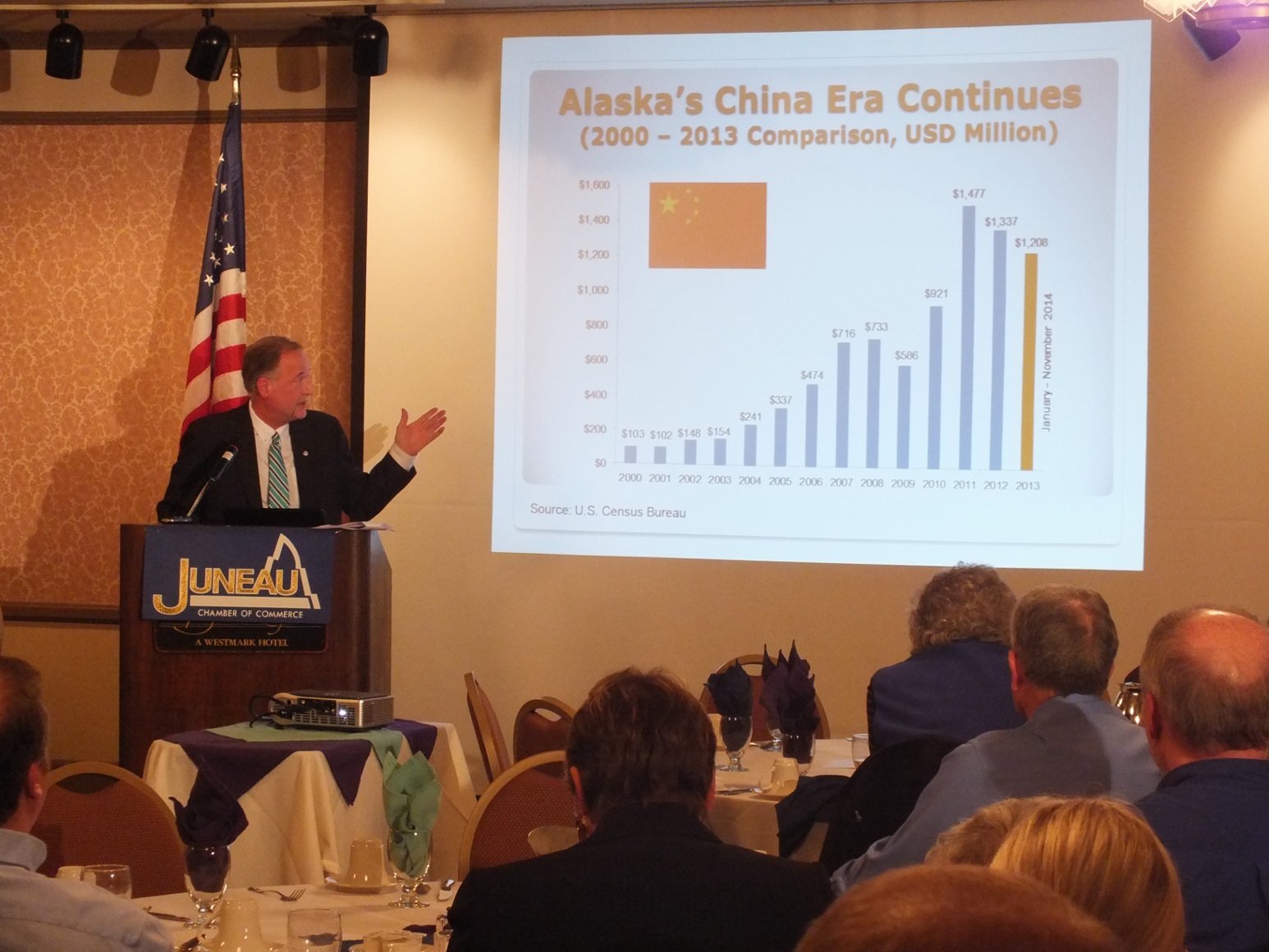
World Trade Center Alaska Executive Director Greg Wolf says China is now the largest importer of goods from Alaska. Photo by Casey Kelly/KTOO.

Alaska’s economy slowed in 2013. On Thursday, two economists offered different takes on what that means for this year at the World Trade Center Alaska‘s annual statewide economic forecast talk in Juneau.

Marcus Hartley ticked off how many jobs he expects various industries in Alaska to gain or lose in 2014.

“We see natural resources going up by 200 jobs; transportation and utilities going up by a little bit, a hundred jobs,” he said. “These are not big numbers, but they’re some winners.”

Hartley is a senior economist with Anchorage based consultants Northern Economics. He says other winners include health care, retail, and tourism.

And then there are the losers.

“Here’s my sector – professional business services – we’re saying that that sector is going to be hit pretty hard by government cutbacks,” said Hartley. “And then government is also very likely to lose jobs.”

“So total change, a whopping 450 jobs increase,” he said. “Not too bad. But really, if we’re in a big recovery, where’s all the jobs, dude?”

Hartley says reductions in state and federal spending, as well as the continued decline in North Slope oil production were behind a state economy that slowed in 2013. After several years of growth, he says, Alaska’s gross state product – a measure of total economic output – declined about $2 billion last year to $51 billion. He predicts it will be down another $1.8 billion this year to $49.2 billion.

“So the question is, are we grounded?” he asked

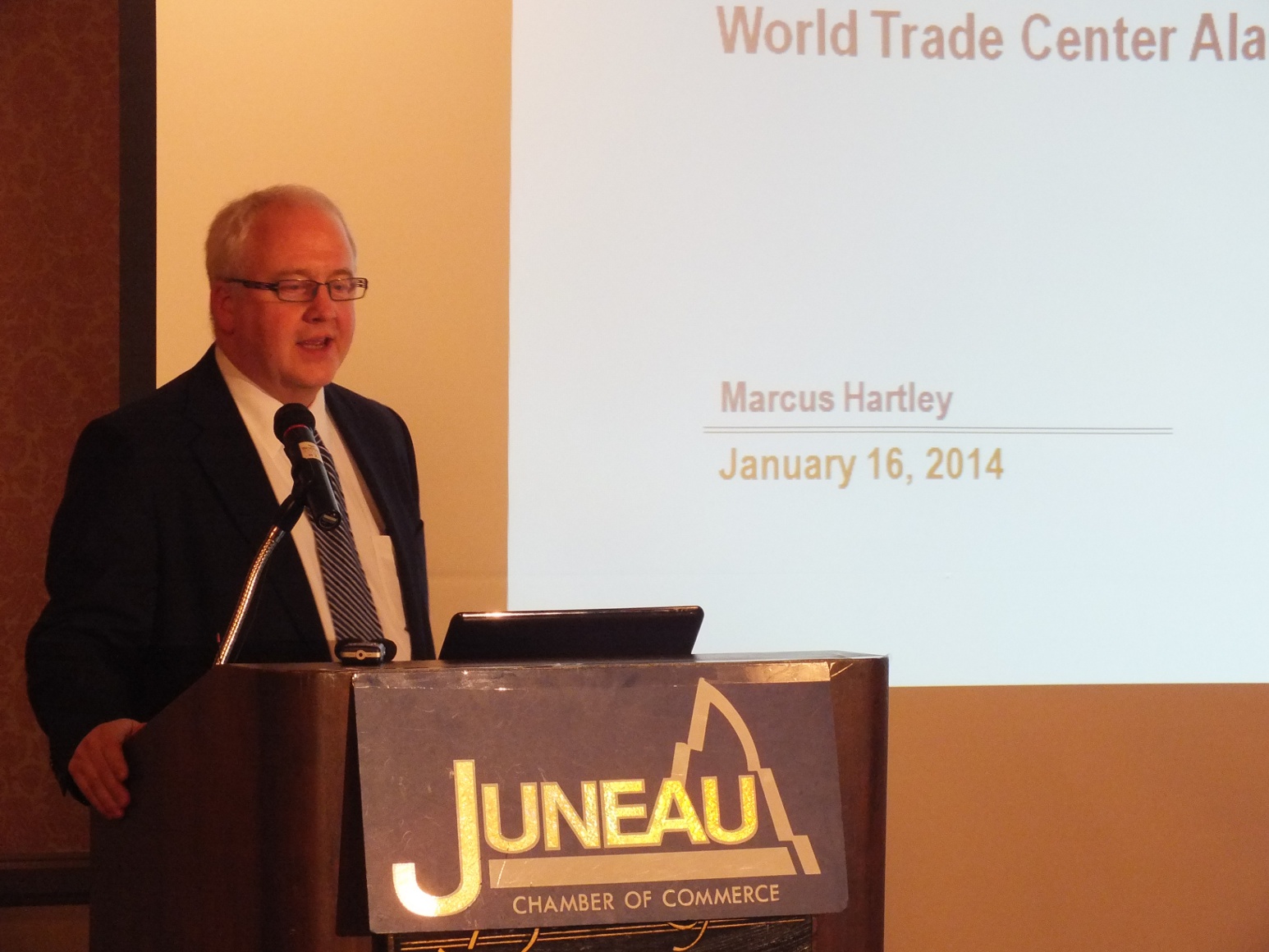
Northern Economics Senior Economist and Vice President Marcus Hartley speaks to the Juneau Chamber of Commerce. Photo by Casey Kelly/KTOO.

Hartley didn’t give a yes or no answer to that question. But he did say Northern Economics’ computer models painted an even bleaker picture of the state’s economic future.

“We basically threw out our models this year, because it was pessimistic,” Hartley said. “And we just didn’t feel like the world was going to jump off a cliff.”

World Trade Center Alaska Executive Director Greg Wolf was more bullish on the state’s economy. In 2013, he said companies operating in Alaska exported about $4.5 billion worth of goods and services overseas. He expects a similar amount this year.

“Trade represents new money coming into the economy,” Wolf said. “It sustains and results in thousands of both direct and indirect jobs. The overall effect, of course, it results in a stronger, more diversified economy for our state.”

In the past 20 years, Wolf says Alaska exports have more than doubled, from about $2 billion per year to between $4.5 and $5 billion.

“I think this sort of demonstrates that exports have been a pretty consistent part of the economy, and also a quietly growing part of the economy,” he said.

Wolf says Alaska’s biggest trade partners are in Asia. China buys about 28 percent of the goods exported from the state. Japan is second at 16 percent, followed by South Korea, Canada, and Singapore.

Seafood makes up about 50 percent of Alaska exports, followed by minerals and precious metals at 34 percent, energy – including liquefied natural gas, coal, and refined fuels – at 8 percent, and timber at 4 percent.

The Juneau Chamber of Commerce hosted the statewide economic forecast talk, which has been held in the Capital City for the past seven years. The economists were in Fairbanks earlier this week and will be in Anchorage on February 4th.

Strong winds snap spruce tree

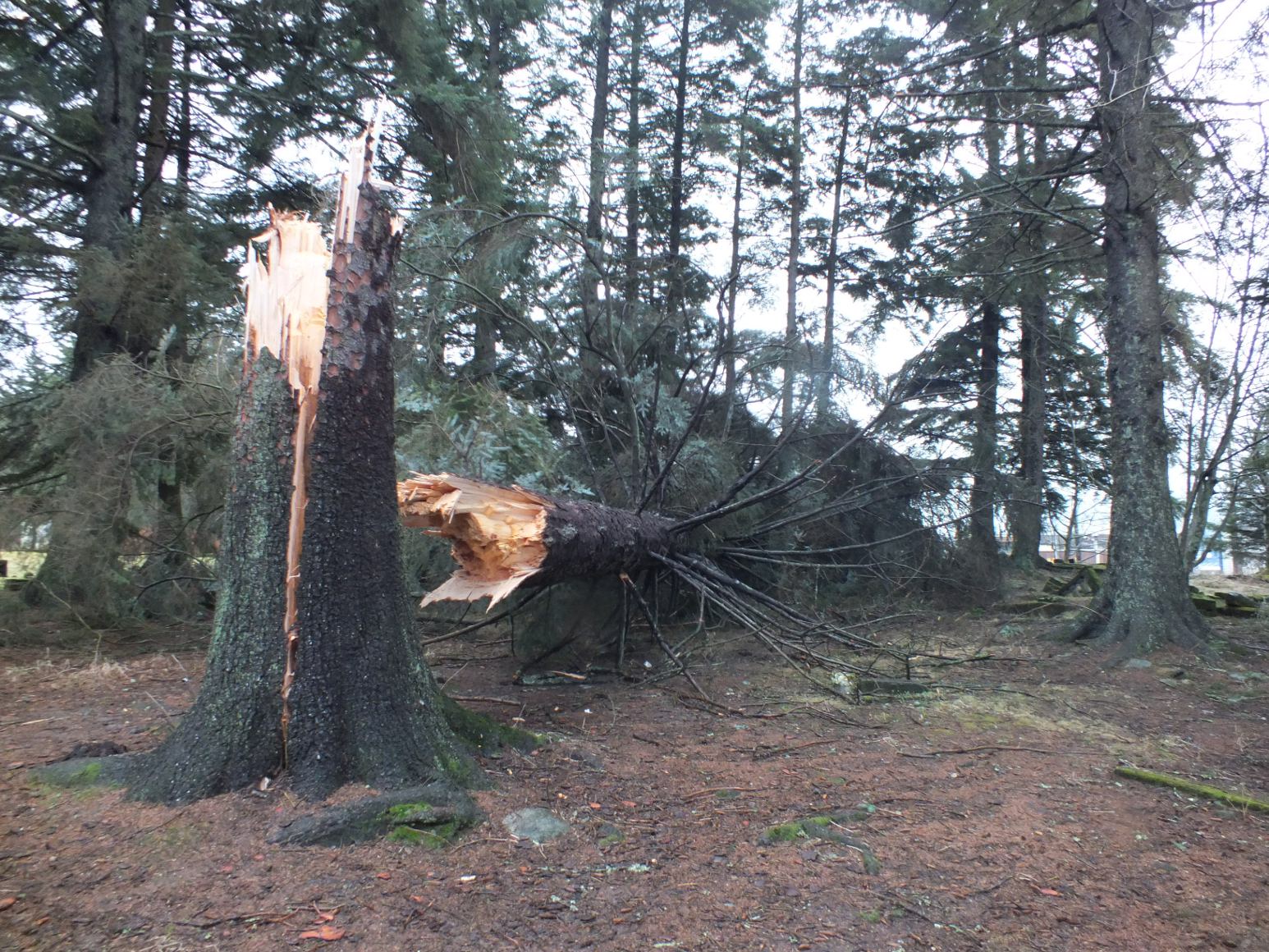
A large Sitka spruce fell in Juneau's Evergreen Cemetery during a storm that blew through Southeast Alaska Tuesday. Photo by Casey Kelly/KTOO.
A large Sitka spruce fell in Juneau’s Evergreen Cemetery during a storm that blew through Southeast Alaska Tuesday. Photo by Casey Kelly/KTOO.

We’ve all heard the riddle, “If a tree falls in a forest and no one is around to hear it, does it make a sound?”

How about if a tree falls in a cemetery?

That’s what happened Tuesday in downtown Juneau during the rain and wind storm that blew through Southeast Alaska… except someone was around to see it.

The large Sitka spruce toppled over in Evergreen Cemetery within striking distance of the offices of MRV Architects. Project Manager Zane Jones watched it fall with some colleagues.

“We had some wind gusts that pulled our front door open, so we started looking out the windows,” said Jones. “Sure enough, as soon as we did, a gust came around the building and we watched it bend clear down and snap.”

Fortunately, the tree fell away from the building. A large stump with a crack in it is all that’s left in the ground. The rest of the trunk came down on top of some graves, surrounded by a stand of other trees.

“It was just one of those kinda planet Earth moments, where we were just in awe and quite amazed that it took down such a big tree,” Jones said, adding “and also so fortunate that it fell in neutral location.”

Juneau’s Parks and Recreation Department manages Evergreen Cemetery. Parks and Landscape Superintendent George Schaaf says the plan is to cut up the fallen tree and clear it from the cemetery, hopefully by the end of the week.

“Get it bucked up into rounds, and get those moved out of the cemetery, and at that point people would be welcome to come by and take what they would like,” Schaaf said. “But the big concern we have is that we don’t want people driving into the cemetery, because the tree came down over some very old graves that really wouldn’t be able to support vehicles.”

Schaaf says he won’t know the approximate age of the tree until they can cut it up. He estimates it was close to 100 feet tall and says the trunk is about 3.5 to 4 feet in diameter.

“Certainly not a very young tree,” he said. “It’s pretty old for downtown Juneau anyway.”

The tree fell around 1:30 or 2:00 in the afternoon. National Weather Service observation data from the nearby Juneau Federal Building shows wind gusts between 25 and 50 miles per hour Tuesday morning. But the largest gust recorded at the Federal Building that day was 73 miles per hour at about 2:30 p.m.

Full disclosure: George Schaaf is a member of KTOO’s Board of Directors.

“Field of Fireweed” to stay a field for now

Tina Brown, Alaska Wildlife Alliance. Photo by Casey Kelly/KTOO.

Juneau wildlife enthusiasts got their wish Tuesday as the city Planning Commission opted not to take another look at a proposal to rezone a privately owned 82-acre field that’s a popular spot for birders.

About three dozen members of the public packed the Assembly Chambers to see if the Planning Commission would put the rezone request back on the table. Many consider the field owned by Bicknell, Inc. to be an extension of the Mendenhall Wetlands State Game Refuge.

On a 5-2 vote last month, the commission denied Bicknell’s request to allow a mix of commercial, industrial, and light development on the property just southwest of Juneau International Airport.

Tina Brown, president of the local Alaska Wildlife Alliance chapter, says the commission made the right decision.

“We’re very pleased that the Planning Commission has held strong in support of community values, of habitat, of protection of the wetlands,” Brown said.

As it’s currently zoned only small development is allowed on Bicknell’s property, though part of it used to be a gravel pit now commonly known as Honsinger Pond.

Planning Commissioner Dennis Watson urged his fellow members to reconsider the decision to deny the company’s rezone request.

“The search for buildable lands conducted in the 2008 Comprehensive Plan identified very little potential industrial lands suitable for development in the short term,” Watson said. “Lands found to be suitable for development in the near future include current and former gravel extraction areas.”

Four members of the commission did not take part in the vote on Watson’s motion to reconsider. Commissioner Dan Miller had a conflict of interest, while Bill Peters, Gordon Jackson, and Paul Voelckers were appointed to the commission after the vote denying the rezone took place, so the city attorney advised them not to vote.

Of the members left only Ben Haight voted with Watson. Karen Lawfer, Nicole Grewe, and chair Mike Satre voted no. Grewe said the rezone proposal had already been thoroughly considered.

“This body has heard this particular application in some way, shape or form three times prior,” she said. “We’ve deliberated on it, we’ve taken public comment, we’ve studied it, we’ve read the in depth packets prepared by the planners, and our end result has consistently remained the same.”

After his request failed, Watson made a motion to rescind the commission’s vote denying the rezone. But Assistant City Attorney Robert Palmer said that was not allowed under the commission’s rules of procedure.

Bicknell could appeal the Planning Commission’s recommendation to the Juneau Assembly. But the wildlife alliance’s Brown says the company has other options.

“At one of the Planning Commission meetings, if not more than one, it was suggested that the city trade some land with Mr. Bicknell, which hopefully would work out equitably for everyone,” Brown suggested. “There are also groups who are interested in purchasing the land at a fair market value, and there are others who would be willing to help raise money to support that effort.”

Dan Bruce, an attorney for Bicknell, declined to comment, saying there are still a lot of issues to be resolved.

Those seeking to prevent the property from being rezoned have dubbed it the “Field of Fireweed” for the brightly colored plant that grows there during the summer. At Tuesday’s meeting many of them wore postcards with a picture of the field on it pinned to their clothing.

Related stories:
Honsinger Pond property subject of Planning Commission appeal

Site notifications
Update notification options
Subscribe to notifications