"My mission is to hold Juneau’s elected officials accountable for their actions and how their decisions impact the lives of the people they represent. It’s rooted in the belief that an informed public has the power to make positive change."
When Clarise isn't working, you can find her skijoring with her dog, Bloon, or climbing up walls at the Rock Dump.
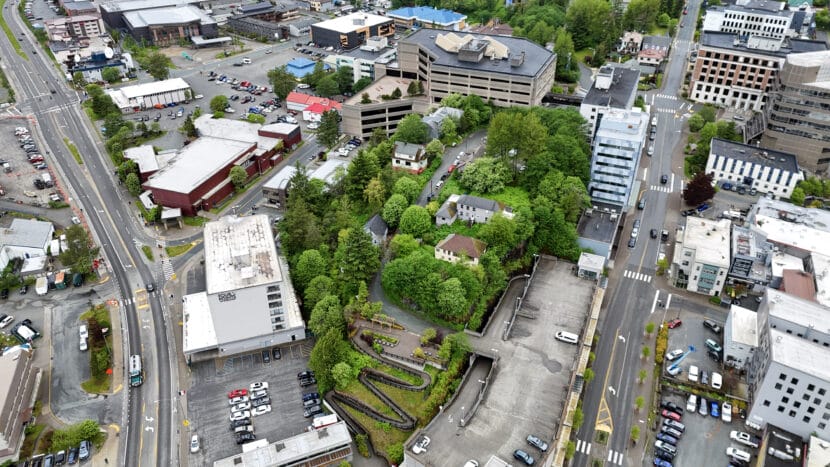
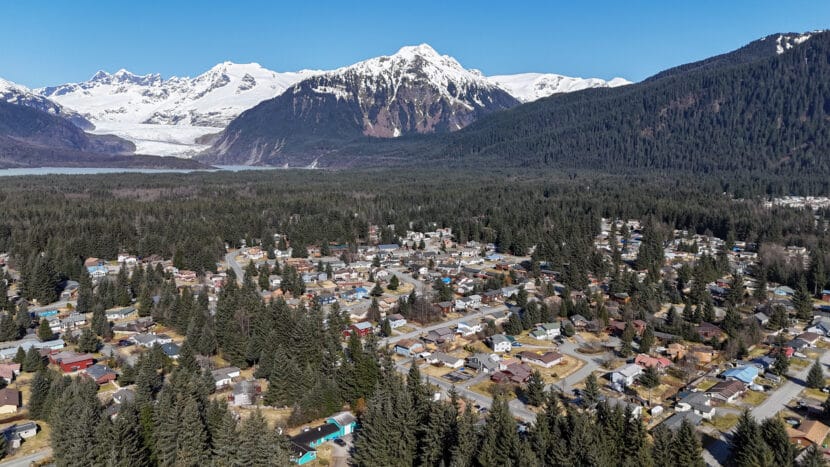
Trees outline the Telephone Hill neighborhood in downtown Juneau on Monday, June 9, 2025. (Photo by Clarise Larson/KTOO)
The City and Borough of Juneau has pushed back the eviction deadline for renters living in the historic Telephone Hill neighborhood in downtown Juneau.
Residents now have until Nov. 1 to move out.
City Attorney Emily Wright told the Juneau Assembly during an executive session Monday night. Mayor Beth Weldon announced the change to the public during an Assembly committee meeting that followed.
According to Wright, the city received two notices in the past week from attorneys indicating that it did not properly and legally serve residents with eviction notices.
Upon review, the city discovered the property management company in charge of alerting residents on the hill that their rental agreement was ending did so, but did not properly document it.
The City and Borough of Juneau sent out an Oct. 1 eviction notice in late May. The city plans to demolish the houses on the hill this December in hopes of making way for newer, denser housing in response to the city’s housing crunch. The city does not yet have a developer signed on to the project.
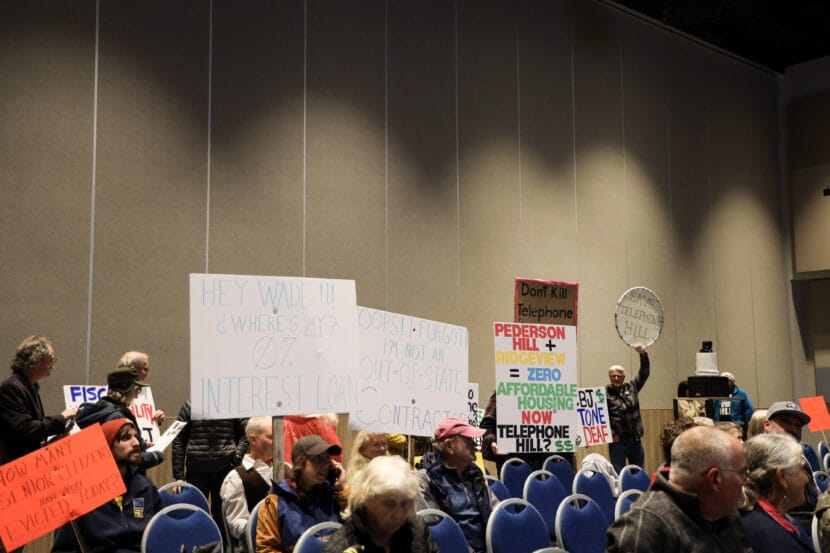
Last week, dozens of residents attended the Juneau Assembly meeting to protest the plan to evict residents. Assembly members could have chosen to rescind the eviction notices sent to residents at the meeting, but they declined.
The city plans to put out new notices to vacate on the hill on Tuesday.
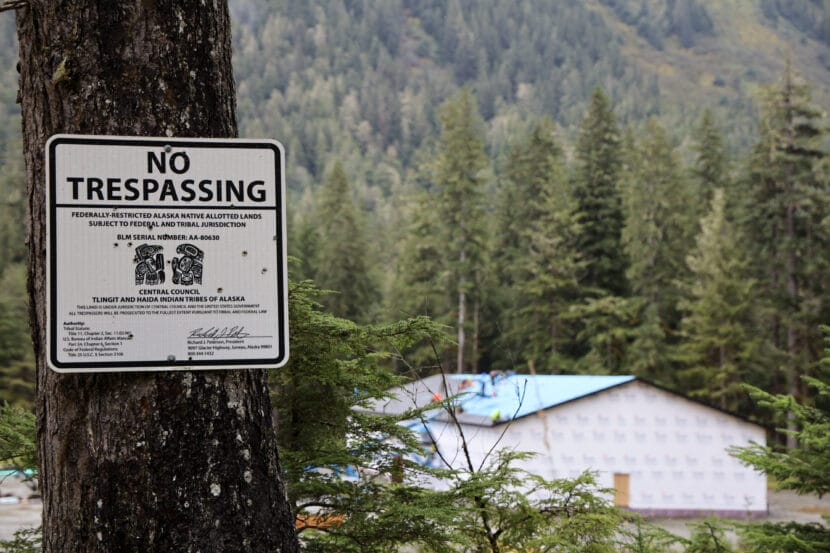
A “No Trespassing” sign hangs on a tree at the border of a Native allotment on Douglas Island on Friday, Sept. 26, 2025. (Photo by Clarise Larson/KTOO)
That’s after the U.S. Department of the Interior withdrew a legal opinion that gave Tlingit and Haida — and other tribes in Alaska — legal jurisdiction over Alaska Native allotments.
On Thursday, the U.S. Department of the Interior withdrew a Biden Administration decision that allowed tribes in Alaska to hold jurisdiction over Native allotments in the state.
The National Indian Gaming Commission approved Tlingit and Haida’s proposal for a gaming hall on Douglas Island in January — just days before President Donald Trump began his second term in office.
The land is a small parcel on Fish Creek Road, just a short drive from Eaglecrest Ski Area. It’s owned by tribal members who lease it to Tlingit and Haida. Rumors of the tribe developing something on that property have circulated for years.
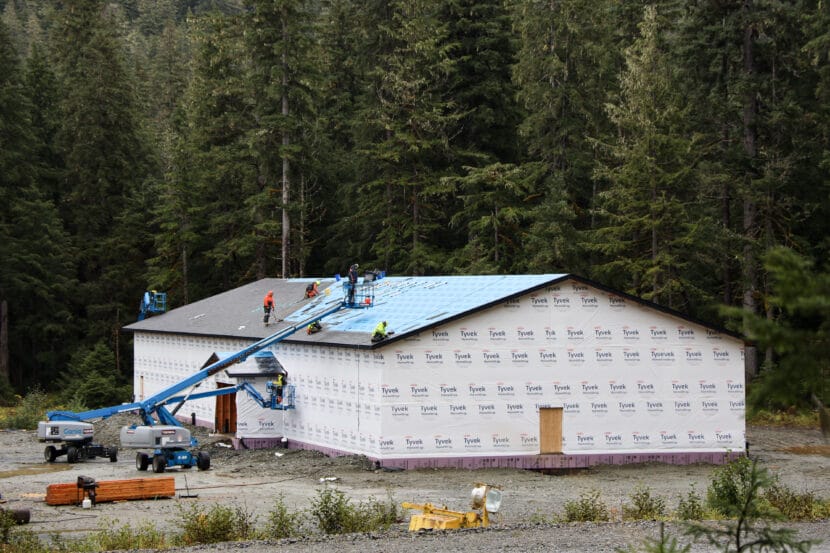
Last month, Tlingit and Haida confirmed its plans to open the gambling hall. Construction is already underway. The tribe says the facility would be a step toward economic self-sufficiency and sovereignty.
Construction is underway at a Native allotment on Douglas Island on Friday, Sept. 26, 2025. (Photo by Clarise Larson/KTOO)
Very few tribes in Alaska have authority over land, so they haven’t had a way to open reservation-style casinos like tribes in the Lower 48. Many, like Tlingit and Haida, have sought to assert authority over Native allotments owned by individual tribal members.
But following Thursday’s withdrawal, it’s unclear if the tribe will be able to open the gambling hall after all.
The withdrawal is a return to decades of precedent. Federal and state officials in Alaska have long said that land allotments given to individual tribal members in Alaska were not considered “Indian country.” Therefore, they are not under tribal jurisdiction and cannot be home to federally regulated gaming halls.
But that opinion was briefly reversed during the Biden Administration when the Interior Department Solicitor released a legal opinion that expanded tribal jurisdiction in Alaska. That opinion is what provided an avenue for tribes like Tlingit and Haida to move forward with gambling halls.
In a statement on Monday, Tlingit and Haida spokesperson Dixie Hutchinson said the tribe anticipated the action and remains “committed to exercising our Tribal sovereignty to preserve sovereignty, enhance economic and cultural resources and promote self-sufficiency and self-governance for Tribal citizens.”
Other tribes in Alaska, like the Native Village of Eklutna, had also begun to take advantage of the Biden-era ruling. In February, Eklutna opened a gaming hall on a Native allotment near Anchorage. But the State of Alaska filed a lawsuit toshut it down just days after it opened, arguing that the state still maintains primary jurisdiction over Native allotments.
In a statement on Friday, Alaska’s new Attorney General Stephen Cox applauded the federal action. He said it “restores the jurisdictional balance Congress intended and courts have repeatedly affirmed.”
According to the withdrawal memo, Tlingit and Haida’s approval for gaming from the National Indian Gaming Commission in January needs to be reevaluated in accordance with the revocation.
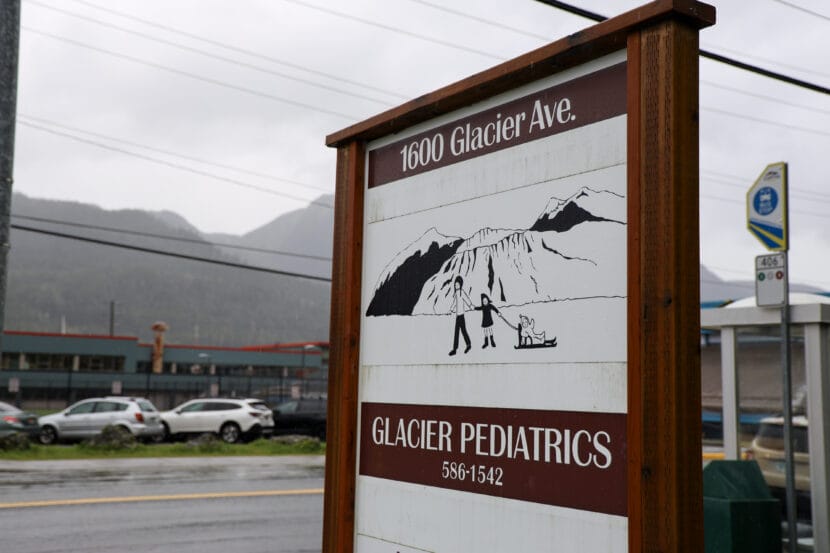
Glacier Pediatrics in downtown Juneau on Friday, Sept. 26, 2025. (Photo by Clarise Larson/KTOO)
Bartlett Regional Hospital is taking over ownership of an independently-owned pediatric clinic in downtown Juneau.
Glacier Pediatrics has been offering pediatric care in Juneau for more than two decades. But hospital administration says discussions with the practice about its struggles to operate independently have been ongoing over the past month and a half.
The clinic sees children from birth through age 19. Earlier this week, the city-owned hospital’s board of directors voted unanimously to purchase the assets of the practice and bring the clinic under Bartlett’s umbrella of care.
Under the plan approved by the board, the clinic will remain at the same location and its current employees will continue to oversee medical services. Clinic employees will become hospital employees and the clinic will be renamed Bartlett Glacier Pediatrics.
“I think (it’s) very much in the best interest of the hospital to have our dual system, where we still have privately-owned clinics, like Valley Medical, and have the option for corporate hospitals,” said Bartlett Board Member Hal Geiger.
Juneau has continued to see multiple private medical practices consolidate with larger entities, namely the Alaska Native-run Southeast Alaska Regional Health Consortium. In the past two years, SEARHC has acquired multiple clinics throughout the region. This spring, Bartlett similarly took over Family Practice Physicians in the Mendenhall Valley.
The transition for Glacier Pediatrics is estimated to be complete by the start of next year. On Tuesday, the board approved $200,000 to purchase the assets. The purchase comes as Bartlett’s finances appear more secure following a difficult year.
In 2024, the hospital faced a multimillion-dollar deficit that threatened it with bankruptcy. Its board controversially chose to reduce staffing and shut down multiple programs to keep that from happening.
Homes in the Mendenhall Valley on Wednesday, April 2, 2025. (Photo by Clarise Larson/KTOO)
A proposition on Juneau’s local ballot this year asks voters whether to lower the cap on the local property tax rate, also known as the mill rate. Advocates say the proposition will help make Juneau more affordable.
Proposition 1 seeks to cap the rate the city uses to determine how much residents pay in property taxes each year.
“Everyone who owns property in Juneau pays property tax to the city based on the value of their property. This would be capping the rate at which the Assembly can charge them for that,” said Assembly member Christine Woll.
Right now, the city caps the mill rate at 12 mills. That limit excludes debt service, which goes toward paying off the city’s existing bonds and loans.
If voters pass Proposition 1 this election, that cap would be lowered to 9 mills. Juneau’s current rate, when excluding debt service, is 9.16. But the rate has been higher before, and the Assembly wants the flexibility to charge more in the future.
But an advocacy group called the Affordable Juneau Coalition says the city needs to focus its spending on things it needs to fund, and not what it wants to fund. Angela Rodell is the treasurer of the group.
“I think it’s really imperative that the city show its residents that they care about affordability and want to really focus on the things that make this community very livable,” she said.
So, what would the change actually mean for your wallet? The city estimates that owners with property valued at half a million dollars or less would save about $80 per year in property taxes if the proposition passes. That’s assuming the home value stays the same.
Now, let’s compare that to the top commercial property owner in the city: Hecla Greens Creek Mine. It owns property valued at just under $285 million based on its 2024 assessment. With the proposed cap, it could save just over $45,000, assuming the value stays the same.
According to census data, more than a third of Juneau households are renters. And renters might not see any benefit from a cap — landlords have no legal obligation to pass any savings from the change on to their tenants.
So, the winner in this scenario is those who own a lot of property in town. The city is the loser. That’s because the Assembly would have less money to fund city services.
“The question that’s being asked this year is, ‘Do you think we should be focusing on making this a community that has services for our lowest-income people, or do you think that we should cut taxes for the wealthiest in the community to make things more affordable?’” Woll said.
The change would result in a roughly $1 million loss in revenue to the city year over year. The rate cap wouldn’t be immediately devastating to the city’s roughly $140 million in annual discretionary revenue. But less revenue equals less money to pay for services. Woll says over time, the Assembly may need to make cuts to the budget if the proposition passes.
For each dollar the city collects in property taxes, a bit more than 50 cents goes toward education and a little under 40 cents goes toward city services.
“When I think long term, it’s maybe less about the money and more about the city’s ability to respond to changing environments,” Woll said.
It’s unclear what services the Assembly might choose to cut. It would make those decisions after the election.
Rodell said she thinks the city can handle the change, and in doing so, it will prove to constituents that it, too, can tighten its belt.
“We know that the city can deliver a lot of services for 9 mills,” she said. “What we’re asking the city to do is to continue to be really thoughtful about how and where and when they collect tax and spend that tax.”
If approved by voters, the rate cap would be applied next city budget season. Election Day is Tuesday, Oct. 7.
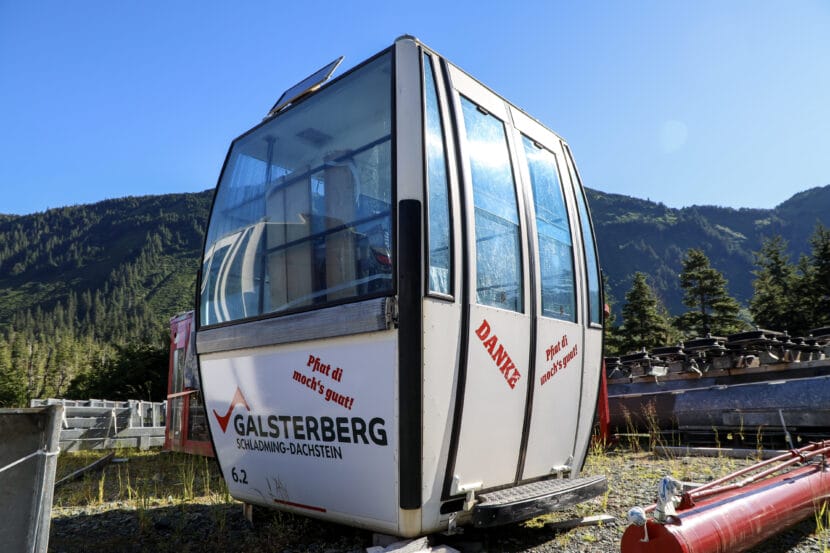
Parts of the city-owned gondola sit outside at Eaglecrest Ski Area on Wednesday, Aug. 6, 2025. (Photo by Clarise Larson/KTOO)
Construction to get Eaglecrest Ski Area’s controversial gondola up and running is finally underway.
The ski area announced Wednesday that work has begun to develop the access road to one of the gondola’s stations on Douglas Island. That means that the mountain will be closed off to the public beyond the main lodges for the foreseeable future.
The road construction comes more than three years after the city bought the used gondola from Austria.
And now, the ski area’s future is riding on it.
In the coming years, the ski area is slated to run into a multimillion-dollar deficit. That is intentional – it’s part of a plan to repair some broken and aging infrastructure while boosting pay to employees and preparing to operate year-round. The plan to dig out of the deficit relies heavily on revenue from the gondola.
Eaglecrest General Manager Craig Cimmons said the road construction marks a major step for the ski area.
“It’s really exciting,” he said. “Like I’ve been saying all along, the summer revenue is going to change the course of Eaglecrest forever, and having these crews here working on this really solidifies that this is happening. It’s really going to be a big deal.”
Cimmons said the goal is to have the gondola up and running by the summer of 2028. This January, the ski area will celebrate 50 years of operation.
A local Alaska Native corporation, Goldbelt Incorporated, invested $10 million in the gondola in 2022 in exchange for a revenue-sharing agreement. Goldbelt announced last fall that it plans to develop a cruise ship port a few miles north of Eaglecrest on Douglas.
Cimmons said the ski area will provide updates regularly about the status of the closure.
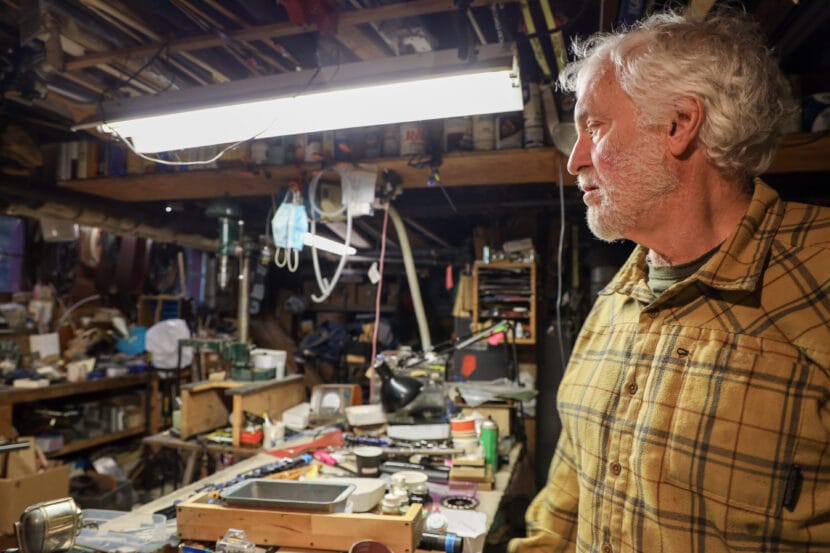
John Ingalls looks at his flute-making shop in the basement of his longtime rental on Telephone Hill in downtown Juneau on Tuesday, Sept. 24, 2025. (Photo by Clarise Larson/KTOO)
Renters living on Juneau’s historic Telephone Hill have a week to pack up their belongings and vacate their homes before the city’s Oct. 1 eviction date.
In the basement of a red-trimmed house with cedar siding on Telephone Hill, John Ingalls played a carbon fiber bass flute on Tuesday afternoon. He’s rented this space for decades.
For the last 15 or so years, he’s been making flutes on the hill in his well-loved shop. There’s hardly an inch of open space on the tables and walls in there, all filled with tools, varnishes or half-finished flutes.
John Ingalls plays a flute he made in the basement of his longtime rental on Telephone Hill in downtown Juneau on Tuesday, Sept. 24, 2025. (Photo by Clarise Larson/KTOO)
“It’s amazing the things that have happened in this little shop here — all the things we’ve built,” he said, looking around.
But before next Wednesday, all of it will need to be packed up and taken off the hill. In December, the city plans to demolish the homes there in hopes of making way for newer, denser housing. The city does not yet have a developer signed on to the project.
Juneau is facing a housing crisis — there are simply not enough homes to keep up with demand. Alarms of a crisis date back more than a decade. The Telephone Hill redevelopment would add more than 100 new housing units to downtown.
Sitting in his dining room alongside some of his neighbors on Tuesday evening, Ingalls said this isn’t the first time he’s had an eviction scare on the hill.
“When I was younger, I sort of had a plan if I got evicted, that I would build a platform and scaffolding up on the roof, and hang up on the roof with a squirt gun,” he said, laughing.
All the people living on Telephone Hill are renters, and have been since the state took ownership of the neighborhood in the 1980s. It was originally intended to be redeveloped to build a new Capitol complex there. But that didn’t happen.
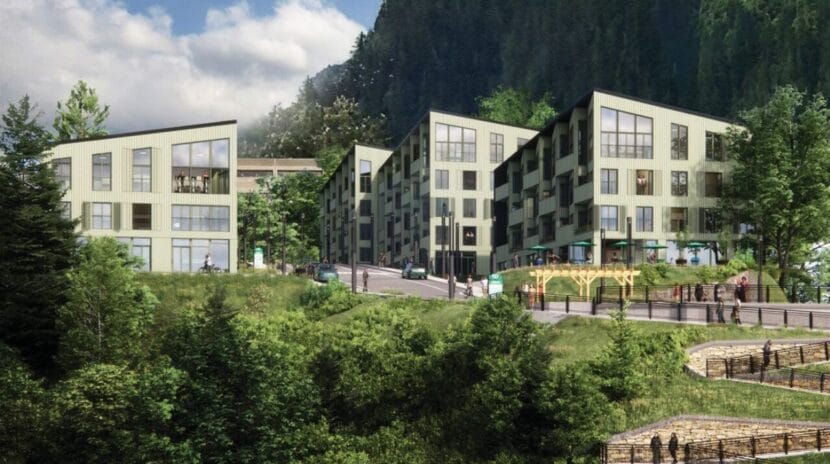
This is a preliminary concept drawing of what the Telephone Hill neighborhood redevelopment could look like. (Courtesy/City and Borough of Juneau)
Joe Karson just turned 80 years old. He rents an apartment on the hill.
“My history on the hill goes back quite a length, but I’ve actually been in this particular unit for 20 years,” he said. “That’s enough to make it a home.”
Karson said he’s been struggling to find new housing since the Oct. 1 eviction notices went out almost four months ago.
He said he’s applied for a spot in senior living facilities, but was told the waitlists are at least a year long. He said he’s looking for other options, but is still holding out hope that the Juneau Assembly will reverse course.
“That’s my home,” he said. “It doesn’t make any sense. As far as affordable housing goes, to tear it down, it’s totally counterproductive to what they say that they want to do.”
Karson isn’t alone. Other Telephone Hill residents find themselves without a plan.
Residents hold signs in protest during a Juneau Assembly meeting at Centennial Hall on Monday, Sept. 22, 2025. (Photo by Clarise Larson/KTOO)
On Monday, dozens of residents attended the Juneau Assembly meeting to protest the city’s plans to evict residents. The Assembly could have chosen to rescind the eviction notices sent to residents at the meeting, but it did not do that.
Instead, multiple members, like Alicia Hughes-Skandijs, shared why they stood behind their decision.
“I love that neighborhood too, but I truly believe in my heart that to take a property that has a smaller number of houses on it and trade that for more dense housing is a right move for us, for where we are in our housing crisis,” she said.
Juneau’s city attorney, Emily Wright, said the city is prepared to take legal action against residents who do not vacate by the eviction deadline.
“Everybody on the Hill received an eviction notice for October 1,” she said. “If they don’t leave their homes by October 1, the city would initiate a legal action against them, the same as any landlord-tenant situation in Alaska.”
Trees outline the Telephone Hill neighborhood in downtown Juneau on Monday, June 9, 2025. (Photo by Clarise Larson/KTOO)
Back on the hill, Ingalls’ partner, Rachel Beck, said she and Ingalls own a home they’ll move into after the eviction notice. But, she said, they’d rather stay. She said Juneau is losing much more than just a couple of old houses — it’s losing history.
“To me, it’s like throwing away your grandmother’s jewels,” she said. “This is a really special place.”
The neighborhood is one of the oldest continuously occupied areas in Juneau. It has a history for Beck; she gave birth to her children there. It has statewide significance, too. Alaska’s first commercial telephone service started out of a house in the neighborhood.
“I think for Juneau, it’s important to have reminders of our past,” she said.
But she fears that once the demolition begins, the memory of the neighborhood will fade, dwindling to just words on a plaque – the only reminder of what once was.
Close
Update notification options
Subscribe to notifications
Subscribe
Get notifications about news related to the topics you care about. You can unsubscribe anytime.