"My mission is to hold Juneau’s elected officials accountable for their actions and how their decisions impact the lives of the people they represent. It’s rooted in the belief that an informed public has the power to make positive change."
When Clarise isn't working, you can find her skijoring with her dog, Bloon, or climbing up walls at the Rock Dump.
Cruise ship passengers who arrive at Juneau’s farthest dock may not have to trek as far to get to downtown in the coming years.
The union representing most Juneau Police Department staff has declared an impasse in its negotiations for a new contract with the City and Borough of Juneau.
After nearly a decade finessing her craft, artist Sydney Akagi is eager to introduce Sitkans to Ravenstail and Chilkat weaving as the most recent Native Arts Resident at the Sheldon Jackson Museum.
Southcentral Alaska residents who bought air filters, face masks and dog goggles in preparation for the potential eruption of Mount Spurr can breathe a sigh of relief. Alaska volcano observers Wednesday moved the alert level on Spurr from the yellow “advisory” status to a green “normal” status, indicating an extremely low chance of an eruption.
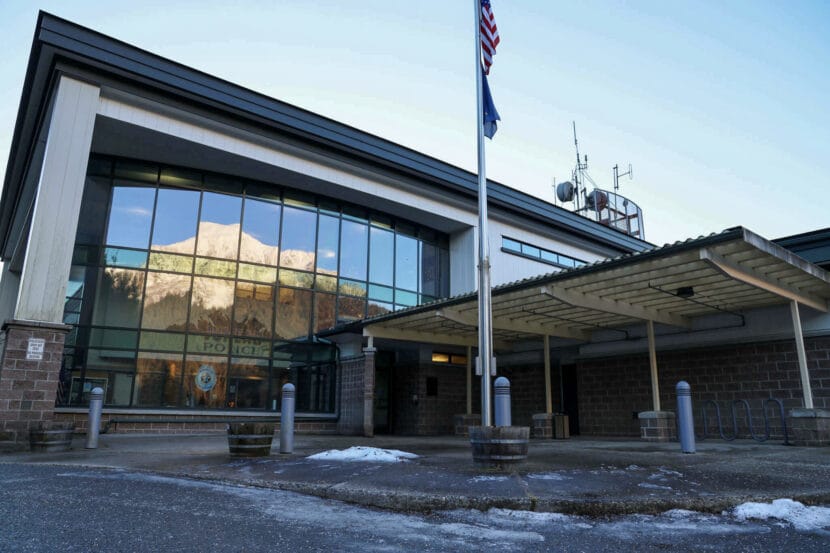
The Juneau Police Department station in Lemon Creek in 2022. (Photo by Clarise Larson/KTOO)
The union representing most Juneau Police Department staff has declared an impasse in its negotiations for a new contract with the City and Borough of Juneau.
Juneau Police Sergeant Sterling Salisbury is the chapter president for the Public Safety Employees Association. He said low pay and staffing shortages are stretching the department beyond its limits — and it’s putting the public at risk.
“They need to make it a place where people want to come to Juneau and to recruit and retain officers and dispatchers and under their current proposals to us, it’s not even coming close,” he said.
The union and city have been negotiating a new contract since February. The previous contract expired in June. The union declared an impasse earlier this month.
Salisbury said Juneau’s wages aren’t competitive with other departments and agencies in the state. He said that, paired with severe understaffing, is driving people away from the department.
Right now, the department has 11 vacant positions, which is fewer than last year.
But Salisbury said it’s not enough, since many officers are still in training. He said the lack of officers has led to delayed response times, strained investigations and mandatory overtime. He said better pay and benefits are needed to attract and retain staff.
The department came under public scrutiny recently after a video posted online showed a Juneau police officer slamming a man to the ground during an arrest in July. In the days following the incident, the department placed the officer on paid administrative leave and requested an independent investigation into the incident.
Juneau Police Chief Derek Bos agreed with Salisbury that understaffing is a challenge, but said that the department is making strides to address it. He said JPD currently has eight officers in training.
“We are definitely doing a robust effort with recruiting and hiring, and that is making a difference,” he said. “We are making headway — beyond just breaking even between attrition — we’re now in a forward number. So I think that is helping.”
Juneau’s firefighters union is also in the midst of wage negotiations with the city. Union representatives said that low staffing rates could also impact Capital City Fire Rescue’s response times.
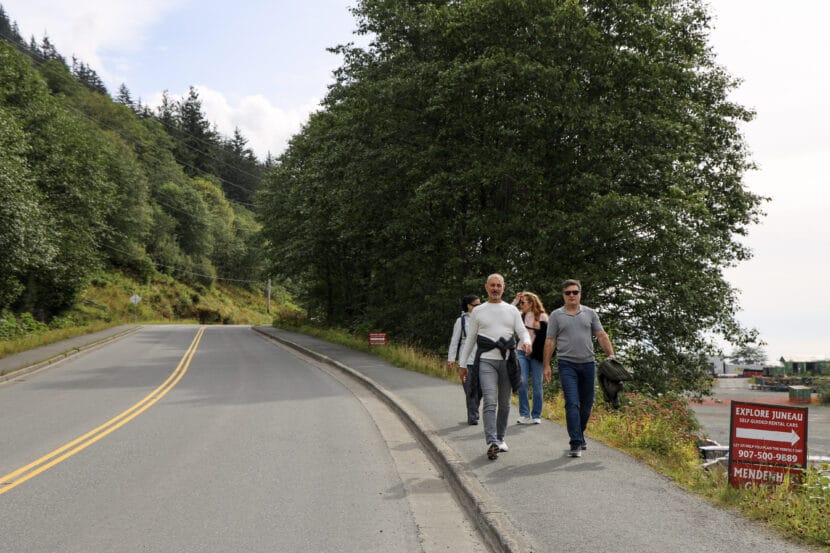
Cruise ship passengers walk on a sidewalk from the AJ Dock to get to downtown Juneau on Thursday, Aug. 21, 2025. (Photo by Clarise Larson/KTOO)
Cruise ship passengers who arrive at Juneau’s farthest dock may not have to trek as far to get to downtown in the coming years.
On Monday, the Juneau Assembly approved leasing a downtown waterfront property and tidelands near where the seawalk currently ends by the port. Petro Marine Services owns the property. City Manager Katie Koester says the lease is needed to finally connect all of Juneau’s cruise ship docks.
“This ordinance is a really important piece in extending the sea walk all the way to the AJ dock,” she said.
Right now, the AJ dock is isolated from the rest of the other cruise ships. So, visitors who get dropped off there have to shuttle into town or walk roughly 10 minutes through an industrial area to get there. The proposed seawalk extension would allow them to walk directly to downtown along the waterfront.
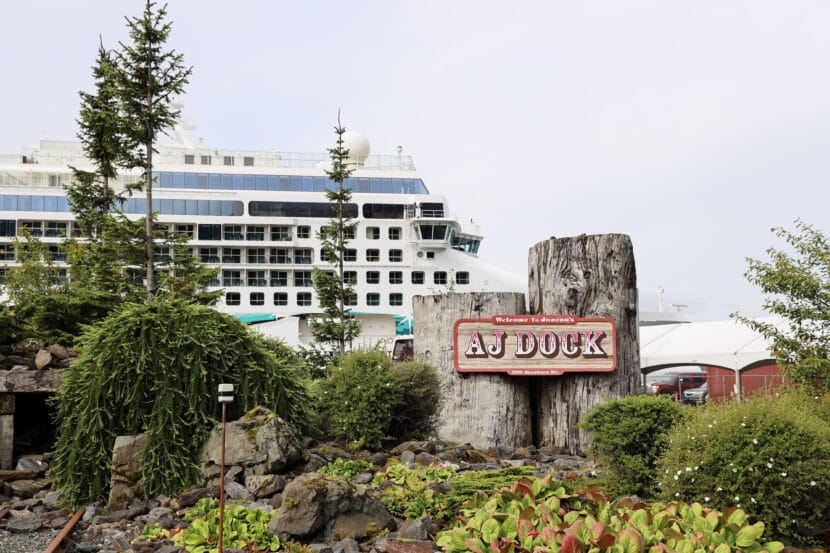
A cruise ship berths at the AJ Dock in Juneau on Thursday, Aug. 21, 2025. (Photo by Clarise Larson/KTOO)
The city has long planned to develop a continuous, mile-and-a-half-long path from the Douglas Bridge to the AJ dock. The city has extended the seawalk in sections over the years, and this new section will stretch a quarter mile south towards Thane.
Plans are underway to eventually build a fifth cruise ship dock next to the U.S. Coast Guard station on Egan Drive. The Assembly approved a tidelands lease for that development in April, but a few more hurdles need to be cleared before construction can begin.
The city will pay $75,000 annually to lease the property, which will be paid for using marine passenger fees – the tax the city collects from cruise ship passengers who arrive in port. The lease was approved for 35 years.
At the meeting, some residents testified in support, but not everyone was on board with the plan. Auke Bay resident Heather Marlow questioned whether the extension was needed, given the high cost. She suggested widening the sidewalks that visitors currently use instead.
“Keep the long-term vision of extending the seawalk to the rock dump as a long-term vision. We’re not there yet,” she said. “If you get another cruise ship and you have true demand at the Rock dump, we can fulfill the vision later. We do not need that expense now.”
City officials estimate the total price tag of the extension project will likely cost $20 to $25 million and construction is still likely a few years out. The city already has more than $7 million set aside for the project from marine passenger fees, but the Assembly will need to decide how to pay for the rest. It’s likely passenger fees will pay for most of it.
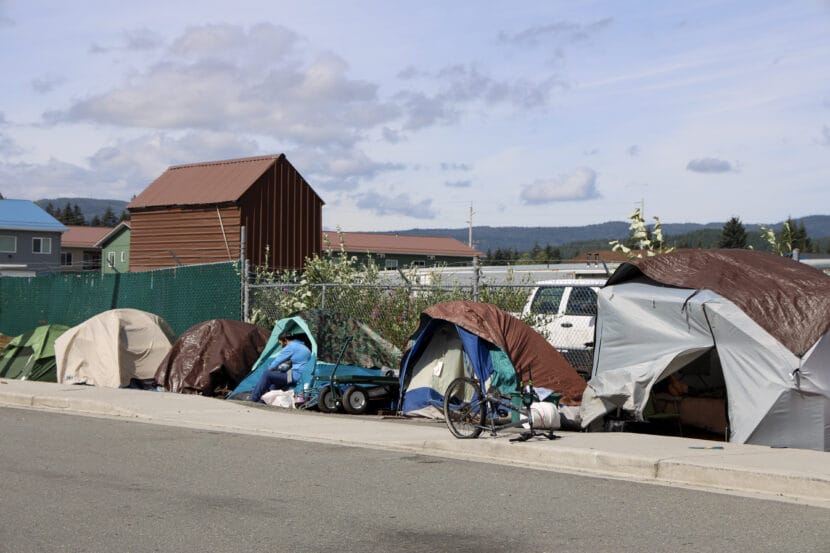
Tents line the sidewalks along Teal Street in Mendenhall Valley on Thursday, Aug. 7, 2025. (Photo by Clarise Larson/KTOO)
The Juneau Assembly voted to kill a proposed ordinance on Monday that would have made it easier for police officers to arrest people who are camping in public spaces.
The Assembly made the decision unanimously. It came at the recommendation of City Manager Katie Koester, who asked members to table the ordinance, which means the proposal is dead and they can’t reconsider it. A similar ordinance could still arise in the future under a new Assembly.
“I think that the ordinance in itself, both from an internal perspective, can really use some improvement,” she said. “From management’s perspective, we really would like to not take this up at this time or in the near future.”
Assembly members originally considered the change earlier this summer after escalating complaints from residents and businesses in town about the problems caused by homeless people who camp in neighborhoods.
Recently Juneau’s homeless shelter announced it would reduce its services later this month due to what staff say is a deteriorating and unsafe environment in the neighborhood.
Right now, city code allows Juneau police officers to arrest people for trespassing if they’re obstructing public spaces by camping — but that requires several steps. The proposed code change would have allowed officers to skip those steps by expanding what could be considered disorderly conduct. Therefore, it would make it easier to arrest people for obstructing public spaces by camping.
The city’s Systemic Racism Review Committee considered the ordinance earlier this month and formally asked the Assembly to reject it. They cited concerns that the change would disproportionately impact marginalized communities — and could be discriminatory.
Ephraim Froehlich chairs the board. He testified at the meeting on his own behalf.
“The fact that it’s even being considered this far and up to this point is extremely concerning to me,” he said. “I think the proposed ordinance and the code changes therein demonstrate a lack of constitutional legal understanding, a lack of interest in real solutions for the issues that it’s attempting to address, and a clear lack of compassion for our neighbors.”
Martin Stepetin, Sr. is a former school board member and the brother of a man who has been missing since late June. At the meeting, Stepetin commended the Assembly for tabling the ordinance and encouraged them to focus on solutions that help people out of homelessness and into stable housing. His brother Benjamin was homeless when he went missing.
“Those are the most vulnerable people in the community, my brother would have been one of them,” he said. “I think that you have heard from a community that in my language it means Wax̂talix. It means we hold something of high value or love. We Wax̂talix our homeless people. We hold them high and Juneau has shown up to defend those people.”
In an interview on Tuesday, Police Chief Derek Bos said he thinks the Assembly made the right call. He said he will continue to work with the city to find other solutions.
“Our goal is not to make it easier to arrest people. Our goal is to make it easier to address specific problems as they relate to homelessness,” he said. “Making an arrest is our last resort solution in these circumstances.”
Last year, the U.S. Supreme Court ruled that cities can ban people from sleeping and camping in public places. Juneau city policy allows for dispersed camping but prohibits it on places like sidewalks or roads. In general, the city allows people to camp on unimproved public land as long as they keep their impact low on the surrounding community.
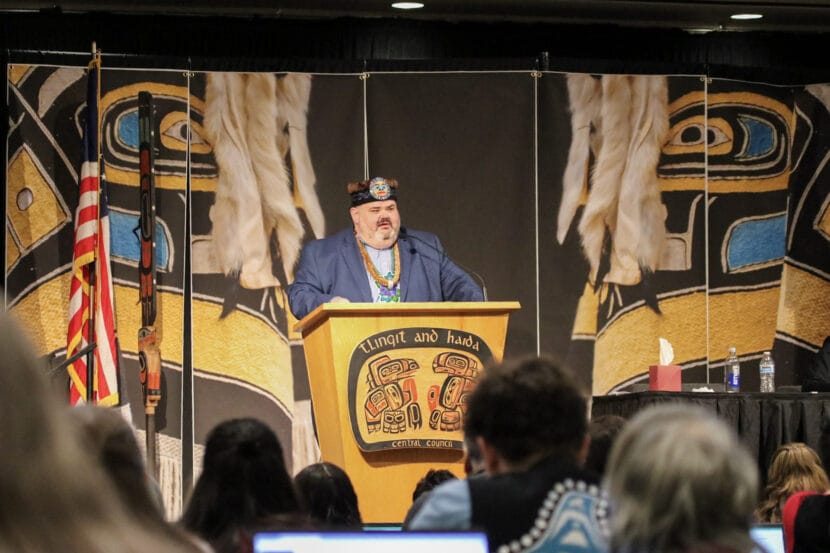
Chalyee Éesh Richard Peterson, president of the Central Council of the Tlingit and Haida Indian Tribes of Alaska, speaks at the 90th annual Tribal Assembly in Juneau on Wednesday, April 18, 2025. (Photo by Clarise Larson/KTOO)
The president of the Central Council of the Tlingit and Haida Indian Tribes of Alaska, Chalyee Éesh Richard Peterson, has returned from personal leave following accusations of misconduct that circulated widely online earlier this month.
Tlingit and Haida is Alaska’s largest tribal government. Peterson has been its president since 2014. His personal leave last week coincided with abuse accusations made by his former fiancée that spread broadly on social media.
The tribe’s first Vice President, Ku.seen Jacqueline Pata, informed Tlingit and Haida staff in an email shared with KTOO that the tribe’s executive council was aware of the online accusations. She wrote that the council was taking the matter “very seriously” and initiated a review. Pata served as acting president in Peterson’s absence.
“This process is being handled with care, respect and a strong commitment to fairness for everyone involved,” she wrote. “Our priority is to ensure that all employees are supported and protected in matters relating to their employment and that our policies reflect those protections.”
Last week, tribal spokesperson Dixie Hutchinson said in a written statement that the council “initiated an internal review and confirmed our workplace policies and practices remain sound.”
“In addition, we have engaged independent human resources and employment law experts to assess the Tribe’s existing policies and ensure they reflect best practices, grounded in our tribal values,” she wrote.
Hutchinson did not respond to a question asking whether the review was of Peterson’s alleged conduct or of the tribe’s policies and did not answer any other questions. She did not say whether the tribe’s policies and practices address informal allegations.
As of Tuesday, no official charges have been filed against Peterson, and the tribe has not confirmed whether a formal complaint was made against him.
The tribe’s executive council, which includes the president, is required to adhere to a code of conduct adopted by the tribe.
The code states that members must not engage in “any form of sexual harassment, coercion, or misconduct” and that members are required to self-disclose if they believe their actions fall short of council standards and may negatively impact the perception of the tribe.
The code states that violations may result in disciplinary action, up to and including removal from office.
Following the accusations, some tribal members have asked for more transparency from the tribe. A petition started by local Alaska Native artist and activist Chloey Cavanaugh has gathered nearly 300 signatures. It calls on Tlingit and Haida to hire an independent, trauma-informed investigator to review policy and leadership behavior in light of the accusations.
The executive council’s next regular meeting is on Friday and will be open for public comment.
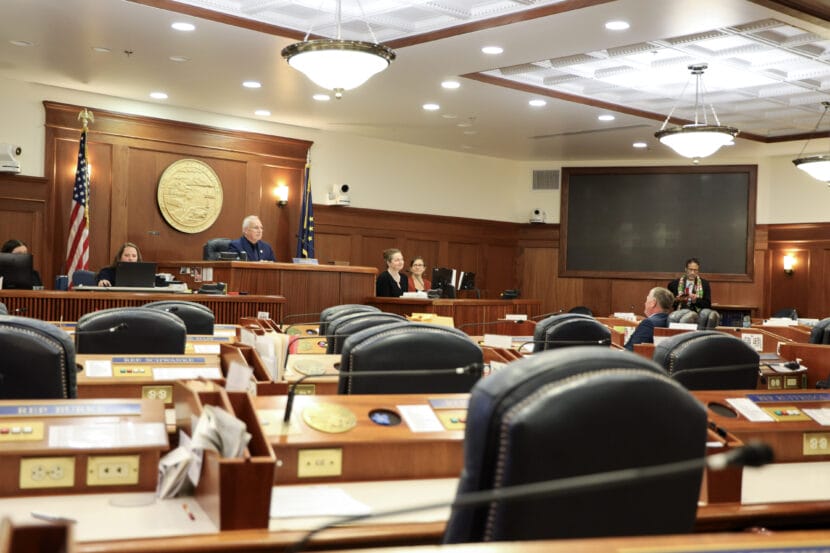
Speaker of the House Bryce Edgmon, a Dillingham Independent, speaks to a nearly empty floor at the Alaska State Capitol on Tuesday, Aug. 19, 2025. (Photo by Clarise Larson/KTOO)
The Alaska House and Senate met Tuesday in Juneau but adjourned in less than a minute.
A total of five lawmakers showed up for the floor sessions and took no action. They needed to meet to prevent Gov. Mike Dunleavy from calling lawmakers back for another special session.
Senate President Gary Stevens, R-Kodiak, said on Tuesday that lawmakers already achieved everything they sought during the special session. He said there’s no reason to bring more lawmakers down to Juneau than necessary.
“We didn’t accomplish anything today other than following the legal issues of calling ourselves back in doing a technical session,” he said.
Dunleavy called the special session earlier this summer for lawmakers to consider his education reform policies and to create a new state Agriculture Department.
But instead, within hours of convening, lawmakers overrode two of his vetoes. They restored more than $50 million in state funding for public schools that Dunleavy cut when he signed the budget. They also strengthened the authority of the legislative auditor.
The governor can call another special session once members gavel out on Aug. 31. But, Speaker of the House Bryce Edgmon, I-Dillingham, said he hopes to avoid that. He said doing so wouldn’t accomplish much.
“If he calls us back in, the results are going to likely be the same as where we’re at now,” he said
Both Stevens and Edgmon said they have had no communication with Dunleavy or his staff since lawmakers last convened.
The governor’s communications director, Jeff Turner, in a statement on Tuesday, said a public announcement will be made if the governor plans to call another special session. He said the Legislature’s actions were disappointing.
“The longer the Legislature waits to pass meaningful education reform, the more Alaskan children will pass through an education system in which too many Alaskan students are not learning the skills necessary for future success in school and life beyond the classroom,” he said.
A group of state lawmakers are expected to meet Aug. 25 to kick off a Task Force on Education Funding. The aim is to discuss ways to improve Alaska’s public schools and examine state funding as student performance continues to wane. The task force will also look at Dunleavy’s proposed policies.
Close
Update notification options
Subscribe to notifications
Subscribe
Get notifications about news related to the topics you care about. You can unsubscribe anytime.