"My mission is to hold Juneau’s elected officials accountable for their actions and how their decisions impact the lives of the people they represent. It’s rooted in the belief that an informed public has the power to make positive change."
When Clarise isn't working, you can find her skijoring with her dog, Bloon, or climbing up walls at the Rock Dump.
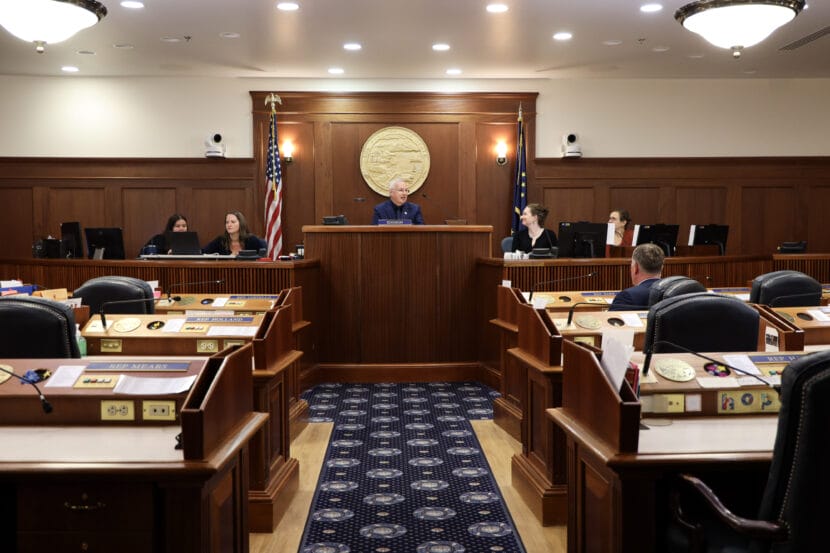
Speaker of the House Bryce Edgmon, a Dillingham Independent, speaks to a nearly empty floor at the Alaska State Capitol on Tuesday, Aug. 19, 2025. (Photo by Clarise Larson/KTOO)
Gov. Mike Dunleavy’s 30-day special session ends this weekend and lawmakers don’t plan to meet at the Capitol again. But, the governor left open the possibility of calling another special session.
“We’re having a discussion, I’ll let you know,” he said during a press briefing in Anchorage on Wednesday.
Dunleavy’s statement comes after House leadership notified Representatives on Wednesday that a technical session scheduled for Sunday morning — the last day of the special session — was canceled.
The governor originally called the session earlier this summer with a plan for lawmakers to consider his education reform policies and to create a new state Agriculture Department.
Neither happened. Instead, lawmakers convened and overrode two of his vetoes, including restoring more than $50 million in state funding for public schools and strengthening the authority of the legislative auditor.
Instead of adjourning, lawmakers decided to keep the session open to prevent Dunleavy from calling lawmakers back into session.
The Legislature briefly gaveled in and out for a technical session midway through August and a total of five lawmakers showed up. They took no action and adjourned in less than a minute.
In a statement on Wednesday, the governor’s communications director, Jeff Turner, called the Legislature’s actions disappointing.
A group of state lawmakers kicked off a Task Force on Education Funding on Monday. The aim of the 18-month-long study is to examine Alaska’s public schools and find areas of improvement.
The Alaska Department of Transportation and Public Facilities announced Tuesday that the emergency bridge work is complete. Engineers say the bridge is safe for the public.
The department closed the bridge as a precaution before the annual glacial outburst flood, which eroded the riverbank nearby and damaged an abutment wall. Hundreds of homes along the Mendenhall River were spared from damage because of the temporary levee the city installed this spring and summer. Several homes still saw significant damage.
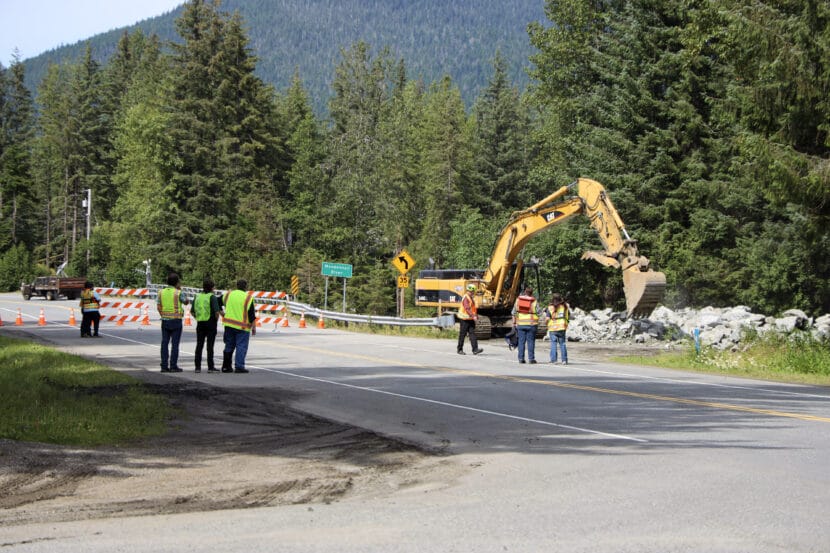
An excavator reinforces Backloop Bridge with large boulders. The bridge was partially damaged by flood waters on Wednesday, Aug. 13, 2025. (Photo by Clarise Larson/KTOO)
According to the department, there will be a gravel approach to the bridge in place for a short period. They say to expect potential intermittent lane closures and crews on-site as they begin asphalting and paving the area as soon as next week.
The department says there will be more permanent river work and bank stabilization surrounding the bridge in the coming months.
Goldbelt Incorporated has unveiled more information about its proposed cruise ship port on the backside of Douglas Island, but city officials say they are still largely in the dark.
The trial against a former Juneau chiropractor accused of assaulting a dozen patients under the guise of medical care has ended, and jurors are set to begin deliberation.
The U.S. House Natural Resources Committee is touring Alaska to take a closer look at the land they spend so much time talking about in Congress.
Most people have had a pet at some point in their life – likely more than one. But the same pet for nearly half a century? Well, one man in South Anchorage has been living with his box turtle for 43 years.
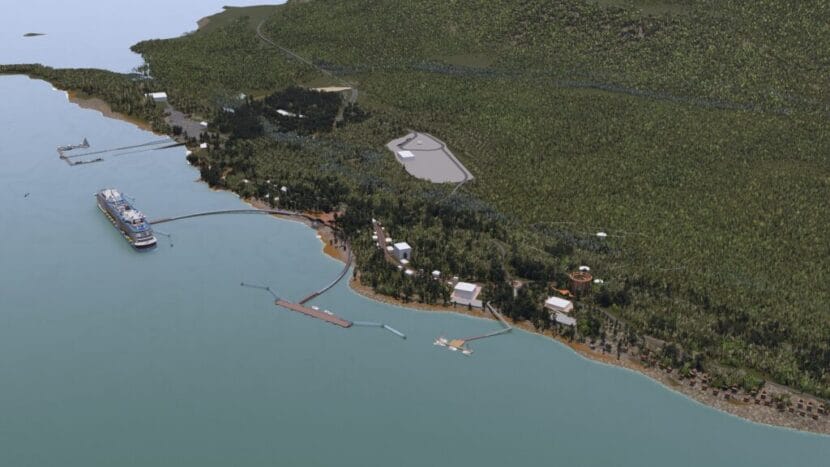
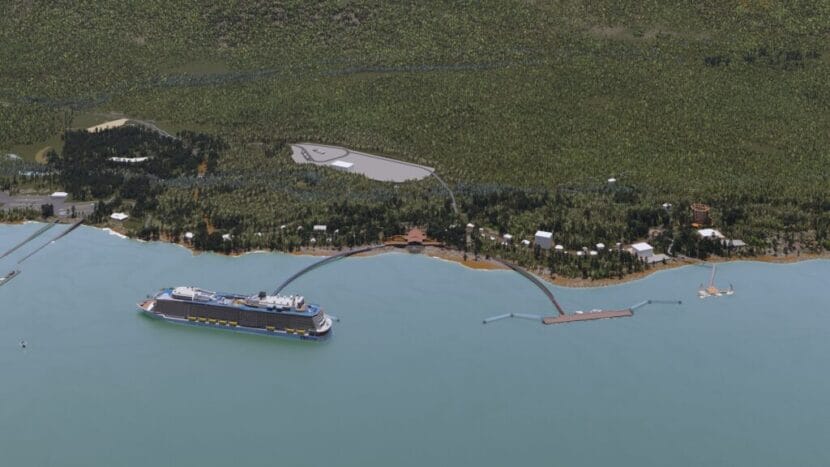
This is a conceptual design of the Goldbelt Aaní port proposed by Goldbelt Incorporated on Douglas Island. (Courtesy of Port of Tomorrow)
Goldbelt Incorporated has unveiled more information about its proposed cruise ship port on the backside of Douglas Island, but city officials say they are still largely in the dark.
Earlier this summer, the local Alaska Native corporation released a new website for the project that includes a timeline for the port’s opening, details about tourist attractions on the site, and conceptual drawings. The project is named Goldbelt Aaní.
Goldbelt originally announced plans to develop the new port last fall, in partnership with Royal Caribbean Group. At the time of the announcement, city officials said they felt blindsided by the news. And now, more than nine months later, Juneau’s Visitor Industry Director Alix Pierce said she still doesn’t know much about the project.
“We haven’t received any sort of permit applications, we haven’t had any formal dialogue about their plans,” she said.
Goldbelt President and CEO McHugh Pierre said the corporation plans to submit a conditional use permit application to the city, but declined to comment further.
Goldbelt is the beneficiary of the Alaska Native Claims Settlement Act and owns land along the northwest coastline of Douglas between False Outer Point and Point Hilda. The port will be located on about 250 acres just beyond where the road ends on North Douglas.
This is a conceptual design of the Goldbelt Aaní port proposed by Goldbelt Incorporated on Douglas Island. (Courtesy of Port of Tomorrow)
On its website, Goldbelt describes the port as an “immersive Tlingit-themed and inspired modern cruise destination.” It’s designed to replicate a Lingít village from the 1800s. The corporation says it plans to offer other tourist attractions like floatplane and whale watching docks, and wants to develop on-site employee housing and a child care center.
The corporation says the new port will help reduce downtown visitor traffic and congestion, and will uplift Alaska Native culture in Juneau.
The company has begun the groundwork for permitting the dock and amenities with the state and the U.S. Army Corps of Engineers.
The project will need approvals from both the city’s planning commission and the Juneau Assembly to move forward. Pierce said it’s hard to say how long that process will take. According to the website, Goldbelt expects to welcome its first cruise ship during the 2028 tourism season.
“There are a lot of considerations to developing in that area, but without seeing a formal application from them, it’s very difficult to speak to the process,” she said.
Goldbelt’s plan coincides with another dock development by Huna Totem Corp., an Alaska Native village corporation based in Hoonah. The Assembly approved the corporation’s plan to build a new cruise ship dock in downtown Juneau earlier this year.
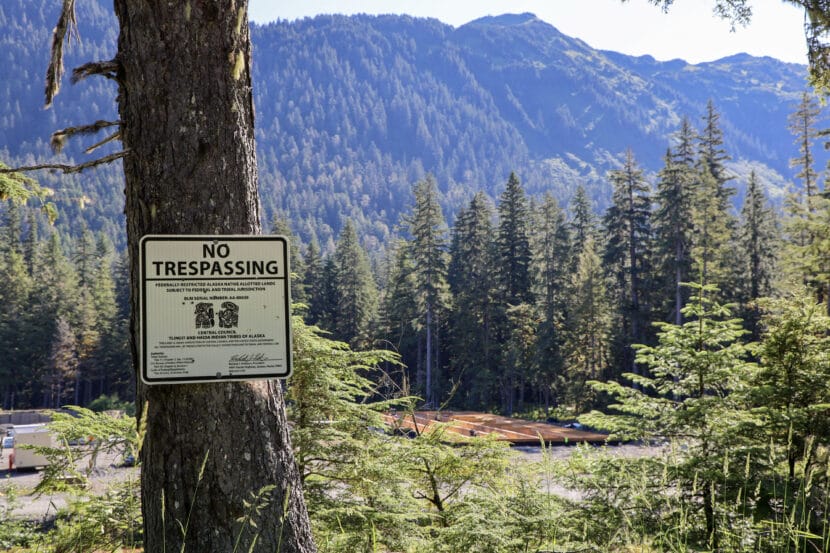
A “No Trespassing” sign hangs on a tree at the border of a Native allotment on Douglas Island on Wednesday, Aug. 6, 2025. (Photo by Clarise Larson/KTOO)
A site on Douglas Island could be the future home of a casino-like gambling hall after a proposal from the Central Council of the Tlingit and Haida Indian Tribes of Alaska was approved by the National Indian Gaming Commission.
Tlingit and Haida says the facility’s approval represents a step toward economic self-sufficiency and sovereignty for the tribe.
The land is on Fish Creek Road, not far from Eaglecrest Ski Area on Douglas Island. It’s just a small piece of a Native allotment owned by tribal members who lease it to Tlingit and Haida. Rumors of the tribe developing something on that property have circulated for years. The tribe first cleared that area in 2018 and has hosted fireworks shops there on and off over the years.
But, nothing substantive has been developed — until recently.
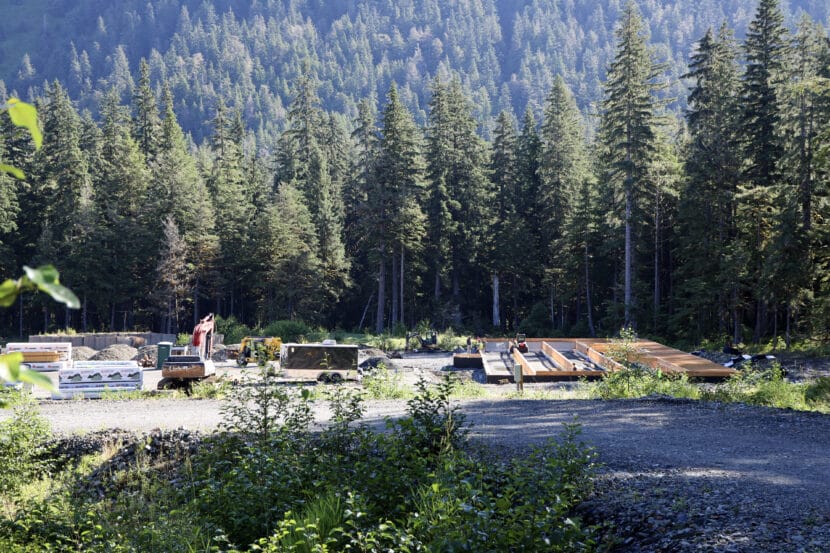
Driving past the location in August, “No Trespassing” signs lined the area and a sign at the entrance warned of construction. Excavators, trucks and building material scattered the graveled area as the structure of a building was beginning to take shape.
Construction is underway at a Native allotment on Douglas Island on Wednesday, Aug. 6, 2025. (Photo by Clarise Larson/KTOO)
In an email this week, Tlingit and Haida spokesperson Dixie Hutchinson confirmed that the tribe is developing a gaming facility. According to Hutchinson, the plan “aligns with Tlingit and Haida’s broader mission to expand revenue-generating opportunities that support essential programs and services for tribal citizens.”
The tribe intends to offer Class II gaming, which covers things like pull tabs, bingo and slot-style electronic machines. It doesn’t cover games like poker or blackjack. Pull-tab gambling is common across Alaska, but what’s less common are electronic pull-tab machines. Tlingit and Haida’s gambling hall could resemble one that’s been operating in Metlakatla, on Alaska’s only Indian Reservation, for years. There, rows of slot-machine-like devices sit in rows, with stools in front of each machine.
The National Indian Gaming Commission’s acting chair approved the tribe for site-specific gaming at the location in January. The decision came just days before President Donald Trump began his second term in office.
In Alaska, very few tribes have authority over land, so they haven’t had a way to open reservation-style casinos like tribes in the Lower 48. But many tribes in Alaska have sought to assert authority over Native allotments owned by individual tribal members.
For decades, federal officials — and state officials in Alaska — have said that Native allotments owned by tribal members in Alaska were not considered “Indian country.” Therefore, they are not under the jurisdiction of tribes and cannot be home to casinos or casino-like gambling halls under the Indian Gaming Regulatory Act.
That stance held firm during the first Trump Administration – the commission declined Tlingit and Haida’s request for gaming authorization at the site in 2020.
But MichelleJaagalAatDemmert, a professor at the University of Alaska Fairbanks’ tribal governance department, says the legal interpretation of Native allotments shifted when former President Joe Biden came into office.
“During the Biden administration, there was a solicitor’s opinion that evaluated the laws and made the determination that the laws supported that Indian tribes in Alaska have jurisdiction over allotments and other land that’s classified as Indian country,” she said.
Demmert is also an attorney and Tlingit and Haida’s former chief justice. She said gaming serves as an important governmental function for many tribes in the U.S.
“People look at it that it’s just this big money-making operation, but it’s so much more than that,” she said. “It’s an opportunity to make money and an opportunity to put that right back into your governmental system, to provide essential services to your citizens.”
The change in opinion during the Biden administration provided an avenue for tribes like Tlingit and Haida and the Native Village of Eklutna to move forward. In February, Eklutna opened a gaming hall on a Native allotment near Anchorage.
However, just days after the Eklutna hall opened its doors, the State of Alaska filed a lawsuit to shut them down, arguing that the state still maintains primary jurisdiction over Native allotments. That lawsuit is still ongoing.
Tlingit and Haida President Chalyee Éesh Richard Peterson expressed his support for the Eklutna Tribe’s gaming hall and championed the benefits it brings to the tribe. He did not respond to a request for comment on Tlingit and Haida’s proposed facility.
In a statement, Juneau City Manager Katie Koester said the City and Borough of Juneau “respects the sovereignty of Tlingit and Haida, and recognizes that this parcel is not subject to CBJ jurisdiction.”
Hutchinson said the project is still in the early phases of development, and she did not offer a timeline for when it will open to the public. She said the tribe intends to reinvest the gaming hall’s revenue into essential tribal programs and services.
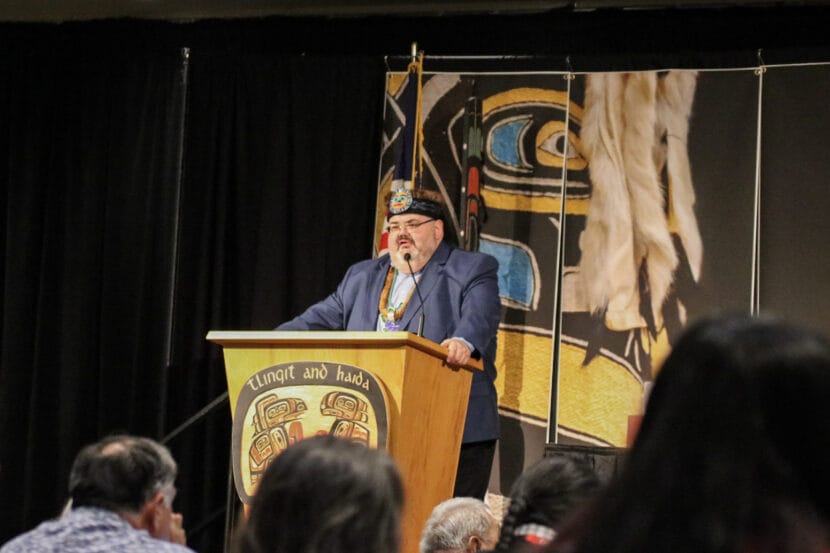
Chalyee Éesh Richard Peterson, president of the Central Council of the Tlingit and Haida Indian Tribes of Alaska, speaks at the 90th annual Tribal Assembly in Juneau on Wednesday, April 18, 2025. (Photo by Clarise Larson/KTOO)
The Central Council of the Tlingit and Haida Indian Tribes of Alaska’s executive council says it has concluded its review of abuse allegations against its president, Chalyee Éesh Richard Peterson.
He returned from a brief personal leave last week. His time away from his role coincided with the wide circulation of sexual abuse accusations made by his former fiancée on social media.
On Friday morning, the tribe’s executive council — which includes the president — hosted its regular monthly meeting.
The tribe’s first Vice President, Ku.seen Jacqueline Pata, briefly acknowledged the allegations. Pata did not directly identify Peterson in her remarks.
“Tlingit and Haida has been reviewing an employment matter with the assistance of outside counsel following a social media post concerning the private personal lives of current and former employees,” she said.
Tlingit and Haida is Alaska’s largest tribal government. Peterson has been its president for more than a decade. He attended the meeting on Friday and did not speak to the allegations during his presidential report.
Pata originally informed Tlingit and Haida staff in an email earlier this month that the tribe’s executive council was aware of the online accusations. She wrote that the council was taking the matter “very seriously” and initiated a review. Pata served as acting president in Peterson’s absence.
Pata said the review focused on whether inappropriate conduct occurred in the workplace and whether the tribe has effective measures to uphold workplace respect and accountability. She said the council also conducted a broader review of the tribe’s policies, procedures and reporting mechanisms. She said that review led to the council adding a third-party reporting system and additional training to its policies and accountability systems.
“With the review of this matter now concluded, we are confident in moving forward with strengthened policies and supports in place,” she said. “Tlingit and Haida remains committed to providing a respectful and welcoming workplace that honors our traditions and culture and reflects tribal values.”
The meeting was open for public comment. Multiple tribal members testified, asking for transparency regarding the allegations and what the tribe’s executive council is doing to address them. Stláay Cloud-Morrison testified that she is a survivor of sexual assault, and said the allegations made her think about what the tribe owes its citizens.
“It’s deeply troubling when serious complaints are not handled with [the] honesty and respect they deserve,” she said. “Only through genuine transparency can our tribe demonstrate respect for survivors and a real commitment to healing.”
Following the accusations earlier this month, local Alaska Native artist and activist Chloey Cavanaugh gathered more than 350 signatures demanding Tlingit and Haida hire an independent, trauma-informed investigator to review policy and leadership behavior. She testified at the meeting on Friday — and said the issue raised broader questions about accountability in tribal government.
“I realized through this process that there’s really no way for us tribal citizens to contact our delegates and talk to those that represent our communities to be able to voice our complaints or things that we’re seeing that we don’t like,” she said.
The tribe’s executive council is required to adhere to a code of conduct adopted by the tribe.
The code states that members must not engage in “any form of sexual harassment, coercion, or misconduct” and that members are required to self-disclose if they believe their actions fall short of council standards and may negatively impact the perception of the tribe. The code states that violations may result in disciplinary action, up to and including removal from office.
No criminal charges have been filed against Peterson as of Friday.
Close
Update notification options
Subscribe to notifications
Subscribe
Get notifications about news related to the topics you care about. You can unsubscribe anytime.