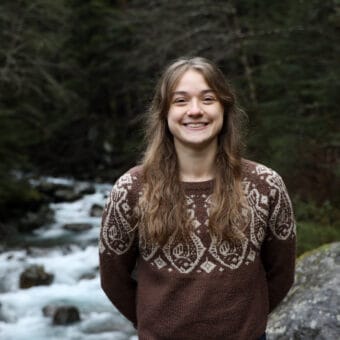
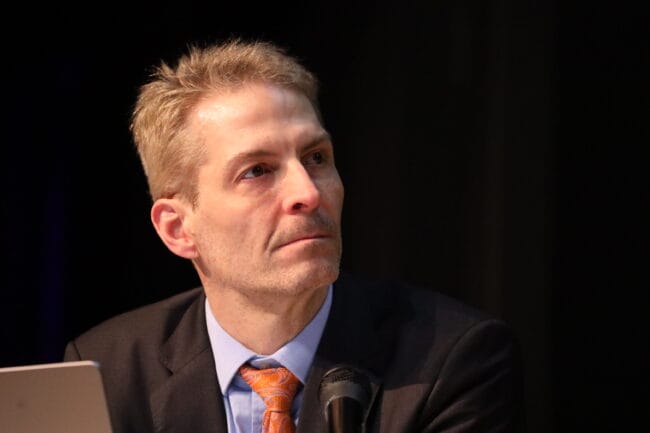
"My mission is to hold Juneau’s elected officials accountable for their actions and how their decisions impact the lives of the people they represent. It’s rooted in the belief that an informed public has the power to make positive change."
When Clarise isn't working, you can find her skijoring with her dog, Bloon, or climbing up walls at the Rock Dump.
It was the first day of school for students in the Juneau School District today. And, it’s also the first time students headed to the newly consolidated high school and middle school campuses.
An emergency day care center opens up in the former Floyd Dryden Middle School as residents continue to recover from the glacier outburst flood last week.
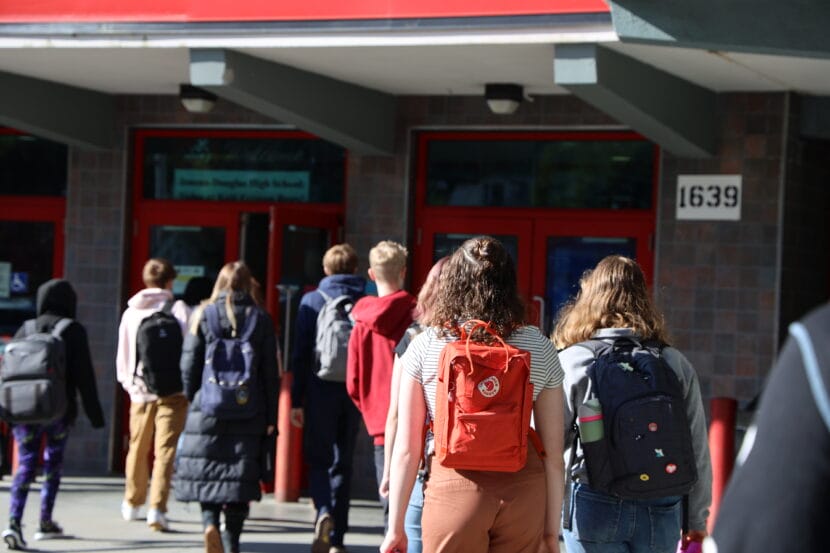
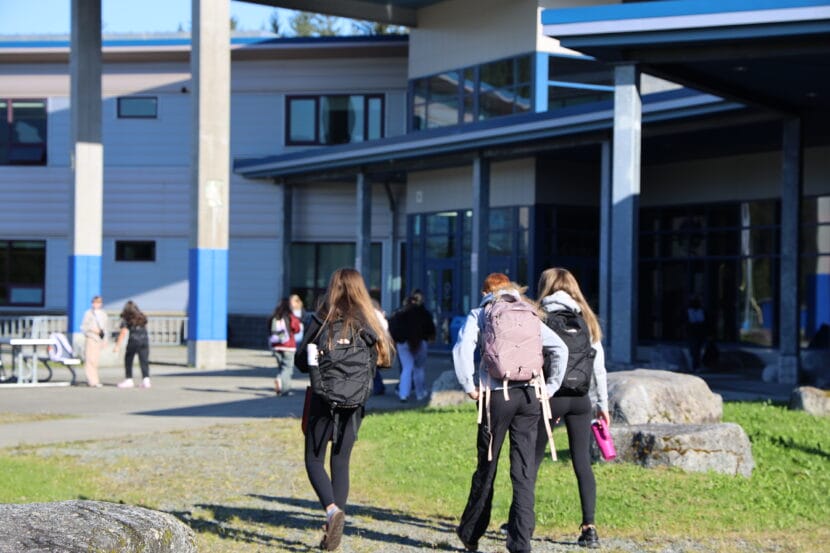
Students walk to the Juneau-Douglas High School: Yadaa.at Kalé entrance for the first day of school on Thursday, Aug. 15, 2024. (Clarise Larson/KTOO)
The neighborhood surrounding Juneau-Douglas High School: Yadaa.at Kalé was packed Thursday morning. It was the first day of school for the Juneau School District.
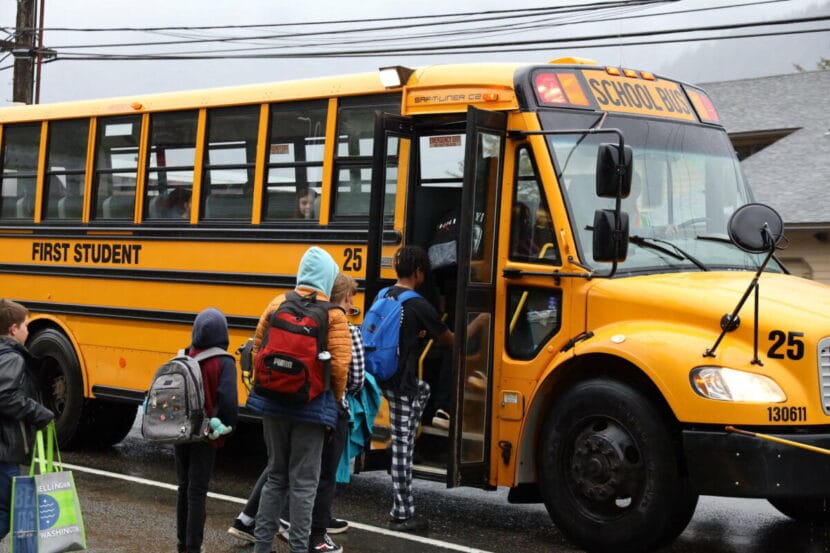
Cars lined the streets, buses filled the roads and students shuffled down the sidewalks.
Juniors Ximena Ramirez and Aurora Cole were headed to their first classes. Ramirez said she had a lot of emotions running through her head.
“I think it’s chill. I’m excited for it. I’m just, like, nervous,” she said. “I think everybody’s nervous to just be with everybody, find parking and stuff.”
This school year is the first time in 16 years that all high school students in Juneau are under one roof, instead of splitting between Juneau-Douglas and Thunder Mountain High School in the Mendenhall Valley. That’s because that building is now Thunder Mountain Middle School.
This past winter, the school board voted to consolidate Juneau’s high schools and middle schools — among other cost-cutting measures — in order to fix a multimillion-dollar budget crisis.
Students walk to the Juneau-Douglas High School: Yadaa.at Kalé entrance for the first day of school on Thursday, Aug. 15, 2024. (Clarise Larson/KTOO)
Ramirez went to Juneau-Douglas last year, but this is Cole’s first year here from Thunder Mountain. She said it’s nice to have some friends like Ramirez to help guide her through the new building, but she’s still nervous.
“It’s kind of exciting, just because of all the people, but it’s also scary because you know nothing,” she said.
And, it’s not just students who are on edge. Brooke Rohweder is a parent of a junior starting his first year at Juneau-Douglas after spending his first two years at Thunder Mountain, which is closer to their home.
“There are just a lot of unknowns I guess,” she said. “I think we’re trying to go into it optimistically, but it’s a big, big, big shift for us.”
Rohweder said she might be more nervous than her kid.
“He’s been positive the whole time, as well as all of his friends that I’ve talked to,” she said. “They’re just going into it more positively I think than I feel right now.”
Juneau School Board Member Britteny Cioni-Haywood was at the high school Thursday morning to check in on how things were going. She said she heard a few concerns like the lack of parking downtown, a few late buses and scheduling issues for some students.
But overall, things were going better than she hoped.
“At this point anyway, from the little that I’ve seen, feels like it’s going fairly smoothly,” she said. “I believe that there probably will be some rough spots as we kind of try and get those smoothed out — patience and grace.”
Across town at the newly combined middle school campus at Thunder Mountain, the parking lot was a lot more empty than in years before.
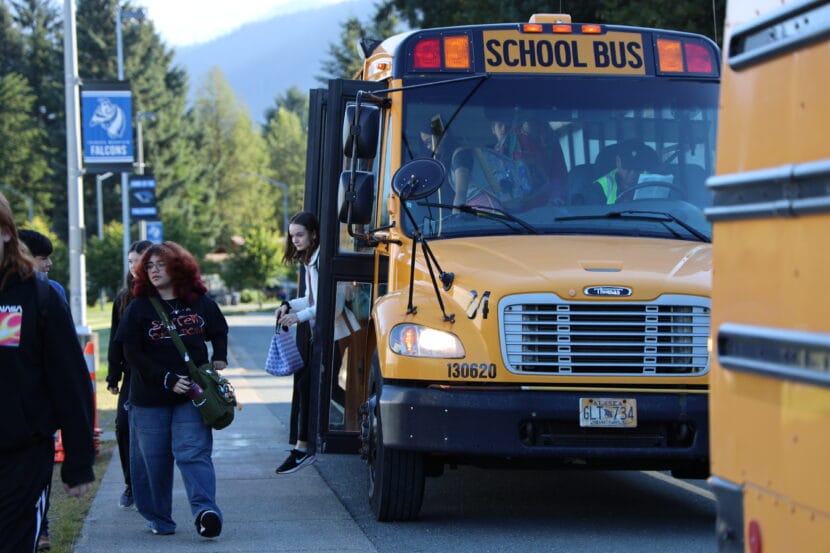
Students walk off a bus to the Thunder Mountain Middle School entrance for the first day of school on Thursday, Aug. 15, 2024. (Clarise Larson/KTOO)
As parents lined the drop-off lane and said goodbye to their kids, seventh-grade student Cianna Kahl stood in front of the sign outside of the school so that her dad, Neil Kahl, could take her photo.
“I’m feeling pretty confident because I have some friends so I’m excited to see them here,” she said.
One downside for Cianna and her dad is that they live right next to the former Floyd Dryden Middle School, which she would have attended had it not closed down this year under the consolidation plan. Floyd Dryden, along with the Marie Drake building, are now owned by the city.
But Neil said they’re staying positive.
“That was kind of a bummer,” he said. “But it’s a really nice facility here, so the middle schoolers are gonna have a good learning experience. And that’s the main thing.”
In an interview earlier this week, Superintendent Frank Hauser said he is confident that consolidating schools is a major milestone for getting the district back on track financially.
“I think the district is positioned to be more responsive, but at the same time being able to provide those opportunities for our students and really expanding out and not having to reduce more because of those costs,” he said. “The consolidation really made it possible to put us on firm financial footing.”
But, with state funding for education in unknown territory heading into the next legislative session, Hauser warned there still could be more bumps to come on the road ahead.
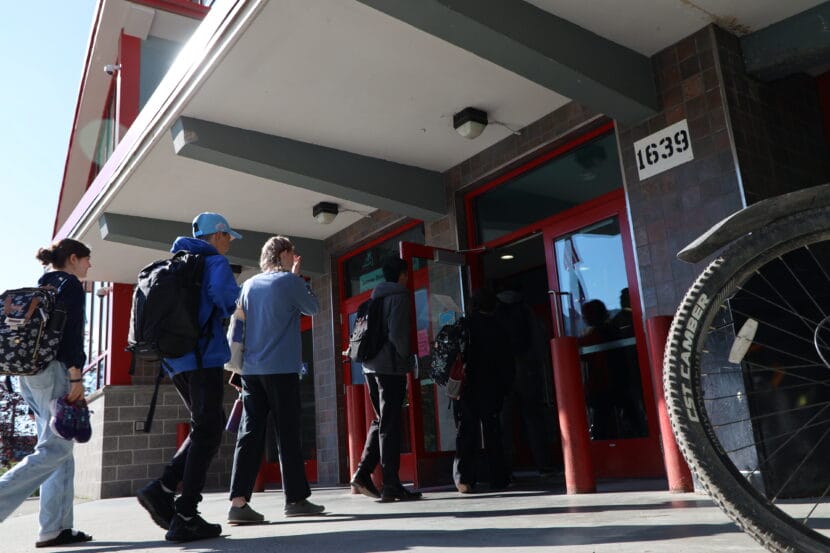
Students walk to the Thunder Mountain Middle School entrance for the first day of school on Thursday, Aug. 15, 2024. (Clarise Larson/KTOO)
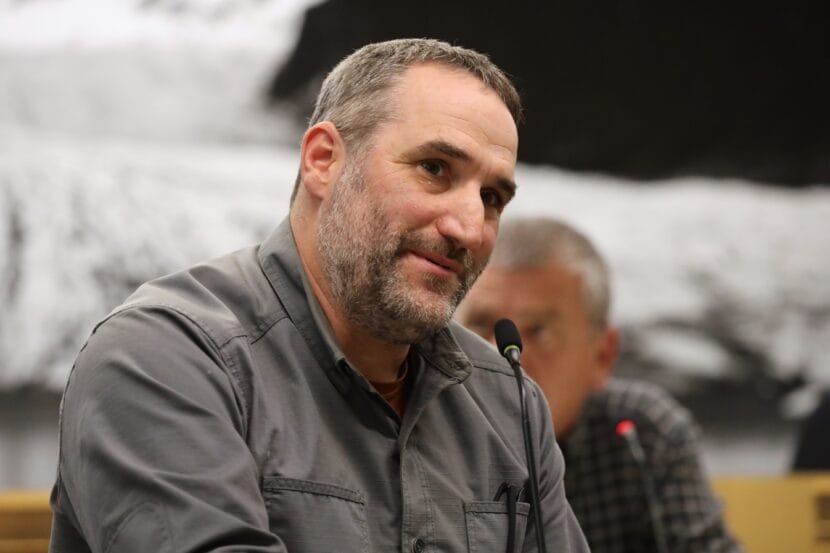
Craig Cimmons interviews for the Eaglecrest Ski Area general manager position during a meeting at City Hall on Friday, Aug. 2, 2024. (Clarise Larson/KTOO)
The Eaglecrest Board of Directors has selected a new general manager for the ski area.
On Wednesday, the board announced Craig Cimmons accepted the position and will begin his new role in early October. He was one of two finalists chosen from a pool of 17 applicants.
Cimmons is currently based in Vermont and is the director of the Ski & Ride School at Jay Peak Resort. He’s held the position since 2012. According to the city, he’s also held various roles related to ski and snowboarding education, environmental education and adventure recreation.
During a public meeting earlier this month, Cimmons said his focus as general manager would be navigating Juneau’s skiing and snowboarding community through ongoing changes like the gondola project.
“Community is at the heart of everything I do — everything I’ve done,” Cimmons said. “It’s the most important part.”
He said if he was selected as manager, building strong communication with staff would be a key priority for him.
“Communication is probably the most important aspect of any management structure. Not only communication but timely, accurate and honest communication,” he said. “Setting up that structure is important.”
He’ll take over the position from interim general manager Erin Lupro. She temporarily held the role during the hiring process after the ski area’s previous manager of seven years was abruptly asked to resign by the board in late May.
In an interview following his resignation, former manager Dave Scanlan said he didn’t want to leave his job. Despite public backlash to the decision, the board has not publicly shared why they asked for his resignation.
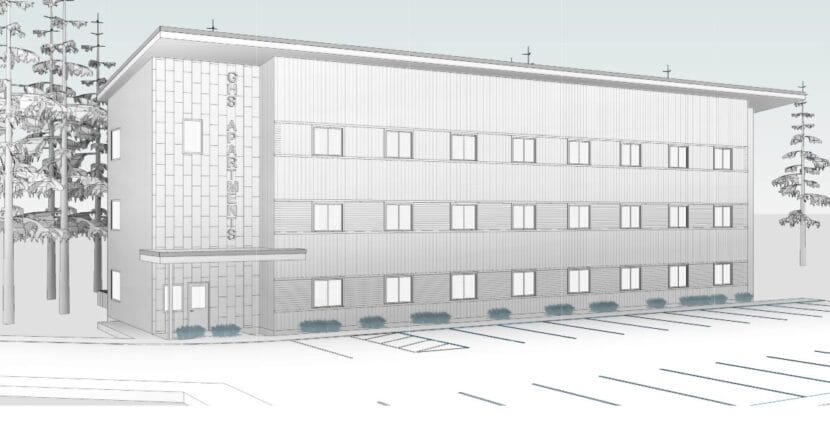
A conceptual design for Gastineau Human Service’s proposed 51-unit permanent supportive housing project in the Lemon Creek area. (Clarise Larson/KTOO)
Juneau needs more housing for its most vulnerable populations — and a newly permitted affordable housing project hopes to help fill in the gaps.
On Tuesday, the city planning commission unanimously granted a conditional use permit to local nonprofit Gastineau Human Services for a three-story apartment building with 51 long-term housing units in the Lemon Creek area.
Jonathan Swinton is the executive director of Gastineau Human Services. The nonprofit helps people affected by homelessness or addiction.
“It’s just so important,” Swinton said. “Anybody who has experienced an addiction, or has been through incarceration, or has ever experienced homelessness, knows how difficult it is to be in that kind of environment and believe in and hope for yourself, and hope for your future.”
The housing project was designed specifically for people in recovery from substance misuse, reentering society after incarceration, or facing housing instability.
Swinton said residents will be surrounded by other people going through a similar journey to recovery. They will have access to case managers, treatment groups, AA and NA meetings and individual counseling.
He said those resources are key to helping people maintain sobriety, feel confident to successfully re-enter society post-incarceration and find a network of support.
“We think by having both this environment of support from those in similar circumstances and the additional resources that our nonprofit can offer, that we’re setting them up for a much better chance of long-term success,” he said.
The nonprofit’s goal is to have construction begin next year and open the facility in 2026.
In May, the Juneau Assembly gave the project a $2 million grant. But, the nonprofit still needs to gather another $9.5 million from other sources to be able to fully fund construction. And, Swinton said this building is hopefully just the first phase of a larger development project.
Correction: A previous version of this story misidentified the type of permit issued by the Planning Commission on Tuesday.
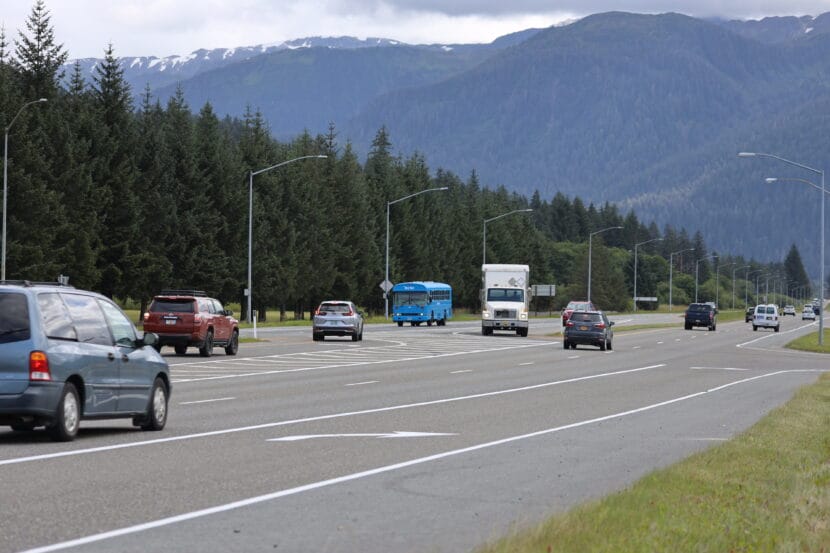
The intersection by the Fred Meyer grocery store — where Yandukin Drive crosses Egan Drive — has long been one of Juneau’s most accident-prone areas. Dozens of crashes, some deadly, have occurred there over the years.
Sam Dapcevich, a spokesperson for the Alaska Department of Transportation, said making the state-owned intersection safer has been a long time coming.
“I know that it’s a very high priority for DOT, and DOT knows from our frequent communications with the community that it’s a high priority for Juneau, too,” he said. “So we are working hard to get it done.”
Juneau residents have been vocal about the need for safety changes for at least two decades. And, last fall the Juneau Assembly passed a resolution asking the state to make “immediate and substantial improvements” at the intersection following a fatal crash there just months before.
Recently, the state’s Department of Transportation and Public Facilities made small changes like extending the medians there, painting clearer markings and introducing a seasonal speed limit reduction.
But now, officials are looking for a company to design more substantive changes — like adding a traffic light, a pedestrian crossing and an alternative route.
Dapevich said the department hopes to start construction by 2026. The updates will happen in phases.
“We’ve got a great contractor team who’s going to review everything and make sure that we cross all the t’s and dot all the i’s, and we’re going to try to expedite it as much as possible,” he said.
In total, the improvements are expected to cost between $23 and $47 million. Most of that will likely be funded using federal-aid highway program funds.
Students enter a bus stopped on Douglas Highway during the first day of the 2023-2024 school year. (Clarise Larson/for the Juneau Empire)
The first day of school for the Juneau School District is just around the corner — classes kick off on Thursday.
Superintendent Frank Hauser sat down with KTOO to chat about the start of the new year with the consolidation plan in place, the stability of the district moving forward and what students can expect.
Listen:
This interview has been edited for length and clarity.
Clarise Larson: The school board voted to consolidate Juneau’s high schools and middle schools this past winter. This means many students will be walking into new schools and social environments on Thursday which will likely be pretty different from last school year.
How prepared is the district for these changes, and do you expect a smooth transition?
Frank Hauser: One of the things that we focused on a lot this summer is, of course, the move and making sure that the move took place. And, we’ve got all of our buildings ready to go, everyone has moved in. So, that is one piece that is not a concern at all.
And I mean, it’s a small community — the students all know each other, whether it’s sports, whether it’s different activities, whether it was when they were in elementary school or they were at the same middle school. And so one of the things I’ve heard a lot of is that at least the students are going to be together with their friends, and they know each other because they are so closely connected because this is such a tight-knit community. So I think a lot of our students are excited to be able to be in school with their friends.
Juneau School District Superintendent Frank Hauser during a meeting on Thursday, Jan. 18, 2024. (Clarise Larson/KTOO)
Clarise Larson: The Juneau School Board voted back in May to slightly change the start times for some grade levels. Why did they do that, and what impact will this have on both parents and students traveling to classes each day?
Frank Hauser: One of the main reasons why I felt strongly about this as well was, especially when the winter comes and it’s a little snowy, sometimes there were some tight turnarounds for some of our students.
With the consolidation, making sure that we had 45 minutes between elementary to middle school, middle school to high school, provided enough opportunity and time for all the buses to get around, to pick up the students and drop them off in time, not necessarily in time for school to start, but in time for students to be able to have access to breakfast.
And be able to have a good start to the day and not feel like they’re coming in and feeling rushed. So that was one of the reasons why we’re looking at the school start time and starting a little bit later for middle school and high school.
Clarise Larson: With a lot more students heading to Juneau-Douglas High School: Yadaa.at Kalé this year, how will the district mitigate parking issues that may arise?
Frank Hauser: There’s a couple of things that we’ve got in place that I’m actually excited to talk about. One thing is, we actually have buses going from Thunder Mountain to JD every day in the morning and after school is out – it can double as an activities bus at the end of the day too.
And so students who might not want to park down downtown by JD can actually park at Thunder Mountain and catch one of the buses that come straight down to the Juneau Douglas and the campus here.
Another thing we’ve been doing is working closely with the city and Capital Transit, which is great. They have a reduced-price student ticket, and students can use capital transit as much as they want. And so those stops will either stop close to the schools, or you can kind of stop at one of the stations to be able to have access. So we’re working with and trying to communicate that information out to make sure that they know that we’re really trying to support students — especially if they’re worried about parking — making sure that they have a means to get to downtown without that being a concern.
Clarise Larson: This July, the school board voted to add back a few dozen positions to the district that were previously cut because of a lack of funding.
They were able to do that because the governor signed this year’s state budget, which included a one-time funding boost of about $5.2 million to the Juneau School District. What kind of positions were added back, and how will it help as students start the new school year?
Frank Hauser: The add-back really will help out in a lot of different ways. One, it added back some much-needed staff, certificated staff, and some of our teachers. But it also helped provide additional support for our paraeducators, it brought back some office staff, and so all those pieces are essential to students being able to learn. And so the board was able to add back a maintenance position, IT, it brought some teachers back, paraeducators — they brought in just some additional supports.
Clarise Larson: With the drastic measures the school board had to take to address budget shortfalls last school year, along with the continuing unknowns about education funding in the state, do you anticipate more tough decisions in the coming school year?
Frank Hauser: That’s a good question. I mean, really it comes down to, after years of deficit spending, I really think now the district is in and is repositioned on firm financial footing with the promise of increased academic opportunities and support for students through the consolidation process.
But I also think it’s important to remember that this extra funding that provided some of those add-backs, is one-time funding. So as we start looking at the next school year, we are thinking about and looking at and making sure that we’re responsive to our student’s needs, but also staying within the budget.
So I think the district is positioned to be more responsive, but at the same time being able to provide those opportunities for our students and really expanding out and not having to reduce more because of those costs. The consolidation really made it possible to put us on firm financial footing.
Clarise Larson: Well, thanks so much for speaking with me today, Frank.
Frank Hauser: No Clarise, thank you, I really appreciate it.
Close
Update notification options
Subscribe to notifications
Subscribe
Get notifications about news related to the topics you care about. You can unsubscribe anytime.