"My mission is to hold Juneau’s elected officials accountable for their actions and how their decisions impact the lives of the people they represent. It’s rooted in the belief that an informed public has the power to make positive change."
When Clarise isn't working, you can find her skijoring with her dog, Bloon, or climbing up walls at the Rock Dump.
Alaska Congresswoman Mary Peltola joined D.C. lawmakers from 16 states in a legal brief backing a lawsuit to stop a massive, national grocery store merger,
In House District 40, covering the North Slope and the Northwest Arctic, the big issue is the incumbent’s vote this spring to sustain the governor’s veto of education funding,
Alaska used to have some of the strictest campaign spending laws in the country, but since 2021 the state has had no limits on individual donations, but a group is trying to restore some limits with a ballot initiative
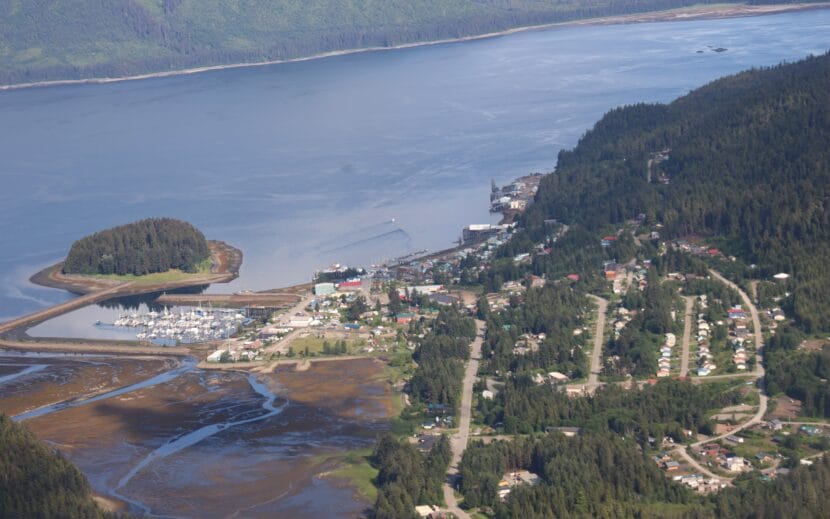
The City of Hoonah on July 3, 2024. (Clarise Larson/KTOO)
Staff with Alaska’s Local Boundary Commission issued its final report on the City of Hoonah’s most recent petition to form its own borough, citing “substantive concerns” with the plan and recommending it be denied.
The Xunaa Borough petition — pronounced like Hoonah, with a slightly guttural “h” — would form Alaska’s 20th borough. It proposes including more than 10,000 square miles of land and water, including Glacier Bay, Chichagof Island, and more. It encompasses lands traditionally used by the Huna Lingít clans.
The commission’s staff wrote that the petition fails to meet constitutional, statutory and regulatory requirements laid out for borough incorporation in the state.
Advocates for the borough say it would allow residents to have a greater say in the future of the region and it would let the borough implement a 1% seasonal sales tax during the summer cruise season.It could also likely mean more state funding for Hoonah School District.
But, the petition has faced some opposition. Elfin Cove, a small community that would be incorporated into the borough, sent a letter in February asking for the commission to reject the petition.
And, the Juneau Assembly also voted to formally oppose a specific portion of the plan because some of it overlapped with a territory that the City and Borough of Juneau once considered annexing.
Though the commission’s staff recommended the petition’s denial, the five members of the Local Boundary Commission still have the final say. They are set to travel to Hoonah for a public hearing on Sept. 5. Then, they must issue a decision within 90 days.
Juneau residents affected by record-breaking glacial outburst flooding are in the process of cleaning up flood damage. Scores of volunteers are pitching in, and the state and the City and Borough of Juneau are offering resources for clean up.
Plans to redevelop a historic neighborhood in the heart of downtown Juneau are moving forward. The city says the project could add more than 100 new units of badly needed housing.
Alaska musician Quinn Christopherson speaks to KTOO for the latest Tongass Voices episode.
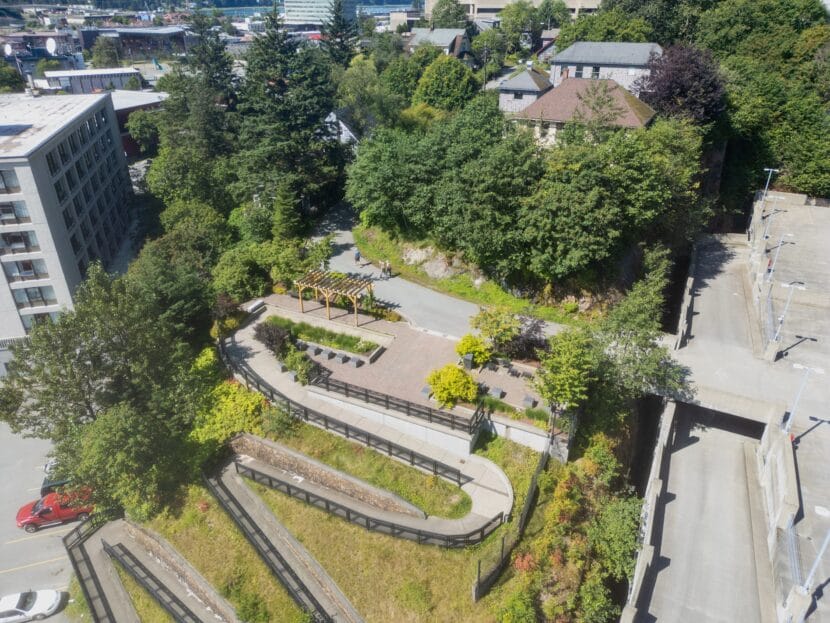
Telephone Hill in downtown Juneau on Monday, Aug. 5, 2024. (Clarise Larson/KTOO)
Tommy Jimmie Jr. and Joe Johnson sat in the bright afternoon sun on the steps leading up to the Telephone Hill neighborhood in downtown Juneau on Thursday.
The pair came to relax near the tall green trees and thimbleberry bushes. Jimmie said he’s there almost every day.
“This has always been a part of my walk going through this neighborhood. I do the flume, and oftentimes I’ll meet him here, and I’ll come down this way,” he said.
Jimmie is Lingít and grew up in Juneau. He said he didn’t know that there were plans underway by the City and Borough of Juneau to redevelop the area to make way for more housing.
“I think those houses are just as old as some of those that are down here in the village,” he said. “I would think they would be renovating some of those houses up there rather than trying to get rid of them — they’re historical monuments, as far as I’m concerned.”
The neighborhood sits on roughly four acres of land on a hill in the center of downtown Juneau. There are seven houses and one five-unit apartment building there. Most residents there have openly opposed the city’s redevelopment plan.
But in February, after a handful of community meetings on the topic, the Juneau Assembly asked city staff to move forward with a redevelopment plan that would demolish the neighborhood’s historic homes and add more than 100 new housing units.
But when that will happen is still up in the air. At Monday’s Assembly committee meeting, City Manager Katie Koester said it all depends on the developer.
“I think the earliest we can do anything would be next summer — which I find that to be very unlikely — but I hope it doesn’t take up to three years which is the other end of the spectrum on that,” she said,
At the meeting, the Assembly approved a plan to seek interested developers who might want to take on the project. Once the city chooses one of them, that will determine how quickly the project moves along.
All the people who live on Telephone Hill right now are renters, but some have lived there for decades. The land is owned by the city, which acquired it from the state in recent years. Before that, the state had owned it since 1984.
Koester said the city is not actively maintaining the houses up there anymore but will continue to let the renters live there for the time being. But if any health or safety issues arise in the buildings, they may need to vacate the residents.
“We are encouraging people to move out and find alternative housing as soon as possible,” she said.
Affordability is also a key point for the Assembly in its decisions about how the project should move forward. For years the Assembly has been trying to find different avenues to tuck affordability requirements or incentives into development projects amid Juneau’s housing crisis.
On Monday, the Assembly approved a goal for the Telephone Hill project to have 20% of its units to be below-market rent at 80% of the area median income.
But, Koester warned that requiring developers to sell some of their units below-market will likely come with a cost to the city.
“Tax abatement, site development, land transfer — we don’t really know what strategies might be needed. But, if the Assembly wants to mandate something as part of the development, we can expect to have to pay for part of that one way or another,” she said.
Mayor Beth Weldon made the motion to add the affordability aspect to the redevelopment plan. But she worried some developers would be discouraged by it.
“Part of me wants to just let the free market reign on this particular piece of property,” she said. “It’s a prime piece of property — this is my struggle.”
Koester said the city will put out the request for interested developers in the coming months.
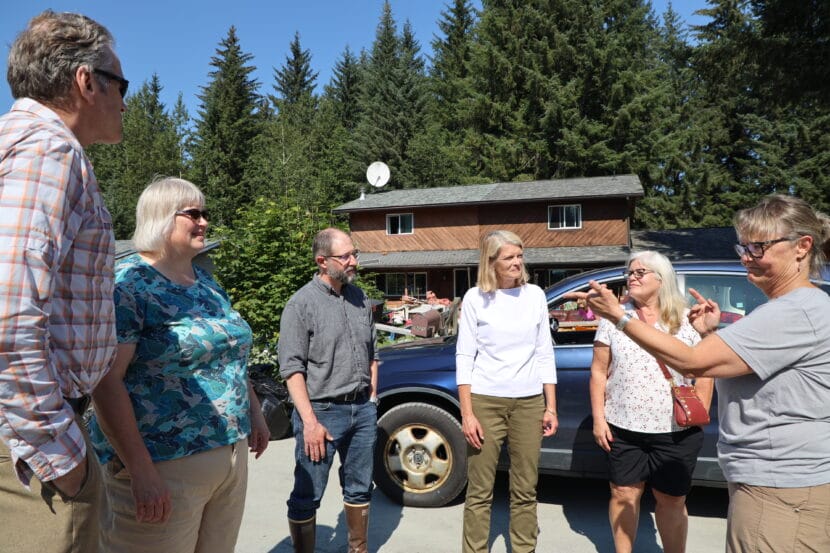
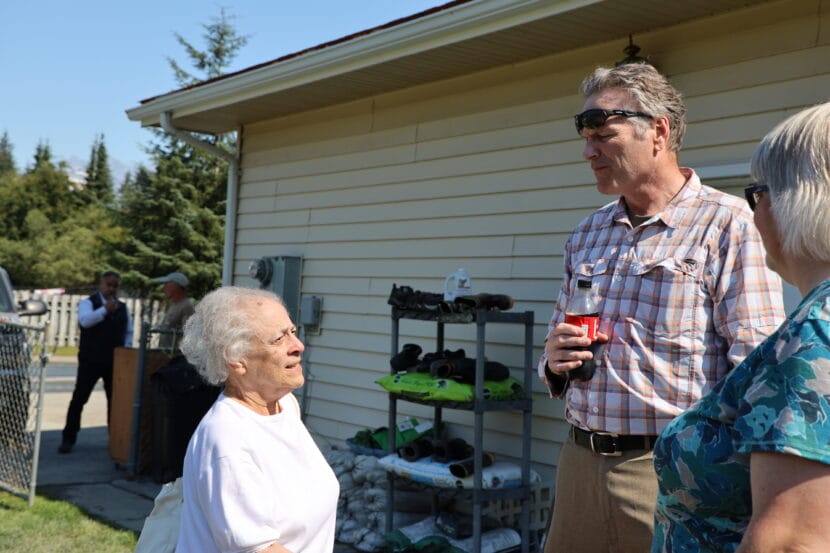
Gov. Mike Dunleavy, Juneau Mayor Beth Weldon, Alaska Sen. Jessie Kiehl and U.S. Sen. Lisa Murkowski listen to Lisa Wallace as she describes the flood damage to her home on Emily Way on Wednesday, Aug. 7, 2024. (Clarise Larson/KTOO)
Gov. Mike Dunleavy and U.S. Sen. Lisa Murkowski toured the Juneau neighborhoods that experienced record-breaking flooding earlier this week.
On Wednesday, they met with residents who are beginning to recover and assess the damage, like Janet Coffin. When they arrived, water was gushing from a tube outside of her house.
The water was being pulled from the flooded crawl space of her home on Killewich Drive.
The flood happens every year, but the past two years have been unprecedented. This year’s flood happened almost exactly a year after the last catastrophic event.
Coffin didn’t think it could get worse from last year.
“When it burst last year, it only went from the curb six feet into the yard and driveway,” she said.
Janet Coffin talks with Gov. Mike Dunleavy and Mayor Beth Weldon about the damages to her home following the glacial outburst flood on Wednesday, Aug. 7, 2024. (Clarise Larson/KTOO)
But it was worse. This year, it flooded her crawlspace and car and soaked everything in her garage. On the tour of other houses though, some people had it much worse. The city estimates at least a hundred homes and buildings were damaged.
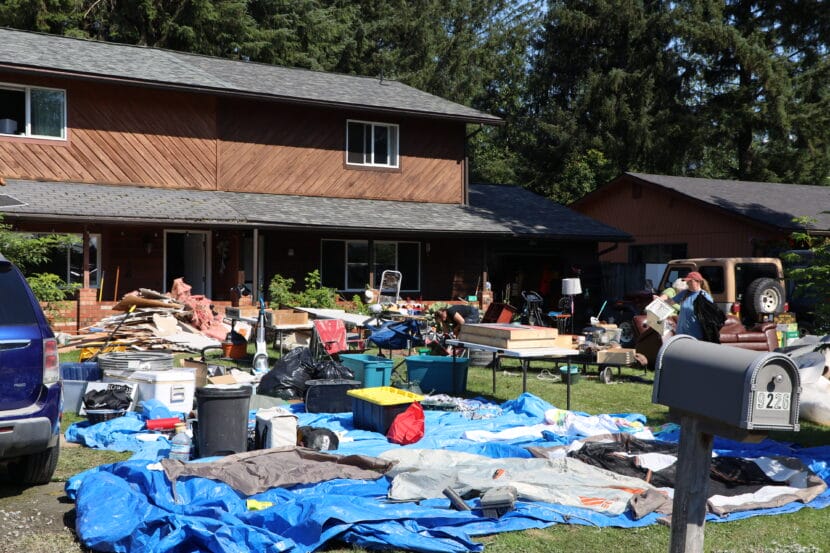
On Emily Way, it looked like everyone in the neighborhood was having a garage sale. Clothes, furniture and books were splayed out in the yards. But, a closer look revealed that the pages were wet and the clothes were covered in silt.
Clothing, furniture and appliances dry in the sun outside of Lisa Wallace’s home on Wednesday, Aug. 7, 2024. (Clarise Larson/KTOO)
The flooding started due to the rapid retreat of the Mendenhall Glacier, fueled by human-caused climate change.
Each year, a basin behind the glacier fills with rain and meltwater before bursting downstream into the Mendenhall Lake and River. Last year’s flood pushed the Mendenhall River to nearly 15 feet. This year, the river rose even higher, setting a new record of 15.99 feet early Tuesday morning.
On Tuesday afternoon, the Juneau Assembly passed a resolution to declare the flood a local emergency. Dunleavy swiftly followed with a state declaration.
During the tour on Wednesday, he said the quick turnaround of the declaration means recovery money at the state level is already on its way.
“It allows us, over the next 30 days, to do whatever we can in terms of regulation, and suspension to help expedite clean up,” he said. “It also frees up money from the state’s coffers to help out.”
And, the state’s declaration may draw attention from the Federal Emergency Management Agency. Murkowski said though this year’s flood in Juneau is a wake-up call for Alaska, FEMA aid is already stretched thin nationwide.
“As devastating as this is for many families here, we have disasters all over the country that federal agencies are looking at and trying to address at the same time that this is unfolding,” she said.
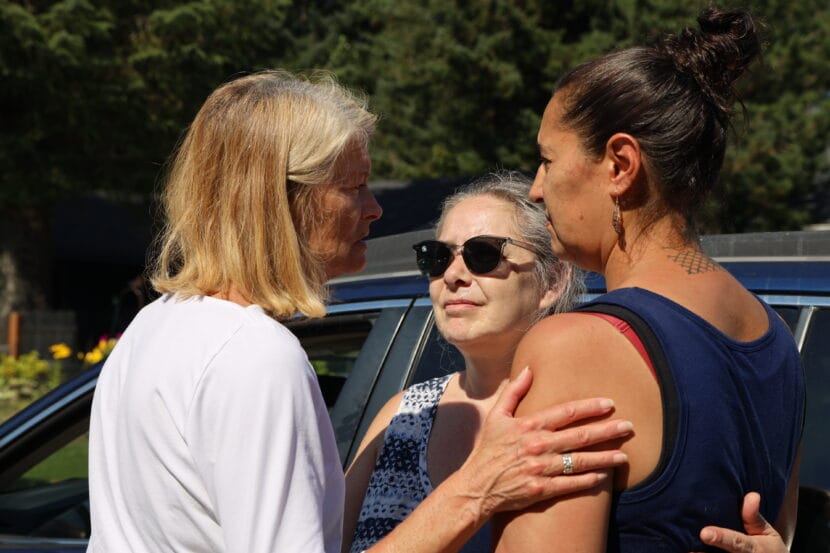
U.S. Sen Lisa Murkowski comforts residents whose homes were damaged by the glacial outburst flooding in Juneau on Wednesday, Aug. 7, 2024. (Clarise Larson/KTOO)
But, she said this can’t keep happening. It’s going to take a collaborative effort between the city, state and federal government to find ways to prevent a disaster of this magnitude from happening again.
“We don’t want the people of Juneau to be dreading Aug. 5 and 6 every year,” she said. “That’s not the way to move forward.”
The Central Council of the Tlingit and Haida Indian Tribes of Alaska continues to provide emergency shelters to tribal members displaced by the flooding.
Kus.een Jackie Pata with the tribe said it’s important that people support one another during this time.
“Yesterday, it was emotional for everybody, and it’s a crisis that people are dealing with,” she said. “We want to take care of them physically as well with their body and soul.”
Other resources like free sump pumps, debris cleanup, distress hotlines and food distribution are also available.
Governor Mike Dunleavy and U.S. Senator Lisa Murkowski toured the Juneau neighborhoods that experienced record-breaking flooding earlier this week. Now, residents are beginning to recover and assess the damage, and city and state officials are working together to figure out next steps.
The U.S. Interior Department says it reviewed over a million pages of federal records to produce a two-volume report on Native boarding schools. Interior Secretary Deb Haaland released the second volume last month. The report also makes recommendations –that include apologies to communities for forcibly taking children from their homes to assimilate them — as well as programs that offer healing through language and culture.
Southeast Alaska has almost a full week of sunshine ahead, but those blue skies will be slightly dingy with smoke from wildfires in Canada.
Close
Update notification options
Subscribe to notifications
Subscribe
Get notifications about news related to the topics you care about. You can unsubscribe anytime.