"My mission is to hold Juneau’s elected officials accountable for their actions and how their decisions impact the lives of the people they represent. It’s rooted in the belief that an informed public has the power to make positive change."
When Clarise isn't working, you can find her skijoring with her dog, Bloon, or climbing up walls at the Rock Dump.
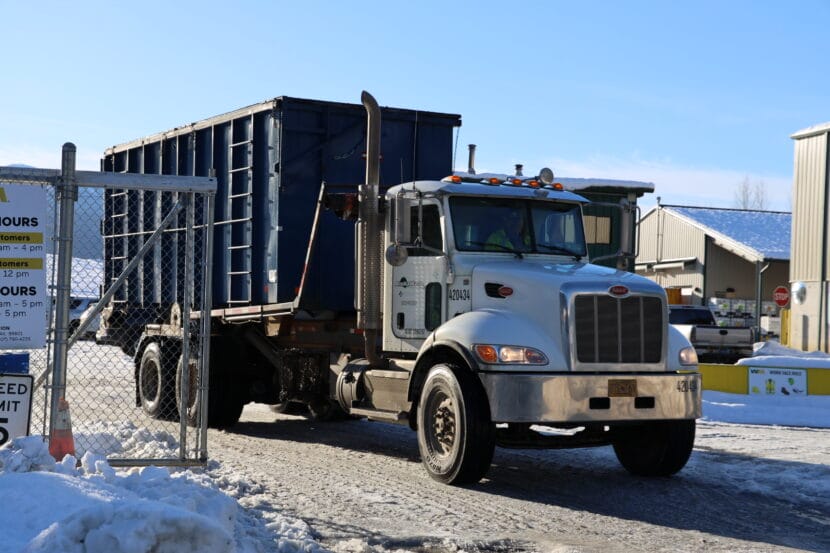
A garbage truck exits Waste Management’s Capitol Disposal Landfill in Lemon Creek on Wednesday, Feb. 7, 2024. (Clarise Larson/KTOO)
Household garbage fees in Juneau will soon go up by almost 9%, beginning on March 1. Meanwhile, rates for disposing of metal will rise sharply, with the minimum charge spiking from $40 to $110.
Waste Management is the private company that owns Juneau’s only landfill. Patrick McCarthy, a spokesperson for the company, said in an email that increases in operational and transportation costs led to the price hikes.
Waste Management has not posted the new prices on its website. McCarthy said they are handing out flyers with the new rates at the dump.
Jesse Hay owns a landscaping business in Juneau. He said he wants answers about why the costs have increased so dramatically — like, whether the landfill’s dwindling capacity has anything to do with it. The landfill is only projected to last another 20 years.
“The life expectancy of the landfill is definitely a consideration. If that is the case, then, you know, come out and say it,” he said. “Get in front of this and say, ‘Hey, look, this is why we’re doing it. This is what our long-term plan is.’”
Hay said the rise in dump costs will affect his customers. Come March, the minimum charge for household garbage and construction debris will rise to more than $150.
He’s also worried that changes at the dump will cause more illegal dumping around town. Just over a year ago, Waste Management nearly tripled its minimum disposal charge, while also cutting back on its hours. Residents can now dispose of their trash for just four hours on Saturdays.
“I understand that business costs have gone up, but when is enough, enough?” he said. “I mean sooner or later, people are just going to start throwing their trash on the side of the road and letting the city or the state deal with it.”
City Manager Katie Koester said the city can’t control Waste Management’s rates. But she said that the city has seen a rise in illegal dumping since last year’s price increase — and she’s concerned that the coming rate hike will only compound the issue.
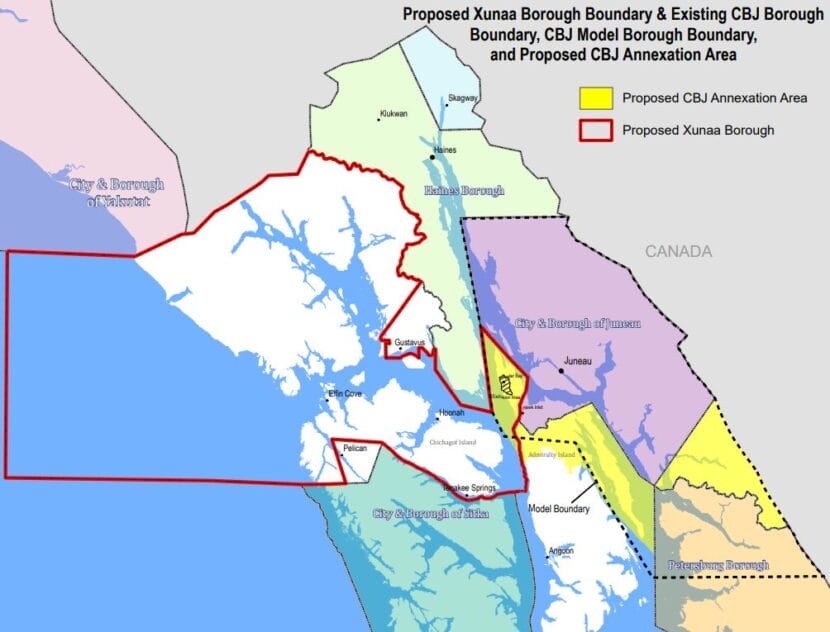
A map of the proposed Xunaa Borough boundary and the existing City and Borough of Juneau boundary. (Courtesy of City and Borough of Juneau)
The Juneau Assembly voted on Monday to oppose part of the City of Hoonah’s plan to create Alaska’s 20th organized borough.
The new borough would take in more than 10,000 square miles of land and water, including Glacier Bay, Chichagof Island, and more. But a small part of the proposed borough overlaps with territory that the City and Borough of Juneau once made an effort to annex.
The Mansfield Peninsula and Horse and Colt Islands are small pieces of land at the northern tip of Admiralty Island, near Juneau. They’re lightly populated, with a few homes and cabins. Juneau once explored annexing the area, but dropped the effort in 2019.
Now, those parcels are part of a much larger area that the city of Hoonah hopes to include in a new borough that would include the lands traditionally used by the Huna Lingít clans — a plan that’s seen several versions over the last 30 years.
On Monday night, the Juneau Assembly voted 5-3 to formally oppose the part of Hoonah’s plan that includes the peninsula and islands. Juneau Mayor Beth Weldon said she’s not interested in renewing the effort to annex the area, but she also doesn’t want to see it become part of a new borough.
“I just think the area’s ties to Juneau are much stronger for a variety of reasons than the ties to Hoonah,” she said.
The Xunaa Borough petition — pronounced like Hoonah, with a slightly guttural “h” — would form Alaska’s 20th borough.
That would likely mean the Hoonah School District would get more state funding, and it would allow the borough to implement a 1% seasonal sales tax during the summer cruise season.
Right now, the Mansfield Peninsula and the two islands are not part of an organized borough, which means residents are not subject to local government regulations or taxes. Juneau’s discussions about annexing the area ultimately fizzled out, but they hinged on the idea that the area has strong economic and cultural ties to Juneau.
Assembly member Michelle Bonnet Hale said she supports the partial opposition of the plan because it could allow a future Assembly to decide if Juneau wants to annex it.
“If we don’t file this, we lose the opportunity to petition in the future. So this land just goes to the Xunaa Borough if the boundary commission agrees,” she said.”
Assembly member Alicia Hughes-Skandijs voted to not oppose Hoonah annexing the area. She said there are compelling reasons to have the land under Juneau’s jurisdiction — but not much to gain by keeping it unorganized.
“It’s not adding it to the Juneau borough, we’re just saying ‘Hey don’t put it in Hoonah, but also just leave it unorganized,” she said. “I think Juneau is fine as it is and I don’t think we need to make this comment.”
Assembly member Wáahlaal Gíidaak Barbara Blake also voted not to oppose the annexation. She said she spoke with Alaska Native leaders in Juneau, who supported Hoonah annexing the land.
In the end, the Assembly’s formal opposition is only for that specific portion of land in the Xunaa annexation plan — but not the overall plan for a new borough. That means if the state Local Boundary Commission agrees with Juneau’s assembly’s petition, it would keep the peninsula and islands in an unorganized borough, for now.
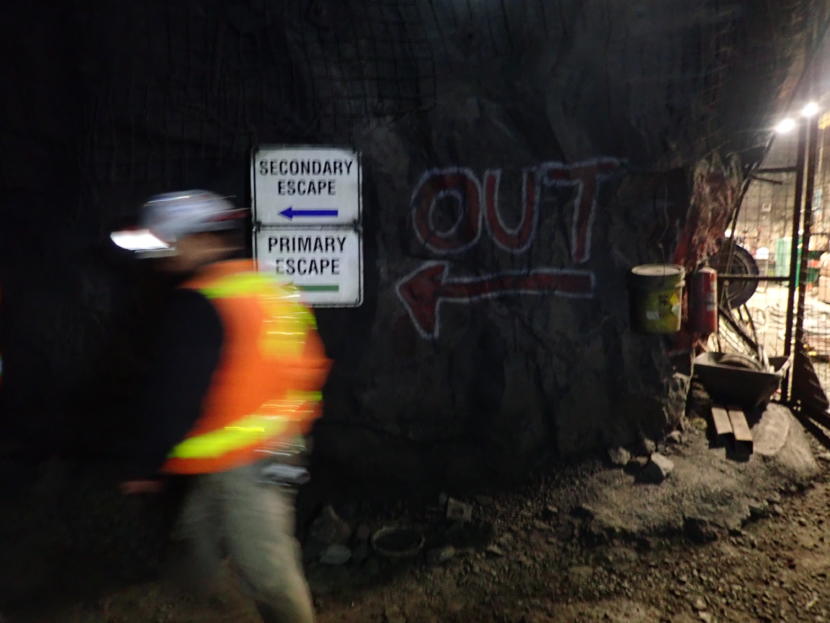
A manager walks past Kensington Gold Mine’s Elmira deposit on Oct. 15, 2019. It’s one of the areas Coeur Alaska is currently exploring. (Photo by Jacob Resneck/CoastAlaska)
Kensington Mine recently cut pay by 20% for all of its hourly employees hired before 2016, according to a memo obtained by KTOO.
The gold mine is owned by Coeur Alaska and is about 45 miles northwest of Juneau, near Berners Bay. It’s only accessible by air or water.
In the memo, which was sent in early January, the mine’s general manager Steve Ball wrote that the amount of pay that would be cut beginning on Jan. 21 was originally offered as a premium, and it was not supposed to last forever. The memo said the premium was introduced back in 2016 as “short-term financial relief.”
The memo said that, moving forward, all hourly employees would be paid the same amount for the same job, regardless of their hire date.
Kensington began commercial production in 2010. Now, with about 400 employees, the company is the second largest private employer in the City and Borough of Juneau.
The company did not answer KTOO’s questions about how many employees would be affected and what financial impact the premium has had on the mine. Rochelle Lindley, the mine’s community and government affairs manager, provided a statement from the company saying it does not comment on employee compensation matters.
According to Ball’s memo, the mine’s mill grade and overall production have dropped almost 20% over the past three years, and labor costs per employee have increased 7% in the same period. He wrote that the mine is not in a financial position to continue the premium and will struggle to remain viable long-term if it does not find ways to reduce costs.
In 2022, the U.S. Forest Service approved a controversial expansion of the mine’s operations, which extends the life of the gold mine for at least another 10 years.
If you are a Kensington Mine employee affected by the cut, you can reach reporter Clarise Larson here.
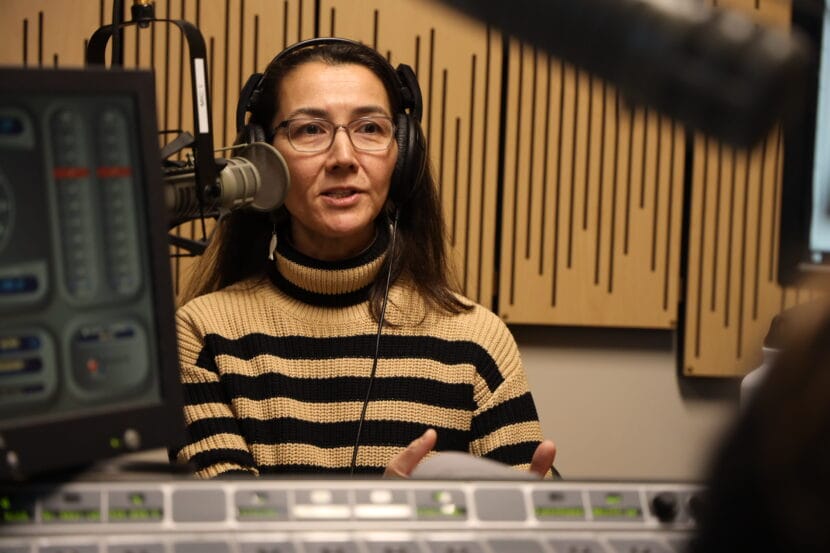
U.S. Rep. Mary Peltola in KTOO’s studio on Saturday, Jan. 27, 2024. (Katie Anastas/KTOO)
Alaska’s sole U.S. representative, Mary Peltola,visited Juneau over the weekend as part of a series of meet-and-greets she hosted across the state to kick off her reelection campaign.
Peltola, a Democrat, spoke with KTOO about her first term, why she thinks FEMA needs an overhaul, and more.
Listen:
This interview has been edited for length and clarity.
Mary Peltola: One of the things I’m very proud of is the work that my office has done in really leading the charge to convince the FTC not to approve the mega merger between Albertsons and Kroger. This really will affect every Alaskan household. Even if you’re in the bush, this will affect you. …
And of course, working on Willow. Willow is something that our leaders have been working on in Alaska for over a decade. And I am proud of the fact that I helped bring it across the finish line. I was the one who worked with the leadership in my caucus, to really insist that Joe Biden meet with us. That was not a sure thing. And it was really a coup that we were able to get a meeting with him and John Podesta and two of his other staff. And the senators and I made very compelling cases. And I do feel like I singularly did push that forward. …
One other thing I’m really proud of is the executive order that came out a few weeks ago, banning illegal Russian trawling, where they’re poaching our salmon, and marketing them through China using slave labor, Uyghur labor, driving down our prices. And that will affect fishermen in Southeast tremendously. If we can get those fish prices back up where they need to be, we can keep fishing. We can have fishing families that can continue to fish and make a profit.
Clarise Larson: The Alaska House Judiciary Committee advanced a bill earlier this month that would repeal ranked choice voting and open primaries. There’s also a group hoping to put the repeal question on the 2024 ballot. How has ranked choice voting shaped your campaigns, and what are your thoughts on these repeal attempts?
Mary Peltola: You know, a lot of people projected onto me that I was polite and didn’t slam other people because of ranked choice voting. That is like muscle memory for me. The 10 years that I worked in the legislature, that was a real take-home lesson that I learned, that you need to have 59 best friends if you want to get anything done. And I really have that just built into my habits, so that was natural. And it worked well for ranked choice voting. And I think that Americans and Alaskans want more civility and more middle-road candidates. It’s really interesting to me to hear very, very conservative people blasting ranked choice voting, because with ranked choice voting, we also elected the most conservative governor in the United States, Mike Dunleavy. … I do hope that other states look at this and see the success that it has brought, and it is not a complicated system. It’s very, very simple. And I’m very optimistic that ranked choice voting can help bring more middle of the road candidates forward who will put their names forward and work in a more collaborative way.
Clarise Larson: In Southeast and across Alaska, we’re seeing an increasing number of disasters that could be made more common or severe by climate change. What role can you play in helping Alaskans better prepare for that future?
Mary Peltola: FEMA needs a systemic overhaul. They were designed to accommodate six natural disasters a year. I believe last year, we had about 28. The size and scope of our natural disasters have compounded so much, and FEMA hasn’t really kept up with that in terms of their systems. So that is something that long-term needs to be addressed, and I’ll be happy to work on. …
We have seen in Southeast Alaska three very concerning mudslides, one in Haines, one in Sitka, and one in Wrangell. I was able to go to Wrangell and see firsthand the impact of the slide, talk to one of the victims, an amazing woman who survived the slide. I was able to talk with folks from the municipality and people who are there rescuing that night. And one of the things that we need to be working on in Alaska is really partnering with universities to get things like soil stability samples, taking a much closer look at areas that are of concern in Wrangell. The folks there on the ground said that there were multiple other sites that they would have guessed would have had a mudslide before the site that had it. So even for the folks who’ve lived there all their lives or have families who’ve lived there their whole lives, it’s really hard to tell where these mudslides might happen. And it’s really important as Alaskans for us to start getting a better ability to predict where these are and get out of harm’s way before a disaster happens.
Clarise Larson: To a lot of Americans, Congress seems pretty dysfunctional, with very little getting passed. And it seems like national politics are about as far as they could get from the kinds of bipartisan models we’ve seen in Alaska politics. Do you have any hopes left for a more productive Congress or thoughts on how that could come about?
Mary Peltola: I’m always hopeful. And I do believe that Alaska has so much to teach the rest of the nation in terms of working collaboratively and working across party lines and setting partisanship to the side to solve our problems. Nowhere else in America are you going to see a tripartisan House Minority and a tripartisan House majority, and I think that that is so reflective of Alaska.
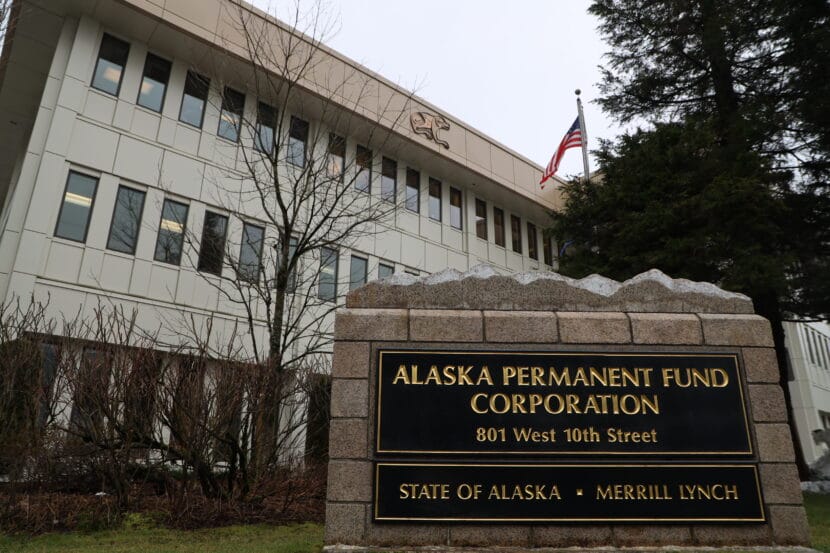
The Michael J. Burns Building, which houses the Permanent Fund offices on 10th Street, on Tuesday, Jan. 20, 2024. (Clarise Larson/KTOO)
The Juneau Assembly unanimously asked the city manager to explore moving all city staff to the building that houses the Alaska Permanent Fund Corporation on Monday.
The city has been looking for new office space since this fall, when voters rejected the city’s request to fund a new City Hall through a $27 million bond. It was the city’s second attempt to fund a new city hall through a ballot measure.
Assembly member Wade Bryson said he favors having all employees under one roof despite the higher costs of leasing space — anticipated to be around $1.6 million a year.
“Nobody likes what a lease rate is going to be but that’s what the citizens asked us to do. To lease space instead of go build new stuff,” he said. “That’s what we’re doing, let’s do it right and have everybody under the same thing.”
Right now, 60% of the city’s employees can’t fit in City Hall. They work in four separate office spaces downtown, at a total cost of nearly $900,000 per year in rent.
The Michael J. Burns Building, which houses the Permanent Fund offices on 10th Street, is one of three rental options that met the city’s criteria. City Manager Katie Koester said it appears large enough to fit all city employees — an issue city leadership pointed to during the past election.
Tracey Ricker of Ricker Real Estate, the broker representing the Alaska Permanent Fund Corp., said space will soon be opening in the building.
“One of the reasons we have more square footage to house CBJ is because one of the state agencies has verbally said that they are not going to renew their lease at mid ‘25,” she said.
Assembly member Wáahlaal Gíidaak Barbara Blake said she supports the city moving to entirely leased space because of the maintenance problems and lack of space at City Hall.
“Knowing what this building needs in order to keep it functioning safely, literally safely for employees, I think it makes sense for us to be in a space all together,” she said.
Koester said the Michael J. Burns Building also offers the option of a partial move, should the Assembly decide against a full move. She said the city could rent out City Hall if a full move occurs.
Deputy Mayor Michelle Bonnet Hale suggested selling it.
Correction: This story has been updated to reflect that Alaska Permanent Fund Corporation announced in August that it will open a satellite office in Anchorage. Also, an earlier version of this story included an incorrect spelling of Tracey Ricker’s name.
Disclosure: Tracey Ricker serves on KTOO’s board of directors.
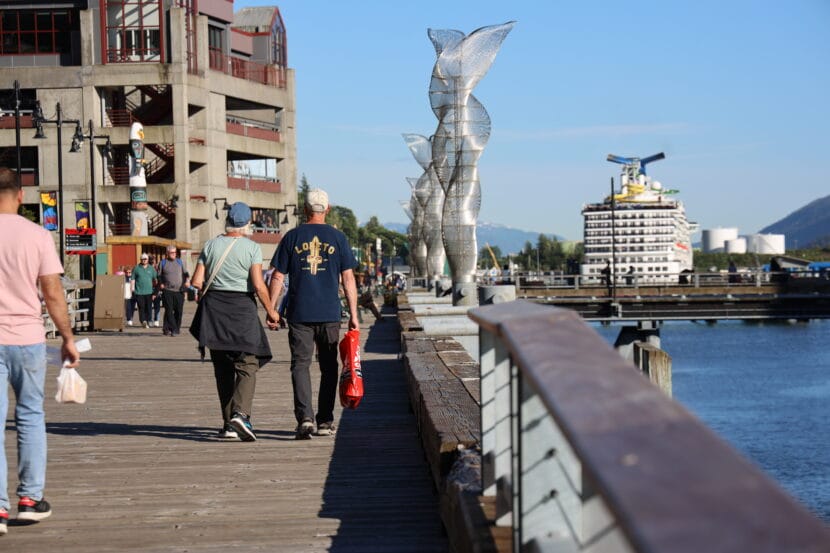
Tourists walk the docks in Juneau in July 2023. (Clarise Larson/KTOO)
Recent data shows about 250,000 pounds of trash made its way from cruise ships to Juneau’s landfill last summer. That might sound like a lot – especially considering that the landfill is only projected to last another 20 years.
Juneau Tourism Manager Alix Pierce said the reduction — which came despite record numbers of cruise passengers — is groundbreaking. It follows an agreement made by the city and cruise lines in 2022 to reduce those numbers.
“It’s over a 90% reduction, which is what we were going for with the agreements,” she said. “What we’re doing is exciting, and it takes a lot of collaboration and coordination, but we’re making real change in our community.”
Waste Management, the company that operates the landfill, said it takes in about 100 tons of trash daily — which means all of the cruise ship trash in 2023 amounted to just over a day’s worth of normal trash in Juneau.
In 2019, cruise ships dumped about 16 days’ worth of trash.
Pierce said the agreement is one step the city has taken in recent years to better manage tourism impacts. Reducing waste was one of the commitments the city’s Visitor Industry Task Force recommended back in 2020.
The agreement asks cruise lines to eliminate offloading bulky and oversized items into the landfill.
“We’ve been hearing for years that cruise ships have been dumping things like mattresses and furniture in our landfill — and that’s really problematic,” Pierce said. “We don’t want to see that in an islanded community, from a waste perspective like we have.”
According to the city’s data, the trash from cruise lines this past season came almost exclusively from two ships that continued to offload regularly. A small portion of trash came from a third ship, but Pierce said it was a “one-off” issue.
She said the city was aware of the third ship because it was ported at a public dock. But the other two ships were at a private dock.
“In a port where we have four docks, and two of them are public and two of them are private, we don’t have any real control over the private docks,” she said. “We don’t have any regulatory control, and I think that this has taught me that we need better coordination with our partners just so that we know.”
Next season, Pierce says she wants to improve communication with the private docks so the city knows of any offloading as it happens.
According to Renée Reeve, a spokesperson for Cruise Lines International Association Alaska, the organization has wanted to reduce trash left in Juneau since 2019, when it became aware of how much cruise ships were contributing to the dying landfill. She said the agency is pleased with the results.
“This is something that isn’t done in necessarily other places in the world. And it was kind of a first of its kind and I think the ability of the industry and the community to work together is extremely important as we address, you know, tough issues together,” she said.
Reeve said the trash that used to get left in Juneau is likely now going to the ports where the cruises started: Seattle, Vancouver and Victoria.
This year, Juneau’s first cruise ship will come on April 9. It will be Juneau’s first season with a limit of five large ships per day — another agreement the city negotiated with cruise lines.
Close
Update notification options
Subscribe to notifications
Subscribe
Get notifications about news related to the topics you care about. You can unsubscribe anytime.