David is currently part of the 360TV team working on major digital and content projects. Formerly he worked in the newsroom as Digital Director overseeing digital platforms.
The tsunami warning has been downgraded to an advisory. Being in or around the water is still dangerous – aftershocks and changing water levels still possible.
The #tsunami warning is canceled for the coastal areas of British Columbia and #Alaska from WA/BC border to Hinchinbrook Entrance, AK, per JTWC. A tsunami was generated but does not pose a threat to these areas. #akwx
Juneau itself appears to be safe — for now at least.
Tom Ainsworth in the Juneau office of the National Weather Service says, “For the Juneau area, it’s highly unlikely that there will be significant waves felt this far in the inner channels.”
Capital City Fire Rescue reported on their Facebook page that there is “no local evacuation ordered in Juneau.”
If you go hiking in the Juneau area, you might find some rocks that look a little different.
A national hobby of painting designs on small rocks and hiding them for others to find has made its way to Alaska.
Thousands of people are members of local rock painting Facebook groups for communities from Sitka to Fairbanks.
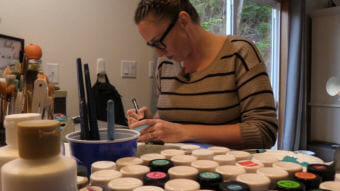
Heather Stemmerman paints a rock surrounded by her supplies (Photo by David Purdy/KTOO)
Heather Stemmerman is an amateur painter, but you won’t find her work hanging on the wall or sitting in a gallery.
She paints on small rocks, and hides them on local trails for others to find.
The rocks feature all kinds of designs – animals, scenes, abstract patterns and more.
Painted rocks by Heather Stemmerman (Photo by David Purdy/KTOO)
A rock painted with an abstract pattern by Heather Stemmerman (Photo by David Purdy/KTOO)
A rock painted like an octopus by Heather Stemmerman (Photo by David Purdy/KTOO)
A rock painted like a cat by Heather Stemmerman (Photo by David Purdy/KTOO)
A rock painted like a tiny house by Heather Stemmerman (Photo by David Purdy/KTOO)
Stemmerman likes experimenting, and it’s a relaxing way to wind down from her job in incident management with the Coast Guard.
She sometimes paints rocks with her husband and 5-year-old son, but she enjoys painting by herself as well.
“I like just getting into it, kind of testing my artistic ability, getting better and better each time,” she said. “I kind of just Zen out – it’s my little stress relief at the end of the day.”
She’s not alone.
A Juneau Facebook group featuring pictures of rocks people paint and find was started about nine months ago and has more than 1,800 members.
“I like seeing pictures of people collecting those rocks,” she said. “I get more joy in other people finding them than me finding them.”
Heather Stemmerman paints a rock surrounded by her supplies (Photo by David Purdy/KTOO)
Stemmerman lays out her supplies – dozens of paint colors, brushes and blank rocks.
She base coats each rock first and then moves on to the design.
Her paintings are often inspired by the shapes of the rocks themselves or artwork she finds online.
Her secret weapon for complicated designs? Paint pens.
Heather Stemmerman uses paint pens for the fine details on the rocks she paints (Photo by David Purdy/KTOO)
Heather Stemmerman uses a paint pen to create a design on a rock in Juneau. (Photo by David Purdy/KTOO)
A rock painted with an abstract pattern by Heather Stemmerman (Photo by David Purdy/KTOO)
The last step is protecting each rock with a coat of clear sealant when she’s happy with the design.
Sometimes it takes a couple of tries to get there.
“I’ve definitely covered over some of these if they’re not good,” she said. “I’ll just paint right over it and try again.”
The Forest Service approves of the hobby — with some caveats. They suggest environmentally friendly paints and keeping the rocks small enough to be easily moved if necessary.
“We’re glad that residents and vendors alike come up with creative ways to enjoy their national forest,” said Forest Service spokesman Paul Robbins Jr. “We just ask that they take some time and consider the effects they may have on that ecosystem as well as other people’s enjoyment of the forest.”
If you catch an unexpected splash of color on a local trail, take a closer look – you might just have found a rock by Stemmerman or another local rock painter.
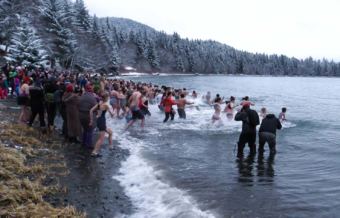
At 1 p.m. New Year’s Day, a group of brave souls continued the Juneau tradition of plunging into the icy cold water at Auke Recreation Picnic Area. The plunge didn’t last long — most swimmers returned to shore and warmed up as quickly as possible.
Swimmers plunge into the water at the 2018 New Year’s Day Polar Bear Plunge at Auke Rec (Photo by David Purdy/KTOO)
Swimmers wait before the 2018 New Year’s Day Polar Bear Plunge at Auke Rec (Photo by David Purdy/KTOO)
Swimmers return to shore in the 2018 New Year’s Day Polar Bear Plunge at Auke Rec (Photo by David Purdy/KTOO)
The sign for the 2018 New Year’s Day Polar Bear Plunge at Auke Rec (Photo by David Purdy/KTOO)
Swimmers warm up after the 2018 New Year’s Day Polar Bear Plunge at Auke Rec (Photo by David Purdy/KTOO)
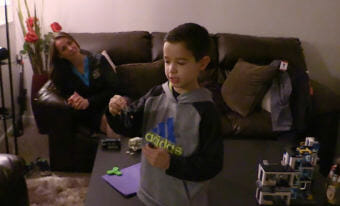
Tristan Ridgeway tells a story while his mom, Chloe Abbott, watches. (Video still by David Purdy/KTOO)
Working parents looking for child care can find themselves without many options in Juneau. Like a lot of things in Alaska, it’s expensive — sometimes costing more than $1,000 a month.
Chloe Abbott and her son, Tristan Ridgeway, have seen the lack of child care first hand.
The energetic 9-year-old likes building things and telling stories. His mom hasn’t had an easy time finding a good fit for him in the child care environment.
Two and a half years ago, Abbott was building a career with the state when Tristan came home one day.
“He said he was getting hurt at day care, by one of the providers,” she said.
Confronted with a decision, she filed a complaint with the state. A few months later, the day care center shut down, citing financial reasons.
When Abbott went to look for a new day care for Tristan, she only found one. That provider spoke almost exclusively Spanish.
She didn’t feel comfortable with the language barrier, so she left her career and found a job where she could bring her son along – cleaning apartments during the week. She also was able to work as a server on the weekends when Tristan was with his father.
But it wasn’t enough.
“Even between those two part-time jobs,” she said, “still that didn’t make up for the break I took in pay.”
Without other child care options for Tristan, Abbott’s work and finances took a hit.
“I lost my retirement,” she said, “because I needed something to make up for – I had a car payment, I had rent, bills, get food, you know, lights. All those things are really expensive here in Juneau.”
A challenge for Juneau
Many parents struggle to find child care in a city with more kids than available slots.
For every licensed child care slot in Juneau, there are almost 3.5 children under 6 without a stay-at-home parent, according to a 2016 report, commissioned by the Association for the Education of Young Children, which helped fund this reporting project.
Even when it is available, child care isn’t necessarily affordable.
Brian Holst has thought a lot about the role of education in the economy in his positions as president of the Juneau Economic Development Council and a member of the school board. (Video still by David Purdy/KTOO)
“Parents are faced with this dilemma of, ‘Well, I can get a job, but it will cost me almost all my earnings to pay for child care for my child’,” said Brian Holst, the president of the Juneau Economic Development Council and a school board member.
He said some people opt to stay out of the workforce altogether. According Holst, making child care available to more parents could help fill lower paid jobs and make Juneau more attractive to workers with in-demand skills.
“There’s work for people to take if we had opportunities for them to enter the work force,” Holst said.
Recently, there have been a few efforts to boost child care in Juneau.
In 2015, the Assembly voted to relax zoning rules to make it easier to start in-home child care facilities in residential neighborhoods. And there are training and startup resources for new providers.
The business of child care
But in the end, like any business, it comes down to money.
One reason the city doesn’t have enough child care is that providers are getting squeezed financially as well.
Kueni Maake, who has provided child care at ABC Center in Juneau for 25 years, understands the financial pressure.
Like many providers she said she could probably charge more, but she’s reluctant to raise prices when she thinks about the parents and families relying on her.
“I think that’s my downfall as a businesswoman,” she said. “I go with my own emotion a lot of time when I do the rate. I do not go with the market rate.”
But prices that are too low can ultimately mean fewer slots for kids that need them.
Many child care centers lack the income to grow, and some aren’t even able to cover costs and end up closing altogether.
Chloe Abbott and her son, Tristan Ridgeway. (Video still by David Purdy/KTOO)
Abbott never did find child care for her son. She stuck it out until Tristan was in school full time and able to be a little more independent.
“Now that he is old enough to spend a little time on his own I can still work full time,” she said. “But it took quite a while for us to get where we’re at right now, and me to get back to the career I want to be in.”
Earlier this year, a volunteer group lobbied the Juneau Assembly to spend sales tax money to subsidize early childhood education, but that proposal lost out to a host of infrastructure and maintenance projects.
Some kids need extra help learning what’s expected of them in a work place.
Juneau Parks and Recreation and Southeast Alaska Independent Living have a summer program that gets them outside and teaches them interpersonal skills they’ll need.
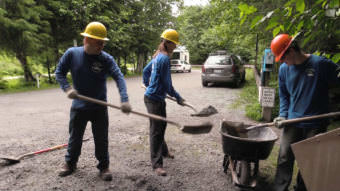
C. Allen Truitt, who coordinates the Youth Employment in Parks program, drives a bus packed with six teenagers from Zach Gordon Youth Center.
The back is filled with shovels, rakes and wheelbarrows.
“We do things like work on our city trails and in our city parks,” he said. “From creating new trails to repairing old trails to landscaping work – so they really get that rounded, first job experience.”
Minutes later, at a North Douglas trailhead, Truitt is loading wheelbarrows full of gravel alongside the youth. At the end of the trail, Nicklaus Doogan is waiting with a rake to spread the gravel.
Doogan, who’s now 16, is no stranger to a part-time job – his family owns a deli downtown, where he regularly works behind the counter and moving freight.
“I like working indoors and all, but outside suits me better,” he said. “If I’m inside, like, I’m doing nothing at all. It feels like I’m just at my parents’ store doing nothing, just using the cash register or taking orders.”
His parents encouraged him to branch out last summer.
“My family was right,” he said, “I need to get outside, get a job, meet some new friends I don’t know, get along with them. And it went pretty well.”
Supervisor Mallory Story said that working with other people is one of the things the program is all about.
“We’ve really focused on communication with everyone you’re working with, with your supervisor, with other co-workers,” she said. “As well as how to deal with frustration because it’s a different environment than being in school or being with your family.”
Story also works with the students one day a week in the summer focusing on team building or soft job skills like interviewing or building a resume.
Truitt agrees it’s about a lot more than trails.
“I don’t care if they never operate a shovel for the rest of their lives,” he said. “I care that they know they can do something with themselves, that they know that they can do things, and that they have a future.”
As the day goes on, the work settles into a routine and the students keep an eye on their progress. If not today, they hope that by tomorrow the trail will be finished and they can look back on what they’ve accomplished.
Quinton Chandler in Juneau contributed to this report.
This reporting was made possible by a grant from WNET’s American Graduate project. Television coverage of American Graduate Day 2017 begins at noon Saturday, Oct. 14, 2017 on 360 North.
On Monday, a radio engineer in Juneau loaded four nondescript black cases into a truck and drove it to air cargo.
It was one of three emergency radio broadcasting kits of its kind, designed in Southeast Alaska. On Thursday, it arrived in Puerto Rico, where Hurricane Maria wrecked communications infrastructure.
Rich Parker helps keep Southeast Alaska public radio stations on the air (including KTOO).
Part of his job as an engineer working on broadcasting infrastructure means maintaining the emergency radio kits – and he prepped Juneau’s for the Puerto Rico Public Broadcasting Corporation.
The emergency broadcasting kit has everything an engineer needs to set up a small radio station in less than a half-hour. Sitka and Ketchikan have similar systems.
“This is what’s called a Radio to Go,” he said. “It’s a kit with studio components: mast with an antenna, a small transmitter and mic and other equipment you need to set up an emergency studio.”
The kit has flexible power options. The audio equipment can be powered by a vehicle using an inverter, and the transmitter can even operate at reduced power by wiring together car batteries.
CoastAlaska built the kit. The organization pools business, overhead and staff among a group of Alaska public radio stations, including KTOO.
Mollie Kabler, the executive director of CoastAlaska, said the Corporation for Public Broadcasting had heard about the kit and contacted her.
“Since it’s a custom built piece of equipment, I didn’t have anywhere to send them to get one,” she said, “but I said ‘we’ll send it.’”
An engineer from public radio station WNYC met the kit in New York and took to WIPR in Puerto Rico. The kit will help the station stay on the air during the hurricane recovery.
Close
Update notification options
Subscribe to notifications
Subscribe
Get notifications about news related to the topics you care about. You can unsubscribe anytime.