David Purdy

Creative Services Director, KTOO

David is currently part of the 360TV team working on major digital and content projects. Formerly he worked in the newsroom as Digital Director overseeing digital platforms.
Students connect with tradition and language at Hoonah culture camp

When young people face challenges in life, adults and educators can struggle with how to help.

Over the summer, students in Hoonah attended a culture camp that seeks to address some of these problems by connecting students with Alaska Native traditions.
The Haa Tóo Yéi Yatee culture camp is almost an hour drive from Hoonah.

Over the summer, about 35 students made the trip down a narrow, unpaved logging road to immerse themselves in Native art, food and language for four days.

The isolated location is intentional.

“We came out as far as we could to make sure that we didn’t have cell phone reception, and that the only connections that we had were with each other,” Heather Powell said.

Students gather beach asparagus at the Haa Tóo Yéi Yatee culture camp near Hoonah (Photo by David Purdy/KTOO)

Powell works for Hoonah City Schools, and she created this camp with support from many others in the community, partly to help students confront some of the biggest challenges in their lives.

“We have young people in our community that are facing depression, addiction, suicide,” she said. “Things can ail not only your physical well-being, but your spirit.”

She hopes a traditional mindset will lead to a more holistic approach.

“In these non-Native ways of doing, we acknowledge and then we diagnose just that thing, and we deal with just that thing, she said. “But a long time ago we worked with the entire person, the entire family. Because none of us has the strength to do everything.”

The activities at the camp are deeply rooted in history.

Inside a cabin, students gathered around a table to cut, file and hammer copper sheets into small tináas. Almost everyone was wearing one of the traditional copper shields around their neck by the end of the camp.

Outside, a group of students spread out along the water to gather beach asparagus during low tide.

Later, they prepared it for canning, along with salmon fresh from the smoke house.

Heather Powell shows students the proper technique for canning smoked fish at the Haa Tóo Yéi Yatee culture camp near Hoonah (Photo by David Purdy/KTOO)

Powell hopes that this will be an opportunity for students to practice speaking Tlingit, and she moves seamlessly in and out of the language. She

believes that integrating Tlingit into everyday education will help revitalize the language and connect students to tradition.

The students also made their own cultural contribution together.

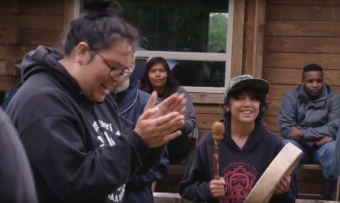
Besides playing music they already knew, Powell and others lead the students in creating their own original song.

Ultimately, her vision goes beyond specific skills and activities to something much more fundamental.

“Teaching traditional ecological knowledge and teaching place-based learning are all the … all the rage these days,” she said. “But for us, this is survival. This is who we are. We have done things for time immemorial because it calls to us. This is our food, this is our responsibility, this is our passion.”

Powell said she plans to offer more camps in the Hoonah area focusing on different cultural activities.

Quinton Chandler in Juneau contributed to this report.


This reporting was made possible by a grant from WNET’s American Graduate project. Television coverage of American Graduate Day 2017 begins at noon Saturday, Oct. 14, 2017 on 360 North.

Mentors help family struggling with illness

Major illness is always stressful, but for families with young children, struggling with health challenges can be especially difficult.

Derrick Price just started sixth grade, and like a lot of middle schoolers, he spends time on his phone and loves to talk about video games. But he’s also had to take on more than many kids his age – his mother, Courtney Price, has cancer.

Courtney Price (Screenshot from video by Rashah McChesney/Alaska’s Energy Desk)

“Derrick has helped just really being there for me if I needed anything,” she said. “But it’s also a stressor on him.”

Derrick enrolled in the Big Brothers Big Sisters program, which provides children facing adversity with professionally supported adult mentoring relationships. About 70 kids participate in Juneau, and 15 more are on the wait list. Derrick was matched with a Big Couple: Teri Rasmussen and John Parent.

At a Saturday afternoon barbecue at their house, Derrick put away his phone to jump between logs and poke at the fire pit.

“You know, I think if it was natural inclination, he would stay inside and play his video games all the time, so we try and do things outside,” Parent said.

He said they have tried to introduce Derrick to more outdoor activities like skiing.

The couple estimates they’ve been volunteering with Big Brothers Big Sisters for about 10 years.

“We really have enjoyed the program,” Rasmussen said. “So we’ve stuck with it. Our first little turned 18, so the match ended at 18 and then we immediately asked for another one and have just kept with it.”

Rasmussen enjoys Derrick’s energy and enthusiasm, but she also likes seeing the impact they have.

“I think it’s really important to just provide that support for the kids,” she said, “and give them an additional set of people that care about them and are interested in them and are part of the overall family that’s helping them, you know, make their way through life.”

Price thinks Derrick’s time with his Big Couple has made her son more open to new experiences.

“I think it kind of helped push him a little bit to try new things,” she said. “After John and Teri came into his life, he was more willing to try.”

With his mother’s illness and her time out of town for treatment, Derrick is glad to spend time with his Big Couple.

“I’m like, kind of worried about my mom when she’s gone,” he said, “but I’m more happy when I’m here with John and Teri.”

Price can see the difference the visits make.

“He gets to take a break with John and Teri from his everyday life,” she said, “and comes home a little bit more at ease and ready to go.”

She is grateful for the opportunity for Derrick to get away from things for a while and also for the positive role models his Big Couple give him.

Quinton Chandler in Juneau contributed to this report.


This reporting was made possible by a grant from WNET’s American Graduate project. Television coverage of American Graduate Day 2017 begins at noon Saturday, Oct. 14, 2017, on 360 North.

Juneau’s Housing First project takes shape

The Housing First facility under construction. (Photo by David Purdy/KTOO)

Juneau is getting a new kind of apartment building. The Housing First Project in Lemon Creek is built to provide safe, affordable housing to the city’s most vulnerable homeless individuals.

The outside of the building looks mostly finished, but inside the apartments are still bare plywood and studs. Each of the 32 efficiency apartments is small – about as big as a row of three parking spaces. Each one will have its own private bathroom and a small kitchen area.

Workers broke ground for the facility in May, but the concept has been in progress for over four years.  Almost a dozen organizations and agencies have been involved. The Glory Hole, Juneau’s downtown homeless shelter, is managing the project. Mariya Lovishchuk is the executive director of the Glory Hole.

“I am just so excited to be standing in this building right now and, like, actually have a floor and walls and windows and not just, like, an idea in my head,” said Lovishchuk. “That’s really, really awesome. And also I can’t wait — like, I can’t wait to see people in here.”

Lovishchuk said the future residents will be the most at-risk chronically homeless individuals in Juneau, as measured by a vulnerability survey. Lovishchuk said this building will be a place for people to live who have had trouble with other housing programs.

“They end up getting evicted because there are rules about drinking,” she said, “And people are not able to follow those rules and so they get evicted because of that, or people have to participate in treatment and people fail out of that housing because treatment has not worked for them even though they’ve tried, like many of our clients have been to treatment programs, you know 20 times in their lives with no success.”

The Housing First approach does not require treatment or sobriety as a condition of housing. Services and treatment for residents will be available in the building, and will include medical exam rooms and a space for mental health counseling.

Supporters of housing first say that having a stable place to live makes it easier to address the underlying causes of homelessness.

The transition to housing can be rocky for people who have been homeless for a long time. The Housing First facility in Anchorage, Karluk Manor, has found it challenging to track down people on the waiting list and help them adjust to the housing facility. They have placed restrictions on visitors and certain types of alcohol.

The Juneau Housing First Project still needs about a million dollars, which it plans to raise with capital grants and local support through the Juneau Community Foundation.

Lovishchuk expects that facility will be completed in May and the first residents will be able to move in by early summer.

Voters renew Juneau sales tax, add extra 3% for marijuana

grocery checkout
(Creative Commons photo by Laura Thorne)

Shoppers in Juneau will continue to pay the same sales tax rates, for now. Local voters chose to renew the city’s 3 percent temporary sales tax through Proposition 2 in Tuesday night’s municipal election by a 3-1 margin, but shot down another question that asked to make it permanent.

Voters have renewed the temporary sales tax every four or five years since 1983, according to the city’s voter information pamphlet. City Manager Rorie Watt says it brings in about $25 million every year.

“So we use the sales tax for police, fire, road maintenance, libraries, parks and rec, city manager, everything,” Watt said.

The temporary sales tax is set to expire in 2022 if it’s not renewed again. The 3 percent is part of the city’s overall sales tax rate of 5 percent; there’s also a permanent 1 percent tax and another temporary 1 percent that is used for special projects, such as the Mendenhall Valley Library, building maintenance and sewer expansion. The 1 percent temporary tax is set to expire in 2018.

Voters also overwhelmingly backed a special 3 percent sales tax on marijuana products through Proposition 1. This brings the total marijuana tax to 8 percent — the same rate as alcohol. City staff forecast that the 3 percent increase will bring in an extra $65,000 to $175,000 a year. The money will go into the city’s general fund.

Slideshow: Alaska’s new Coast Guard commander

About 2,500 Coast Guardsmen in Alaska have a new commanding officer.

Rear Adm. Daniel Abel handed over command of the 17th District on Wednesday to Rear Adm. Michael McAllister.

A change of command ceremony is traditionally held every two years for Coast Guard officers leading the district.

Here is the Coast Guard’s biography of the new commander.

Photo gallery: 2016 Juneau Maritime Festival

The annual Juneau Maritime Festival was held Saturday, May 7 at Marine Park. Events included a search and rescue demonstration by the Coast Guard, exhibits, a tote race and a regatta. Governor Bill Walker also signed HB 128 “establishing August 10 of each year as Alaska Wild Salmon Day.”

(Click any picture for a slideshow view)

Site notifications
Update notification options
Subscribe to notifications