
David Purdy

Creative Services Director, KTOO

David is currently part of the 360TV team working on major digital and content projects. Formerly he worked in the newsroom as Digital Director overseeing digital platforms.
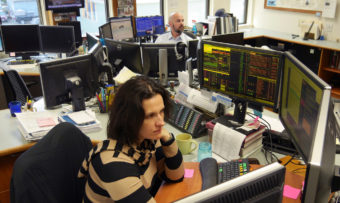
Inside the Alaska Permanent Fund Corp.

Alaska Permanent Fund Corp. employees use up to six computer screens each to monitor all things economic. Here, Fixed Income Portfolio Manager Maria (Masha) Skuratovskaya studies her screens. Jim Parise, director of investments is in the background, March 14, 2016. (Photo by Skip Gray/360 North)
Alaska Permanent Fund Corp. employees use up to six computer screens each to monitor all things economic. (Photo by Skip Gray/360 North)

The Permanent Fund Dividend is in the news a lot, but where does the money come from? The Alaska Permanent Fund Corp. manages the $52 billion fund, and its investment earnings determine the size of the dividend.

So what is it like to manage this much money? Jim Parise is the director of fixed income for the corporation, and from his office in Juneau he manages about $10 billion of Alaska’s money. He’s one of just 18 people managing investments at the fund.

Jim Parise, director of investments, at his desk in the Alaska Permanent Fund Corp., March 14, 2016. (Photo by Skip Gray/360 North)
Jim Parise, director of fixed income. (Photo by Skip Gray/360 North)

“We all are managing billions each, but we think of it as units,” he said. “If you think of it as actual money, you’d go crazy.”

For perspective, the fund is worth every piece of taxable property in Juneau a dozen times over, according to the Juneau Assessor’s office, which had just over $4 billion of taxable property on the books for 2015.

Even with billions of dollars on the line, Parise seems to take it all in stride. He talks calmly about staying the course in the face of market downturns. During the early days of the Great Recession, the fund was literally losing millions of dollars a day.

“2008 was really, really tough,” he said, “because no matter what you did you were getting hurt … we were down quite a bit, but that’s when you’re really tested to see whether or not your philosophy and the way that you manage and your discipline — the way that you manage money works.”

Parise says they had to trust their convictions and analysis to make some decisions that felt counterintuitive at the time.

“We did a lot of analysis and we had some pretty high conviction bets on at the time that proved to be true,” he said.

Even with billions of dollars on the line, Parise says the investment team manages to stay calm no matter how the market is doing.

“Whether it’s going well or going poorly – it pretty much looks the same. It’s just a steady group of people that have been doing it a long time and know what they’re doing.”

Part of staying on top of those ups and downs is being in close communication with traders in New York. That means coming to work at 5 a.m. so he’s around for the start of the day on the East Coast.

“That’s when an issuer like Microsoft may decide to bring a bond deal,” he said. “They do it first thing in the morning. And so we have to be here to be able to say we’d like some of those bonds or not. … If we came in too much later then we would miss out on those opportunities.”

Fixed Income Portfolio Manager Maria (Masha) Skuratovskaya studies her screens at the Alaska Permanent Fund Corp., March 14, 2016. (Photo by Skip Gray/360 North)
Fixed Income Portfolio Manager Maria (Masha) Skuratovskaya studies her screens. (Photo by Skip Gray/360 North)

When he’s not on the phone with New York, a lot of Parise’s day is spent on trading, research, watching the markets and analyzing the fund’s portfolio. Most of the trading is done on the computer these days, but sometimes it still comes down to a negotiation on the phone, when all that research pays off.

“The trader wants to buy them at a certain price, I want to sell them at a certain price,” he said. “And we have to agree on a price, so we go back and forth. It’s not just a guess – we have, they have very good data, we have very good data, and we use it against each other to try and figure out what the best price is.”

Parise says he often knows when to buy or sell a corporate bond based on how it compares to a “natural” price level that their analysis predicts it will return to. So if the demand – and the price – dips below this natural level, he might take the opportunity to buy on the cheap, counting on the price to rebound later. Or he might sell a bond that goes above this level before it comes back down.

This strategy requires patience, and in general the fund relies on taking a long-term approach.

Alaska Permanent Fund Executive Director Angela Rodell at the corporate office, March 14, 2016. (Photo by Skip Gray/360 North)
Alaska Permanent Fund Executive Director Angela Rodell at the corporate office. (Photo by Skip Gray/360 North)

“The nice thing for the fund is we have an infinite time horizon,” said Executive Director Angela Rodell. “So we can make 5-, 8-, 10-year investments, knowing we don’t need to see the returns on that, or realize the returns on that in the next year.”

That kind of long-term outlook could come with some tradeoffs.

Gregg Erickson owns an economic consulting firm, Erickson & Associates. He says that there may be a disconnect between long-term results and who’s responsible for them.

“The problem with that in my view is that the Permanent Fund is a political organization that’s run on behalf of the people of Alaska,” he said. “And how are the people of Alaska able to judge whether they’ve done well or not if their time horizon is 15 years? By the time 15 years rolls around and you can prove — or 10 years, and you can prove that they’ve done either poorly or well, the people who were responsible for that are long gone.”

The governor appoints the members to board trustees that lead the Permanent Fund Corporation.

Erickson says evaluating the fund’s performance is also difficult because it’s unique – there just aren’t that many multibillion dollar funds with similar goals that you can use for comparison. One possibility is the Public Employees’ Retirement System and the Teachers’ Retirement System, or PERS and TRS.

PERS and TRS have slightly higher returns over time – 6.7 percent compared to 6.4 percent for the Permanent Fund when you look at annualized total returns for the past 10 years. It’s important to remember that there are different goals at play, which means different investment strategies: PERS and TRS have to bring in a certain amount of money to cover retirement benefits, while the Permanent Fund Corp. places a higher priority on preserving the value of the fund.

Ultimately, Parise says he has faith in his colleagues at the Permanent Fund.

“Everybody here is very, very passionate about what they do,” he said. “And they’ve dedicated themselves to it, and I think that Alaskans should take comfort in the fact that there’s people here that really care about the Permanent Fund, they care about Alaska, and they care about managing money.”

Ready, aim, fire! Lawmakers, aides and staff compete for best shot

Every year, legislators take a break from their work at the Capitol and head to the gun range. Lawmakers, their staff, and members of the Alaska Correctional Officers Association recently participated in the 19th Annual Legislative Team Shoot at the Juneau Gun Club and Juneau Hunter Education Shooting Complex.

“It is an event that brings together the House, the Senate, the corrections officers, and it just brings some awareness to shooting sports,” said Wasilla Rep. Cathy Tilton, who participates in the legislative shoot every year.

Participants in the archery event during the 19th Annual Legislative Team Shoot. (Photo by David Purdy/KTOO)
Participants fire arrows in the archery event during the 19th Annual Legislative Team Shoot. (Photo by David Purdy/KTOO)

Participants compete in teams of three, moving at their own pace between four events — archery, handguns, rifles and trap shooting. Instructors are available at each station for those who need a refresher, something Tilton is grateful for when it comes to archery.
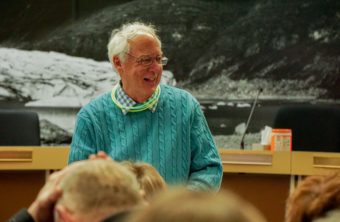
“My experience with archery is not nearly as good as my experience with shooting,” she said.

The instructor demonstrates proper form and soon the arrows are flying, most of them into the target.

After the shots are scored and the arrows collected, the team moves on. Next up, Tilton moves on to the handgun range, where she picks out a .40-caliber Glock.

“I feel pretty good about the pistol event,” she said as she waited for her turn on the pistol range. “I’ve been practicing my pistol shooting at another range whenever I have had time, and hopefully, I’ll do OK. This target’s a little small, so it’s gonna take a little bit of skill.”

A target for the pistol event (Photo by David Purdy/KTOO)

The target does look small and it looks even smaller when it’s hung up about 50 feet down the pistol range. After two minutes to prepare, Tilton loads her gun. Her long, manicured fingernails make it a little difficult to load cartridges into the magazine.

Out of five shots, three hit the paper but only one in the target area.

After handguns, Tilton moves on to the outdoor range, where she competes with a .22-caliber rifle and, finally, trap shooting with a shotgun. At the end of the day, she says it’s about more than competing or hitting the target.

“As you know, when we’re in the legislature we can have differences of opinion on policy and things like that,” she said. “But it’s always good to get together, to have some camaraderie with each other and just do something where you’re just let your hair down and (are) able to communicate with each other — doing something that’s not in stressful situation.”

As for the competition, Tilton says improvement is the key – she’s happy to report that her team did better than they did last year.

Ken Koelsch wins Juneau mayor’s seat

Juneau Mayor-elect Ken Koelsch addresses his supporters on election night at City Hall, March 15, 2015.
Juneau Mayor-elect Ken Koelsch addresses his supporters on election night at City Hall. (Photo by Jeremy Hsieh/KTOO)

Ken Koelsch will be Juneau’s new mayor.

Unofficial results from Tuesday’s special election show Juneau voters backed Koelsch with 59 percent of the vote. Koelsch read from a prepared statement before addressing his supporters:

“Thank you, Juneau, for your confidence, your turnout, caring about our future. A learning experience to run for mayor. Thank you to my wife, our family, and all the contributors and volunteers who feel like family. Thank you to Karen Crane and her supporters. This has been a good race with people involved on both sides because they care deeply about Juneau. I feel positive about our future. My goal is to unite us as a community. I will work hard for you with honor and with integrity. We have our work cut out for us, so let’s unite.”

Koelsch is expected to be sworn in on April 4, after election results are certified.
Juneau Assemblymember Kate Troll (left) and mayoral candidate Karen Crane watch election numbers come in at City Hall on election night, March 15, 2016.
Juneau Assemblymember Kate Troll, left, and mayoral candidate Karen Crane watch election numbers come in at City Hall on election night. (Photo by Jeremy Hsieh/KTOO)

Karen Crane, who received 40 percent of the vote, was on the Juneau Assembly until she resigned earlier this year to run for mayor.

“Well, we ran a good campaign,” she said. “I want to thank all my volunteers. I had a great team working with me. We had a very positive campaign – we stayed positive throughout. Lot of effort went into this. And I really appreciate all the help and support I’ve had, um, over the entire campaign.”

As of election night, election officials reported 1,520 absentee ballots that are expected to be counted by Friday.

The election resolves a months-long game of musical chairs on the assembly. Assemblymember Mary Becker had been serving as mayor since Mayor Greg Fisk’s death in November. She will return to her regular assembly seat.

That puts out Barbara Sheinberg, who was appointed to temporarily fill Mary Becker’s seat pending this election.

In Juneau’s form of government, the mayor is a largely ceremonial position. In assembly business, the mayor’s vote carries that same weight as the other eight members. Municipal employees answer to the city manager, who answers to the assembly.

The mayor earns $2,500 a month. The term ends in October 2018.

Video: Gastineau Apartments demolished

City officials plan to file a complaint in court this week as a first step toward getting a lien on the newly cleared Gastineau Apartments property in downtown Juneau.
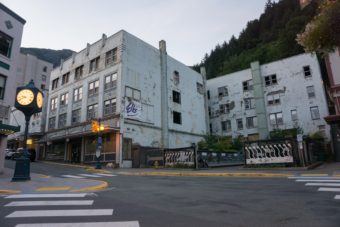
According to Municipal Attorney Amy Mead, a lien on the property would entitle the city to recover the cost of demolition from any sale of the property. The selling price could be significantly less than the demolition cost — the land was appraised for just over $810,000 a few years ago, but the demolition cost almost $1.4 million. To make up the difference, the city could choose to work with current or future owners on alternatives such as providing public parking spaces.

Public Works Director Rorie Watt says the demolition has gone smoothly.

“It was a difficult project in terms of trying to plan and do it in a way that was least impactful to downtown,” he said. “The buildings came down a lot easier than we thought they would, and the reason they did was that there was a lot less steel in the concrete. And so that was both good that they came down easier, but it was also scary because they came down faster.”

Besides the land previously occupied by the apartments, the demolition also included Gunakadeit Park. Watt says it’s possible the land could be turned back into a park, but the city is also open to including it in future development.

“Depending on who ends up with the Gastineau Apartments property – whether the current owner or somebody else – if there was a development proposal that made use of the park property and created the possibility for commercial and/or residential building, I think we would be really excited about that. It’s kind of a key piece of property and I think it needs to be put to its highest and best use.”

A fire rendered the century-old Gastineau Apartments uninhabitable in November 2012. Last year, the city determined it was unreasonable to repair and ordered their demolition. The owner failed to comply, so the city hired a contractor who demolished the building over the past few weeks.

Gastineau Apartments Timeline

Moccasins take over social media for ‘Rock Your Mocs’ 2015

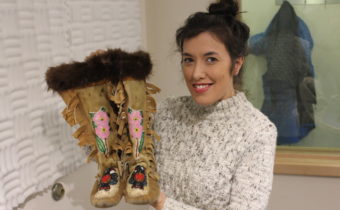
Crystal Nelson holds up a pair of moccasins passed down to her from her grandmother (Photo by David Purdy/KTOO)
Crystal Nelson holds up a pair of moccasins passed down to her from her grandmother. (Photo by David Purdy/KTOO)

November is Native American Heritage Month, and people across the world are celebrating on social media with an online event called Rock Your Mocs.

Now in its fifth year, the event encourages indigenous people everywhere to post pictures of themselves wearing moccasins. Social networks are full of people sporting an array of moccasins of all shapes, sizes and colors.


Crystal Nelson in Juneau posted a picture of her moccasins to the group’s Facebook page this year. For her, they represent a common symbol for Native people no matter where they are.

“I think moccasins are such an iconic image for indigenous people on this continent and they look different from different regions, but we all have a version and it’s probably one of the easiest things we can use to represent us all, ‘cause we can just slip them on and go about our day,” she said.

Her moccasins have intricate bead work and fur, but their significance goes far beyond their aesthetic  appeal – they make a statement.

Two pairs of moccasins Crystal Nelson has worn for Rock Your Mocs 2015 (Photo by David Purdy/KTOO)
Two pairs of moccasins Crystal Nelson has worn for Rock Your Mocs 2015. (Photo by David Purdy/KTOO)

“It’s about family, it’s about heritage, it’s about solidarity,” she said. “To make people remember, we are still here and we still hold the parts of us that they could never take away.”

Each pair has a special meaning for her and a story that goes with them. The most significant to her are a pair that has been in her family for generations. When her aunt gave them to her as a graduation gift, she was overwhelmed.

“I was like ‘oh my god, you’re giving these to me?’ And she said, yeah, your grandmother put a lot miles on those, and then your mom put a lot of miles on those and now they’re for you to dance in because I know that you’ll use them and I know you’ll take care of them.”

Crystal uses these moccasins for dance performances, but for other occasions and every day wear, she has other pairs as well – each with their own story.

Juneau Makerspace moves into community workspace

For those who love to make things and tinker, finding the right tools and work space can be difficult and expensive.

In recent years, many people have been turning to community workshops known as “makerspaces.” Members of these organizations have access to a shared workspace and tools for their own personal projects — anything from artwork to prototyping new products.

Now, the fledgling Juneau Makerspace is bringing this movement to the capital city.

About a year ago, founder Sam Bornstein started the nonprofit as a place for like-minded creators to “come and build their dreams.” Although he currently works in finance, his passion for engineering inspired him to start the organization in his spare time.

“Anyone who wants to create or make or design anything is our goal,” he said. “We want to be able to get the widest net possible and be available for any type of project that you have that you want to work on.”

He and some volunteers are still clearing out the group’s new facility in Lemon Creek. When they moved in over the summer, it was filled wall to wall with ceramic molds from the previous occupants.

It’s mostly cleared now, with room for some tables and the latest addition — a donated 3D printer. Inside a big glass and metal box, the moving print nozzle lays down melted plastic in a precise pattern. As the plastic cools, more layers are added to form small objects based on a digital model.

The printer requires precise calibration. Bornstein is still getting familiar with all the different controls and adjustments.

“It sat in someone’s garage until yesterday. And they brought it over here and gave it to us and said ‘Good luck,’” he said.

Once it’s adjusted, the print head moves back and forth, laying down layers of plastic. The outline of the base emerges in a couple of minutes, but Bornstein estimates it will take 7 to 12 hours for the printer to build up the finished vase, layer by layer.

Bornstein plans to eventually teach others in Juneau to use the printer for their own projects. Juneau Makerspace is planning a Kickstarter campaign to pay for more tools and equipment, and Bornstein hopes that people with many different skills will gather to share their knowledge and experience.

“I’m hoping we can build a community of makers here,” he said. “We’ve got artists and teachers and designers all coming together and I’m hoping that we can all learn from each other.”

Soon, they’ll announce membership plans for those interested in gaining access to the space and its resources. Updates and more information are available on Facebook.

Site notifications
Update notification options
Subscribe to notifications