American Graduate

Youth Employment in Parks program offers students real world job experience

Some kids need extra help learning what’s expected of them in a work place.

Juneau Parks and Recreation and Southeast Alaska Independent Living have a summer program that gets them outside and teaches them interpersonal skills they’ll need.

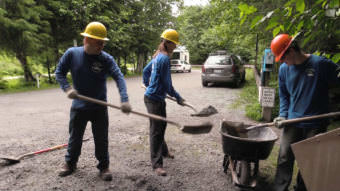
C. Allen Truitt, who coordinates the Youth Employment in Parks program, drives a bus packed with six teenagers from Zach Gordon Youth Center.

The back is filled with shovels, rakes and wheelbarrows.

“We do things like work on our city trails and in our city parks,” he said. “From creating new trails to repairing old trails to landscaping work – so they really get that rounded, first job experience.”

Minutes later, at a North Douglas trailhead, Truitt is loading wheelbarrows full of gravel alongside the youth. At the end of the trail, Nicklaus Doogan is waiting with a rake to spread the gravel.

Doogan, who’s now 16, is no stranger to a part-time job – his family owns a deli downtown, where he regularly works behind the counter and moving freight.

“I like working indoors and all, but outside suits me better,” he said. “If I’m inside, like, I’m doing nothing at all. It feels like I’m just at my parents’ store doing nothing, just using the cash register or taking orders.”

His parents encouraged him to branch out last summer.

“My family was right,” he said, “I need to get outside, get a job, meet some new friends I don’t know, get along with them. And it went pretty well.”

Supervisor Mallory Story said that working with other people is one of the things the program is all about.

“We’ve really focused on communication with everyone you’re working with, with your supervisor, with other co-workers,” she said. “As well as how to deal with frustration because it’s a different environment than being in school or being with your family.”

Story also works with the students one day a week in the summer focusing on team building or soft job skills like interviewing or building a resume.

Truitt agrees it’s about a lot more than trails.

“I don’t care if they never operate a shovel for the rest of their lives,” he said. “I care that they know they can do something with themselves, that they know that they can do things, and that they have a future.”

As the day goes on, the work settles into a routine and the students keep an eye on their progress. If not today, they hope that by tomorrow the trail will be finished and they can look back on what they’ve accomplished.

Quinton Chandler in Juneau contributed to this report.


This reporting was made possible by a grant from WNET’s American Graduate project. Television coverage of American Graduate Day 2017 begins at noon Saturday, Oct. 14, 2017 on 360 North.

Students connect with tradition and language at Hoonah culture camp

When young people face challenges in life, adults and educators can struggle with how to help.

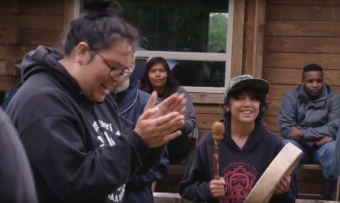
Over the summer, students in Hoonah attended a culture camp that seeks to address some of these problems by connecting students with Alaska Native traditions.
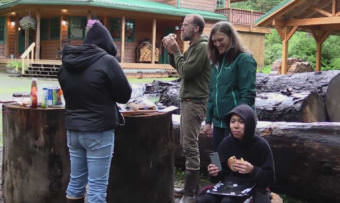
The Haa Tóo Yéi Yatee culture camp is almost an hour drive from Hoonah.

Over the summer, about 35 students made the trip down a narrow, unpaved logging road to immerse themselves in Native art, food and language for four days.

The isolated location is intentional.

“We came out as far as we could to make sure that we didn’t have cell phone reception, and that the only connections that we had were with each other,” Heather Powell said.

Students gather beach asparagus at the Haa Tóo Yéi Yatee culture camp near Hoonah (Photo by David Purdy/KTOO)

Powell works for Hoonah City Schools, and she created this camp with support from many others in the community, partly to help students confront some of the biggest challenges in their lives.

“We have young people in our community that are facing depression, addiction, suicide,” she said. “Things can ail not only your physical well-being, but your spirit.”

She hopes a traditional mindset will lead to a more holistic approach.

“In these non-Native ways of doing, we acknowledge and then we diagnose just that thing, and we deal with just that thing, she said. “But a long time ago we worked with the entire person, the entire family. Because none of us has the strength to do everything.”

The activities at the camp are deeply rooted in history.

Inside a cabin, students gathered around a table to cut, file and hammer copper sheets into small tináas. Almost everyone was wearing one of the traditional copper shields around their neck by the end of the camp.

Outside, a group of students spread out along the water to gather beach asparagus during low tide.

Later, they prepared it for canning, along with salmon fresh from the smoke house.

Heather Powell shows students the proper technique for canning smoked fish at the Haa Tóo Yéi Yatee culture camp near Hoonah (Photo by David Purdy/KTOO)

Powell hopes that this will be an opportunity for students to practice speaking Tlingit, and she moves seamlessly in and out of the language. She

believes that integrating Tlingit into everyday education will help revitalize the language and connect students to tradition.

The students also made their own cultural contribution together.

Besides playing music they already knew, Powell and others lead the students in creating their own original song.

Ultimately, her vision goes beyond specific skills and activities to something much more fundamental.

“Teaching traditional ecological knowledge and teaching place-based learning are all the … all the rage these days,” she said. “But for us, this is survival. This is who we are. We have done things for time immemorial because it calls to us. This is our food, this is our responsibility, this is our passion.”

Powell said she plans to offer more camps in the Hoonah area focusing on different cultural activities.

Quinton Chandler in Juneau contributed to this report.


This reporting was made possible by a grant from WNET’s American Graduate project. Television coverage of American Graduate Day 2017 begins at noon Saturday, Oct. 14, 2017 on 360 North.

Mentors help family struggling with illness

Major illness is always stressful, but for families with young children, struggling with health challenges can be especially difficult.

Derrick Price just started sixth grade, and like a lot of middle schoolers, he spends time on his phone and loves to talk about video games. But he’s also had to take on more than many kids his age – his mother, Courtney Price, has cancer.

Courtney Price (Screenshot from video by Rashah McChesney/Alaska’s Energy Desk)

“Derrick has helped just really being there for me if I needed anything,” she said. “But it’s also a stressor on him.”

Derrick enrolled in the Big Brothers Big Sisters program, which provides children facing adversity with professionally supported adult mentoring relationships. About 70 kids participate in Juneau, and 15 more are on the wait list. Derrick was matched with a Big Couple: Teri Rasmussen and John Parent.

At a Saturday afternoon barbecue at their house, Derrick put away his phone to jump between logs and poke at the fire pit.

“You know, I think if it was natural inclination, he would stay inside and play his video games all the time, so we try and do things outside,” Parent said.

He said they have tried to introduce Derrick to more outdoor activities like skiing.

The couple estimates they’ve been volunteering with Big Brothers Big Sisters for about 10 years.

“We really have enjoyed the program,” Rasmussen said. “So we’ve stuck with it. Our first little turned 18, so the match ended at 18 and then we immediately asked for another one and have just kept with it.”

Rasmussen enjoys Derrick’s energy and enthusiasm, but she also likes seeing the impact they have.

“I think it’s really important to just provide that support for the kids,” she said, “and give them an additional set of people that care about them and are interested in them and are part of the overall family that’s helping them, you know, make their way through life.”

Price thinks Derrick’s time with his Big Couple has made her son more open to new experiences.

“I think it kind of helped push him a little bit to try new things,” she said. “After John and Teri came into his life, he was more willing to try.”

With his mother’s illness and her time out of town for treatment, Derrick is glad to spend time with his Big Couple.

“I’m like, kind of worried about my mom when she’s gone,” he said, “but I’m more happy when I’m here with John and Teri.”

Price can see the difference the visits make.

“He gets to take a break with John and Teri from his everyday life,” she said, “and comes home a little bit more at ease and ready to go.”

She is grateful for the opportunity for Derrick to get away from things for a while and also for the positive role models his Big Couple give him.

Quinton Chandler in Juneau contributed to this report.


This reporting was made possible by a grant from WNET’s American Graduate project. Television coverage of American Graduate Day 2017 begins at noon Saturday, Oct. 14, 2017, on 360 North.

Site notifications
Update notification options
Subscribe to notifications