Heather Bryant

Statoil makes plans for drilling in Chukchi Sea

Statoil is inching closer to exploratory drilling in Alaska’s Chukchi Sea. The only question is: When?

A delegation from the Norwegian oil company held a public meeting in Nome on Monday. Statoil acquired 16 leases in a 2008 sale, and would partner with ConocoPhillips on another 50 leases. The potential drill sites are located about 150 miles northwest of Barrow.

Statoil’s Alaska Exploration Manager Lars Sunde said the company is optimistic about Alaska’s role in its future.

“Alaska is an important emerging area for Statoil. And we are confident from the Norwegian waters and the Norwegian Arctic, we feel that our technology and knowledge level is a very good fit for Alaska,” Sunde said.

Statoil started conducting fieldwork in the Chukchi Sea in 2010, completing 2D and 3D seismic testing of the sea floor. In, 2011 work included sonar to look for shallow gas pockets that could present risks. They also took soil core samples to get a sense of sea floor stability.

Sunde detailed plans for one exploration well, and one or two appraisal wells at depths between 115 to 145 feet. A mobile offshore drilling rig or a jack-up rig would be used, along with a contingent of support ships and oil spill response vessels. The company plans to drill only during the open water season, in ice-free conditions. But Sunde says the schedule is still up in the air.

“What we’re doing is to plan an execution of a drilling program. We don’t know when that might take place. It will not be earlier than 2015, maybe later. But we want to do a very thorough job in understanding all the challenges that are associated with operating in the Arctic and make sure that we do this properly,” Sunde said.

Nome residents who attended the company’s presentation raised questions about the impact Statoil’s ships would have on subsistence. The company’s marine biologist Jurgen Weissenberger said the goal is to have “zero impact” on marine and subsistence species.

Statoil is the national oil company of Norway. Founded in 1972, it was partially privatized in 2001. The Norwegian government retains 67 percent of the company’s shares. It operates in 40 countries and opened an Anchorage office in 2009.

Alaska Primary 2012

Alaska Primary 2012          U.S. Representative & Ballot Measures           Alaska Senate          Alaska House

Today is primary election day statewide.

Polls open at 7 a.m. and will stay open until 8 o’clock tonight.

Division of Elections Director Gail Fenumiai says she expects the first results to hit the web about 9 p.m., but it will be late before all the results are in, since some rural precincts still count their ballots by hand.

“So those are usually the precincts that are the latest to report. Usually it’s around 11, midnight just because of the hand count precincts. They just take a long time to get their results in,” she says.

Absentee ballots from overseas are accepted up to 15 days after the election.

Fenumiai says the plan is to count ballots cast in the early voting process tonight with ballots cast on Election Day.

“Our first count of absentee ballots and the remaining early votes will be done seven days following the election. We go through a process to check for duplicate voting to make sure people did not vote a by-mail ballot then go to their polling place and vote on Election Day,” she says.

The state review board will convene on Sept. 12, the 16th day after the election. Fenumiai anticipates the election will be certified about Sept. 20.

Check back before 9 p.m. for election results. Also tune into KTOO Radio at 9, 10 and 11 p.m. for statewide updates from the Alaska Public Radio Network.

Alaska Primary 2012          U.S. Representative & Ballot Measures           Alaska Senate          Alaska House

Assembly approves $29 million for new docks

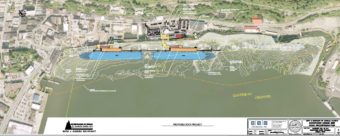
Another piece of financing for Juneau’s controversial new cruise ship docks on the downtown waterfront is in place.

The Juneau Assembly last night (Monday) approved selling up to $29 million dollars in bonds for two floating Panamax berths.

The bonds would be issued for a term of 19 years, according to Deputy City Manager Rob Steedle.

“Terms required CBJ to pledge the Port Development Fee known as the PDF revenue, to fund the debt service.  The debt service will be paid from FY 14 to FY 33 revenues,” Steedle said.

At an average interest rate of 4.37 percent, Steedle says debt service on the bonds is estimated at $42.37 million dollars. The total project is estimated at $88.1 million dollars. To date, the Assembly has appropriated about $42.6 million for the project. Other funding sources include grants and state marine passenger fees.

CBJ Finance Director Bob Bartholomew said the CBJ Port Development Fee is assessed only on the companies that use Juneau’s major public docks in the port — generally the cruise ship companies.

“If there anybody outside the cruise ship industry that uses the large public docks in the port, they would be subject to the fee,” Bartholomew said.

The fee is not assessed on commercial fishing vessel and private boat owners who use Juneau’s Aurora, Harris, Douglas or Auke Bay harbors.

Two members of the public testified on the bond issue. Larry Spencer, President of the Juneau Downtown Business Association, told the Assembly it’s time to get the project finished.

The project is controversial among the Fishermen’s Memorial board and some fishermen, concerned that it could block approach to the Taku Fisheries fisheries dock. Linnea Osborn represented those interests and complained the floating berths would obstruct the view of the water from the seawalk and destroy the annual blessing of the fleet.

Three Assembly members voted against the bond ordinance: Ruth Danner, Johann Dybdahl and Randy Wanamaker.

They cited four reasons for the no vote including the high cost of the project, the lack of support for the project by industry and the public in general and concern about the uncertainty of the funding mechanisms over the long term.

The proposed project has been under discussion for several years.  Some cruise industry representatives have said the large floating berths that will accommodate thousand-foot long ships are not necessary.

Proposed changes to the Juneau docks. Drawing courtesy of CBJ.
Site notifications
Update notification options
Subscribe to notifications